第2章原子・分子・イオン
Chemical Symbols元素記号
A chemical symbol is an abbreviation that we use to indicate an element or an atom of an element. For example, the symbol for mercury is Hg (Figure 2.13). We use the same symbol to indicate one atom of mercury (microscopic domain) or to label a container of many atoms of the element mercury (macroscopic domain).
元素記号は、元素またはその元素の原子を示すために使う略号である。たとえば、水銀の記号はHgである(図2.13)。同じ記号を使って、水銀原子1個を示すことも(微視的領域)、水銀という元素の原子を多数含む容器に表示することもできる(巨視的領域)。
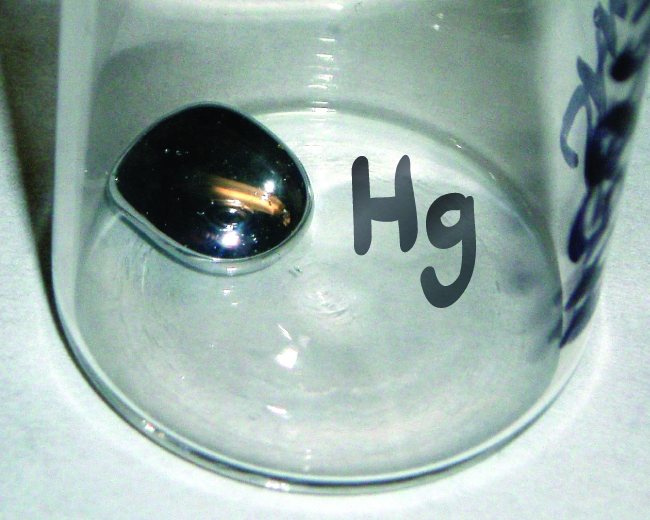
Figure 2.13図 2.13
The symbol Hg represents the element mercury regardless of the amount; it could represent one atom of mercury or a large amount of mercury.
Hgという記号は、量にかかわらず水銀という元素を表す。水銀原子1個を示すことも、大量の水銀を示すこともある。
The symbols for several common elements and their atoms are listed in Table 2.3. Some symbols are derived from the common name of the element; others are abbreviations of the name in another language. Most symbols have one or two letters, but three-letter symbols have been used to describe some elements that have atomic numbers greater than 112. To avoid confusion with other notations, only the first letter of a symbol is capitalized. For example, Co is the symbol for the element cobalt, but CO is the notation for the compound carbon monoxide, which contains atoms of the elements carbon (C) and oxygen (O). All known elements and their symbols are in the periodic table in Figure 2.26 (also found in Appendix A).
英語のヒント
Some Common Elements and Their Symbols 身近な元素とその記号 |
|||
|---|---|---|---|
Element 元素 |
Symbol 記号 |
Element 元素 |
Symbol 記号 |
aluminum アルミニウム |
Al |
iron 鉄 |
Fe (from ferrum) Fe(ferrumに由来) |
bromine 臭素 |
Br |
lead 鉛 |
Pb (from plumbum) Pb(plumbumに由来) |
calcium カルシウム |
Ca |
magnesium マグネシウム |
Mg |
carbon 炭素 |
C |
mercury 水銀 |
Hg (from hydrargyrum) Hg(hydrargyrumに由来) |
chlorine 塩素 |
Cl |
nitrogen 窒素 |
N |
chromium クロム |
Cr |
oxygen 酸素 |
O |
cobalt コバルト |
Co |
potassium カリウム |
K (from kalium) K(kaliumに由来) |
copper 銅 |
Cu (from cuprum) Cu(cuprumに由来) |
silicon ケイ素 |
Si |
fluorine フッ素 |
F |
silver 銀 |
Ag (from argentum) Ag(argentumに由来) |
gold 金 |
Au (from aurum) Au(aurumに由来) |
sodium ナトリウム |
Na (from natrium) Na(natriumに由来) |
helium ヘリウム |
He |
sulfur 硫黄 |
S |
hydrogen 水素 |
H |
tin スズ |
Sn (from stannum) Sn(stannumに由来) |
iodine ヨウ素 |
I |
zinc 亜鉛 |
Zn |
Traditionally, the discoverer (or discoverers) of a new element names the element. However, until the name is recognized by the International Union of Pure and Applied Chemistry (IUPAC), the recommended name of the new element is based on the Latin word(s) for its atomic number. For example, element 106 was called unnilhexium (Unh), element 107 was called unnilseptium (Uns), and element 108 was called unniloctium (Uno) for several years. These elements are now named after scientists (or occasionally locations); for example, element 106 is now known as seaborgium (Sg) in honor of Glenn Seaborg, a Nobel Prize winner who was active in the discovery of several heavy elements. Element 109 was named in honor of Lise Meitner, who discovered nuclear fission, a phenomenon that would have world-changing impacts; Meitner also contributed to the discovery of some major isotopes, discussed immediately below.
英語のヒント
伝統的に、新元素の発見者がその元素を命名する。しかし、国際純正・応用化学連合(IUPAC)が名称を認めるまでは、新元素の推奨名は、その原子番号を表すラテン語に基づいている。たとえば、106番元素はウンニルヘキシウム(Unh)、107番元素はウンニルセプチウム(Uns)、108番元素はウンニルオクチウム(Uno)と、数年間呼ばれていた。これらの元素には現在、科学者(ときには場所)にちなんだ名前が付いている。たとえば106番元素は、いくつかの重元素の発見に貢献したノーベル賞受賞者グレン・シーボーグをたたえ、現在はシーボーギウム(Sg)と呼ばれる。109番元素は、世界を変える影響をもたらす現象、核分裂を発見したリーゼ・マイトナーをたたえて命名された。マイトナーは、すぐ後で取り上げる、いくつかの重要な同位体の発見にも貢献した。
Isotopes同位体
The symbol for a specific isotope of any element is written by placing the mass number as a superscript to the left of the element symbol (Figure 2.14). The atomic number is sometimes written as a subscript preceding the symbol, but since this number defines the element’s identity, as does its symbol, it is often omitted. For example, magnesium exists as a mixture of three isotopes, each with an atomic number of 12 and with mass numbers of 24, 25, and 26, respectively. These isotopes can be identified as 24Mg, 25Mg, and 26Mg. These isotope symbols are read as “element, mass number” and can be symbolized consistent with this reading. For instance, 24Mg is read as “magnesium 24,” and can be written as “magnesium-24” or “Mg-24.” 25Mg is read as “magnesium 25,” and can be written as “magnesium-25” or “Mg-25.” All magnesium atoms have 12 protons in their nucleus. They differ only because a 24Mg atom has 12 neutrons in its nucleus, a 25Mg atom has 13 neutrons, and a 26Mg has 14 neutrons.
英語のヒント
どの元素でも、特定の同位体の記号は、元素記号の左上に質量数を付けて表す(図2.14)。原子番号を記号の左下に書くこともあるが、原子番号も元素記号と同様に元素の種類を決めるため、省略されることが多い。たとえばマグネシウムは、原子番号はいずれも12で、質量数がそれぞれ24、25、26の三つの同位体の混合物として存在する。これらの同位体は24Mg、25Mg、26Mgと表せる。同位体記号は「元素名、質量数」と読み、この読み方に従った表記もできる。たとえば24Mgは「マグネシウム24」と読み、「magnesium-24」または「Mg-24」と書ける。25Mgは「マグネシウム25」と読み、「magnesium-25」または「Mg-25」と書ける。マグネシウムの原子はすべて、原子核内に陽子を12個もつ。違いは中性子数だけであり、24Mg原子の核内には中性子が12個、25Mg原子には13個、26Mgには14個ある。
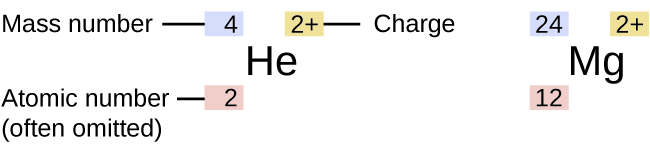


Figure 2.14図 2.14
The symbol for an atom indicates the element via its usual two-letter symbol, the mass number as a left superscript, the atomic number as a left subscript (sometimes omitted), and the charge as a right superscript.
原子の記号は、通常の2文字の元素記号で元素を、左上の添字で質量数を、左下の添字で原子番号を(省略することもある)、右上の添字で電荷を示す。
Information about the naturally occurring isotopes of elements with atomic numbers 1 through 10 is given in Table 2.4. Note that in addition to standard names and symbols, the isotopes of hydrogen are often referred to using common names and accompanying symbols. Hydrogen-2, symbolized 2H, is also called deuterium and sometimes symbolized D. Hydrogen-3, symbolized 3H, is also called tritium and sometimes symbolized T.
英語のヒント
原子番号1〜10の元素について、天然に存在する同位体の情報を表2.4に示す。水素の同位体には、標準の名称と記号のほかに、慣用名とそれに対応する記号がよく使われることに注意しよう。2Hで表す水素2は重水素(デューテリウム)とも呼ばれ、Dと表すこともある。3Hで表す水素3は三重水素(トリチウム)とも呼ばれ、Tと表すこともある。
Nuclear Compositions of Atoms of the Very Light Elements 非常に軽い元素の原子核の構成 |
||||||
|---|---|---|---|---|---|---|
Element 元素 |
Symbol 記号 |
Atomic Number 原子番号 |
Number of Protons 陽子の数 |
Number of Neutrons 中性子の数 |
Mass (amu) 質量(amu) |
% Natural Abundance 天然存在比(%) |
hydrogen 水素 |
(protium) (軽水素) |
1 |
1 |
0 |
1.0078 |
99.989 |
(deuterium) (重水素) |
1 |
1 |
1 |
2.0141 |
0.0115 |
|
(tritium) (三重水素) |
1 |
1 |
2 |
3.01605 |
— (trace) —(微量) |
|
helium ヘリウム |
2 |
2 |
1 |
3.01603 |
0.00013 |
|
2 |
2 |
2 |
4.0026 |
100 |
||
lithium リチウム |
3 |
3 |
3 |
6.0151 |
7.59 |
|
3 |
3 |
4 |
7.0160 |
92.41 |
||
beryllium ベリリウム |
4 |
4 |
5 |
9.0122 |
100 |
|
boron ホウ素 |
5 |
5 |
5 |
10.0129 |
19.9 |
|
5 |
5 |
6 |
11.0093 |
80.1 |
||
carbon 炭素 |
6 |
6 |
6 |
12.0000 |
98.89 |
|
6 |
6 |
7 |
13.0034 |
1.11 |
||
6 |
6 |
8 |
14.0032 |
— (trace) —(微量) |
||
nitrogen 窒素 |
7 |
7 |
7 |
14.0031 |
99.63 |
|
7 |
7 |
8 |
15.0001 |
0.37 |
||
oxygen 酸素 |
8 |
8 |
8 |
15.9949 |
99.757 |
|
8 |
8 |
9 |
16.9991 |
0.038 |
||
8 |
8 |
10 |
17.9992 |
0.205 |
||
fluorine フッ素 |
9 |
9 |
10 |
18.9984 |
100 |
|
neon ネオン |
10 |
10 |
10 |
19.9924 |
90.48 |
|
10 |
10 |
11 |
20.9938 |
0.27 |
||
10 |
10 |
12 |
21.9914 |
9.25 |
||