第2章原子・分子・イオン
2.2 Evolution of Atomic Theory2.2 原子論の発展
Learning Objectives学習目標
By the end of this section, you will be able to:
この節を終えると、次のことができるようになる。
- Outline milestones in the development of modern atomic theory現代の原子論の発展における重要な出来事を概説する
- Summarize and interpret the results of the experiments of Thomson, Millikan, and Rutherfordトムソン、ミリカン、ラザフォードの実験結果を要約し、解釈する
- Describe the three subatomic particles that compose atoms原子を構成する三つの粒子を説明する
- Define isotopes and give examples for several elements同位体を定義し、いくつかの元素で例を挙げる
If matter is composed of atoms, what are atoms composed of? Are they the smallest particles, or is there something smaller? In the late 1800s, a number of scientists interested in questions like these investigated the electrical discharges that could be produced in low-pressure gases, with the most significant discovery made by English physicist J. J. Thomson using a cathode ray tube. This apparatus consisted of a sealed glass tube from which almost all the air had been removed; the tube contained two metal electrodes. When high voltage was applied across the electrodes, a visible beam called a cathode ray appeared between them. This beam was deflected toward the positive charge and away from the negative charge, and was produced in the same way with identical properties when different metals were used for the electrodes. In similar experiments, the ray was simultaneously deflected by an applied magnetic field, and measurements of the extent of deflection and the magnetic field strength allowed Thomson to calculate the charge-to-mass ratio of the cathode ray particles. The results of these measurements indicated that these particles were much lighter than atoms (Figure 2.6).
英語のヒント
物質が原子からできているなら、原子は何からできているのだろうか。原子は最小の粒子なのか、それともさらに小さいものがあるのか。1800年代後半、こうした疑問に関心をもった多くの科学者が、低圧の気体中で起こせる放電を調べた。その中で最も重要な発見をしたのが、陰極線管を使った英国の物理学者J・J・トムソンである。この装置は、内部の空気をほぼすべて取り除いた密閉ガラス管からなり、管内に二つの金属電極が入っていた。電極間に高電圧をかけると、陰極線と呼ばれる目に見えるビームが両者の間に現れた。このビームは、正電荷のほうに曲がり、負電荷から離れるほうに曲がった。また、電極の金属を変えても、同じ性質のビームが同じように生じた。同様の実験で、陰極線は加えた磁場によっても同時に曲げられた。曲がりの程度と磁場の強さを測定することで、トムソンは陰極線を構成する粒子の電荷と質量の比を計算できた。これらの測定結果は、その粒子が原子よりもはるかに軽いことを示した(図2.6)。
Image omitted because its reuse rights could not be verified.権利の確認ができないため画像を割愛。
Figure 2.6図 2.6
(a) J. J. Thomson produced a visible beam in a cathode ray tube. (b) This is an early cathode ray tube, invented in 1897 by Ferdinand Braun. (c) In the cathode ray, the beam (shown in yellow) comes from the cathode and is accelerated past the anode toward a fluorescent scale at the end of the tube. Simultaneous deflections by applied electric and magnetic fields permitted Thomson to calculate the mass-to-charge ratio of the particles composing the cathode ray. (credit a: modification of work by Nobel Foundation; credit b: modification of work by Eugen Nesper; credit c: modification of work by “Kurzon”/Wikimedia Commons)
(a) J・J・トムソンは陰極線管内で目に見えるビームを発生させた。(b) 1897年にフェルディナント・ブラウンが発明した初期の陰極線管。(c) 陰極線では、ビーム(黄色)が陰極から出て、陽極を通過して加速され、管の端にある蛍光目盛りへ向かう。加えた電場と磁場によって同時に曲がることを利用し、トムソンは陰極線を構成する粒子の質量と電荷の比を計算できた。(出典a:Nobel Foundationの作品を改変、出典b:Eugen Nesperの作品を改変、出典c:「Kurzon」/Wikimedia Commonsの作品を改変)
Based on his observations, here is what Thomson proposed and why: The particles are attracted by positive (+) charges and repelled by negative (−) charges, so they must be negatively charged (like charges repel and unlike charges attract); they are less massive than atoms and indistinguishable, regardless of the source material, so they must be fundamental, subatomic constituents of all atoms. Although controversial at the time, Thomson’s idea was gradually accepted, and his cathode ray particle is what we now call an electron, a negatively charged, subatomic particle with a mass more than one thousand-times less that of an atom. The term “electron” was coined in 1891 by Irish physicist George Stoney, from “electric ion.”
英語のヒント
トムソンが観察に基づいて提案したことと、その理由は次のとおりである。粒子は正(+)の電荷に引かれ、負(−)の電荷から反発されるので、負に帯電しているはずである(同符号の電荷は反発し、異符号の電荷は引き合う)。粒子は原子よりも質量が小さく、材料が何であっても区別できないので、すべての原子に共通する、原子より小さい基本的な構成粒子であるはずだ。当時は論争を呼んだが、トムソンの考えは次第に受け入れられた。彼の陰極線の粒子は、今日われわれが電子と呼ぶものであり、負に帯電し、質量が原子の1000分の1よりも小さい、原子より小さな粒子である。「electron」という語は、「electric ion」から、アイルランドの物理学者ジョージ・ストーニーが1891年に作った。
In 1909, more information about the electron was uncovered by American physicist Robert A. Millikan via his “oil drop” experiments. Millikan created microscopic oil droplets, which could be electrically charged by friction as they formed or by using X-rays. These droplets initially fell due to gravity, but their downward progress could be slowed or even reversed by an electric field lower in the apparatus. By adjusting the electric field strength and making careful measurements and appropriate calculations, Millikan was able to determine the charge on individual drops (Figure 2.7).
英語のヒント
1909年、米国の物理学者ロバート・A・ミリカンは、「油滴」実験によって電子についてさらに多くの情報を明らかにした。ミリカンは微小な油滴を作り、生成時の摩擦やX線を使って、それらを帯電させることができた。油滴は初め重力によって落下するが、装置の下部にある電場によって、その下降を遅くしたり、逆向きにしたりすることさえできた。電場の強さを調整し、注意深い測定と適切な計算を行うことで、ミリカンは個々の油滴の電荷を求めることができた(図2.7)。
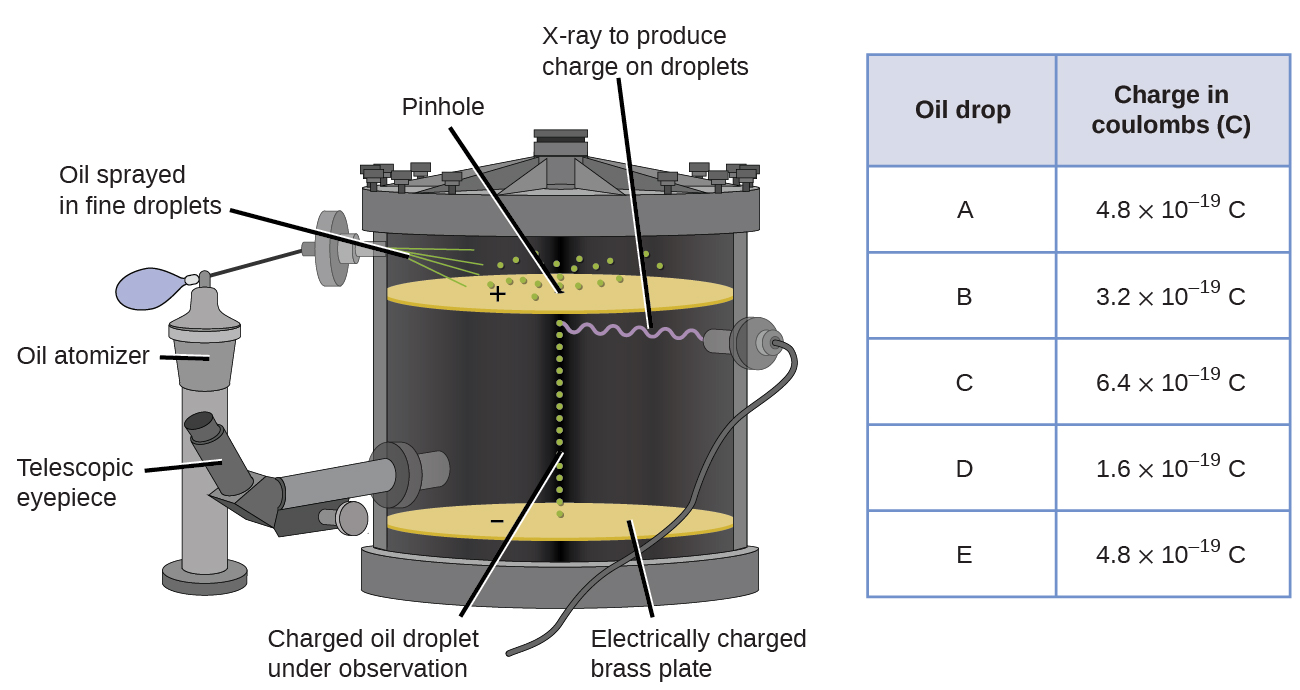
Figure 2.7図 2.7
Millikan’s experiment measured the charge of individual oil drops. The tabulated data are examples of a few possible values.
ミリカンの実験では、個々の油滴の電荷を測定した。表のデータは、得られ得る値の例である。
Looking at the charge data that Millikan gathered, you may have recognized that the charge of an oil droplet is always a multiple of a specific charge, 1.6 10−19 C. Millikan concluded that this value must therefore be a fundamental charge—the charge of a single electron—with his measured charges due to an excess of one electron (1 times 1.6 10−19 C), two electrons (2 times 1.6 10−19 C), three electrons (3 times 1.6 10−19 C), and so on, on a given oil droplet. Since the charge of an electron was now known due to Millikan’s research, and the charge-to-mass ratio was already known due to Thomson’s research (1.759 1011 C/kg), it only required a simple calculation to determine the mass of the electron as well.
英語のヒント
ミリカンの集めた電荷のデータを見ると、油滴の電荷が常に、1.6 10−19 Cという特定の電荷の倍数になっていることに気づくかもしれない。ミリカンは、この値こそ基本的な電荷、すなわち電子1個の電荷であるはずだと結論づけた。測定された電荷は、油滴上に電子が1個余分にある(1×1.6 10−19 C)、2個余分にある(2×1.6 10−19 C)、3個余分にある(3×1.6 10−19 C)などの場合に対応する。ミリカンの研究によって電子の電荷が分かり、トムソンの研究によって電荷と質量の比(1.759 1011 C/kg)はすでに分かっていたので、電子の質量も単純な計算だけで求められるようになった。
Scientists had now established that the atom was not indivisible as Dalton had believed, and due to the work of Thomson, Millikan, and others, the charge and mass of the negative, subatomic particles—the electrons—were known. However, the positively charged part of an atom was not yet well understood. In 1904, Thomson proposed the “plum pudding” model of atoms, which described a positively charged mass with an equal amount of negative charge in the form of electrons embedded in it, since all atoms are electrically neutral. A competing model had been proposed in 1903 by Hantaro Nagaoka, who postulated a Saturn-like atom, consisting of a positively charged sphere surrounded by a halo of electrons (Figure 2.8).
英語のヒント
この時点で科学者は、ドルトンが考えたように原子が分割不能なのではないことを確立していた。トムソン、ミリカンらの研究によって、原子より小さい負の粒子、すなわち電子の電荷と質量も分かっていた。しかし、原子の正に帯電した部分については、まだよく分かっていなかった。1904年、トムソンは原子の「プラムプディング」模型を提案した。すべての原子は電気的に中性なので、正に帯電した塊の中に、同量の負電荷を電子という形で埋め込んだ模型である。それと競合する模型は、1903年に長岡半太郎が提案していた。長岡は、正に帯電した球の周囲を電子の環が囲む、土星のような原子を仮定した(図2.8)。
Image omitted because its reuse rights could not be verified.権利の確認ができないため画像を割愛。
Figure 2.8図 2.8
(a) Thomson suggested that atoms resembled plum pudding, an English dessert consisting of moist cake with embedded raisins (“plums”). (b) Nagaoka proposed that atoms resembled the planet Saturn, with a ring of electrons surrounding a positive “planet.” (credit a: modification of work by “Man vyi”/Wikimedia Commons; credit b: modification of work by “NASA”/Wikimedia Commons)
(a) トムソンは、原子がプラムプディングに似ていると考えた。これは、しっとりしたケーキにレーズン(「プラム」)を埋め込んだ英国の菓子である。(b) 長岡は、原子が惑星土星に似ており、正の「惑星」を電子の環が囲んでいると提案した。(出典a:「Man vyi」/Wikimedia Commonsの作品を改変、出典b:「NASA」/Wikimedia Commonsの作品を改変)
The next major development in understanding the atom came from Ernest Rutherford, a physicist from New Zealand who largely spent his scientific career in Canada and England. He performed a series of experiments using a beam of high-speed, positively charged alpha particles (α particles) that were produced by the radioactive decay of radium; α particles consist of two protons and two neutrons (you will learn more about radioactive decay in the chapter on nuclear chemistry). Rutherford and his colleagues Hans Geiger (later famous for the Geiger counter) and Ernest Marsden aimed a beam of α particles, the source of which was embedded in a lead block to absorb most of the radiation, at a very thin piece of gold foil and examined the resultant scattering of the α particles using a luminescent screen that glowed briefly where hit by an α particle.
英語のヒント
原子の理解における次の大きな進展は、ニュージーランド出身で、科学者としての経歴の大部分をカナダと英国で過ごした物理学者アーネスト・ラザフォードによるものだった。彼は、ラジウムの放射性崩壊によって生じる、高速で正に帯電したアルファ粒子(α粒子)のビームを使って一連の実験を行った。α粒子は二つの陽子と二つの中性子からなる(放射性崩壊は核化学の章でさらに学ぶ)。ラザフォードと共同研究者のハンス・ガイガー(後にガイガーカウンターで有名になる)、アーネスト・マースデンは、非常に薄い金箔にα粒子のビームを当てた。ビームの線源は、放射線の大部分を吸収するため鉛の塊に埋め込んであった。そして、α粒子が当たった場所で短時間光る発光スクリーンを使い、生じたα粒子の散乱を調べた。
What did they discover? Most particles passed right through the foil without being deflected at all. However, some were diverted slightly, and a very small number were deflected almost straight back toward the source (Figure 2.9). Rutherford described finding these results: “It was quite the most incredible event that has ever happened to me in my life. It was almost as incredible as if you fired a 15-inch shell at a piece of tissue paper and it came back and hit you.” Ernest Rutherford, “The Development of the Theory of Atomic Structure,” ed. J. A. Ratcliffe, in Background to Modern Science, eds. Joseph Needham and Walter Pagel, (Cambridge, UK: Cambridge University Press, 1938), 61–74. Accessed September 22, 2014, https://ia600508.us.archive.org/3/items/backgroundtomode032734mbp/backgroundtomode032734mbp.pdf.
英語のヒント
彼らは何を発見したのだろうか。ほとんどの粒子はまったく曲げられず、そのまま金箔を通り抜けた。しかし、少し方向を変えた粒子もあり、ごく少数はほぼ真後ろ、線源のほうへ跳ね返った(図2.9)。ラザフォードは、この結果を見つけたときのことをこう述べた。「それは、私の生涯に起きた中でもまったく信じられない出来事だった。薄いティッシュペーパーに15インチ砲弾を撃ち込んだら、跳ね返ってきて自分に当たった、というのとほとんど同じくらい信じられなかった。」Ernest Rutherford, “The Development of the Theory of Atomic Structure,” ed. J. A. Ratcliffe, in Background to Modern Science, eds. Joseph Needham and Walter Pagel, (Cambridge, UK: Cambridge University Press, 1938), 61–74. 2014年9月22日閲覧、https://ia600508.us.archive.org/3/items/backgroundtomode032734mbp/backgroundtomode032734mbp.pdf。
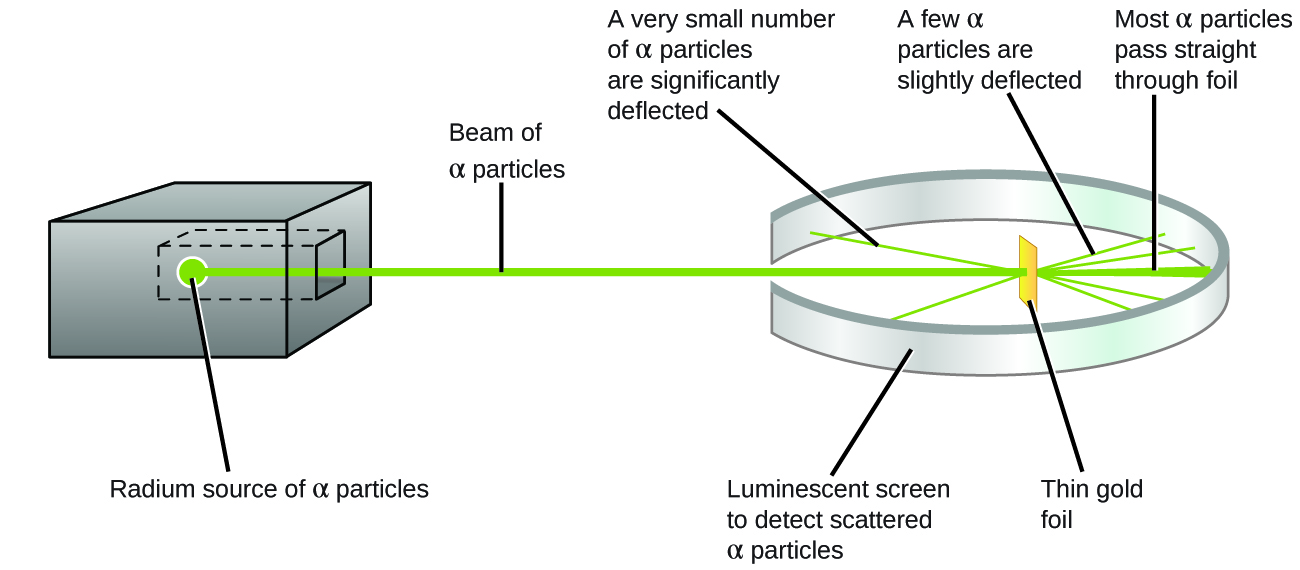
Figure 2.9図 2.9
Geiger and Rutherford fired α particles at a piece of gold foil and detected where those particles went, as shown in this schematic diagram of their experiment. Most of the particles passed straight through the foil, but a few were deflected slightly and a very small number were significantly deflected.
実験の模式図に示すように、ガイガーとラザフォードは金箔にα粒子を撃ち込み、その粒子がどこへ進んだかを検出した。ほとんどは金箔をまっすぐ通り抜けたが、少し曲がる粒子もあり、ごく少数は大きく曲がった。
Here is what Rutherford deduced: Because most of the fast-moving α particles passed through the gold atoms undeflected, they must have traveled through essentially empty space inside the atom. Alpha particles are positively charged, so deflections arose when they encountered another positive charge (like charges repel each other). Since like charges repel one another, the few positively charged α particles that changed paths abruptly must have hit, or closely approached, another body that also had a highly concentrated, positive charge. Since the deflections occurred a small fraction of the time, this charge only occupied a small amount of the space in the gold foil. Analyzing a series of such experiments in detail, Rutherford drew two conclusions:
英語のヒント
ラザフォードの推論は次のようなものだった。高速のα粒子の大部分は金原子を曲げられずに通り抜けたので、原子内部のほぼ空の空間を通ったはずである。α粒子は正に帯電しているので、別の正電荷に出合ったときに曲がった(同符号の電荷は互いに反発する)。同符号の電荷が互いに反発することから、突然進路を変えた少数の正のα粒子は、正電荷が高度に集中した別の物体に衝突したか、非常に近づいたはずである。大きく曲がるのはごく一部の場合だけだったので、この電荷が占めるのは金箔内のごく小さな空間だけであった。一連の実験を詳しく分析し、ラザフォードは二つの結論を導いた。
- The volume occupied by an atom must consist of a large amount of empty space.原子が占める体積の大部分は、空の空間でできているはずである。
- A small, relatively heavy, positively charged body, the nucleus, must be at the center of each atom.各原子の中心には、小さく、比較的重く、正に帯電した物体である原子核があるはずである。
This analysis led Rutherford to propose a model in which an atom consists of a very small, positively charged nucleus, in which most of the mass of the atom is concentrated, surrounded by the negatively charged electrons, so that the atom is electrically neutral (Figure 2.10). After many more experiments, Rutherford also discovered that the nuclei of other elements contain the hydrogen nucleus as a “building block,” and he named this more fundamental particle the proton, the positively charged, subatomic particle found in the nucleus. With one addition, which you will learn next, this nuclear model of the atom, proposed over a century ago, is still used today.
この分析からラザフォードは、原子の質量の大部分が集中した非常に小さな正の原子核を、負に帯電した電子が取り囲み、原子全体として電気的に中性になる模型を提案した(図2.10)。さらに多くの実験の後、ラザフォードは、ほかの元素の原子核にも水素の原子核が「構成要素」として含まれていることを発見した。そして、このより基本的な粒子を、陽子と名づけた。陽子は、原子核内にある、正に帯電した原子より小さい粒子である。次に学ぶ一つの追加事項を除けば、100年以上前に提案されたこの原子の核模型は、今日でも使われている。
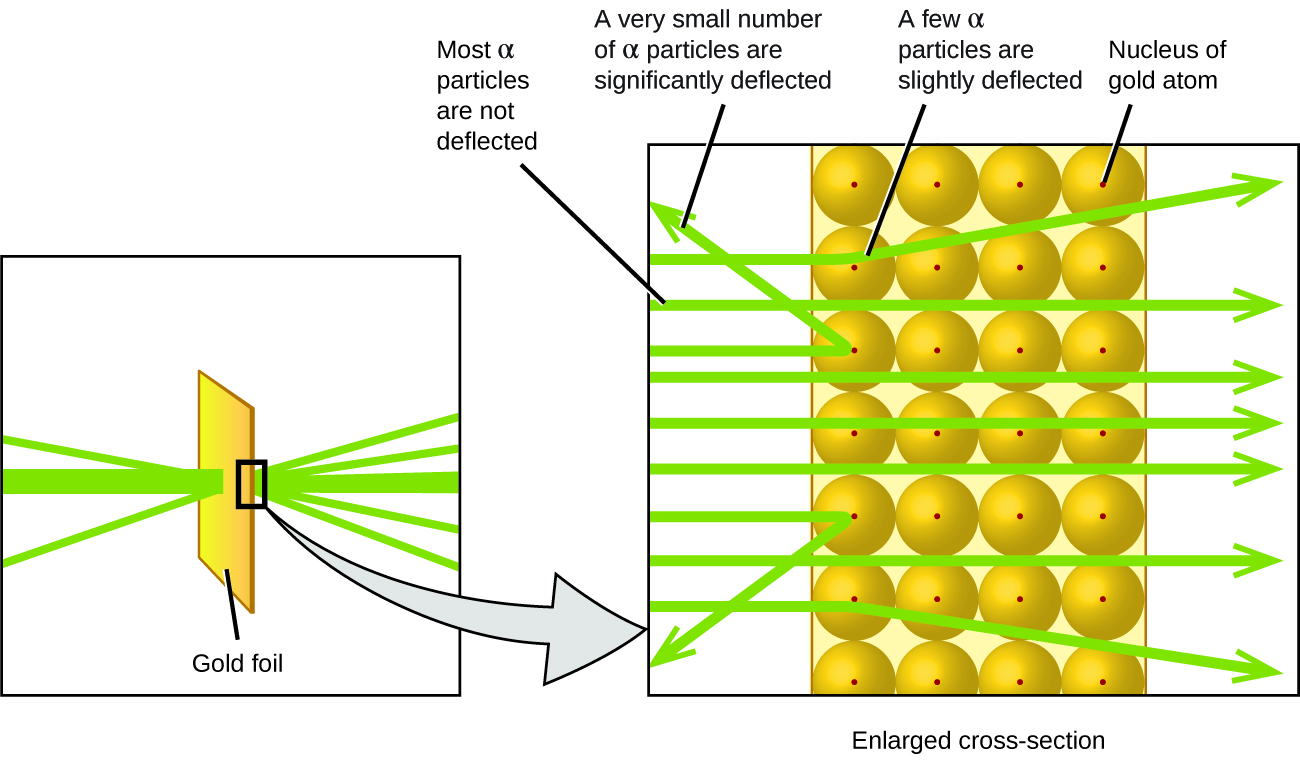


Figure 2.10図 2.10
The α particles are deflected only when they collide with or pass close to the much heavier, positively charged gold nucleus. Because the nucleus is very small compared to the size of an atom, very few α particles are deflected. Most pass through the relatively large region occupied by electrons, which are too light to deflect the rapidly moving particles.
α粒子は、はるかに重い、正に帯電した金の原子核に衝突するか、その近くを通るときだけ曲げられる。原子核は原子の大きさに比べて非常に小さいため、曲げられるα粒子はごく少数である。ほとんどは、電子が占める比較的広い領域を通過する。電子は軽すぎて、高速で動く粒子を曲げられない。
Another important finding was the discovery of isotopes. During the early 1900s, scientists identified several substances that appeared to be new elements, isolating them from radioactive ores. For example, a “new element” produced by the radioactive decay of thorium was initially given the name mesothorium. However, a more detailed analysis showed that mesothorium was chemically identical to radium (another decay product), despite having a different atomic mass. This result, along with similar findings for other elements, led the English chemist Frederick Soddy to realize that an element could have types of atoms with different masses that were chemically indistinguishable. These different types are called isotopes—atoms of the same element that differ in mass. Soddy was awarded the Nobel Prize in Chemistry in 1921 for this discovery.
英語のヒント
もう一つの重要な発見は、同位体である。1900年代初め、科学者は放射性の鉱石から、新しい元素に見える物質をいくつか単離した。たとえば、トリウムの放射性崩壊で生じる「新元素」には、当初メソトリウムという名が与えられた。しかし、さらに詳しい分析から、メソトリウムは原子の質量が異なるにもかかわらず、ラジウム(これも崩壊生成物)と化学的には同じであることが分かった。この結果と、ほかの元素についての同様の発見から、英国の化学者フレデリック・ソディは、一つの元素に、質量は異なっても化学的に区別できない原子の種類があり得ると気づいた。このような異なる種類は同位体、すなわち質量の異なる同じ元素の原子と呼ばれる。ソディはこの発見によって、1921年にノーベル化学賞を受賞した。
One puzzle remained: The nucleus was known to contain almost all of the mass of an atom, with the number of protons only providing half, or less, of that mass. Different proposals were made to explain what constituted the remaining mass, including the existence of neutral particles in the nucleus. As you might expect, detecting uncharged particles is very challenging, and it was not until 1932 that James Chadwick found evidence of neutrons, uncharged, subatomic particles with a mass approximately the same as that of protons. The existence of the neutron also explained isotopes: They differ in mass because they have different numbers of neutrons, but they are chemically identical because they have the same number of protons. This will be explained in more detail later in this chapter.
英語のヒント
一つの謎が残っていた。原子核は原子の質量のほぼすべてを含むと分かっていたが、その中の陽子だけでは、その質量の半分かそれ以下にしかならなかった。残りの質量を何が担うかについて、核内に中性の粒子があるという考えなど、さまざまな提案がなされた。想像できるように、電荷をもたない粒子を検出するのは非常に難しい。1932年になってようやく、ジェームズ・チャドウィックが中性子の証拠を見つけた。中性子は、陽子とほぼ同じ質量をもち、電荷をもたない、原子より小さい粒子である。中性子の存在は同位体も説明した。同位体は中性子の数が異なるため質量は違うが、陽子の数が同じため化学的には同じなのである。このことは、この章の後半でさらに詳しく説明する。