第2章原子・分子・イオン
Ionic Compoundsイオン化合物
When an element composed of atoms that readily lose electrons (a metal) reacts with an element composed of atoms that readily gain electrons (a nonmetal), a transfer of electrons usually occurs, producing ions. The compound formed by this transfer is stabilized by the electrostatic attractions (ionic bonds) between the ions of opposite charge present in the compound. For example, when each sodium atom in a sample of sodium metal (group 1) gives up one electron to form a sodium cation, Na+, and each chlorine atom in a sample of chlorine gas (group 17) accepts one electron to form a chloride anion, Cl−, the resulting compound, NaCl, is composed of sodium ions and chloride ions in the ratio of one Na+ ion for each Cl− ion. Similarly, each calcium atom (group 2) can give up two electrons and transfer one to each of two chlorine atoms to form CaCl2, which is composed of Ca2+ and Cl− ions in the ratio of one Ca2+ ion to two Cl− ions.
英語のヒント
電子を失いやすい原子からなる元素(金属)と、電子を受け取りやすい原子からなる元素(非金属)が反応すると、ふつう電子の移動が起こり、イオンが生じる。この移動によってできた化合物は、その中にある反対符号のイオン間の静電引力(イオン結合)によって安定化する。たとえば、金属ナトリウム(1族)の試料中の各ナトリウム原子が電子を1個放出してナトリウム陽イオンNa+になり、塩素気体(17族)の試料中の各塩素原子が電子を1個受け取って塩化物陰イオンCl−になると、生じる化合物NaClは、Cl−イオン1個につきNa+イオン1個という比率のナトリウムイオンと塩化物イオンからなる。同様に、カルシウム原子(2族)はそれぞれ電子を2個放出し、2個の塩素原子へ1個ずつ渡してCaCl2をつくる。この化合物はCa2+とCl−のイオンからなり、その比率はCa2+イオン1個に対しCl−イオン2個である。
A compound that contains ions and is held together by ionic bonds is called an ionic compound. The periodic table can help us recognize many of the compounds that are ionic: When a metal is combined with one or more nonmetals, the compound is usually ionic. This guideline works well for predicting ionic compound formation for most of the compounds typically encountered in an introductory chemistry course. However, it is not always true (for example, aluminum chloride, AlCl3, is not ionic).
英語のヒント
イオンを含み、イオン結合によって結びつけられている化合物をイオン化合物という。周期表を使うと、多くの化合物がイオン化合物かどうかを見分けられる。金属が1種類以上の非金属と結びつく場合、その化合物はふつうイオン化合物である。この目安は、化学の入門課程でよく扱う化合物の大半について、イオン化合物になるかを予測するのに役立つ。しかし、いつも当てはまるわけではない(たとえば塩化アルミニウムAlCl3はイオン化合物ではない)。
You can often recognize ionic compounds because of their properties. Ionic compounds are solids that typically melt at high temperatures and boil at even higher temperatures. For example, sodium chloride melts at 801 °C and boils at 1413 °C. (As a comparison, the molecular compound water melts at 0 °C and boils at 100 °C.) In solid form, an ionic compound is not electrically conductive because its ions are unable to flow (“electricity” is the flow of charged particles). When molten, however, it can conduct electricity because its ions are able to move freely through the liquid (Figure 2.30).
英語のヒント
イオン化合物はその性質から見分けられることがよくある。イオン化合物はふつう、高温で融解し、それよりさらに高温で沸騰する固体である。たとえば、塩化ナトリウムは801 °Cで融解し、1413 °Cで沸騰する。(比較のためにいうと、分子性化合物である水は0 °Cで融解し、100 °Cで沸騰する。)固体のイオン化合物は、イオンが流れられないため電気を通さない(「電気」とは荷電粒子の流れである)。しかし、融解するとイオンが液体中を自由に動けるため、電気を通す(図2.30)。
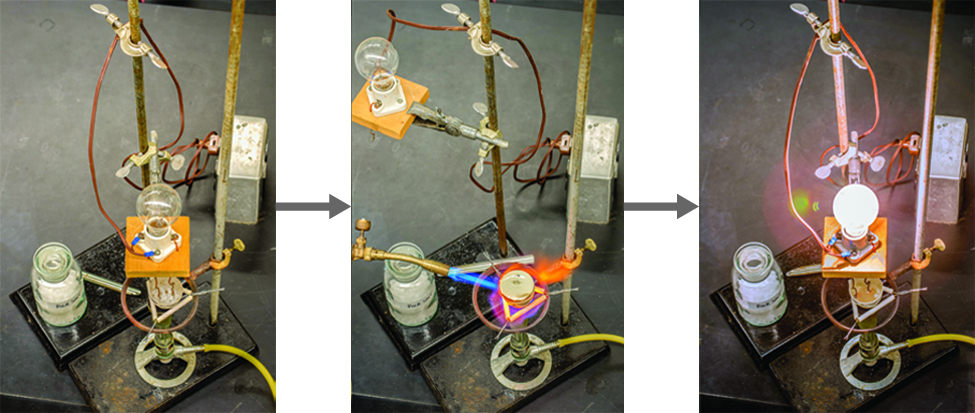
Figure 2.30図 2.30
Sodium chloride melts at 801 °C and conducts electricity when molten. (credit: modification of work by Mark Blaser and Matt Evans)
塩化ナトリウムは801 °Cで融解し、溶融状態では電気を通す。(出典:Mark BlaserおよびMatt Evansの作品を改変)
In every ionic compound, the total number of positive charges of the cations equals the total number of negative charges of the anions. Thus, ionic compounds are electrically neutral overall, even though they contain positive and negative ions. We can use this observation to help us write the formula of an ionic compound. The formula of an ionic compound must have a ratio of ions such that the numbers of positive and negative charges are equal.
英語のヒント
どのイオン化合物でも、陽イオンの正電荷の総数と陰イオンの負電荷の総数は等しくなる。したがって、イオン化合物は正と負のイオンを含んでいても、全体として電気的に中性である。この事実を使って、イオン化合物の化学式を書くことができる。イオン化合物の化学式では、正電荷と負電荷の数が等しくなるようなイオンの比率にしなければならない。
Example 2.10例題 2.10
Predicting the Formula of an Ionic Compoundイオン化合物の化学式を予測する
The gemstone sapphire (Figure 2.31) is mostly a compound of aluminum and oxygen that contains aluminum cations, Al3+, and oxygen anions, O2−. What is the formula of this compound?
宝石のサファイア(図2.31)は、主にアルミニウムと酸素の化合物で、アルミニウム陽イオンAl3+と酸素陰イオンO2−を含んでいる。この化合物の化学式は何か。
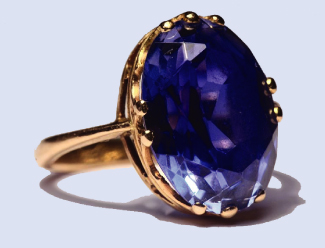

Figure 2.31図 2.31
Although pure aluminum oxide is colorless, trace amounts of iron and titanium give blue sapphire its characteristic color. (credit: modification of work by Stanislav Doronenko)
純粋な酸化アルミニウムは無色であるが、ごく微量の鉄とチタンがブルーサファイアに特有の色を与える。(出典:Stanislav Doronenkoの作品を改変)
Solution解法
Because the ionic compound must be electrically neutral, it must have the same number of positive and negative charges. Two aluminum ions, each with a charge of 3+, would give us six positive charges, and three oxide ions, each with a charge of 2−, would give us six negative charges. The formula would be Al2O3.
イオン化合物は電気的に中性でなければならないため、正電荷と負電荷を同数もつ必要がある。電荷3+のアルミニウムイオンが2個あれば正電荷は6個になり、電荷2−の酸化物イオンが3個あれば負電荷は6個になる。したがって、化学式はAl2O3である。
Check Your Learning理解を確かめよう
Predict the formula of the ionic compound formed between the sodium cation, Na+, and the sulfide anion, S2−.
ナトリウム陽イオンNa+と硫化物陰イオンS2−からできるイオン化合物の化学式を予測しなさい。
Many ionic compounds contain polyatomic ions (Table 2.5) as the cation, the anion, or both. As with simple ionic compounds, these compounds must also be electrically neutral, so their formulas can be predicted by treating the polyatomic ions as discrete units. We use parentheses in a formula to indicate a group of atoms that behave as a unit. For example, the formula for calcium phosphate, one of the minerals in our bones, is Ca3(PO4)2. This formula indicates that there are three calcium ions (Ca2+) for every two phosphate groups. The groups are discrete units, each consisting of one phosphorus atom and four oxygen atoms, and having an overall charge of 3−. The compound is electrically neutral, and its formula shows a total count of three Ca, two P, and eight O atoms.
英語のヒント
多くのイオン化合物では、陽イオン、陰イオン、またはその両方が多原子イオンである(表2.5)。単純なイオン化合物と同じく、これらも電気的に中性でなければならないため、多原子イオンをそれぞれ独立した単位として扱うことで化学式を予測できる。化学式では、ひとまとまりとして振る舞う原子の集団を括弧で示す。たとえば、骨に含まれる無機質の一つであるリン酸カルシウムの化学式はCa3(PO4)2である。この式は、リン酸イオンの集団2個ごとにカルシウムイオン(Ca2+)が3個あることを示す。の各集団は独立した単位で、それぞれリン原子1個と酸素原子4個からなり、全体で3−の電荷をもつ。化合物は電気的に中性であり、この化学式はCa原子3個、P原子2個、O原子8個を表している。
Example 2.11例題 2.11
Predicting the Formula of a Compound with a Polyatomic Anion多原子陰イオンを含む化合物の化学式を予測する
Baking powder contains calcium dihydrogen phosphate, an ionic compound composed of the ions Ca2+ and What is the formula of this compound?
ベーキングパウダーには、Ca2+とのイオンからなるイオン化合物、リン酸二水素カルシウムが含まれている。この化合物の化学式は何か。
Solution解法
The positive and negative charges must balance, and this ionic compound must be electrically neutral. Thus, we must have two negative charges to balance the 2+ charge of the calcium ion. This requires a ratio of one Ca2+ ion to two ions. We designate this by enclosing the formula for the dihydrogen phosphate ion in parentheses and adding a subscript 2. The formula is Ca(H2PO4)2.
英語のヒント
正電荷と負電荷がつり合い、イオン化合物全体が電気的に中性になる必要がある。したがって、カルシウムイオンの2+の電荷とつり合うには、負電荷が2個必要である。このため、Ca2+イオン1個に対してイオン2個の比率にする。リン酸二水素イオンの化学式を括弧で囲み、その右下に添字2を付けてこれを表す。化学式はCa(H2PO4)2である。
Check Your Learning理解を確かめよう
Predict the formula of the ionic compound formed between the lithium ion and the peroxide ion, (Hint: Use the periodic table to predict the sign and the charge on the lithium ion.)
リチウムイオンと過酸化物イオンからできるイオン化合物の化学式を予測しなさい。(ヒント:周期表を使い、リチウムイオンの電荷の符号と大きさを予測しなさい。)
Because an ionic compound is not made up of single, discrete molecules, it may not be properly symbolized using a molecular formula. Instead, ionic compounds must be symbolized by a formula indicating the relative numbers of its constituent ions. For compounds containing only monatomic ions (such as NaCl) and for many compounds containing polyatomic ions (such as CaSO4), these formulas are just the empirical formulas introduced earlier in this chapter. However, the formulas for some ionic compounds containing polyatomic ions are not empirical formulas. For example, the ionic compound sodium oxalate is comprised of Na+ and ions combined in a 2:1 ratio, and its formula is written as Na2C2O4. The subscripts in this formula are not the smallest-possible whole numbers, as each can be divided by 2 to yield the empirical formula, NaCO2. This is not the accepted formula for sodium oxalate, however, as it does not accurately represent the compound’s polyatomic anion,
英語のヒント
イオン化合物は個々に独立した分子からできているわけではないため、分子式では適切に表せない。代わりに、構成するイオンの相対的な個数を示す式で表す必要がある。単原子イオンだけを含む化合物(NaClなど)や、多原子イオンを含む多くの化合物(CaSO4など)では、こうした式はこの章の前の方で紹介した組成式そのものである。しかし、多原子イオンを含む一部のイオン化合物の式は、組成式ではない。たとえば、イオン化合物であるシュウ酸ナトリウムは、Na+とのイオンが2:1の比で結びついてできており、化学式はNa2C2O4と書く。この式の添字は可能な最小の整数ではなく、どれも2で割れば組成式NaCO2が得られる。しかし、これはシュウ酸ナトリウムの正規の化学式ではない。この化合物中の多原子陰イオンを正確に表していないためである。