第2章原子・分子・イオン
2.1 Early Ideas in Atomic Theory2.1 初期の原子論
Learning Objectives学習目標
By the end of this section, you will be able to:
この節を終えると、次のことができるようになる。
- State the postulates of Dalton’s atomic theoryドルトンの原子論の基本仮説を述べる
- Use postulates of Dalton’s atomic theory to explain the laws of definite and multiple proportionsドルトンの原子論の基本仮説を使って、定比例の法則と倍数比例の法則を説明する
The earliest recorded discussion of the basic structure of matter comes from ancient Greek philosophers, the scientists of their day. In the fifth century BC, Leucippus and Democritus argued that all matter was composed of small, finite particles that they called atomos, a term derived from the Greek word for “indivisible.” They thought of atoms as moving particles that differed in shape and size, and which could join together. Later, Aristotle and others came to the conclusion that matter consisted of various combinations of the four “elements”—fire, earth, air, and water—and could be infinitely divided. Interestingly, these philosophers thought about atoms and “elements” as philosophical concepts, but apparently never considered performing experiments to test their ideas.
英語のヒント
物質の基本構造について記録に残る最古の議論は、当時の科学者であった古代ギリシャの哲学者たちによるものである。紀元前5世紀、レウキッポスとデモクリトスは、すべての物質は小さく有限の粒子からできていると論じ、その粒子を「分割できない」を意味するギリシャ語に由来するアトモスと呼んだ。彼らは原子を、形や大きさが異なり、互いに結びつくことのできる、動く粒子と考えた。後にアリストテレスらは、物質は火、土、空気、水という四つの「元素」のさまざまな組み合わせからできており、無限に分割できると結論づけた。興味深いことに、これらの哲学者は原子や「元素」を哲学的概念として考えたが、その考えを確かめる実験を行うことは、どうやら考えなかったようである。
The Aristotelian view of the composition of matter held sway for over two thousand years, until English schoolteacher John Dalton helped to revolutionize chemistry with his hypothesis that the behavior of matter could be explained using an atomic theory. First published in 1807, many of Dalton’s hypotheses about the microscopic features of matter are still valid in modern atomic theory. Here are the postulates of Dalton’s atomic theory.
英語のヒント
物質の組成についてのアリストテレスの見方は、2000年以上にわたって主流であり続けた。それを変えたのが、物質のふるまいは原子論を使って説明できるという仮説によって化学の革新に貢献した、英国の学校教師ジョン・ドルトンである。1807年に初めて公表された、物質の微視的な特徴に関するドルトンの仮説の多くは、現代の原子論でも有効である。以下にドルトンの原子論の基本仮説を示す。
- Matter is composed of exceedingly small particles called atoms. An atom is the smallest unit of an element that can participate in a chemical change.物質は、原子と呼ばれる極めて小さな粒子からできている。原子は、化学変化に参加できる元素の最小単位である。
- An element consists of only one type of atom, which has a mass that is characteristic of the element and is the same for all atoms of that element (Figure 2.2). A macroscopic sample of an element contains an incredibly large number of atoms, all of which have identical chemical properties.
英語のヒント
一つの元素は1種類の原子だけからなる。その原子は元素に固有の質量をもち、同じ元素の原子ではすべてその質量が同じである(図2.2)。元素の巨視的な試料には、想像を超えるほど多くの原子が含まれ、そのすべてが同じ化学的性質をもつ。Image omitted because its reuse rights could not be verified.権利の確認ができないため画像を割愛。Figure 2.2図 2.2A pre-1982 copper penny (left) contains approximately 3 1022 copper atoms (several dozen are represented as brown spheres at the right), each of which has the same chemical properties. (credit: modification of work by “slgckgc”/Flickr)1982年より前の銅製1セント硬貨(左)には、およそ3 1022個の銅原子が含まれ(右では数十個を褐色の球で表している)、それぞれ同じ化学的性質をもつ。(出典:「slgckgc」/Flickrの作品を改変) - Atoms of one element differ in properties from atoms of all other elements.ある元素の原子は、ほかのすべての元素の原子とは性質が異なる。
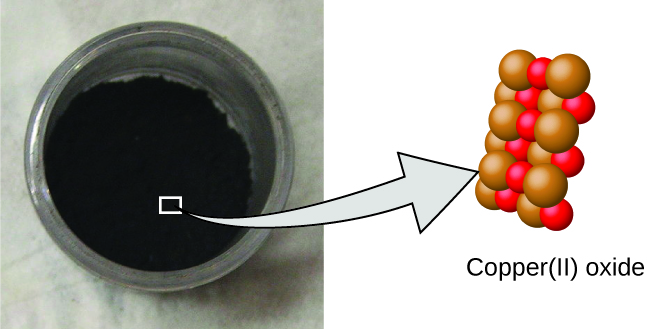
- A compound consists of atoms of two or more elements combined in a small, whole-number ratio. In a given compound, the numbers of atoms of each of its elements are always present in the same ratio (Figure 2.3).化合物は、2種類以上の元素の原子が、小さな整数比で結びついてできている。ある特定の化合物では、それぞれの元素の原子数は常に同じ比で存在する(図2.3)。
Chemicalinterest; modified by OpenStax. · CC BY 4.0; public-domain source photograph · Source出典
Figure 2.3図 2.3Copper(II) oxide, a powdery, black compound, results from the combination of two types of atoms—copper (brown spheres) and oxygen (red spheres)—in a 1:1 ratio. (credit: modification of work by “Chemicalinterest”/Wikimedia Commons)黒い粉末状の化合物である酸化銅(II)は、銅(褐色の球)と酸素(赤い球)という2種類の原子が1:1の比で結びついてできる。(出典:「Chemicalinterest」/Wikimedia Commonsの作品を改変) - Atoms are neither created nor destroyed during a chemical change, but are instead rearranged to yield substances that are different from those present before the change (Figure 2.4).
英語のヒント
原子は化学変化の間に生成することも消滅することもなく、並び替わることによって、変化前とは異なる物質になる(図2.4)。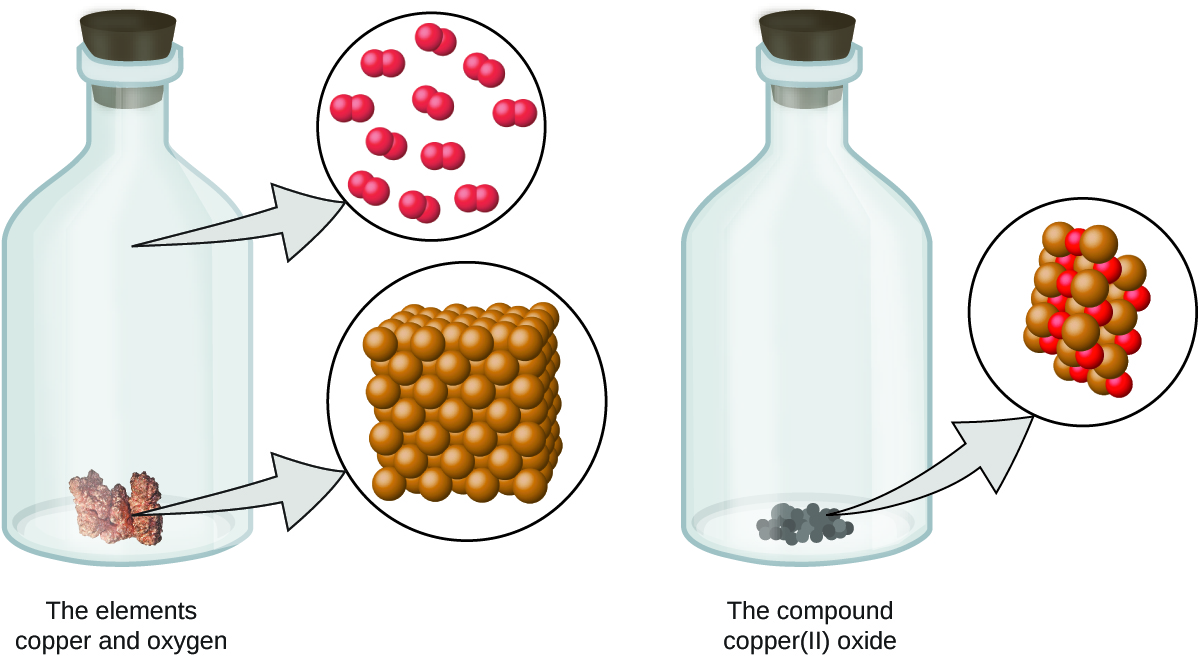
images-of-elements.com / Jumk.de Webprojects; modified by OpenStax. · CC BY 3.0; CC BY 4.0 composition · Source出典
Figure 2.4図 2.4When the elements copper (a shiny, red-brown solid, shown here as brown spheres) and oxygen (a clear and colorless gas, shown here as red spheres) react, their atoms rearrange to form a compound containing copper and oxygen (a powdery, black solid). (credit copper: modification of work by http://images-of-elements.com/copper.php)元素の銅(光沢のある赤褐色の固体で、ここでは褐色の球)と酸素(透明で無色の気体で、ここでは赤い球)が反応すると、原子が並び替わり、銅と酸素を含む化合物(黒い粉末状の固体)を生じる。(銅の出典:http://images-of-elements.com/copper.phpの作品を改変)
Dalton’s atomic theory provides a microscopic explanation of the many macroscopic properties of matter that you’ve learned about. For example, if an element such as copper consists of only one kind of atom, then it cannot be broken down into simpler substances, that is, into substances composed of fewer types of atoms. And if atoms are neither created nor destroyed during a chemical change, then the total mass of matter present when matter changes from one type to another will remain constant (the law of conservation of matter).
ドルトンの原子論は、これまでに学んだ物質の多くの巨視的性質を、微視的に説明する。たとえば、銅のような元素が1種類の原子だけからできているなら、それ以上単純な物質、すなわち、より少ない種類の原子からなる物質には分解できない。また、化学変化の間に原子が生成も消滅もしないなら、物質がある種類から別の種類へ変わっても、存在する物質の総質量は一定のままである(物質保存の法則)。
Example 2.1例題 2.1
Testing Dalton’s Atomic Theoryドルトンの原子論を検証する
In the following drawing, the green spheres represent atoms of a certain element. The purple spheres represent atoms of another element. If the spheres touch, they are part of a single unit of a compound. Does the following chemical change represented by these symbols violate any of the ideas of Dalton’s atomic theory? If so, which one?
次の図で、緑色の球はある元素の原子、紫色の球は別の元素の原子を表す。球同士が接していれば、一つの化合物単位の一部である。これらの記号で表した次の化学変化は、ドルトンの原子論の考え方のどれかに反するか。反するなら、どれか。

Solution解法
The starting materials consist of two green spheres and two purple spheres. The products consist of only one green sphere and one purple sphere. This violates Dalton’s postulate that atoms are neither created nor destroyed during a chemical change, but are merely redistributed. (In this case, atoms appear to have been destroyed.)
英語のヒント
反応前の物質は緑色の球二つと紫色の球二つからなり、生成物は緑色の球一つと紫色の球一つだけからなる。これは、原子は化学変化で生成も消滅もせず、単に配置し直されるだけだというドルトンの基本仮説に反する。(この場合、原子が消滅したように見える。)
Check Your Learning理解を確かめよう
In the following drawing, the green spheres represent atoms of a certain element. The purple spheres represent atoms of another element. If the spheres touch, they are part of a single unit of a compound. Does the following chemical change represented by these symbols violate any of the ideas of Dalton’s atomic theory? If so, which one?
次の図で、緑色の球はある元素の原子、紫色の球は別の元素の原子を表す。球同士が接していれば、一つの化合物単位の一部である。これらの記号で表した次の化学変化は、ドルトンの原子論の考え方のどれかに反するか。反するなら、どれか。



Dalton knew of the experiments of French chemist Joseph Proust, who demonstrated that all samples of a pure compound contain the same elements in the same proportion by mass. This statement is known as the law of definite proportions or the law of constant composition. The suggestion that the numbers of atoms of the elements in a given compound always exist in the same ratio is consistent with these observations. For example, when different samples of isooctane (a component of gasoline and one of the standards used in the octane rating system) are analyzed, they are found to have a carbon-to-hydrogen mass ratio of 5.33:1, as shown in Table 2.1.
英語のヒント
ドルトンは、フランスの化学者ジョゼフ・プルーストの実験を知っていた。プルーストは、純粋な化合物のどの試料も、同じ元素を同じ質量比で含むことを示した。この記述は、定比例の法則、または組成一定の法則として知られている。ある化合物に含まれる各元素の原子数は常に同じ比で存在するという考えは、この観察結果と一致する。たとえば、イソオクタン(ガソリンの成分であり、オクタン価の評価に使う基準物質の一つ)の異なる試料を分析すると、表2.1に示すように、炭素と水素の質量比は5.33:1であることが分かる。
Constant Composition of Isooctane イソオクタンの一定の組成 |
|||
|---|---|---|---|
Sample 試料 |
Carbon 炭素 |
Hydrogen 水素 |
Mass Ratio 質量比 |
A |
14.82 g |
2.78 g |
|
B |
22.33 g |
4.19 g |
|
C |
19.40 g |
3.64 g |
|
It is worth noting that although all samples of a particular compound have the same mass ratio, the converse is not true in general. That is, samples that have the same mass ratio are not necessarily the same substance. For example, there are many compounds other than isooctane that also have a carbon-to-hydrogen mass ratio of 5.33:1.00.
英語のヒント
特定の化合物の試料はすべて同じ質量比をもつが、その逆は一般には成り立たないことに注意しよう。つまり、同じ質量比をもつ試料が、必ずしも同じ物質とは限らない。たとえば、イソオクタン以外にも、炭素と水素の質量比が5.33:1.00の化合物は多く存在する。
Dalton also used data from Proust, as well as results from his own experiments, to formulate another interesting law. The law of multiple proportions states that when two elements react to form more than one compound, a fixed mass of one element will react with masses of the other element in a ratio of small, whole numbers. For example, copper and chlorine can form a green, crystalline solid with a mass ratio of 0.558 g chlorine to 1 g copper, as well as a brown crystalline solid with a mass ratio of 1.116 g chlorine to 1 g copper. These ratios by themselves may not seem particularly interesting or informative; however, if we take a ratio of these ratios, we obtain a useful and possibly surprising result: a small, whole-number ratio.
英語のヒント
ドルトンは、プルーストのデータと自身の実験結果を使い、さらに興味深い別の法則を定式化した。倍数比例の法則は、二つの元素が反応して複数の化合物を作るとき、一方の元素の質量を一定にすると、それと反応するもう一方の元素の質量は小さな整数比になる、というものである。たとえば、銅と塩素は、銅1 gに対し塩素0.558 gの質量比をもつ緑色の結晶性固体と、銅1 gに対し塩素1.116 gの質量比をもつ褐色の結晶性固体を作ることができる。これらの比だけを見ても、とりわけ興味深く、多くを教えてくれるようには思えないかもしれない。しかし、これらの比同士の比を取ると、有用で、意外にも思える結果が得られる。小さな整数比になるのである。
This 2-to-1 ratio means that the brown compound has twice the amount of chlorine per amount of copper as the green compound.
この2:1の比は、同じ量の銅に対して、褐色の化合物が緑色の化合物の2倍の塩素を含むことを意味する。
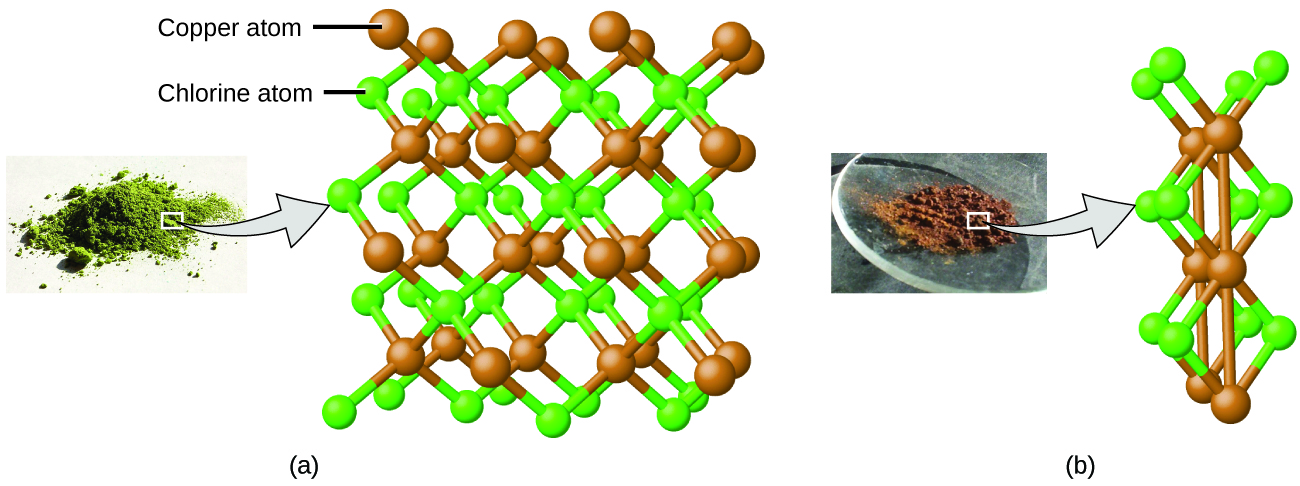
This can be explained by atomic theory if the copper-to-chlorine ratio in the brown compound is 1 copper atom to 2 chlorine atoms, and the ratio in the green compound is 1 copper atom to 1 chlorine atom. The ratio of chlorine atoms (and thus the ratio of their masses) is therefore 2 to 1 (Figure 2.5).
褐色の化合物で銅と塩素の比が銅原子1個に対して塩素原子2個、緑色の化合物では銅原子1個に対して塩素原子1個なら、このことは原子論で説明できる。したがって、塩素原子の数の比(それゆえ質量の比も)は2:1となる(図2.5)。
Benjah-bmm27 and Walkerma; modified by OpenStax. · CC BY 4.0; public-domain source photographs · Source出典

Figure 2.5図 2.5
Compared to the copper chlorine compound in (a), where copper is represented by brown spheres and chlorine by green spheres, the copper chlorine compound in (b) has twice as many chlorine atoms per copper atom. (credit a: modification of work by “Benjah-bmm27”/Wikimedia Commons; credit b: modification of work by “Walkerma”/Wikimedia Commons)
銅を褐色の球、塩素を緑色の球で表した(a)の銅と塩素の化合物に比べて、(b)の銅と塩素の化合物では、銅原子1個当たりの塩素原子数が2倍になっている。(出典a:「Benjah-bmm27」/Wikimedia Commonsの作品を改変、出典b:「Walkerma」/Wikimedia Commonsの作品を改変)
Example 2.2例題 2.2
Laws of Definite and Multiple Proportions定比例の法則と倍数比例の法則
A sample of compound A (a clear, colorless gas) is analyzed and found to contain 4.27 g carbon and 5.69 g oxygen. A sample of compound B (also a clear, colorless gas) is analyzed and found to contain 5.19 g carbon and 13.84 g oxygen. Are these data an example of the law of definite proportions, the law of multiple proportions, or neither? What do these data tell you about substances A and B?
化合物A(透明で無色の気体)の試料を分析すると、炭素4.27 gと酸素5.69 gが含まれていた。化合物B(これも透明で無色の気体)の試料を分析すると、炭素5.19 gと酸素13.84 gが含まれていた。これらのデータは、定比例の法則、倍数比例の法則、どちらでもない、のどの例か。このデータから、物質AとBについて何が分かるか。
Solution解法
In compound A, the mass ratio of oxygen to carbon is:
化合物Aでは、酸素と炭素の質量比は次のようになる。
In compound B, the mass ratio of oxygen to carbon is:
化合物Bでは、酸素と炭素の質量比は次のようになる。
The ratio of these ratios is:
これらの比同士の比は次のようになる。
This supports the law of multiple proportions. This means that A and B are different compounds, with A having one-half as much oxygen per amount of carbon (or twice as much carbon per amount of oxygen) as B. A possible pair of compounds that would fit this relationship would be A = CO and B = CO2.
これは倍数比例の法則を支持する。AとBは異なる化合物であり、同じ量の炭素に対してAの酸素量はBの半分である(あるいは、同じ量の酸素に対してAの炭素量はBの2倍である)ことを意味する。この関係に当てはまる化合物の組として、A = CO、B = CO2が考えられる。
Check Your Learning理解を確かめよう
A sample of compound X (a clear, colorless, combustible liquid with a noticeable odor) is analyzed and found to contain 14.13 g carbon and 2.96 g hydrogen. A sample of compound Y (a clear, colorless, combustible liquid with a noticeable odor that is slightly different from X’s odor) is analyzed and found to contain 19.91 g carbon and 3.34 g hydrogen. Are these data an example of the law of definite proportions, the law of multiple proportions, or neither? What do these data tell you about substances X and Y?
化合物X(透明で無色、はっきりしたにおいのある可燃性液体)の試料を分析すると、炭素14.13 gと水素2.96 gが含まれていた。化合物Y(透明で無色、Xとは少し異なるはっきりしたにおいのある可燃性液体)の試料を分析すると、炭素19.91 gと水素3.34 gが含まれていた。これらのデータは、定比例の法則、倍数比例の法則、どちらでもない、のどの例か。このデータから、物質XとYについて何が分かるか。