第2章原子・分子・イオン
2.4 Chemical Formulas2.4 化学式
Learning Objectives学習目標
By the end of this section, you will be able to:
この節を終えると、次のことができるようになる。
- Symbolize the composition of molecules using molecular formulas and empirical formulas分子式と組成式を使って、分子の組成を記号で表す
- Represent the bonding arrangement of atoms within molecules using structural formulas構造式を使って、分子内の原子の結合配置を表す
A molecular formula is a representation of a molecule that uses chemical symbols to indicate the types of atoms followed by subscripts to show the number of atoms of each type in the molecule. (A subscript is used only when more than one atom of a given type is present.) Molecular formulas are also used as abbreviations for the names of compounds.
英語のヒント
分子式は、元素記号で原子の種類を示し、その後の下付き数字で分子内の各種類の原子数を示す、分子の表し方である。(下付き数字は、その種類の原子が2個以上あるときだけ使う。)分子式は、化合物の名称の略記としても使われる。
The structural formula for a compound gives the same information as its molecular formula (the types and numbers of atoms in the molecule) but also shows how the atoms are connected in the molecule. The structural formula for methane contains symbols for one C atom and four H atoms, indicating the number of atoms in the molecule (Figure 2.16). The lines represent bonds that hold the atoms together. (A chemical bond is an attraction between atoms or ions that holds them together in a molecule or a crystal.) We will discuss chemical bonds and see how to predict the arrangement of atoms in a molecule later. For now, simply know that the lines are an indication of how the atoms are connected in a molecule. A ball-and-stick model shows the geometric arrangement of the atoms with atomic sizes not to scale, and a space-filling model shows the relative sizes of the atoms.
英語のヒント
化合物の構造式は、分子式と同じ情報(分子内の原子の種類と数)を示すだけでなく、分子内で原子がどのようにつながっているかも示す。メタンの構造式にはC原子1個とH原子4個の記号があり、分子内の原子数を表している(図2.16)。線は、原子同士をつなぎとめる結合を表す。(化学結合とは、分子や結晶の中で原子やイオンをつなぎとめる、原子間またはイオン間の引力である。)化学結合と、分子内の原子の配置を予測する方法は後で扱う。今は、線が分子内の原子のつながり方を示す、と知っておけばよい。球棒模型は原子の幾何学的配置を示すが、原子の大きさは縮尺どおりではない。空間充填模型は原子の相対的な大きさを示す。
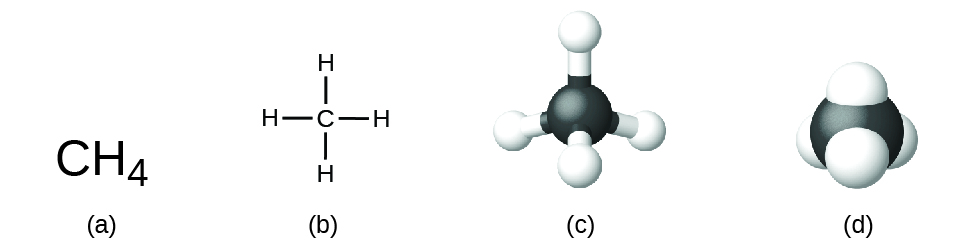
Figure 2.16図 2.16
A methane molecule can be represented as (a) a molecular formula, (b) a structural formula, (c) a ball-and-stick model, and (d) a space-filling model. Carbon and hydrogen atoms are represented by black and white spheres, respectively.
メタン分子は、(a) 分子式、(b) 構造式、(c) 球棒模型、(d) 空間充填模型で表せる。炭素原子は黒い球、水素原子は白い球で表している。
Although many elements consist of discrete, individual atoms, some exist as molecules made up of two or more atoms of the element chemically bonded together. For example, most samples of the elements hydrogen, oxygen, and nitrogen are composed of molecules that contain two atoms each (called diatomic molecules) and thus have the molecular formulas H2, O2, and N2, respectively. Other elements commonly found as diatomic molecules are fluorine (F2), chlorine (Cl2), bromine (Br2), and iodine (I2). The most common form of the element sulfur is composed of molecules that consist of eight atoms of sulfur; its molecular formula is S8 (Figure 2.17).
英語のヒント
多くの元素は独立した個々の原子として存在するが、同じ元素の原子が2個以上、化学的に結びついた分子として存在するものもある。たとえば、水素、酸素、窒素という元素のほとんどの試料は、それぞれ原子を2個含む分子(二原子分子)からなり、その分子式はそれぞれH2、O2、N2である。ほかに、フッ素(F2)、塩素(Cl2)、臭素(Br2)、ヨウ素(I2)も、通常は二原子分子として存在する。硫黄という元素の最も一般的な形は、硫黄原子8個からなる分子でできており、分子式はS8である(図2.17)。
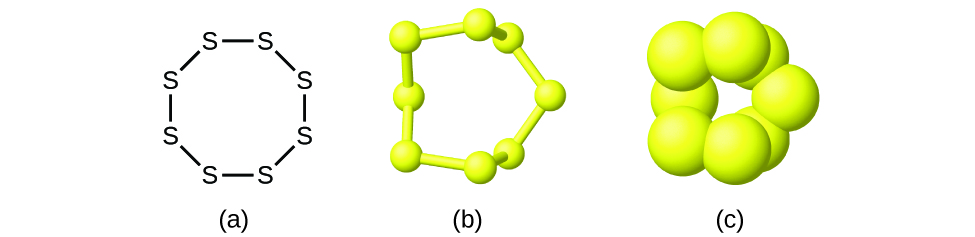
Figure 2.17図 2.17
A molecule of sulfur is composed of eight sulfur atoms and is therefore written as S8. It can be represented as (a) a structural formula, (b) a ball-and-stick model, and (c) a space-filling model. Sulfur atoms are represented by yellow spheres.
硫黄分子は硫黄原子8個からなるため、S8と書く。(a) 構造式、(b) 球棒模型、(c) 空間充填模型で表せる。硫黄原子は黄色い球で表している。
It is important to note that a subscript following a symbol and a number in front of a symbol do not represent the same thing; for example, H2 and 2H represent distinctly different species. H2 is a molecular formula; it represents a diatomic molecule of hydrogen, consisting of two atoms of the element that are chemically bonded together. The expression 2H, on the other hand, indicates two separate hydrogen atoms that are not combined as a unit. The expression 2H2 represents two molecules of diatomic hydrogen (Figure 2.18).
英語のヒント
記号の後ろの下付き数字と、記号の前に置く数は、同じ意味ではないことに注意しよう。たとえば、H2と2Hは明確に異なる化学種を表す。H2は分子式であり、水素という元素の原子2個が化学的に結びついた、水素の二原子分子を表す。一方、2Hは、一つの単位として結びついていない、別々の水素原子2個を表す。2H2は、二原子分子である水素分子2個を表す(図2.18)。
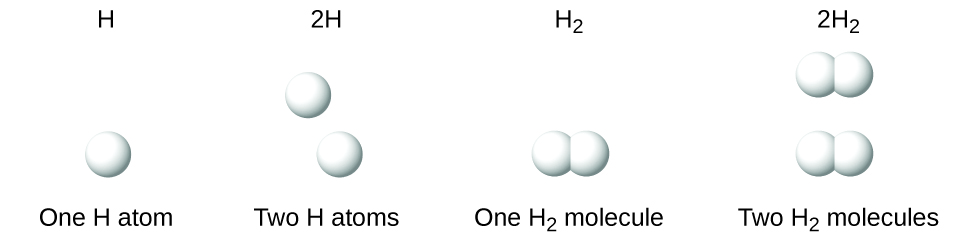
Figure 2.18図 2.18
The symbols H, 2H, H2, and 2H2 represent very different entities.
H、2H、H2、2H2という記号は、それぞれ非常に異なるものを表す。
Compounds are formed when two or more elements chemically combine, resulting in the formation of bonds. For example, hydrogen and oxygen can react to form water, and sodium and chlorine can react to form table salt. We sometimes describe the composition of these compounds with an empirical formula, which indicates the types of atoms present and the simplest whole-number ratio of the number of atoms (or ions) in the compound. For example, titanium dioxide (used as pigment in white paint and in the thick, white, blocking type of sunscreen) has an empirical formula of TiO2. This identifies the elements titanium (Ti) and oxygen (O) as the constituents of titanium dioxide, and indicates the presence of twice as many atoms of the element oxygen as atoms of the element titanium (Figure 2.19).
英語のヒント
2種類以上の元素が化学的に結びついて結合を作ると、化合物ができる。たとえば、水素と酸素は反応して水を作り、ナトリウムと塩素は反応して食塩を作る。これらの化合物の組成を組成式で表すことがある。組成式は、含まれる原子の種類と、化合物内の原子(またはイオン)の数の最も簡単な整数比を示す。たとえば、二酸化チタン(白い塗料や、濃く白い遮蔽型の日焼け止めの顔料に使われる)の組成式はTiO2である。これは、二酸化チタンの構成元素がチタン(Ti)と酸素(O)であり、酸素原子がチタン原子の2倍あることを示している(図2.19)。
Image omitted because its reuse rights could not be verified.権利の確認ができないため画像を割愛。
Figure 2.19図 2.19
(a) The white compound titanium dioxide provides effective protection from the sun. (b) A crystal of titanium dioxide, TiO2, contains titanium and oxygen in a ratio of 1 to 2. The titanium atoms are gray and the oxygen atoms are red. (credit a: modification of work by “osseous”/Flickr)
(a) 白い化合物の二酸化チタンは、日光から効果的に保護する。(b) 二酸化チタンTiO2の結晶には、チタンと酸素が1:2の比で含まれる。チタン原子は灰色、酸素原子は赤色である。(出典a:「osseous」/Flickrの作品を改変)
As discussed previously, we can describe a compound with a molecular formula, in which the subscripts indicate the actual numbers of atoms of each element in a molecule of the compound. In many cases, the molecular formula of a substance is derived from experimental determination of both its empirical formula and its molecular mass (the sum of atomic masses for all atoms composing the molecule). For example, it can be determined experimentally that benzene contains two elements, carbon (C) and hydrogen (H), and that for every carbon atom in benzene, there is one hydrogen atom. Thus, the empirical formula is CH. An experimental determination of the molecular mass reveals that a molecule of benzene contains six carbon atoms and six hydrogen atoms, so the molecular formula for benzene is C6H6 (Figure 2.20).
英語のヒント
前に述べたように、化合物は分子式で表せる。分子式の下付き数字は、その化合物の分子1個に含まれる各元素の実際の原子数を示す。多くの場合、物質の分子式は、組成式と分子の質量(その分子を構成する全原子の原子質量の和)の両方を実験で求めることによって得られる。たとえば、ベンゼンは炭素(C)と水素(H)の二つの元素を含み、炭素原子1個に対して水素原子1個があることを実験で求められる。したがって、組成式はCHである。分子の質量を実験で求めると、ベンゼン分子は炭素原子6個と水素原子6個を含むと分かるので、分子式はC6H6となる(図2.20)。
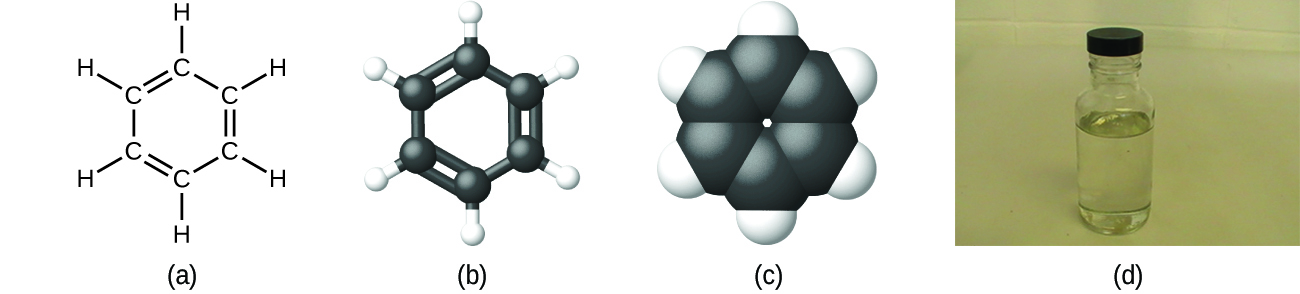
Figure 2.20図 2.20
Benzene, C6H6, is produced during oil refining and has many industrial uses. A benzene molecule can be represented as (a) a structural formula, (b) a ball-and-stick model, and (c) a space-filling model. (d) Benzene is a clear liquid. (credit d: modification of work by Sahar Atwa)
ベンゼンC6H6は石油精製で生じ、工業で広く使われる。ベンゼン分子は、(a) 構造式、(b) 球棒模型、(c) 空間充填模型で表せる。(d) ベンゼンは透明な液体である。(出典d:Sahar Atwaの作品を改変)
If we know a compound’s formula, we can easily determine the empirical formula. (This is somewhat of an academic exercise; the reverse chronology is generally followed in actual practice.) For example, the molecular formula for acetic acid, the component that gives vinegar its sharp taste, is C2H4O2. This formula indicates that a molecule of acetic acid (Figure 2.21) contains two carbon atoms, four hydrogen atoms, and two oxygen atoms. The ratio of atoms is 2:4:2. Dividing by the lowest common denominator (2) gives the simplest, whole-number ratio of atoms, 1:2:1, so the empirical formula is CH2O. Note that a molecular formula is always a whole-number multiple of an empirical formula.
英語のヒント
化合物の分子式が分かれば、組成式は簡単に求められる。(これはどちらかといえば学習上の練習であり、実際には一般に逆の順序で求める。)たとえば、食酢に鋭い味を与える成分である酢酸の分子式はC2H4O2である。この式は、酢酸分子(図2.21)が炭素原子2個、水素原子4個、酸素原子2個を含むことを示している。原子数の比は2:4:2である。最小の共通分母(2)で割ると、原子数の最も簡単な整数比1:2:1が得られるため、組成式はCH2Oとなる。分子式は常に、組成式の整数倍であることに注意しよう。
Image omitted because its reuse rights could not be verified.権利の確認ができないため画像を割愛。
Figure 2.21図 2.21
(a) Vinegar contains acetic acid, C2H4O2, which has an empirical formula of CH2O. It can be represented as (b) a structural formula and (c) as a ball-and-stick model. (credit a: modification of work by “HomeSpot HQ”/Flickr)
(a) 食酢には酢酸C2H4O2が含まれ、その組成式はCH2Oである。(b) 構造式、(c) 球棒模型で表せる。(出典a:「HomeSpot HQ」/Flickrの作品を改変)
Example 2.6例題 2.6
Empirical and Molecular Formulas組成式と分子式
Molecules of glucose (blood sugar) contain 6 carbon atoms, 12 hydrogen atoms, and 6 oxygen atoms. What are the molecular and empirical formulas of glucose?
グルコース(血糖)の分子は、炭素原子6個、水素原子12個、酸素原子6個を含む。グルコースの分子式と組成式は何か。
Solution解法
The molecular formula is C6H12O6 because one molecule actually contains 6 C, 12 H, and 6 O atoms. The simplest whole-number ratio of C to H to O atoms in glucose is 1:2:1, so the empirical formula is CH2O.
英語のヒント
分子1個には実際にC原子6個、H原子12個、O原子6個が含まれるため、分子式はC6H12O6である。グルコースのC、H、Oの原子数の最も簡単な整数比は1:2:1なので、組成式はCH2Oとなる。
Check Your Learning理解を確かめよう
A molecule of metaldehyde (a pesticide used for snails and slugs) contains 8 carbon atoms, 16 hydrogen atoms, and 4 oxygen atoms. What are the molecular and empirical formulas of metaldehyde?
メタアルデヒド(カタツムリやナメクジに使う農薬)の分子は、炭素原子8個、水素原子16個、酸素原子4個を含む。メタアルデヒドの分子式と組成式は何か。
It is important to be aware that it may be possible for the same atoms to be arranged in different ways: Compounds with the same molecular formula may have different atom-to-atom bonding and therefore different structures. For example, could there be another compound with the same formula as acetic acid, C2H4O2? And if so, what would be the structure of its molecules?
同じ原子でも、異なる並び方があり得ることを知っておくことが大切である。同じ分子式をもつ化合物でも、原子同士の結びつき方が異なり、したがって構造が異なることがある。たとえば、酢酸と同じ式C2H4O2をもつ別の化合物はあり得るだろうか。あり得るとしたら、その分子の構造はどうなるだろうか。
If you predict that another compound with the formula C2H4O2 could exist, then you demonstrated good chemical insight and are correct. Two C atoms, four H atoms, and two O atoms can also be arranged to form a methyl formate, which is used in manufacturing, as an insecticide, and for quick-drying finishes. Methyl formate molecules have one of the oxygen atoms between the two carbon atoms, differing from the arrangement in acetic acid molecules. Acetic acid and methyl formate are examples of isomers—compounds with the same chemical formula but different molecular structures (Figure 2.23). Note that this small difference in the arrangement of the atoms has a major effect on their respective chemical properties. You would certainly not want to use a solution of methyl formate as a substitute for a solution of acetic acid (vinegar) when you make salad dressing.
英語のヒント
C2H4O2という式をもつ別の化合物が存在し得ると予測したなら、よい化学的洞察であり、正解である。C原子2個、H原子4個、O原子2個は、ギ酸メチルを作るようにも並べられる。ギ酸メチルは製造業、殺虫剤、速乾性の仕上げ剤に使われる。その分子では、酸素原子の一つが二つの炭素原子の間にあり、酢酸分子の配置とは異なる。酢酸とギ酸メチルは、同じ化学式で分子構造が異なる化合物、すなわち異性体の例である(図2.23)。原子配置のこの小さな違いが、それぞれの化学的性質に大きな影響を与えることに注意しよう。サラダドレッシングを作るとき、酢酸水溶液(食酢)の代わりにギ酸メチル溶液を使いたいとは、決して思わないだろう。
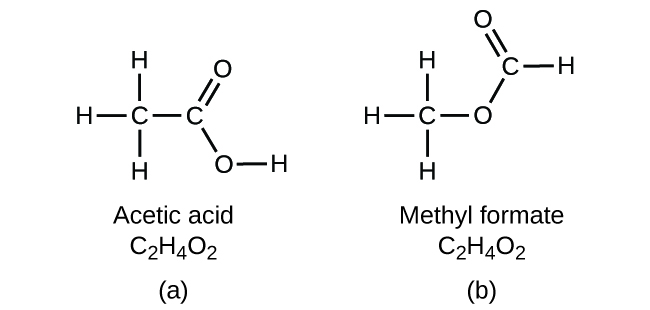


Figure 2.23図 2.23
Molecules of (a) acetic acid and methyl formate (b) are structural isomers; they have the same formula (C2H4O2) but different structures (and therefore different chemical properties).
(a) 酢酸と(b) ギ酸メチルの分子は構造異性体である。同じ式C2H4O2をもつが、構造が異なるため、化学的性質も異なる。
Many types of isomers exist (Figure 2.24). Acetic acid and methyl formate are structural isomers, compounds in which the molecules differ in how the atoms are connected to each other. There are also various types of spatial isomers, in which the relative orientations of the atoms in space can be different. For example, the compound carvone (found in caraway seeds, spearmint, and mandarin orange peels) consists of two isomers that are mirror images of each other. S-(+)-carvone smells like caraway, and R-(−)-carvone smells like spearmint.
英語のヒント
異性体には多くの種類がある(図2.24)。酢酸とギ酸メチルは、原子同士のつながり方が異なる分子をもつ化合物、すなわち構造異性体である。原子の空間的な相対配置が異なる、さまざまな立体異性体も存在する。たとえば、カルボンという化合物(キャラウェイの種、スペアミント、マンダリンオレンジの皮に含まれる)には、互いに鏡像の関係にある二つの異性体がある。S-(+)-カルボンはキャラウェイのにおいがし、R-(−)-カルボンはスペアミントのにおいがする。
Image omitted because its reuse rights could not be verified.権利の確認ができないため画像を割愛。
Figure 2.24図 2.24
Molecules of carvone are spatial isomers; they only differ in the relative orientations of the atoms in space. (credit bottom left: modification of work by “Miansari66”/Wikimedia Commons; credit bottom right: modification of work by Forest & Kim Starr)
カルボン分子は立体異性体であり、原子の空間的な相対配置だけが異なる。(左下の出典:「Miansari66」/Wikimedia Commonsの作品を改変、右下の出典:Forest & Kim Starrの作品を改変)