第1章前提知識Prerequisites
1.4 Polynomials1.4 多項式
Learning Objectives 学習目標
In this section, you will:
この節を終えると、次のことができるようになる。
• Identify the degree and leading coefficient of polynomials.• Add and subtract polynomials.• Multiply polynomials.• Use FOIL to multiply binomials.• Perform operations with polynomials of several variables.
・多項式の次数と最高次係数を見分ける。・多項式を足し引きする。・多項式を掛ける。・FOIL を使って二項式どうしを掛ける。・変数がいくつかある多項式で計算する。
Maahi is building a little free library (a small house-shaped book repository), whose front is in the shape of a square topped with a triangle. There will be a rectangular door through which people can take and donate books. Maahi wants to find the area of the front of the library so that they can purchase the correct amount of paint. Using the measurements of the front of the house, shown in Figure 1, we can create an expression that combines several variable terms, allowing us to solve this problem and others like it.
Maahi は小さな無料図書館(家の形をした小型の本置き場)を作っている。正面は正方形の上に三角形を載せた形をしている。人が本を取ったり寄せたりできるよう、長方形の扉が付く。Maahi は塗料を必要なだけ買えるように、図書館の正面の面積を求めたい。図1に示した正面の寸法を使うと、いくつかの変数の項を組み合わせた式が作れる。これによってこの問題も、似た問題も解ける。
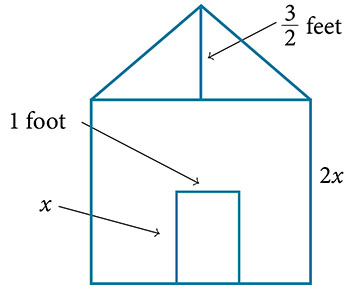
First find the area of the square in square feet.
まず正方形の面積を平方フィートで求める。
Then find the area of the triangle in square feet.
次に三角形の面積を平方フィートで求める。
Next find the area of the rectangular door in square feet.
続いて長方形の扉の面積を平方フィートで求める。
The area of the front of the library can be found by adding the areas of the square and the triangle, and then subtracting the area of the rectangle. When we do this, we get or ft2.
図書館の正面の面積は、正方形と三角形の面積を足し、そこから長方形の面積を引けば求まる。そうすると すなわち ft2 となる。
In this section, we will examine expressions such as this one, which combine several variable terms.
この節では、いまのような、いくつかの変数の項を組み合わせた式を調べる。
Identifying the Degree and Leading Coefficient of Polynomials多項式の次数と最高次係数を見分ける
The formula just found is an example of a polynomial, which is a sum of or difference of terms, each consisting of a variable raised to a nonnegative integer power. A number multiplied by a variable raised to an exponent, such as is known as a coefficient. Coefficients can be positive, negative, or zero, and can be whole numbers, decimals, or fractions. Each product such as is a term of a polynomial. If a term does not contain a variable, it is called a constant.
いま求めた式は多項式の一例である。多項式とは、変数を非負整数の乗数に上げたものからなる項どうしの和または差である。 のように、変数を指数に上げたものに掛かる数を係数という。係数は正でも負でも0でもよく、非負整数でも小数でも分数でもよい。 のような積 のそれぞれが、多項式の項である。変数を含まない項を定数という。
A polynomial containing only one term, such as is called a monomial. A polynomial containing two terms, such as is called a binomial. A polynomial containing three terms, such as is called a trinomial.
のように項が一つだけの多項式を単項式という。 のように項が二つの多項式を二項式という。 のように項が三つの多項式を三項式という。
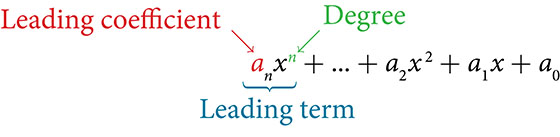
We can find the degree of a polynomial by identifying the highest power of the variable that occurs in the polynomial. The term with the highest degree is called the leading term because it is usually written first. The coefficient of the leading term is called the leading coefficient. When a polynomial is written so that the powers are descending, we say that it is in standard form.
多項式の次数は、その多項式に現れる変数の最も高い乗数を見れば分かる。次数がいちばん高い項を最高次の項という。ふつう最初に書かれるからである。最高次の項の係数を最高次係数という。乗数が下がる順に並べて書かれた多項式は、標準形であるという。
Polynomials 多項式
A polynomial is an expression that can be written in the form
多項式とは、次の形に書ける式である。
Each real number ai is called a coefficient. The number that is not multiplied by a variable is called a constant. Each product is a term of a polynomial. The highest power of the variable that occurs in the polynomial is called the degree of a polynomial. The leading term is the term with the highest power, and its coefficient is called the leading coefficient.
各実数 ai を係数という。変数に掛かっていない数 を定数という。各積 が多項式の項である。多項式に現れる変数の最も高い乗数を、その多項式の次数という。最高次の項とは乗数がいちばん高い項であり、その係数を最高次係数という。
How To 手順
Given a polynomial expression, identify the degree and leading coefficient.
多項式の式が与えられたとき、次数と最高次係数を見分ける。
1. Find the highest power of x to determine the degree.2. Identify the term containing the highest power of x to find the leading term.3. Identify the coefficient of the leading term.
1. x の最も高い乗数を見つけて次数を決める。2. x の最も高い乗数を含む項を見つけて、最高次の項を決める。3. 最高次の項の係数を見分ける。
Example 1例1
Identifying the Degree and Leading Coefficient of a Polynomial多項式の次数と最高次係数を見分ける
For the following polynomials, identify the degree, the leading term, and the leading coefficient.
次の各多項式について、次数・最高次の項・最高次係数を答えよ。
Solution 解答
ⓐThe highest power of x is 3, so the degree is 3. The leading term is the term containing that degree, The leading coefficient is the coefficient of that term, ⓑThe highest power of t is so the degree is The leading term is the term containing that degree, The leading coefficient is the coefficient of that term, ⓒThe highest power of p is so the degree is The leading term is the term containing that degree, The leading coefficient is the coefficient of that term,
ⓐx の最も高い乗数は3なので、次数は3である。最高次の項はその次数を含む項 である。最高次係数はその項の係数 である。ⓑt の最も高い乗数は なので、次数は である。最高次の項はその次数を含む項 である。最高次係数はその項の係数 である。ⓒp の最も高い乗数は なので、次数は である。最高次の項はその次数を含む項 である。最高次係数はその項の係数 である。
Try It #1やってみよう1
Identify the degree, leading term, and leading coefficient of the polynomial
多項式 の次数・最高次の項・最高次係数を答えよ。
Adding and Subtracting Polynomials多項式を足し引きする
We can add and subtract polynomials by combining like terms, which are terms that contain the same variables raised to the same exponents. For example, and are like terms, and can be added to get but and are not like terms, and therefore cannot be added.
多項式は同類項をまとめることで足し引きできる。同類項とは、同じ変数が同じ指数に上げられている項どうしのことである。たとえば と は同類項で、足すと になる。しかし と は同類項ではないので、足せない。
How To 手順
Given multiple polynomials, add or subtract them to simplify the expressions.
複数の多項式が与えられたとき、それらを足し引きして式を簡単にする。
1. Combine like terms.2. Simplify and write in standard form.
1. 同類項をまとめる。2. 簡単にして標準形で書く。
Example 2例2
Adding Polynomials多項式を足す
Find the sum.
和を求めよ。
Solution 解答
式中の英語:Combine like terms:同類項をまとめる / Simplify:整理する
Analysis 考察
We can check our answers to these types of problems using a graphing calculator. To check, graph the problem as given along with the simplified answer. The two graphs should be equivalent. Be sure to use the same window to compare the graphs. Using different windows can make the expressions seem equivalent when they are not.
この種の問題の答えは、グラフ電卓で確かめられる。確かめるには、与えられたままの式と、簡単にした答えとを一緒にグラフに描く。二つのグラフは重なるはずである。比べるときは必ず同じ表示範囲を使うこと。違う範囲を使うと、等しくない式が等しく見えてしまうことがある。
Try It #2やってみよう2
Find the sum.
和を求めよ。
Example 3例3
Subtracting Polynomials多項式を引く
Find the difference.
差を求めよ。
Solution 解答
Analysis 考察
Note that finding the difference between two polynomials is the same as adding the opposite of the second polynomial to the first.
二つの多項式の差を求めることは、一つ目の多項式に二つ目の多項式の反数を足すことと同じであることに注意せよ。
Try It #3やってみよう3
Find the difference.
差を求めよ。
Multiplying Polynomials多項式を掛ける
Multiplying polynomials is a bit more challenging than adding and subtracting polynomials. We must use the distributive property to multiply each term in the first polynomial by each term in the second polynomial. We then combine like terms. We can also use a shortcut called the FOIL method when multiplying binomials. Certain special products follow patterns that we can memorize and use instead of multiplying the polynomials by hand each time. We will look at a variety of ways to multiply polynomials.
多項式どうしの掛け算は、足し引きより少し手ごわい。分配法則を使って、一つ目の多項式の各項を二つ目の多項式の各項に掛けなければならない。その後、同類項をまとめる。二項式どうしを掛けるときは、FOIL 法という近道も使える。ある種の特別な積には型があり、それを覚えておけば毎回手で掛け合わせずに済む。ここでは多項式を掛けるいろいろな方法を見ていく。
Multiplying Polynomials Using the Distributive Property分配法則を使って多項式を掛ける
To multiply a number by a polynomial, we use the distributive property. The number must be distributed to each term of the polynomial. We can distribute the in to obtain the equivalent expression When multiplying polynomials, the distributive property allows us to multiply each term of the first polynomial by each term of the second. We then add the products together and combine like terms to simplify.
数と多項式を掛けるには分配法則を使う。その数を多項式の各項に配らなければならない。 の を配れば、等しい式 が得られる。多項式どうしを掛けるときも、分配法則によって一つ目の多項式の各項を二つ目の各項に掛けられる。その後、積どうしを足し、同類項をまとめて簡単にする。
How To 手順
Given the multiplication of two polynomials, use the distributive property to simplify the expression.
二つの多項式の積が与えられたとき、分配法則を使って式を簡単にする。
1. Multiply each term of the first polynomial by each term of the second.2. Combine like terms.3. Simplify.
1. 一つ目の多項式の各項を、二つ目の各項に掛ける。2. 同類項をまとめる。3. 簡単にする。
Example 4例4
Multiplying Polynomials Using the Distributive Property分配法則を使って多項式を掛ける
Find the product.
積を求めよ。
Solution 解答
式中の英語:Use the distributive property:分配法則を使う / Multiply:掛ける / Combine like terms:同類項をまとめる / Simplify:整理する
Analysis 考察
We can use a table to keep track of our work, as shown in Table 1. Write one polynomial across the top and the other down the side. For each box in the table, multiply the term for that row by the term for that column. Then add all of the terms together, combine like terms, and simplify.
表1のように、表を使うと計算の跡を追える。一方の多項式を上に、もう一方を横に書く。表の各ますで、その行の項とその列の項を掛ける。それからすべての項を足し、同類項をまとめて簡単にする。
Try It #4やってみよう4
Find the product.
積を求めよ。
Using FOIL to Multiply BinomialsFOIL を使って二項式どうしを掛ける
A shortcut called FOIL is sometimes used to find the product of two binomials. It is called FOIL because we multiply the first terms, the outer terms, the inner terms, and then the last terms of each binomial.
二項式どうしの積を求めるのに、FOIL という近道を使うことがある。それぞれの二項式の first(最初の項)、outer(外側の項)、inner(内側の項)、last(最後の項)を掛けるので FOIL という。
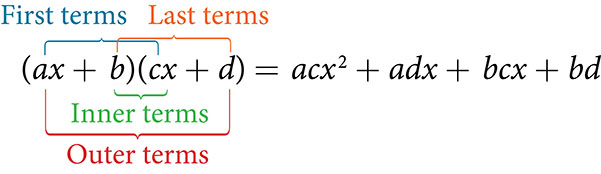
The FOIL method arises out of the distributive property. We are simply multiplying each term of the first binomial by each term of the second binomial, and then combining like terms.
FOIL 法は分配法則から出てくる。一つ目の二項式の各項を二つ目の二項式の各項に掛け、同類項をまとめているだけである。
How To 手順
Given two binomials, use FOIL to simplify the expression.
二つの二項式が与えられたとき、FOIL を使って式を簡単にする。
1. Multiply the first terms of each binomial.2. Multiply the outer terms of the binomials.3. Multiply the inner terms of the binomials.4. Multiply the last terms of each binomial.5. Add the products.6. Combine like terms and simplify.
1. それぞれの二項式の最初の項どうしを掛ける。2. 二項式の外側の項どうしを掛ける。3. 二項式の内側の項どうしを掛ける。4. それぞれの二項式の最後の項どうしを掛ける。5. 積どうしを足す。6. 同類項をまとめて簡単にする。
Example 5例5
Using FOIL to Multiply BinomialsFOIL を使って二項式どうしを掛ける
Use FOIL to find the product.
FOIL を使って積を求めよ。
Solution 解答
Find the product of the first terms.
最初の項どうしの積を求める。

Find the product of the outer terms.
外側の項どうしの積を求める。

Find the product of the inner terms.
内側の項どうしの積を求める。

Find the product of the last terms.
最後の項どうしの積を求める。

式中の英語:Combine like terms:同類項をまとめる / Simplify:整理する
Try It #5やってみよう5
Use FOIL to find the product.
FOIL を使って積を求めよ。
Perfect Square Trinomials完全平方の三項式
Certain binomial products have special forms. When a binomial is squared, the result is called a perfect square trinomial. We can find the square by multiplying the binomial by itself. However, there is a special form that each of these perfect square trinomials takes, and memorizing the form makes squaring binomials much easier and faster. Let’s look at a few perfect square trinomials to familiarize ourselves with the form.
二項式の積には特別な形をとるものがある。二項式を二乗した結果を完全平方の三項式という。二乗は、二項式をそれ自身に掛ければ求まる。しかし完全平方の三項式はどれも決まった形をとるので、その形を覚えておけば二項式の二乗がずっと楽で速くなる。形に慣れるために、完全平方の三項式をいくつか見てみよう。
Notice that the first term of each trinomial is the square of the first term of the binomial and, similarly, the last term of each trinomial is the square of the last term of the binomial. The middle term is double the product of the two terms. Lastly, we see that the first sign of the trinomial is the same as the sign of the binomial.
どの三項式でも、最初の項が二項式の最初の項の二乗になっていることに注意せよ。同じく、最後の項は二項式の最後の項の二乗である。真ん中の項は二つの項の積の2倍である。最後に、三項式の最初の符号が二項式の符号と同じであることも分かる。
Perfect Square Trinomials 完全平方の三項式
When a binomial is squared, the result is the first term squared added to double the product of both terms and the last term squared.
二項式を二乗すると、最初の項の二乗に、両方の項の積の2倍と、最後の項の二乗を足したものになる。
How To 手順
Given a binomial, square it using the formula for perfect square trinomials.
二項式が与えられたとき、完全平方の三項式の公式を使ってそれを二乗する。
1. Square the first term of the binomial.2. Square the last term of the binomial.3. For the middle term of the trinomial, double the product of the two terms.4. Add and simplify.
1. 二項式の最初の項を二乗する。2. 二項式の最後の項を二乗する。3. 三項式の真ん中の項として、二つの項の積を2倍する。4. 足して簡単にする。
Example 6例6
Expanding Perfect Squares完全平方を展開する
Expand
を展開せよ。
Solution 解答
Begin by squaring the first term and the last term. For the middle term of the trinomial, double the product of the two terms.
まず最初の項と最後の項を二乗する。三項式の真ん中の項としては、二つの項の積を2倍する。
Simplify.
簡単にする。
Try It #6やってみよう6
Expand
を展開せよ。
Difference of Squares平方の差
Another special product is called the difference of squares, which occurs when we multiply a binomial by another binomial with the same terms but the opposite sign. Let’s see what happens when we multiply using the FOIL method.
もう一つの特別な積を平方の差という。項は同じで符号だけが逆の二項式どうしを掛けたときに現れる。FOIL 法で を掛けるとどうなるか見てみよう。
The middle term drops out, resulting in a difference of squares. Just as we did with the perfect squares, let’s look at a few examples.
真ん中の項が消えて、平方の差になる。完全平方のときと同じように、例をいくつか見てみよう。
Because the sign changes in the second binomial, the outer and inner terms cancel each other out, and we are left only with the square of the first term minus the square of the last term.
二つ目の二項式で符号が変わるため、外側の項と内側の項が打ち消し合い、最初の項の二乗から最後の項の二乗を引いたものだけが残る。
Q&A 疑問と答え
Is there a special form for the sum of squares?
平方の和にも特別な形はあるか。
No. The difference of squares occurs because the opposite signs of the binomials cause the middle terms to disappear. There are no two binomials that multiply to equal a sum of squares.
無い。平方の差が現れるのは、二項式の符号が逆であるために真ん中の項が消えるからである。掛けて平方の和になるような二項式の組は存在しない。
Difference of Squares 平方の差
When a binomial is multiplied by a binomial with the same terms separated by the opposite sign, the result is the square of the first term minus the square of the last term.
項は同じで符号だけが逆の二項式どうしを掛けると、結果は最初の項の二乗から最後の項の二乗を引いたものになる。
How To 手順
Given a binomial multiplied by a binomial with the same terms but the opposite sign, find the difference of squares.
項は同じで符号だけが逆の二項式どうしの積が与えられたとき、平方の差を求める。
1. Square the first term of the binomials.2. Square the last term of the binomials.3. Subtract the square of the last term from the square of the first term.
1. 二項式の最初の項を二乗する。2. 二項式の最後の項を二乗する。3. 最初の項の二乗から、最後の項の二乗を引く。
Example 7例7
Multiplying Binomials Resulting in a Difference of Squares平方の差になる二項式どうしを掛ける
Multiply
を掛けよ。
Solution 解答
Square the first term to get Square the last term to get Subtract the square of the last term from the square of the first term to find the product of
最初の項を二乗して を得る。最後の項を二乗して を得る。最初の項の二乗から最後の項の二乗を引いて、 の積を求める。
Try It #7やってみよう7
Multiply
を掛けよ。
Performing Operations with Polynomials of Several Variables変数がいくつかある多項式で計算する
We have looked at polynomials containing only one variable. However, a polynomial can contain several variables. All of the same rules apply when working with polynomials containing several variables. Consider an example:
ここまでは変数が一つだけの多項式を見てきた。しかし多項式には変数がいくつあってもよい。変数がいくつかある多項式を扱うときも、規則はまったく同じである。例で考えよう。
Example 8例8
Multiplying Polynomials Containing Several Variables変数がいくつかある多項式を掛ける
Multiply
を掛けよ。
Solution 解答
Follow the same steps that we used to multiply polynomials containing only one variable.
変数が一つだけの多項式を掛けたときと同じ手順をたどる。
Try It #8やってみよう8
Multiply
を掛けよ。
Media 教材
Access these online resources for additional instruction and practice with polynomials.
多項式についての説明と練習をさらに求めるなら、次のオンライン教材にあたるとよい。
• Adding and Subtracting Polynomials• Multiplying Polynomials• Special Products of Polynomials
・多項式を足し引きする・多項式を掛ける・多項式の特別な積
Verbal言葉で答える問題
2. Many times, multiplying two binomials with two variables results in a trinomial. This is not the case when there is a difference of two squares. Explain why the product in this case is also a binomial.
2. 変数が二つある二項式どうしを掛けると、多くの場合は三項式になる。しかし平方の差のときはそうならない。この場合に積が二項式になる理由を説明せよ。
4. State whether the following statement is true and explain why or why not: A trinomial is always a higher degree than a monomial.
4. 次の文が正しいかどうかを述べ、その理由を説明せよ。「三項式の次数はつねに単項式より高い。」
Algebraic代数の問題
For the following exercises, identify the degree of the polynomial.
次の各問について、多項式の次数を答えよ。
For the following exercises, find the sum or difference.
次の各問について、和または差を求めよ。
For the following exercises, find the product.
次の各問について、積を求めよ。
For the following exercises, expand the binomial.
次の各問について、二項式を展開せよ。
For the following exercises, multiply the binomials.
次の各問について、二項式どうしを掛けよ。
For the following exercises, multiply the polynomials.
次の各問について、多項式どうしを掛けよ。
Real-World Applications応用問題
53. A developer wants to purchase a plot of land to build a house. The area of the plot can be described by the following expression: where x is measured in meters. Multiply the binomials to find the area of the plot in standard form.
53. ある開発業者が家を建てるために土地を買おうとしている。その土地の面積は式 で表される。ここで x はメートルで測る。二項式どうしを掛けて、土地の面積を標準形で求めよ。
54. A prospective buyer wants to know how much grain a specific silo can hold. The area of the floor of the silo is The height of the silo is where x is measured in feet. Expand the square and multiply by the height to find the expression that shows how much grain the silo can hold.
54. 買い手候補が、ある穀物倉庫にどれだけの穀物が入るかを知りたがっている。倉庫の床の面積は である。倉庫の高さは で、x はフィートで測る。二乗を展開して高さを掛け、この倉庫に入る穀物の量を表す式を求めよ。
Extensions発展問題
For the following exercises, perform the given operations.
次の各問について、与えられた計算を行え。