第1章前提知識Prerequisites
Classifying a Real Number実数を分類する
The numbers we use for counting, or enumerating items, are the natural numbers: 1, 2, 3, 4, 5, and so on. We describe them in set notation as where the ellipsis (…) indicates that the numbers continue to infinity. The natural numbers are, of course, also called the counting numbers. Any time we enumerate the members of a team, count the coins in a collection, or tally the trees in a grove, we are using the set of natural numbers. The set of whole numbers is the set of natural numbers plus zero:
物を数えるとき、すなわち個数を列挙するときに使う数が自然数で、1, 2, 3, 4, 5, …である。集合の記法ではと書く。ここで省略記号(…)は、数が無限に続くことを示す。自然数はもちろん「数える数」とも呼ばれる。チームの人数を数えるとき、集めた硬貨を数えるとき、林の木を数えるとき、私たちは自然数の集合を使っている。非負整数の集合は、自然数の集合に0を加えたものである。
The set of integers adds the opposites of the natural numbers to the set of whole numbers: It is useful to note that the set of integers is made up of three distinct subsets: negative integers, zero, and positive integers. In this sense, the positive integers are just the natural numbers. Another way to think about it is that the natural numbers are a subset of the integers.
整数の集合は、非負整数の集合に自然数の反対の数を加えたものである。 整数の集合が、負の整数、0、正の整数という三つの異なる部分集合からできていることに注意しておくと役に立つ。この意味で、正の整数はまさに自然数である。言い換えれば、自然数は整数の部分集合である。
The set of rational numbers is written as Notice from the definition that rational numbers are fractions (or quotients) containing integers in both the numerator and the denominator, and the denominator is never 0. We can also see that every natural number, whole number, and integer is a rational number with a denominator of 1.
有理数の集合はと書く。定義から分かるように、有理数とは分子と分母がともに整数である分数(商)で、分母は決して0にならない。また、すべての自然数、非負整数、整数は、分母が1の有理数である。
Because they are fractions, any rational number can also be expressed as a terminating or repeating decimal. Any rational number can be represented as either:
分数であるから、どんな有理数も、有限小数か循環小数として表せる。つまり、どんな有理数も次のどちらかで表せる。
ⓐa terminating decimal: orⓑa repeating decimal:
ⓐ有限小数:、またはⓑ循環小数:
We use a line drawn over the repeating block of numbers instead of writing the group multiple times.
繰り返される数字のまとまりを何度も書く代わりに、そのまとまりの上に線を引く。
Example 1例1
Writing Integers as Rational Numbers整数を有理数として書く
Show that each of the following is a rational number by writing it as a ratio of two integers.
次の各数が有理数であることを、二つの整数の比として書くことで示せ。
Solution 解答
Write a fraction with the integer in the numerator and 1 in the denominator.
整数を分子に、1を分母に置いた分数を書く。
Try It #1やってみよう1
Write each of the following as a rational number.
次の各数を有理数として書け。
Example 2例2
Identifying Rational Numbers有理数を見分ける
Write each of the following rational numbers as either a terminating or repeating decimal.
次の各有理数を、有限小数または循環小数として書け。
Solution 解答
Write each fraction as a decimal by dividing the numerator by the denominator.
分子を分母で割って、各分数を小数として書く。
ⓐ a repeating decimalⓑ (or 3.0), a terminating decimalⓒ a terminating decimal
ⓐ 循環小数ⓑ (すなわち3.0)、有限小数ⓒ 有限小数
Try It #2やってみよう2
Write each of the following rational numbers as either a terminating or repeating decimal.
次の各有理数を、有限小数または循環小数として書け。
Irrational Numbers無理数
At some point in the ancient past, someone discovered that not all numbers are rational numbers. A builder, for instance, may have found that the diagonal of a square with unit sides was not 2 or even but was something else. Or a garment maker might have observed that the ratio of the circumference to the diameter of a roll of cloth was a little bit more than 3, but still not a rational number. Such numbers are said to be irrational because they cannot be written as fractions. These numbers make up the set of irrational numbers. Irrational numbers cannot be expressed as a fraction of two integers. It is impossible to describe this set of numbers by a single rule except to say that a number is irrational if it is not rational. So we write this as shown.
遠い昔のある時点で、誰かが、すべての数が有理数とは限らないことを発見した。たとえば建築職人は、一辺の長さが1の正方形の対角線が2でもでもなく、別の何かであることに気づいたかもしれない。あるいは仕立て職人は、布の巻きの円周と直径の比が3より少し大きいのに、それでも有理数ではないことに気づいたかもしれない。こうした数は分数として書けないので、無理数と呼ばれる。これらの数が無理数の集合をなす。無理数は二つの整数の分数として表せない。この集合を一つの規則で言い表すことはできず、有理数でない数が無理数である、と言うしかない。そこで次のように書く。
Example 3例3
Differentiating Rational and Irrational Numbers有理数と無理数を見分ける
Determine whether each of the following numbers is rational or irrational. If it is rational, determine whether it is a terminating or repeating decimal.
次の各数が有理数か無理数かを判定せよ。有理数なら、有限小数か循環小数かを判定せよ。
Solution 解答
ⓐ This can be simplified as Therefore, is rational.ⓑ Because it is a fraction of integers, is a rational number. Next, simplify and divide. So, is rational and a repeating decimal.ⓒ is irrational because 11 is not a perfect square and cannot be expressed as a fraction.ⓓ Because it is a fraction of integers, is a rational number. Simplify and divide. So, is rational and a terminating decimal.ⓔ is not a terminating decimal. Also note that there is no repeating pattern because the group of 3s increases each time. Therefore it is neither a terminating nor a repeating decimal and, hence, not a rational number. It is an irrational number.
ⓐ これはと簡単にできる。したがっては有理数である。ⓑ 整数の分数だから、は有理数である。次に、約分して割る。 よっては有理数で、循環小数である。ⓒは無理数である。11は平方数ではなく、は分数として表せないからである。ⓓ 整数の分数だから、は有理数である。約分して割る。 よっては有理数で、有限小数である。ⓔは有限小数ではない。また、3のまとまりが毎回長くなるので、繰り返しの型もない。したがって有限小数でも循環小数でもなく、よって有理数ではない。無理数である。
Try It #3やってみよう3
Determine whether each of the following numbers is rational or irrational. If it is rational, determine whether it is a terminating or repeating decimal.
次の各数が有理数か無理数かを判定せよ。有理数なら、有限小数か循環小数かを判定せよ。
Real Numbers実数
Given any number n, we know that n is either rational or irrational. It cannot be both. The sets of rational and irrational numbers together make up the set of real numbers. As we saw with integers, the real numbers can be divided into three subsets: negative real numbers, zero, and positive real numbers. Negative and positive real numbers include fractions, decimals, and irrational numbers according to their algebraic sign (+ or –). Zero is considered neither positive nor negative.
どんな数nについても、nは有理数か無理数のどちらかである。両方であることはない。有理数の集合と無理数の集合を合わせたものが実数の集合である。整数のときと同じように、実数は負の実数、0、正の実数という三つの部分集合に分けられる。負と正の実数には、分数、小数、無理数が、その符号(+または–)に応じて含まれる。0は正でも負でもないとみなす。
The real numbers can be visualized on a horizontal number line with an arbitrary point chosen as 0, with negative numbers to the left of 0 and positive numbers to the right of 0. A fixed unit distance is then used to mark off each integer (or other basic value) on either side of 0. Any real number corresponds to a unique position on the number line.The converse is also true: Each location on the number line corresponds to exactly one real number. This is known as a one-to-one correspondence. We refer to this as the real number line as shown in Figure 1.
実数は、任意の点を0と定めた水平な数直線の上に、負の数を0の左、正の数を0の右に置いて見ることができる。そして0の両側に、一定の単位の長さで各整数(あるいは他の基本の値)を目盛る。どんな実数も、数直線上のただ一つの位置に対応する。逆も成り立つ。数直線上のどの位置も、ちょうど一つの実数に対応する。これを一対一対応という。これを実数直線と呼ぶ。図1に示す。

Example 4例4
Classifying Real Numbers実数を分類する
Classify each number as either positive or negative and as either rational or irrational. Does the number lie to the left or the right of 0 on the number line?
次の各数を、正か負か、有理数か無理数かに分類せよ。その数は数直線上で0の左と右のどちらにあるか。
Solution 解答
ⓐ is negative and rational. It lies to the left of 0 on the number line.ⓑ is positive and irrational. It lies to the right of 0.ⓒ is negative and rational. It lies to the left of 0.ⓓ is negative and irrational. It lies to the left of 0.ⓔ is a repeating decimal so it is rational and positive. It lies to the right of 0.
ⓐは負で有理数である。数直線上で0の左にある。ⓑは正で無理数である。0の右にある。ⓒは負で有理数である。0の左にある。ⓓは負で無理数である。0の左にある。ⓔは循環小数なので有理数で、正である。0の右にある。
Try It #4やってみよう4
Classify each number as either positive or negative and as either rational or irrational. Does the number lie to the left or the right of 0 on the number line?
次の各数を、正か負か、有理数か無理数かに分類せよ。その数は数直線上で0の左と右のどちらにあるか。
Sets of Numbers as Subsets部分集合としての数の集合
Beginning with the natural numbers, we have expanded each set to form a larger set, meaning that there is a subset relationship between the sets of numbers we have encountered so far. These relationships become more obvious when seen as a diagram, such as Figure 2.
自然数から始めて、それぞれの集合を広げてより大きな集合を作ってきた。つまり、ここまでに出てきた数の集合の間には部分集合の関係がある。この関係は、図2のような図にするとより分かりやすい。
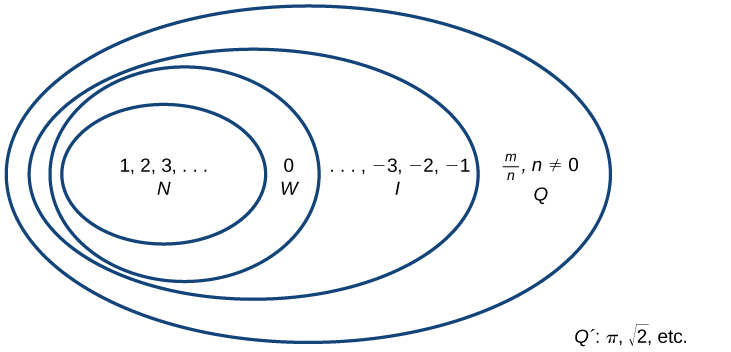
N: the set of natural numbers
W: the set of whole numbers
I: the set of integers
Q: the set of rational numbers
Q´: the set of irrational numbers図2 数の集合 N:自然数の集合 W:非負整数の集合 I:整数の集合 Q:有理数の集合 Q´:無理数の集合
Sets of Numbers 数の集合
The set of natural numbers includes the numbers used for counting:
自然数の集合は、物を数えるのに使う数からなる。
The set of whole numbers is the set of natural numbers plus zero:
非負整数の集合は、自然数の集合に0を加えたものである。
The set of integers adds the negative natural numbers to the set of whole numbers:
整数の集合は、非負整数の集合に負の自然数を加えたものである。
The set of rational numbers includes fractions written as
有理数の集合には、次の形に書ける分数が入る。
The set of irrational numbers is the set of numbers that are not rational, are nonrepeating, and are nonterminating:
無理数の集合は、有理数ではなく、循環せず、有限小数にもならない数の集合である。
Example 5例5
Differentiating the Sets of Numbers数の集合を見分ける
Classify each number as being a natural number (N), whole number (W), integer (I), rational number (Q), and/or irrational number (Q′).
次の各数を、自然数(N)・非負整数(W)・整数(I)・有理数(Q)・無理数(Q′)のうちどれにあたるか分類せよ。あてはまるものが複数あってもよい。
Solution 解答
| N | W | I | Q | Q′ | |
|---|---|---|---|---|---|
| a. | X | X | X | X | |
| b. | X | ||||
| c. | X | ||||
| d. –6 | X | X | |||
| e. 3.2121121112... | X |
Try It #5やってみよう5
Classify each number as being a natural number (N), whole number (W), integer (I), rational number (Q), and/or irrational number (Q′).
次の各数を、自然数(N)・非負整数(W)・整数(I)・有理数(Q)・無理数(Q′)のうちどれにあたるか分類せよ。あてはまるものが複数あってもよい。