第20章磁性Magnetism原書 p.669–710
20.1 Magnetic Fields, Field Lines, and Force20.1 磁場、磁力線、力
SECTION LEARNING OBJECTIVES By the end of this section, you will be able to do the following:
この節の学習目標 この節を終えると、次のことができるようになる。
• Summarize properties of magnets and describe how some nonmagnetic materials can become magnetized• Describe and interpret drawings of magnetic fields around permanent magnets and current-carrying wires• Calculate the magnitude and direction of magnetic force in a magnetic field and the force on a current-carrying wire in a magnetic field
・磁石の性質をまとめ、磁石でない材料の一部がどう磁化されうるかを述べる・永久磁石と電流の流れる導線のまわりの磁場の図を述べ、読む・磁場の中の磁気の力の大きさと向き、および磁場の中で電流の流れる導線にはたらく力を計算する
Section Key Termsこの節の重要語
Curie temperaturedomainelectromagnetelectromagnetismferromagneticmagnetic dipolemagnetic fieldmagnetic polemagnetizednorth polepermanent magnetright-hand rulesolenoidsouth pole
キュリー温度磁区電磁石電磁気強磁性磁気双極子磁場磁極磁化したN極永久磁石右手の法則ソレノイドS極
Magnets and Magnetization磁石と磁化
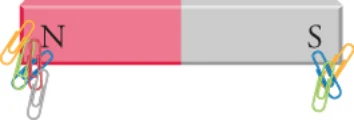
People have been aware of magnets and magnetism for thousands of years. The earliest records date back to ancient times, particularly in the region of Asia Minor called Magnesia—the name of this region is the source of words like magnet. Magnetic rocks found in Magnesia, which is now part of western Turkey, stimulated interest during ancient times. When humans first discovered magnetic rocks, they likely found that certain parts of these rocks attracted bits of iron or other magnetic rocks more strongly than other parts. These areas are called the poles of a magnet. A magnetic pole is the part of a magnet that exerts the strongest force on other magnets or magnetic material, such as iron. For example, the poles of the bar magnet shown in Figure 20.2 are where the paper clips are concentrated.
人類は、何千年も前から磁石と磁性を知っていた。古代の記録には、小アジアのマグネシア地方で見つかった磁石についての記述がある。この地名が、英語の magnet(磁石)などの語源となった。磁性を持つ岩石を観察した人々は、場所によって鉄片などを引きつける力が異なることに気づいただろう。特に強く引きつける部分を磁極という。棒磁石の場合、図20.2でクリップが集中している両端が磁極にあたる。
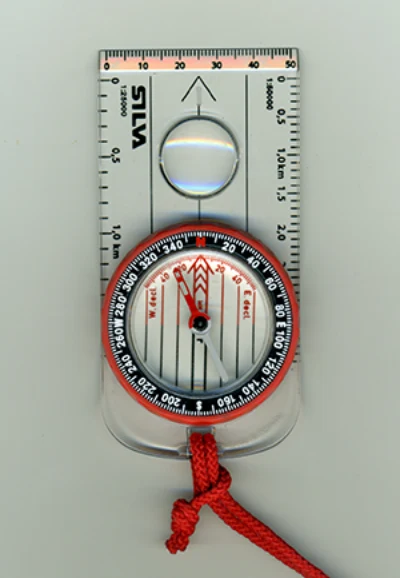
If a bar magnet is suspended so that it rotates freely, one pole of the magnet will always turn toward the north, with the opposite pole facing south. This discovery led to the compass, which is simply a small, elongated magnet mounted so that it can rotate freely. An example of a compass is shown Figure 20.3. The pole of the magnet that orients northward is called the north pole, and the opposite pole of the magnet is called the south pole.
棒磁石を自由に回転できるようにつるすと、一方の極がおおむね北を、もう一方が南を向く。この性質を利用したのが方位磁針である。小さな細長い磁石を、自由に回れるように取り付けてある(図20.3)。北を向く側をN極、反対側をS極という。
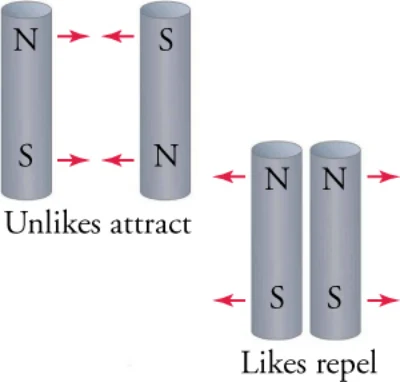
The discovery that one particular pole of a magnet orients northward, whereas the other pole orients southward allowed people to identify the north and south poles of any magnet. It was then noticed that the north poles of two different magnets repel each other, and likewise for the south poles. Conversely, the north pole of one magnet attracts the south pole of other magnets. This situation is analogous to that of electric charge, where like charges repel and unlike charges attract. In magnets, we simply replace charge with pole: Like poles repel and unlike poles attract. This is summarized in Figure 20.4, which shows how the force between magnets depends on their relative orientation.
磁石の一方の極が北を、もう一方が南を向くという発見によって、どんな磁石についてもN極とS極を見きわめられるようになった。それから、違う二つの磁石のN極どうしが反発すること、S極どうしも同様であることが気づかれた。逆に、一方の磁石のN極は他の磁石のS極を引きつける。この状況は、同じ電荷が反発し違う電荷が引き合う電荷の場合と似ている。磁石では、単に電荷を極に置き換えればよい。同じ極は反発し、違う極は引き合う。これを図20.4にまとめる。磁石どうしの力が、その相対的な向きにどうよるかを示している。
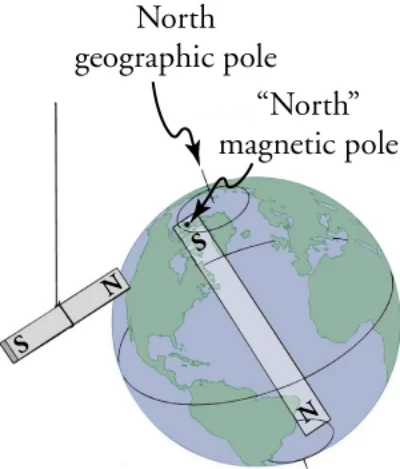
Consider again the fact that the pole of a magnet that orients northward is called the north pole of the magnet. If unlike poles attract, then the magnetic pole of Earth that is close to the geographic North Pole must be a magnetic south pole! Likewise, the magnetic pole of Earth that is close to the geographic South Pole must be a magnetic north pole. This situation is depicted in Figure 20.5, in which Earth is represented as containing a giant internal bar magnet with its magnetic south pole at the geographic North Pole and vice versa. If we were to somehow suspend a giant bar magnet in space near Earth, then the north pole of the space magnet would be attracted to the south pole of Earth’s internal magnet. This is in essence what happens with a compass needle: Its magnetic north pole is attracted to the magnet south pole of Earth’s internal magnet.
北を向く磁石の極を磁石のN極と呼ぶという事実をもう一度考えよう。違う極が引き合うなら、地理上の北極に近い地球の磁極は磁石のS極でなければならない。同じように、地理上の南極に近い地球の磁極は磁石のN極でなければならない。この様子を図20.5に描く。地球は、磁石のS極が地理上の北極に、その逆も同様にある巨大な棒磁石を内部に含むものとして描かれている。もし巨大な棒磁石を地球の近くの宇宙空間に何とかして吊るせたなら、その宇宙の磁石のN極は地球の内部の磁石のS極に引きつけられるだろう。方位磁針の針で起こっているのは本質的にこれである。針の磁石のN極が、地球の内部の磁石のS極に引きつけられているのである。
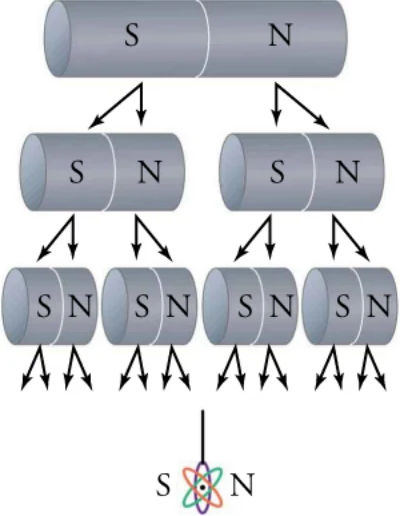
What happens if you cut a bar magnet in half? Do you obtain one magnet with two south poles and one magnet with two north poles? The answer is no: Each half of the bar magnet has a north pole and a south pole. You can even continue cutting each piece of the bar magnet in half, and you will always obtain a new, smaller magnet with two opposite poles. As shown in Figure 20.6, you can continue this process down to the atomic scale, and you will find that even the smallest particles that behave as magnets have two opposite poles. In fact, no experiment has ever found any object with a single magnetic pole, from the smallest subatomic particle such as electrons to the largest objects in the universe such as stars. Because magnets always have two poles, they are referred to as magnetic dipoles—di means two. Below, we will see that magnetic dipoles have properties that are analogous to electric dipoles.
棒磁石を半分に切ったらどうなるか。S極が二つの磁石と、N極が二つの磁石が得られるのか。答えはノーである。棒磁石のそれぞれの半分がN極とS極を持つ。棒磁石のそれぞれの片をさらに半分に切っていっても、つねに逆の二極を持つ新しい小さな磁石が得られる。図20.6に示すように、この過程を原子の尺度まで続けても、磁石としてふるまう最も小さな粒子でさえ逆の二極を持つことが分かる。実のところ、電子のような最も小さな素粒子から、星のような宇宙で最も大きな物まで、磁極を一つしか持たない物はどんな実験でも見つかっていない。磁石はつねに二極を持つので、磁気双極子と呼ばれる。diは二を意味する。下で見るように、磁気双極子は電気双極子と似た性質を持つ。
Introduction to Magnetism This video provides an interesting introduction to magnetism and discusses, in particular, how electrons around their atoms contribute to the magnetic effects that we observe.
磁性の導入 この動画は磁性への興味深い導入で、とくに原子のまわりの電子が、私たちの観察する磁気の効果にどう寄与するかを論じる。
Introduction to magnetism | Physics | Khan Academy (https://www.openstax.org/l/28_intro_magn)
磁性の導入|物理|カーンアカデミー(https://www.openstax.org/l/28_intro_magn)
GRASP CHECK Toward which magnetic pole of Earth is the north pole of a compass needle attracted?
理解の確認 方位磁針の針のN極は、地球のどの磁極に引きつけられるか。
a. The north pole of a compass needle is attracted to the north magnetic pole of Earth, which is located near the geographic North Pole of Earth.b. The north pole of a compass needle is attracted to the south magnetic pole of Earth, which is located near the geographic North Pole of Earth.c. The north pole of a compass needle is attracted to the north magnetic pole of Earth, which is located near the geographic South Pole of Earth.d. The north pole of a compass needle is attracted to the south magnetic pole of Earth, which is located near the geographic South Pole of Earth.
a. 方位磁針の針のN極は地球のN極に引きつけられ、それは地球の地理上の北極の近くにある。b. 方位磁針の針のN極は地球のS極に引きつけられ、それは地球の地理上の北極の近くにある。c. 方位磁針の針のN極は地球のN極に引きつけられ、それは地球の地理上の南極の近くにある。d. 方位磁針の針のN極は地球のS極に引きつけられ、それは地球の地理上の南極の近くにある。
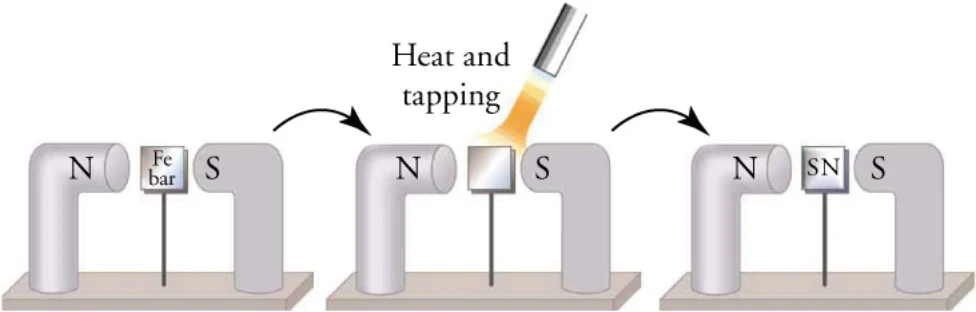
Only certain materials, such as iron, cobalt, nickel, and gadolinium, exhibit strong magnetic effects. Such materials are called ferromagnetic, after the Latin word ferrum for iron. Other materials exhibit weak magnetic effects, which are detectable only with sensitive instruments. Not only do ferromagnetic materials respond strongly to magnets—the way iron is attracted to magnets—but they can also be magnetized themselves—that is, they can be induced to be magnetic or made into permanent magnets (Figure 20.7). A permanent magnet is simply a material that retains its magnetic behavior for a long time, even when exposed to demagnetizing influences.
鉄・コバルト・ニッケル・ガドリニウムなど、決まった材料だけが強い磁気の効果を示す。そうした材料は、鉄を意味するラテン語ferrumにちなんで強磁性と呼ばれる。他の材料も弱い磁気の効果を示すが、それは感度のよい器械でしか検出できない。強磁性の材料は磁石に強く応えるだけでなく——鉄が磁石に引きつけられるように——自ら磁化されもする。すなわち、磁性を帯びさせられたり永久磁石にされたりする(図20.7)。永久磁石とは、単に磁性を失わせる働きにさらされても長いあいだ磁石としてのふるまいを保つ材料である。
its north pole is adjacent to the south pole of the original magnet. Note that attractive forces are created between the central magnet and the outer magnets.
そのN極はもとの磁石のS極の隣にくる。中央の磁石と外側の磁石の間に引力が生じることに注意しよう。
When a magnet is brought near a previously unmagnetized ferromagnetic material, it causes local magnetization of the material with unlike poles closest, as in the right side of Figure 20.7. This causes an attractive force, which is why unmagnetized iron is attracted to a magnet.
磁化されていない強磁性の材料に磁石を近づけると、図20.7の右側のように、違う極どうしが最も近くなるように材料が局所的に磁化される。これが引力を生み、それが磁化されていない鉄が磁石に引きつけられる理由である。
What happens on a microscopic scale is illustrated in Figure 7(a). Regions within the material called domains act like small bar magnets. Within domains, the magnetic poles of individual atoms are aligned. Each atom acts like a tiny bar magnet. Domains are small and randomly oriented in an unmagnetized ferromagnetic object. In response to an external magnetic field, the domains may grow to millimeter size, aligning themselves, as shown in Figure 7(b). This induced magnetization can be made permanent if the material is heated and then cooled, or simply tapped in the presence of other magnets.
微視的な尺度で何が起こるかを図7(a)に示す。材料の中の磁区と呼ばれる領域が、小さな棒磁石のようにふるまう。磁区の中では、個々の原子の磁極が揃っている。それぞれの原子が小さな棒磁石のようにふるまう。磁化されていない強磁性の物では、磁区は小さく、向きもばらばらである。外からの磁場に応えて、磁区は図7(b)のように、揃いながらミリメートルの大きさまで成長しうる。この誘導された磁化は、材料を熱してから冷やす、あるいは他の磁石があるところで単に叩けば、永久のものにできる。
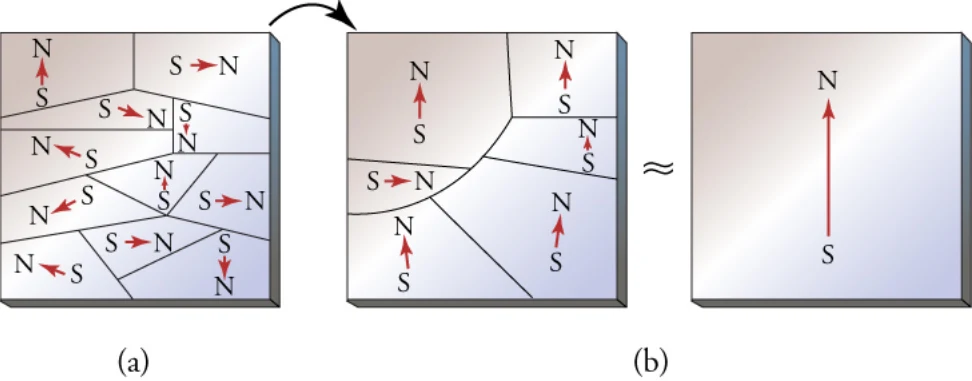
Conversely, a permanent magnet can be demagnetized by hard blows or by heating it in the absence of another magnet. Increased thermal motion at higher temperature can disrupt and randomize the orientation and size of the domains. There is a well-defined temperature for ferromagnetic materials, which is called the Curie temperature, above which they cannot be magnetized. The Curie temperature for iron is 1,043 K (770 ), which is well above room temperature. There are several elements and alloys that have Curie temperatures much lower than room temperature and are ferromagnetic only below those temperatures.
逆に、永久磁石は強く叩いたり、他の磁石のないところで熱したりすれば磁性を失わせられる。高い温度での熱運動の増加が、磁区の向きと大きさを乱してばらばらにしうる。強磁性の材料には、それより上では磁化されえなくなる、はっきり決まった温度がある。これをキュリー温度という。鉄のキュリー温度は1,043 K(770 )で、室温よりずっと高い。キュリー温度が室温よりずっと低く、その温度より下でのみ強磁性である元素や合金もいくつかある。
SNAP LAB身近な実験Refrigerator Magnets冷蔵庫の磁石
We know that like magnetic poles repel and unlike poles attract. See if you can show this for two refrigerator magnets. Will the magnets stick if you turn them over? Why do they stick to the refrigerator door anyway? What can you say about the magnetic properties of the refrigerator door near the magnet? Do refrigerator magnets stick to metal or plastic spoons? Do they stick to all types of metal?
同じ磁極は反発し、違う極は引き合うことは分かっている。冷蔵庫の磁石二つでこれを示せるか試してみよう。ひっくり返しても磁石はくっつくか。そもそもなぜ冷蔵庫の扉にくっつくのか。磁石の近くの冷蔵庫の扉の磁気的な性質について何が言えるか。冷蔵庫の磁石は金属やプラスチックのスプーンにくっつくか。あらゆる種類の金属にくっつくか。
GRASP CHECK You have one magnet with the north and south poles labeled. How can you use this magnet to identify the north and south poles of other magnets?
理解の確認 N極とS極が示された磁石が一つある。この磁石を使って、他の磁石のN極とS極をどう見きわめられるか。
a. If the north pole of a known magnet is repelled by a pole of an unknown magnet on bringing them closer, that pole of unknown magnet is its north pole; otherwise, it is its south pole.b. If the north pole of known magnet is attracted to a pole of an unknown magnet on bringing them closer, that pole of unknown magnet is its north pole; otherwise, it is its south pole.
a. 既知の磁石のN極を未知の磁石のある極に近づけて反発すれば、未知の磁石のその極はN極である。そうでなければS極である。b. 既知の磁石のN極を未知の磁石のある極に近づけて引き合えば、未知の磁石のその極はN極である。そうでなければS極である。
Magnetic Fields磁場
We have thus seen that forces can be applied between magnets and between magnets and ferromagnetic materials without any contact between the objects. This is reminiscent of electric forces, which also act over distances.
これまで見てきたように、磁石どうしの間、また磁石と強磁性の材料の間には、物が触れ合わなくても力がはたらきうる。これは、やはり距離を隔ててはたらく電気の力を思い出させる。
Electric forces are described using the concept of the electric field, which is a force field around electric charges that describes the force on any other charge placed in the field. Likewise, a magnet creates a magnetic field around it that describes the force exerted on other magnets placed in the field. As with electric fields, the pictorial representation of magnetic field lines is very useful for visualizing the strength and direction of the magnetic field.
電気の力は電場の概念で述べられる。電場とは電荷のまわりの力の場で、その場に置かれた他のどんな電荷にはたらく力も表す。同じように、磁石はまわりに磁場を作り、それはその場に置かれた他の磁石に及ぼされる力を表す。電場と同じく、磁力線の絵による表し方は、磁場の強さと向きを思い描くのにとても役立つ。
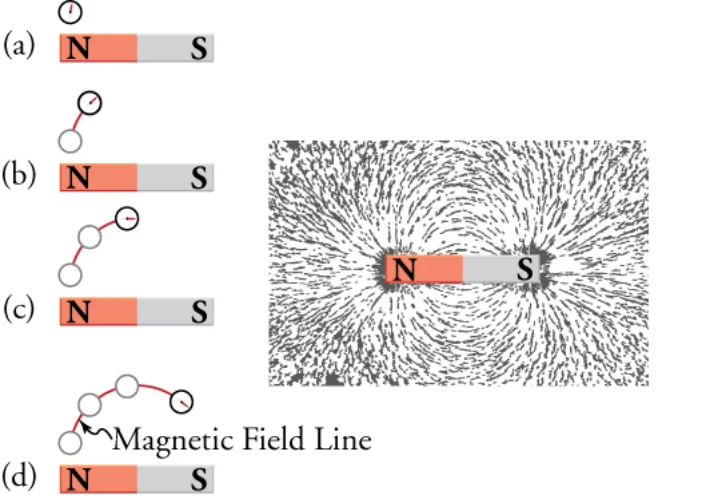
As shown in Figure 20.9, the direction of magnetic field lines is defined to be the direction in which the north pole of a compass needle points. If you place a compass near the north pole of a magnet, the north pole of the compass needle will be repelled and point away from the magnet. Thus, the magnetic field lines point away from the north pole of a magnet and toward its south pole.
図20.9に示すように、磁力線の向きは、方位磁針の針のN極が指す向きと定められる。磁石のN極の近くに方位磁針を置けば、針のN極は反発されて磁石から離れる向きを指す。したがって磁力線は磁石のN極から離れる向きを指し、そのS極へ向かう。
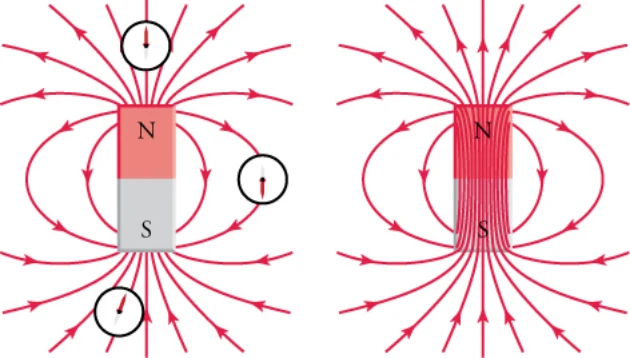
Magnetic field lines can be mapped out using a small compass. The compass is moved from point to point around a magnet, and at each point, a short line is drawn in the direction of the needle, as shown in Figure 20.10. Joining the lines together then reveals the path of the magnetic field line. Another way to visualize magnetic field lines is to sprinkle iron filings around a magnet. The filings will orient themselves along the magnetic field lines, forming a pattern such as that shown on the right in Figure 20.10.
磁力線は小さな方位磁針を使って描き出せる。方位磁針を磁石のまわりで点から点へ動かし、それぞれの点で針の向きに短い線を引く。図20.10のとおりである。それらの線をつなげば磁力線の道筋が現れる。磁力線を思い描くもう一つのやり方が、磁石のまわりに鉄粉を撒くことである。鉄粉は磁力線に沿って向きを揃え、図20.10の右のような模様を作る。
VIRTUAL PHYSICSシミュレーションUsing a Compass to Map Out the Magnetic Field方位磁針で磁場を描き出す
Access multimedia content (http://openstax.org/books/physics/pages/20-1-magnetic-fields-field-lines-and-force) This simulation presents you with a bar magnet and a small compass. Begin by dragging the compass around the bar magnet to see in which direction the magnetic field points. Note that the strength of the magnetic field is represented by the brightness of the magnetic field icons in the grid pattern around the magnet. Use the magnetic field meter to check the field strength at several points around the bar magnet. You can also flip the polarity of the magnet, or place Earth on the image to see how the compass orients itself.
マルチメディア教材はこちら(http://openstax.org/books/physics/pages/20-1-magnetic-fields-field-lines-and-force) このシミュレーションでは棒磁石と小さな方位磁針が与えられる。まず方位磁針を棒磁石のまわりでドラッグして、磁場がどちらを向くか見よう。磁場の強さは、磁石のまわりの格子の磁場の記号の明るさで表されていることに注意しよう。磁場計を使って、棒磁石のまわりのいくつかの点で場の強さを調べよう。磁石の極を反転させたり、地球を画像に置いて方位磁針がどう向くかを見たりもできる。
GRASP CHECK With the slider at the top right of the simulation window, set the magnetic field strength to 100 percent . Now use the magnetic field meter to answer the following question: Near the magnet, where is the magnetic field strongest and where is it weakest? Don’t forget to check inside the bar magnet.
理解の確認 シミュレーションの窓の右上のつまみで、磁場の強さを100パーセントにしよう。それから磁場計を使って次の問いに答えよう。磁石の近くで、磁場が最も強いのはどこで、最も弱いのはどこか。棒磁石の内部も忘れずに調べること。
a. The magnetic field is strongest at the center and weakest between the two poles just outside the bar magnet. The magnetic field lines are densest at the center and least dense between the two poles just outside the bar magnet.b. The magnetic field is strongest at the center and weakest between the two poles just outside the bar magnet. The magnetic field lines are least dense at the center and densest between the two poles just outside the bar magnet.c. The magnetic field is weakest at the center and strongest between the two poles just outside the bar magnet. The magnetic field lines are densest at the center and least dense between the two poles just outside the bar magnet.
a. 磁場は中央で最も強く、棒磁石のすぐ外の二極の間で最も弱い。磁力線は中央で最も密で、棒磁石のすぐ外の二極の間で最も疎である。b. 磁場は中央で最も強く、棒磁石のすぐ外の二極の間で最も弱い。磁力線は中央で最も疎で、棒磁石のすぐ外の二極の間で最も密である。c. 磁場は中央で最も弱く、棒磁石のすぐ外の二極の間で最も強い。磁力線は中央で最も密で、棒磁石のすぐ外の二極の間で最も疎である。
d. The magnetic field is weakest at the center and strongest between the two poles just outside the bar magnet and the magnetic field lines are least dense at the center and densest between the two poles just outside the bar magnet.
d. 磁場は中央で最も弱く、棒磁石のすぐ外の二極の間で最も強い。磁力線は中央で最も疎で、棒磁石のすぐ外の二極の間で最も密である。
When two magnets are brought close together, the magnetic field lines are perturbed, just as happens for electric field lines when two electric charges are brought together. Bringing two north poles together—or two south poles—will cause a repulsion, and the magnetic field lines will bend away from each other. This is shown in Figure 20.11, which shows the magnetic field lines created by the two closely separated north poles of a bar magnet. When opposite poles of two magnets are brought together, the magnetic field lines join together and become denser between the poles. This situation is shown in Figure 20.11.
二つの磁石を近づけると、二つの電荷を近づけたときの電気力線とちょうど同じように、磁力線が乱れる。二つのN極——あるいは二つのS極——を近づけると反発が起こり、磁力線は互いに離れるように曲がる。これを図20.11に示す。棒磁石の二つのN極を近づけたときにできる磁力線である。二つの磁石の逆の極を近づけると、磁力線はつながり、極の間で密になる。この様子を図20.11に示す。
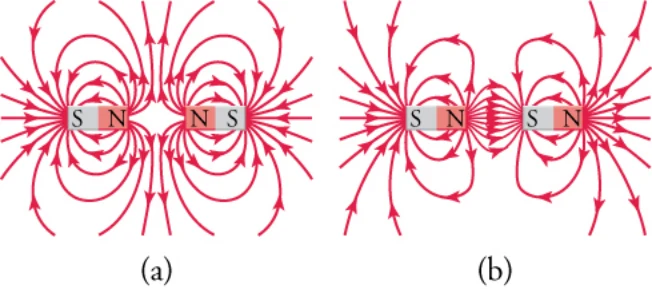
Like the electric field, the magnetic field is stronger where the lines are denser. Thus, between the two north poles in Figure 20.11, the magnetic field is very weak because the density of the magnetic field is almost zero. A compass placed at that point would essentially spin freely if we ignore Earth’s magnetic field. Conversely, the magnetic field lines between the north and south poles in Figure 20.11 are very dense, indicating that the magnetic field is very strong in this region. A compass placed here would quickly align with the magnetic field and point toward the south pole on the right.
電場と同じく、磁場は力線が密なところほど強い。したがって図20.11の二つのN極の間では、磁力線の密度がほぼ0なので磁場はとても弱い。地球の磁場を無視すれば、そこに置いた方位磁針は実質的に自由に回るだろう。逆に、図20.11のN極とS極の間の磁力線はとても密で、この領域の磁場がとても強いことを示している。ここに置いた方位磁針は素早く磁場に揃い、右のS極を指すだろう。
Note that magnets are not the only things that make magnetic fields. Early in the nineteenth century, people discovered that electrical currents cause magnetic effects. The first significant observation was by the Danish scientist Hans Christian Oersted (1777–1851), who found that a compass needle was deflected by a current-carrying wire. This was the first significant evidence that the movement of electric charges had any connection with magnets. An electromagnet is a device that uses electric current to make a magnetic field. These temporarily induced magnets are called electromagnets. Electromagnets are employed for everything from a wrecking yard crane that lifts scrapped cars to controlling the beam of a 90-km-circumference particle accelerator to the magnets in medical-imaging machines (see Figure 20.12).
磁場を作るのは磁石だけではないことに注意しよう。19世紀の初め、電流が磁気の効果を起こすことが見つかった。最初の重要な観察はデンマークの科学者ハンス・クリスチャン・エルステッド(1777–1851)によるもので、彼は方位磁針の針が電流の流れる導線によって振れることを見いだした。これは、電荷の動きが磁石と何らかのつながりを持つことの最初の重要な証拠だった。電磁石とは、電流を使って磁場を作る装置である。この一時的に誘導された磁石を電磁石という。電磁石は、廃車を持ち上げる解体場のクレーンから、周長90 kmの加速器のビームの制御、医用画像の装置の磁石まで、あらゆるものに使われている(図20.12を見よ)。

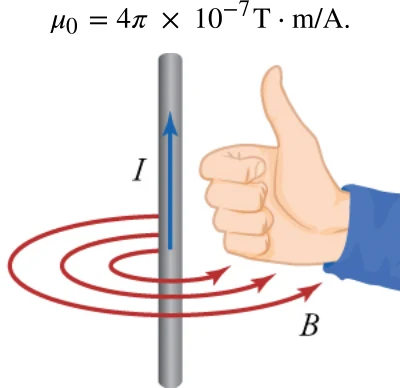
The magnetic field created by an electric current in a long straight wire is shown in Figure 20.13. The magnetic field lines form concentric circles around the wire. The direction of the magnetic field can be determined using the right-hand rule. This rule shows up in several places in the study of electricity and magnetism. Applied to a straight current-carrying wire, the right-hand rule says that, with your right thumb pointed in the direction of the current, the magnetic field will be in the direction in which your right fingers curl, as shown in Figure 20.13. If the wire is very long compared to the distance r from the wire, the strength B of the magnetic field is given by
長いまっすぐな導線を流れる電流が作る磁場を図20.13に示す。磁力線は導線のまわりに同心円をなす。磁場の向きは右手の法則で決められる。この法則は電気と磁気の学習でいくつもの場面に現れる。電流の流れるまっすぐな導線に当てはめると、右手の法則は、右手の親指を電流の向きに向けたとき、磁場は右手の指が丸まる向きになると言う。図20.13のとおりである。導線が、導線からの距離rにくらべてとても長ければ、磁場の強さBは次で与えられる。
where I is the current in the wire in amperes. The SI unit for magnetic field is the tesla (T). The symbol —read “mu-zero”—is a constant called the “permeability of free space” and is given by
ここでIはアンペアで表した導線の電流である。磁場のSI単位はテスラ(T)である。記号——「ミュー・ゼロ」と読む——は「真空の透磁率」と呼ばれる定数で、次で与えられる。
Magnetic Field Due to an Electric Current This video describes the magnetic field created by a straight current-carrying wire. It goes over the right-hand rule to determine the direction of the magnetic field, and presents and discusses the formula for the strength of the magnetic field due to a straight current-carrying wire.
電流による磁場 この動画は、電流の流れるまっすぐな導線が作る磁場を述べる。磁場の向きを決める右手の法則を扱い、電流の流れるまっすぐな導線による磁場の強さの式を示して論じる。
Magnetic field created by a current carrying wire | Physics | Khan Academy (https://www.openstax.org/l/28magfield)
電流の流れる導線が作る磁場|物理|カーンアカデミー(https://www.openstax.org/l/28magfield)
GRASP CHECK A long straight wire is placed on a table top and electric current flows through the wire from right to left. If you look at the wire end-on from the left end, does the magnetic field go clockwise or counterclockwise?
理解の確認 長いまっすぐな導線を机の上に置き、電流が右から左へ流れている。左の端から導線を端から見たとき、磁場は時計回りか反時計回りか。
a. By pointing your right-hand thumb in the direction opposite of current, the right-hand fingers will curl counterclockwise, so the magnetic field will be in the counterclockwise direction.
a. 右手の親指を電流と逆向きに向けると、右手の指は反時計回りに丸まるので、磁場は反時計回りになる。
b. By pointing your right-hand thumb in the direction opposite of current, the right-hand fingers will curl clockwise, so the magnetic field will be in the clockwise direction.c. By pointing your right-hand thumb in the direction of current, the right-hand fingers will curl counterclockwise, so the magnetic field will be in the counterclockwise direction.d. By pointing your right-hand thumb in the direction of current, the right-hand fingers will curl clockwise, so the magnetic field will be in the clockwise direction.
b. 右手の親指を電流と逆向きに向けると、右手の指は時計回りに丸まるので、磁場は時計回りになる。c. 右手の親指を電流の向きに向けると、右手の指は反時計回りに丸まるので、磁場は反時計回りになる。d. 右手の親指を電流の向きに向けると、右手の指は時計回りに丸まるので、磁場は時計回りになる。
Now imagine winding a wire around a cylinder with the cylinder then removed. The result is a wire coil, as shown in Figure 20.14. This is called a solenoid. To find the direction of the magnetic field produced by a solenoid, apply the right-hand rule to several points on the coil. You should be able to convince yourself that, inside the coil, the magnetic field points from left to right. In fact, another application of the right-hand rule is to curl your right-hand fingers around the coil in the direction in which the current flows. Your right thumb then points in the direction of the magnetic field inside the coil: left to right in this case.
ここで、円筒に導線を巻き、それから円筒を取り去ることを想像しよう。結果は図20.14のような導線のコイルである。これをソレノイドという。ソレノイドが作る磁場の向きを求めるには、コイルのいくつかの点に右手の法則を当てはめる。コイルの内側で磁場が左から右を向くことを、自分で納得できるはずである。実のところ、右手の法則のもう一つの使い方は、電流の流れる向きに右手の指をコイルに巻きつけることである。すると右手の親指がコイルの内側の磁場の向き——この場合は左から右——を指す。
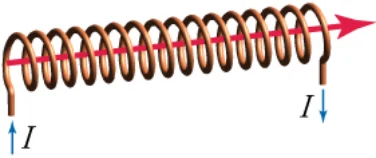
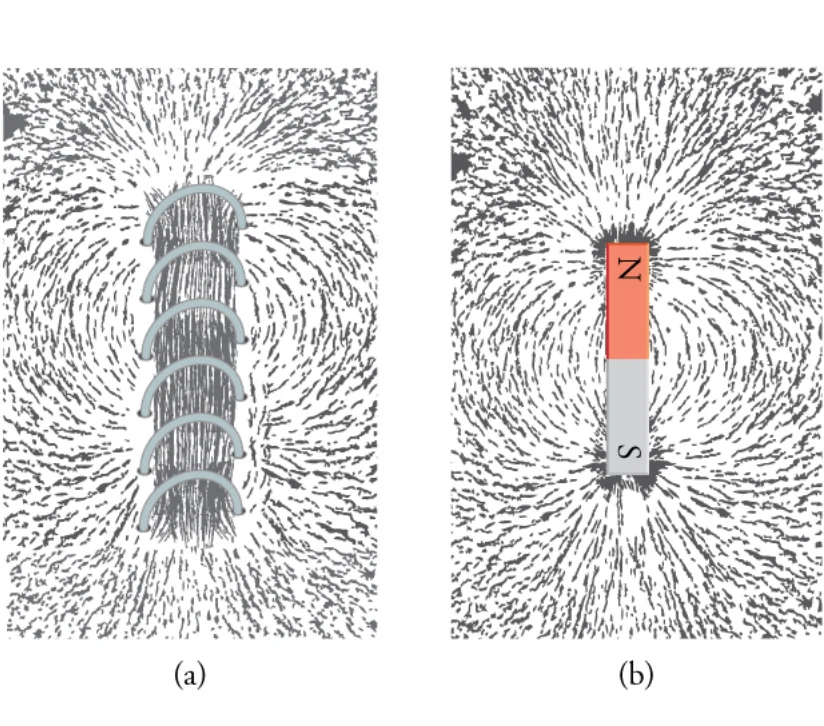
Each loop of wire contributes to the magnetic field inside the solenoid. Because the magnetic field lines must form closed loops, the field lines close the loop outside the solenoid. The magnetic field lines are much denser inside the solenoid than outside the solenoid. The resulting magnetic field looks very much like that of a bar magnet, as shown in Figure 20.15. The magnetic field strength deep inside a solenoid is
導線の一巻き一巻きが、ソレノイドの内側の磁場に寄与する。磁力線は閉じた輪をなさねばならないので、力線はソレノイドの外側で輪を閉じる。磁力線はソレノイドの外側よりも内側でずっと密である。できる磁場は、図20.15に示すように棒磁石のものとよく似ている。ソレノイドの奥深くの磁場の強さは
where N is the number of wire loops in the solenoid and is the length of the solenoid.
である。ここでNはソレノイドの導線の巻き数、はソレノイドの長さである。
VIRTUAL PHYSICSシミュレーションElectromagnets電磁石
Access multimedia content (http://openstax.org/books/physics/pages/20-1-magnetic-fields-field-lines-and-force) Use this simulation to visualize the magnetic field made from a solenoid. Be sure to click on the tab that says Electromagnet. You can drive AC or DC current through the solenoid by choosing the appropriate current source. Use the field meter to measure the strength of the magnetic field and then change the number of loops in the solenoid to see how this affects the magnetic field strength.
マルチメディア教材はこちら(http://openstax.org/books/physics/pages/20-1-magnetic-fields-field-lines-and-force) このシミュレーションで、ソレノイドが作る磁場を目で見てみよう。「Electromagnet」と書かれたタブを必ず押すこと。適切な電源を選べば、ソレノイドに交流でも直流でも流せる。磁場計で磁場の強さを測り、それからソレノイドの巻き数を変えて、それが磁場の強さにどう影響するか見よう。
Choose the battery as current source and set the number of wire loops to four. With a nonzero current going through the solenoid, measure the magnetic field strength at a point. Now decrease the number of wire loops to two. How does the magnetic field strength change at the point you chose?
電源として電池を選び、導線の巻き数を四つにする。0でない電流をソレノイドに流し、ある点で磁場の強さを測る。次に導線の巻き数を二つに減らす。選んだ点での磁場の強さはどう変わるか。
a. There will be no change in magnetic field strength when number of loops reduces from four to two.b. The magnetic field strength decreases to half of its initial value when number of loops reduces from four to two.c. The magnetic field strength increases to twice of its initial value when number of loops reduces from four to two.d. The magnetic field strength increases to four times of its initial value when number of loops reduces from four to two.
a. 巻き数が四つから二つに減っても磁場の強さは変わらない。b. 巻き数が四つから二つに減ると、磁場の強さは初めの値の半分に減る。c. 巻き数が四つから二つに減ると、磁場の強さは初めの値の2倍に増える。d. 巻き数が四つから二つに減ると、磁場の強さは初めの値の4倍に増える。
Magnetic Force磁気の力
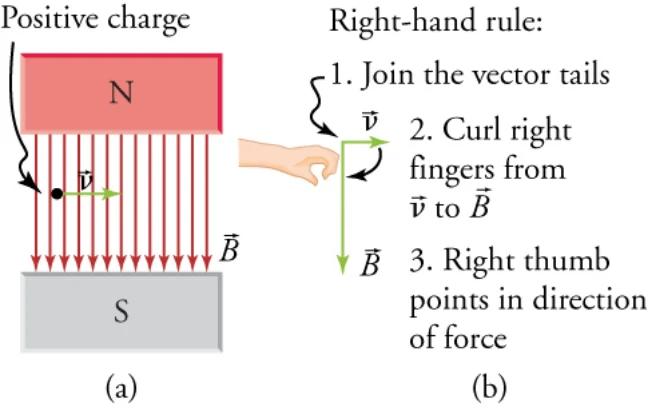
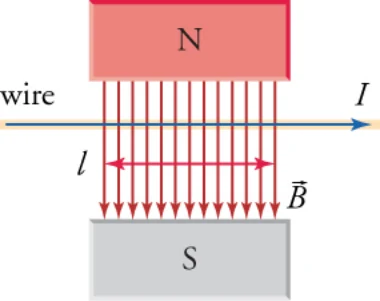
If a moving electric charge, that is electric current, produces a magnetic field that can exert a force on another magnet, then the reverse should be true by Newton’s third law. In other words, a charge moving through the magnetic field produced by another object should experience a force—and this is exactly what we find. As a concrete example, consider Figure 20.16, which shows a charge q moving with velocity through a magnetic field between the poles of a permanent magnet. The magnitude F of the force experienced by this charge is
動く電荷、すなわち電流が、他の磁石に力を及ぼしうる磁場を作るなら、ニュートンの第三法則によって逆も成り立つはずである。言い換えれば、他の物が作る磁場の中を動く電荷は力を受けるはずであり、まさにそのとおりであることが分かる。具体的な例として図20.16を考えよう。電荷qが、永久磁石の極の間の磁場の中を速度で動いている。この電荷が受ける力の大きさFは
where is the angle between the velocity of the charge and the magnetic field. From this equation, we can see that the SI unit of magnetic field, the Tesla, is the magnetic field required to produce a 1 N force on a 1 C charge moving at 1 m/s in a direction perpendicular to the field and equivalent to the following: .
となる。ここでは電荷の速度と磁場の間の角度である。この式から、磁場のSI単位テスラは、場に垂直な向きに1 m/sで動く1 Cの電荷に1 Nの力を及ぼすのに必要な磁場であり、に等しいことが分かる。
The direction of the force may be found by using another version of the right-hand rule: First, we join the tails of the velocity vector and a magnetic field vector, as shown in step 1 of Figure 20.16. We then curl our right fingers from
力の向きは、右手の法則のもう一つの形を使って求められる。まず図20.16の段階1のように、速度ベクトルと磁場ベクトルの尾をつなぐ。それから図20.16の段階(2)のように、右手の指をから
to , as indicated in step (2) of Figure 20.16. The direction in which the right thumb points is the direction of the force. For the charge in Figure 20.16, we find that the force is directed into the page.
へ丸める。右手の親指が指す向きが力の向きである。図20.16の電荷では、力は紙面の奥へ向かうことが分かる。
Note that the factor in the equation means that zero force is applied on a charge that moves parallel to a magnetic field because and . The maximum force a charge can experience is when it moves perpendicular to the magnetic field, because and
式の因子は、磁場に平行に動く電荷にはたらく力が0であることを意味する。でだからである。電荷が受けうる最大の力は、磁場に垂直に動くときである。でだからである。
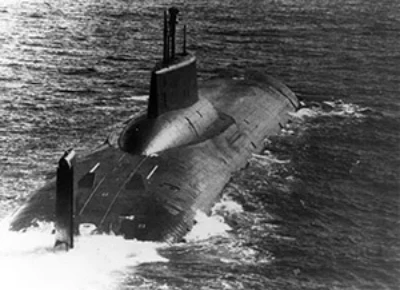
Magnetohydrodynamic Drive In Tom Clancy’s Cold War novel “The Hunt for Red October,” the Soviet Union built a submarine (see Figure 20.17) with a magnetohydrodynamic drive that was so silent it could not be detected by surface ships. The only conceivable purpose to build such a submarine was to give the Soviet Union first-strike capability, because this submarine could sneak close to the coast of the United States and fire its ballistic missiles, destroying key military and government installations to prevent an American counterattack.
電磁流体推進 トム・クランシーの冷戦小説『レッド・オクトーバーを追え』で、ソビエト連邦は電磁流体推進を備えた潜水艦(図20.17を見よ)を建造した。それはあまりに静かで水上艦に探知されなかった。そんな潜水艦を建造する目的として考えられるのは、ソビエト連邦に先制攻撃の能力を与えることだけだった。この潜水艦はアメリカの沿岸へ忍び寄って弾道ミサイルを発射し、アメリカの反撃を防ぐために要となる軍と政府の施設を破壊できるからである。
A magnetohydrodynamic drive is supposed to be silent because it has no moving parts. Instead, it uses the force experienced by charged particles that move in a magnetic field. The basic idea behind such a drive is depicted in Figure 20.18. Salt water flows through a channel that runs from the front to the back of the submarine. A magnetic field is applied horizontally across the channel, and a voltage is applied across the electrodes on the top and bottom of the channel to force a downward electric current through the water. The charge carriers are the positive sodium ions and the negative chlorine ions of salt. Using the right-hand rule, the force on the charge carriers is found to be toward the rear of the vessel. The accelerated charges collide with water molecules and transfer their momentum, creating a jet of water that is propelled out the rear of the channel. By Newton’s third law, the vessel experiences a force of equal magnitude, but in the opposite direction.
電磁流体推進は、動く部品がないので静かなはずである。かわりに、磁場の中を動く帯電した粒子が受ける力を使う。この推進の基本的な考えを図20.18に描く。潜水艦の前から後ろへ通る水路を塩水が流れる。水路を横切って水平に磁場をかけ、水路の上下の電極に電圧をかけて、水に下向きの電流を流す。電荷の担い手は塩の正のナトリウムイオンと負の塩化物イオンである。右手の法則を使うと、電荷の担い手にはたらく力は艦の後方を向くことが分かる。加速された電荷は水の分子と衝突して運動量を移し、水路の後ろから噴き出す水のジェットを作る。ニュートンの第三法則によって、艦は同じ大きさで逆向きの力を受ける。
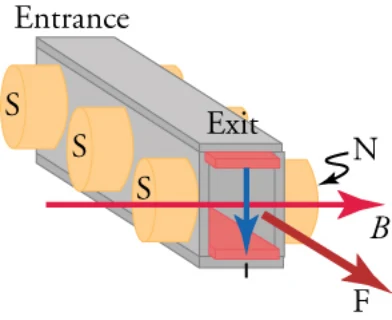
direction, and the resulting force.
向き、そして生じる力を示す。
Fortunately for all involved, it turns out that such a propulsion system is not very practical. Some back-of-the-envelope calculations show that, to power a submarine, either extraordinarily high magnetic fields or extraordinarily high electric currents would be required to obtain a reasonable thrust. In addition, prototypes of magnetohydrodynamic drives show that they are anything but silent. Electrolysis caused by running a current through salt water creates bubbles of hydrogen and oxygen, which makes this propulsion system quite noisy. The system also leaves a trail of chloride ions and metal chlorides that can easily be detected to locate the submarine. Finally, the chloride ions are extremely reactive and very quickly corrode metal parts, such as the electrode or the water channel itself. Thus, the Red October remains in the realm of fiction, but the physics involved is quite real.
関わる人すべてにとって幸いなことに、そうした推進の仕組みはあまり実用的でないことが分かっている。ざっと計算してみると、潜水艦を動かすには、まともな推力を得るのにとてつもなく強い磁場かとてつもなく大きな電流が要る。さらに、電磁流体推進の試作機は、静かどころではないことを示している。塩水に電流を流すことで起こる電気分解が水素と酸素の泡を作り、この推進の仕組みをかなり騒がしくする。この仕組みはまた、潜水艦の位置を突き止めるのに簡単に検出できる塩化物イオンと金属の塩化物の跡も残す。最後に、塩化物イオンはきわめて反応しやすく、電極や水路そのものといった金属の部品をとても速く腐食させる。したがってレッド・オクトーバーは小説の領域にとどまるが、そこに関わる物理はかなり本物である。
Imagine a boat that is powered by the force of charged particles moving in a magnetic field. If the magnetic field is downward, in what direction must the current of charged particles flow to obtain a rearward-pointing force?
磁場の中を動く帯電した粒子の力で進む船を想像しよう。磁場が下向きなら、後ろ向きの力を得るには帯電した粒子の電流をどちら向きに流さねばならないか。
a. The current must flow vertically from up to down when viewed from the rear of the boat.b. The current must flow vertically from down to up when viewed from the rear of the boat.
a. 船の後ろから見て、電流は鉛直に上から下へ流れねばならない。b. 船の後ろから見て、電流は鉛直に下から上へ流れねばならない。
c. The current must flow horizontally from left to right when viewed from the rear of the boat.d. The current must flow horizontally from right to left when viewed from the rear of the boat.
c. 船の後ろから見て、電流は水平に左から右へ流れねばならない。d. 船の後ろから見て、電流は水平に右から左へ流れねばならない。
Instead of a single charge moving through a magnetic field, consider now a steady current I moving through a straight wire. If we place this wire in a uniform magnetic field, as shown in Figure 20.19, what is the force on the wire or, more precisely, on the electrons in the wire? An electric current involves charges that move. If the charges q move a distance in a time t, then their speed is Inserting this into the equation gives
磁場の中を動く一つの電荷のかわりに、こんどはまっすぐな導線を流れる定常な電流Iを考えよう。図20.19のようにこの導線を一様な磁場に置くと、導線に——より正確には導線の中の電子に——はたらく力はいくらか。電流は動く電荷に関わる。電荷qが時間tで距離動くなら、その速さはである。これを式に入れると
The factor q/t in this equation is nothing more than the current in the wire. Thus, using , we obtain
が得られる。この式の因子q/tは、導線の電流にほかならない。したがってを使うと
This equation gives the force on a straight current-carrying wire of length in a magnetic field of strength B. The angle is the angle between the current vector and the magnetic field vector. Note that is the length of wire that is in the magnetic field and for which as shown in Figure 20.19.
が得られる。この式は、強さBの磁場の中の、長さの電流の流れるまっすぐな導線にはたらく力を与える。角度は電流のベクトルと磁場のベクトルの間の角度である。は磁場の中にある導線の長さであり、図20.19に示すとおりであることに注意しよう。
The direction of the force is determined in the same way as for a single charge. Curl your right fingers from the vector for I to the vector for B, and your right thumb will point in the direction of the force on the wire. For the wire shown in Figure 20.19, the force is directed into the page.
力の向きは、一つの電荷の場合と同じやり方で決められる。右手の指をIのベクトルからBのベクトルへ丸めれば、右手の親指が導線にはたらく力の向きを指す。図20.19の導線では、力は紙面の奥を向く。
Throughout this section, you may have noticed the symmetries between magnetic effects and electric effects. These effects all fall under the umbrella of electromagnetism, which is the study of electric and magnetic phenomena. We have seen that electric charges produce electric fields, and moving electric charges produce magnetic fields. A magnetic dipole produces a magnetic field, and, as we will see in the next section, moving magnetic dipoles produce an electric field. Thus, electricity and magnetism are two intimately related and symmetric phenomena.
この節を通して、磁気の効果と電気の効果の間の対称性に気づいたかもしれない。これらの効果はすべて電磁気——電気と磁気の現象の研究——という傘の下に入る。電荷が電場を作り、動く電荷が磁場を作ることを見てきた。磁気双極子は磁場を作り、次の節で見るように、動く磁気双極子は電場を作る。したがって、電気と磁気は密接に関わり合った対称な二つの現象である。
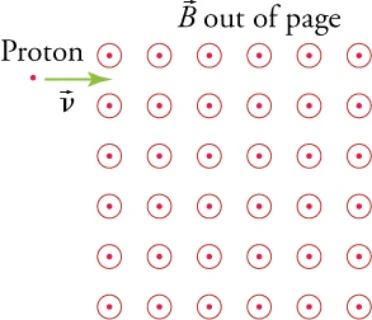
Trajectory of Electron in Magnetic Field A proton enters a region of constant magnetic field, as shown in Figure 20.20. The magnetic field is coming out of the page. If the electron is moving at and the magnetic field strength is 2.0 T, what is the magnitude and direction of the force on the proton?
磁場の中の電子の軌道 図20.20のように、陽子が一定の磁場の領域へ入る。磁場は紙面の手前へ出ている。電子がで動き、磁場の強さが2.0 Tのとき、陽子にはたらく力の大きさと向きはどうか。
Strategy方針
Use the equation to find the magnitude of the force on the proton. The angle between the magnetic field vectors and the velocity vector of the proton is The direction of the force may be found by using the right-hand rule.
式を使って陽子にはたらく力の大きさを求める。磁場のベクトルと陽子の速度ベクトルの間の角度はである。力の向きは右手の法則で求められる。
Solution解答
The charge of the proton is . Entering this value and the given velocity and magnetic field strength into the equation gives
陽子の電荷はである。この値と、与えられた速度と磁場の強さを式に入れると
To find the direction of the force, first join the velocity vector end to end with the magnetic field vector, as shown in Figure 20.21. Now place your right hand so that your fingers point in the direction of the velocity and curl them upward toward the magnetic field vector. The force is in the direction in which your thumb points. In this case, the force is downward in the plane of the paper in the -direction, as shown in Figure 20.21.
となる。力の向きを求めるには、まず図20.21のように速度ベクトルと磁場ベクトルを端どうしでつなぐ。次に右手を、指が速度の向きを指し、磁場ベクトルのほうへ上向きに丸まるように置く。力は親指が指す向きである。この場合、図20.21に示すように、力は紙面内で下向き、すなわち方向である。
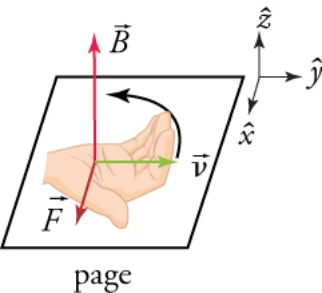
Thus, combining the magnitude and the direction, we find that the force on the proton is
したがって大きさと向きを合わせると、陽子にはたらく力は
Discussion考察
This seems like a very small force. However, the proton has a mass of , so its acceleration is
これはとても小さな力に思える。しかし陽子の質量はなので、その加速度は
, or about ten thousand billion times the acceleration due to gravity!
であり、重力による加速度のおよそ1万兆倍である。
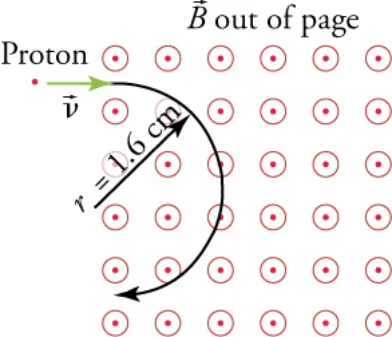
We found that the proton’s initial acceleration as it enters the magnetic field is downward in the plane of the page. Notice that, as the proton accelerates, its velocity remains perpendicular to the magnetic field, so the magnitude of the force does not change. In addition, because of the right-hand rule, the direction of the force remains perpendicular to the velocity. This force is nothing more than a centripetal force: It has a constant magnitude and is always perpendicular to the velocity. Thus, the magnitude of the velocity does not change, and the proton executes circular motion. The radius of this circle may be found by using the kinematics relationship.
陽子が磁場に入るときの初めの加速度は、紙面内で下向きだと分かった。陽子が加速しても、その速度は磁場に垂直なままなので、力の大きさは変わらないことに注目しよう。さらに右手の法則によって、力の向きは速度に垂直なままである。この力は向心力にほかならない。大きさが一定で、つねに速度に垂直だからである。したがって速度の大きさは変わらず、陽子は円運動をする。この円の半径は運動学の関係を使って求められる。
The path of the proton in the magnetic field is shown in Figure 20.22.
磁場の中の陽子の道筋を図20.22に示す。
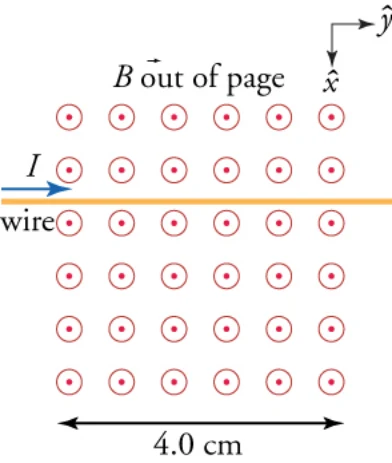
Wire with Current in Magnetic Field Now suppose we run a wire through the uniform magnetic field from the previous example, as shown. If the wire carries a current of 1.5 A in the -direction, and the region with magnetic field is 4.0 cm long, what is the force on the wire?
磁場の中で電流の流れる導線 ここで、前の例の一様な磁場に導線を通すとしよう。図のとおりである。導線が方向に1.5 Aの電流を流し、磁場のある領域の長さが4.0 cmのとき、導線にはたらく力はいくらか。
Strategy方針
683Use equation to find the magnitude of the force on the wire. The length of the wire inside the magnetic field is 4.0 cm, and the angle between the current direction and the magnetic field direction is 90°. To find the direction of the force, use the right-hand rule as explained just after the equation
式を使って導線にはたらく力の大きさを求める。磁場の中の導線の長さは4.0 cm、電流の向きと磁場の向きの間の角度は90°である。力の向きを求めるには、式の直後で説明した右手の法則を使う。
Solution解答
Insert the given values into equation to find the magnitude of the force
与えられた値を式に入れて力の大きさを求めると
To find the direction of the force, begin by placing the current vector end to end with a vector for the magnetic field.
力の向きを求めるには、まず電流のベクトルと磁場のベクトルを端どうしでつなぐ。
The result is as shown in the figure in the previous Worked Example with replaced by . Curl your right-hand fingers from to and your right thumb points down the page, again as shown in the figure in the previous Worked Example. Thus, the direction of the force is in the -direction. The complete force is thus .
結果は、前の例題の図でをに置き換えたものになる。右手の指をからへ丸めると、これも前の例題の図に示すとおり、右手の親指は紙面の下を指す。したがって力の向きは方向である。したがって完全な力はである。
Discussion考察
The direction of the force is the same as the initial direction of the force was in the previous example for a proton. However, because the current in a wire is confined to a wire, the direction in which the charges move does not change. Instead, the entire wire accelerates in the -direction. The force on a current-carrying wire in a magnetic field is the basis of all electrical motors, as we will see in the upcoming sections.
力の向きは、前の例の陽子で初めの力の向きだったものと同じである。しかし導線の電流は導線に閉じ込められているので、電荷の動く向きは変わらない。かわりに導線全体が方向へ加速する。磁場の中で電流の流れる導線にはたらく力は、次の節で見るように、あらゆる電動機の土台である。
Practice Problems練習問題
1What is the magnitude of the force on an electron moving at 1.0 × 10⁶ m/s perpendicular to a 1.0-T magnetic field?a. 0.8 × 10⁻¹³ Nb. 1.6 × 10⁻¹⁴ Nc. 0.8 × 10⁻¹⁴ Nd. 1.6 × 10⁻¹³ N
11.0-Tの磁場に垂直に1.0 × 10⁶ m/sで動く電子にはたらく力の大きさはいくらか。a. 0.8 × 10⁻¹³ Nb. 1.6 × 10⁻¹⁴ Nc. 0.8 × 10⁻¹⁴ Nd. 1.6 × 10⁻¹³ N
2A straight 10 cm wire carries 0.40 A and is oriented perpendicular to a magnetic field. If the force on the wire is 0.022 N, what is the magnitude of the magnetic field?a. 1.10 × 10⁻² Tb. 0.55 × 10⁻² T
2長さ10 cmのまっすぐな導線が0.40 Aを流し、磁場に垂直に置かれている。導線にはたらく力が0.022 Nのとき、磁場の大きさはいくらか。a. 1.10 × 10⁻² Tb. 0.55 × 10⁻² T
c. 1.10 Td. 0.55 T
c. 1.10 Td. 0.55 T
Check Your Understanding理解の確認
3If two magnets repel each other, what can you conclude about their relative orientation?a. Either the south pole of magnet 1 is closer to the north pole of magnet 2 or the north pole of magnet 1 is closer to the south pole of magnet 2.b. Either the south poles of both the magnet 1 and magnet 2 are closer to each other or the north poles of both the magnet 1 and magnet 2 are closer to each other.c. Not enough information is given to draw any conclusion about the orientation of the magnets.
3二つの磁石が反発し合うとき、その相対的な向きについて何が言えるか。a. 磁石1のS極が磁石2のN極に近いか、磁石1のN極が磁石2のS極に近いかのどちらかである。b. 磁石1と磁石2のS極どうしが近いか、N極どうしが近いかのどちらかである。c. 磁石の向きについて結論を出すには情報が足りない。
4Describe methods to demagnetize a ferromagnet.a. by cooling, heating, or submerging in waterb. by heating, hammering, and spinning it in external magnetic fieldc. by hammering, heating, and rubbing with clothd. by cooling, submerging in water, or rubbing with cloth
4強磁性体の磁性を失わせる方法を述べよ。a. 冷やす、熱する、水に沈めるb. 熱する、叩く、外の磁場の中で回すc. 叩く、熱する、布でこするd. 冷やす、水に沈める、布でこする
5What is a magnetic field?a. The directional lines present inside and outside the magnetic material that indicate the magnitude and direction of the magnetic force.b. The directional lines present inside and outside the magnetic material that indicate the magnitude of
5磁場とは何か。a. 磁性の材料の内と外にあり、磁気の力の大きさと向きを示す向きを持った線。b. 磁性の材料の内と外にあり、磁気の力の大きさを
the magnetic force.c. The directional lines present inside the magnetic material that indicate the magnitude and the direction of the magnetic force.d. The directional lines present outside the magnetic material that indicate the magnitude and the direction of the magnetic force.
示す向きを持った線。c. 磁性の材料の内にあり、磁気の力の大きさと向きを示す向きを持った線。d. 磁性の材料の外にあり、磁気の力の大きさと向きを示す向きを持った線。
6Which of the following drawings is correct?
6次の図のうち正しいのはどれか。