第17章回折と干渉Diffraction and Interference原書 p.541–566
17.2 Applications of Diffraction, Interference, and Coherence17.2 回折・干渉・可干渉性の応用
SECTION LEARNING OBJECTIVES By the end of this section, you will be able to do the following:
この節の学習目標 この節を終えると、次のことができるようになる。
• Explain behaviors of waves, including reflection, refraction, diffraction, interference, and coherence, and describe applications based on these behaviors• Perform calculations related to applications based on wave properties of light
・反射・屈折・回折・干渉・可干渉性を含む波のふるまいを説明し、これらのふるまいにもとづく応用を述べる・光の波としての性質にもとづく応用に関する計算を行う
Section Key Termsこの節の重要語
differential interference contrast (DIC)diffraction gratingiridescencelasermonochromatorRayleigh criterionresolution
微分干渉コントラスト(DIC)回折格子構造色レーザー分光器(モノクロメーター)レイリーの基準分解能
Wave-Based Applications of Light光の波にもとづく応用
In 1917, Albert Einstein was thinking about photons and excited atoms. He considered an atom excited by a certain amount of energy and what would happen if that atom were hit by a photon with the same amount of energy. He suggested that the atom would emit a photon with that amount of energy, and it would be accompanied by the original photon. The exciting part is that you would have two photons with the same energy and they would be in phase. Those photons could go on to hit other excited atoms, and soon you would have a stream of in-phase photons. Such a light stream is said to be coherent. Some four decades later, Einstein’s idea found application in a process called, light amplification by stimulated emission of radiation. Take the first letters of all the words (except by and “of”) and write them in order. You get the word laser (see Figure 17.2 (a)), which is the name of the device that produces such a beam of light.
1917年、アルベルト・アインシュタインは光子と励起した原子について考えていた。ある量のエネルギーで励起した原子に、同じ量のエネルギーを持つ光子があたったらどうなるかを考えたのである。彼は、その原子はその量のエネルギーを持つ光子を放ち、それにもとの光子がともなうだろうと考えた。面白いのは、同じエネルギーを持つ二つの光子が得られ、しかも同位相だという点である。これらの光子は別の励起した原子にあたっていき、やがて同位相の光子の流れができる。そうした光の流れは可干渉であるという。それから40年ほどして、アインシュタインの考えは「放射の誘導放出による光の増幅(light amplification by stimulated emission of radiation)」と呼ばれる過程に応用された。すべての語(byとofを除く)の頭文字をとって順に並べるとlaser(レーザー)という語になる(図17.2(a)を見よ)。それが、そのような光の束を作る装置の名である。
Laser beams are directional, very intense, and narrow (only about 0.5 mm in diameter). These properties lead to a number of applications in industry and medicine. The following are just a few examples:
レーザーの光束は指向性が高く、とても強く、細い(直径わずか0.5 mmほど)。これらの性質から、産業と医学で数多くの応用が生まれている。以下はごく一例である。
• This chapter began with a picture of a compact disc (see Figure 17.1). Those audio and data-storage devices began replacing cassette tapes during the 1990s. CDs are read by interpreting variations in reflections of a laser beam from the surface.• Some barcode scanners use a laser beam.• Lasers are used in industry to cut steel and other metals.
・この章はコンパクトディスクの写真から始まった(図17.1を見よ)。この音声とデータの記憶装置は、1990年代にカセットテープに取って代わり始めた。CDは、表面からのレーザー光束の反射の変化を読み取ることで再生される。・バーコードの読み取り機にはレーザーの光束を使うものがある。・レーザーは鋼などの金属を切るのに産業で使われる。
• Lasers are bounced off reflectors that astronauts left on the Moon. The time it takes for the light to make the round trip can be used to make precise calculations of the Earth-Moon distance.• Laser beams are used to produce holograms. The name hologram means entire picture (from the Greek holo-, as in holistic), because the image is three-dimensional. A viewer can move around the image and see it from different perspectives. Holograms take advantage of the wave properties of light, as opposed to traditional photography which is based on geometric optics. A holographic image is produced by constructive and destructive interference of a split laser beam.• One of the advantages of using a laser as a surgical tool is that it is accompanied by very little bleeding.• Laser eye surgery has improved the vision of many people, without the need for corrective lenses. A laser beam is used to change the shape of the lens of the eye, thus changing its focal length.
・レーザーは、宇宙飛行士が月に残した反射鏡ではね返される。光が往復するのにかかる時間から、地球と月の距離を精密に計算できる。・レーザーの光束はホログラムを作るのに使われる。ホログラム(hologram)という名は「全体の絵」という意味である(ギリシャ語のholo-から。holisticと同じ)。像が三次元だからである。見る人は像のまわりを動いて、違う視点から見られる。ホログラムは、幾何光学にもとづく従来の写真と違って、光の波としての性質を利用する。ホログラフィーの像は、分けられたレーザー光束の強め合う干渉と弱め合う干渉によって作られる。・レーザーを手術の道具として使う利点の一つは、出血がほとんどないことである。・レーザーによる眼の手術は、補正レンズなしで多くの人の視力を改善してきた。レーザーの光束を使って目の水晶体の形を変え、その焦点距離を変えるのである。
VIRTUAL PHYSICSシミュレーションLasersレーザー
This animation (https://openstax.org/l/28lasers) allows you to examine the workings of a laser. First view the picture of a real laser. Change the energy of the incoming photons, and see if you can match it to an excitation level that will produce pairs of coherent photons. Change the excitation level and try to match it to the incoming photon energy.
このアニメーション(https://openstax.org/l/28lasers)ではレーザーの働きを調べられる。まず実物のレーザーの写真を見よう。入ってくる光子のエネルギーを変え、可干渉な光子の対を生む励起の準位に合わせられるか試してみよう。励起の準位を変えて、入ってくる光子のエネルギーに合わせてみよう。
In the animation there is only one excited atom. Is that the case for a real laser? Explain.
このアニメーションでは励起した原子は一つしかない。実物のレーザーでもそうか。説明せよ。
a. No, a laser would have two excited atoms.b. No, a laser would have several million excited atoms.
a. いいえ。レーザーには励起した原子が二つある。b. いいえ。レーザーには励起した原子が数百万個ある。
c. Yes, a laser would have only one excited atom.d. No, a laser would have on the order of 1023 excited atoms.
c. はい。レーザーには励起した原子が一つしかない。d. いいえ。レーザーには1023個ほどの励起した原子がある。
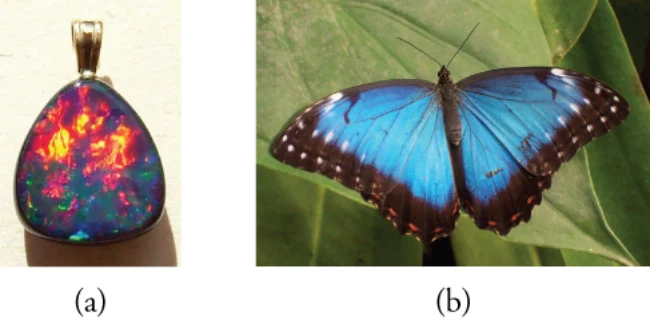
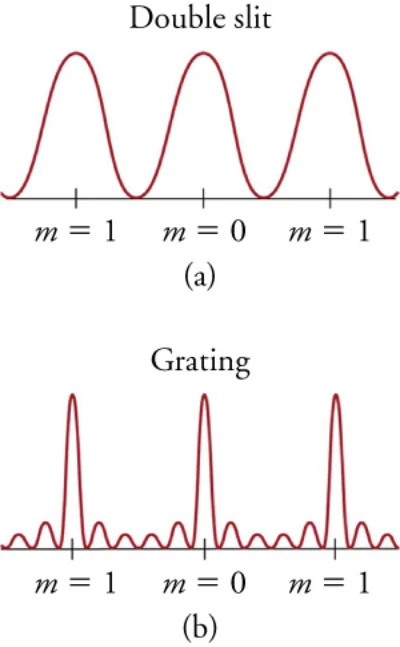
An interesting thing happens if you pass light through a large number of evenly-spaced parallel slits. Such an arrangement of slits is called a diffraction grating. An interference pattern is created that is very similar to the one formed by double-slit diffraction (see Figure 17.8 and Figure 17.9). A diffraction grating can be manufactured by scratching glass with a sharp tool to form a number of precisely positioned parallel lines, which act like slits.Diffraction gratings work both for transmission of light, as in Figure 17.13, and for reflection of light, as on the butterfly wings or the Australian opal shown in Figure 17.14, or the CD pictured in the opening illustration of this chapter. In addition to their use as novelty items, diffraction gratings are commonly used for spectroscopic dispersion and analysis of light. What makes them particularly useful is the fact that they form a sharper pattern than do double slits. That is, their bright regions are narrower and brighter, while their dark regions are darker. Figure 17.15 shows idealized graphs demonstrating the sharper pattern. Natural diffraction gratings occur in the feathers of certain birds. Tiny, fingerlike structures in regular patterns act as reflection gratings, producing constructive interference that gives the feathers colors not solely due to their pigmentation. The effect is called iridescence.
等間隔に並んだ多数の平行なすきまに光を通すと、面白いことが起こる。そうしたすきまの並びを回折格子という。二重スリットの回折が作るのとよく似た干渉の模様ができる(図17.8と図17.9を見よ)。回折格子は、ガラスを鋭い道具でひっかいて、すきまとしてはたらく多数の正確に位置を決めた平行線を作れば製造できる。回折格子は、図17.13のように光を透過させる場合にも、図17.14の蝶の羽やオーストラリアのオパール、あるいはこの章の冒頭の図のCDのように光を反射させる場合にも働く。目新しい品としての使い道に加え、回折格子は分光による光の分散と分析によく使われる。とくに役に立つのは、二重スリットよりも鋭い模様を作るからである。すなわち、明るい領域はより細く明るく、暗い領域はより暗い。図17.15は、その鋭い模様を示す理想化したグラフである。自然の回折格子は、ある種の鳥の羽に見られる。規則正しく並んだ小さな指のような構造が反射格子としてはたらき、強め合う干渉を生んで、色素だけによらない色を羽に与える。この効果を構造色という。
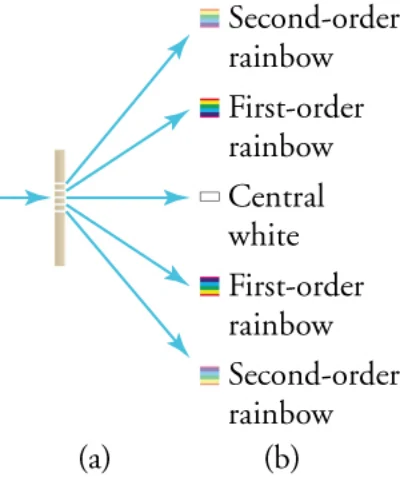
diffracted in a pattern similar to a double slit, with bright regions at various angles. (b) The pattern obtained for white light incident on a grating. The central maximum is white, and the higher-order maxima disperse white light into a rainbow of colors.
二重スリットと似た模様に回折され、いろいろな角度に明るい領域ができる。(b)白い光が格子にあたって得られる模様。中央の極大は白く、高次の極大は白い光を虹の色に分散させる。
SNAP LAB身近な実験Diffraction Grating回折格子
• A CD (compact disc) or DVD• A measuring tape• Sunlight near a white wall
・CD(コンパクトディスク)またはDVD・巻き尺・白い壁の近くの日光
Instructions
手引き
Procedure手順
1. Hold the CD in direct sunlight near the wall, and move it around until a circular rainbow pattern appears on the wall.2. Measure the distance from the CD to the wall and the distance from the center of the circular pattern to a color in the rainbow. Use those two distances to calculate . Find .3. Look up the wavelength of the color you chose. That is .4. Solve for d.5. Compare your answer to the usual spacing between CD tracks, which is 1,600 nm (1.6 μm). How do you know what number to use for m?
1. 壁の近くで直射日光にCDをかざし、壁に円形の虹の模様が現れるまで動かす。2. CDから壁までの距離と、円形の模様の中心から虹のある色までの距離を測る。この二つの距離からを計算する。を求める。3. 選んだ色の波長を調べる。それがである。4. をdについて解く。5. 答えを、CDのトラックのふつうの間隔である1,600 nm(1.6 μm)と比べる。mにどの数を使えばよいかは、どうすれば分かるか。
a. Count the rainbow rings preceding the chosen color.b. Calculate mfrom the frequency of the light of the chosen color.
a. 選んだ色より手前の虹の輪を数える。b. 選んだ色の光の振動数からmを計算する。
c. Calculate m from the wavelength of the light of the chosen color.d. The value of m is fixed for every color.
c. 選んだ色の光の波長からmを計算する。d. mの値はどの色でも決まっている。
CD Players Can you see the grooves on a CD or DVD (see Figure 17.16)? You may think you can because you know they are there, but they are extremely narrow—1,600 in a millimeter. Because the width of the grooves is similar to wavelengths of visible light, they form a diffraction grating. That is why you see rainbows on a CD. The colors are attractive, but they are incidental to the functions of storing and retrieving audio and other data.
CDプレーヤー CDやDVDの溝が見えるだろうか(図17.16を見よ)。そこにあると知っているので見えると思うかもしれないが、溝はきわめて細く、1ミリメートルに1,600本ある。溝の幅が可視光の波長と同じくらいなので、溝は回折格子をなす。CDに虹が見えるのはそのためである。この色は美しいが、音声その他のデータを蓄え、取り出すという働きにとっては付随的なものである。

The grooves are actually one continuous groove that spirals outward from the center. Data are recorded in the grooves as binary code (zeroes and ones) in small pits. Information in the pits is detected by a laser that tracks along the groove. It gets even more complicated: The speed of rotation must be varied as the laser tracks toward the circumference so that the linear speed along the groove remains constant. There is also an error correction mechanism to prevent the laser beam from getting off track. A diffraction grating is used to create the first two maxima on either side of the track. If those maxima are not the same distance from the track, an error is indicated and then corrected.
溝は実際には、中心から外へ渦を描いて延びる一本の連続した溝である。データは溝の中に、小さなくぼみによる二進符号(0と1)として記録されている。くぼみの情報は、溝に沿って追いかけるレーザーによって読み取られる。話はさらに込み入っている。溝に沿った線速度が一定に保たれるように、レーザーが外周へ向かうにつれて回転の速さを変えねばならない。またレーザーの光束が溝から外れないようにする誤り訂正の仕組みもある。回折格子を使ってトラックの両側に最初の二つの極大を作る。その極大がトラックから同じ距離になければ誤りとみなされ、訂正される。
The pits are reflective because they have been coated with a thin layer of aluminum. That allows the laser beam to be reflected back and directed toward a photodiode detector. The signal can then be processed and converted to the audio we hear.
くぼみは薄いアルミの層で覆われているので反射する。これによってレーザーの光束が反射し戻され、フォトダイオードの検出器へ向かう。信号はそのあと処理され、私たちが聞く音声へ変えられる。
The longest wavelength of visible light is about 780 nm . How does that compare to the distance between CD grooves?
可視光の最も長い波長はおよそ780 nmである。それはCDの溝どうしの距離とくらべてどうか。
a. The grooves are about 3 times the longest wavelength of visible light.b. The grooves are about 2 times the longest wavelength of visible light.c. The grooves are about 2 times the shortest wavelength of visible light.d. The grooves are about 3 times the shortest wavelength of visible light.
a. 溝は可視光の最も長い波長のおよそ3倍である。b. 溝は可視光の最も長い波長のおよそ2倍である。c. 溝は可視光の最も短い波長のおよそ2倍である。d. 溝は可視光の最も短い波長のおよそ3倍である。
Biology: DIC Microscopy If you were completely transparent, it would be hard to recognize you from your photograph. The same problem arises when using a traditional microscope to view or photograph small transparent objects such as cells and microbes. Microscopes using differential interference contrast (DIC) solve the problem by making it possible to view microscopic objects with enhanced contrast, as shown in Figure 17.17.
生物学:DIC顕微鏡 もしあなたが完全に透明だったら、写真からあなただと見分けるのは難しいだろう。従来の顕微鏡で細胞や微生物のような小さく透明な物を見たり撮ったりするときにも、同じ問題が起こる。微分干渉コントラスト(DIC)を使う顕微鏡は、図17.17に示すように、微小な物をコントラストを強めて見られるようにすることでこの問題を解く。
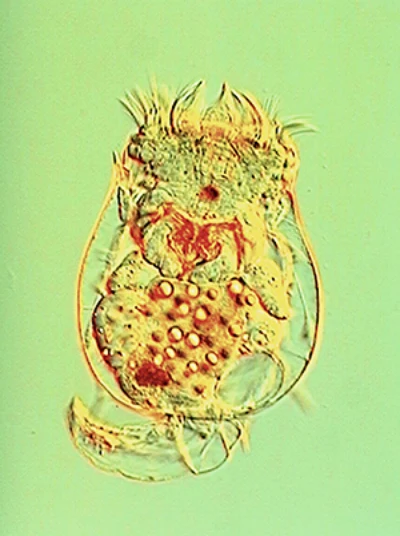
A DIC microscope separates a polarized light source into two beams polarized at right angles to each other and coherent with each other, that is, in phase. After passing through the sample, the beams are recombined and realigned so they have the same plane of polarization. They then create an interference pattern caused by the differences in their optical path and the refractive indices of the parts of the sample they passed through. The result is an image with contrast and shadowing that could not be observed with traditional optics.
DIC顕微鏡は、偏った光源を、互いに直角に偏り、互いに可干渉な——すなわち同位相の——二つの光束に分ける。試料を通り抜けたあと、光束は再び合わされ、偏りの面が同じになるように揃えられる。そして、通り抜けた試料の部分の光路と屈折率の違いによる干渉の模様を作る。その結果、従来の光学では見られないコントラストと陰影を持つ像が得られる。
Where are diffraction gratings used? Diffraction gratings are key components of monochromators—devices that separate the various wavelengths of incoming light and allow a beam with only a specific wavelength to pass through. Monochromators are used, for example, in optical imaging of particular wavelengths from biological or medical samples. A diffraction grating can be chosen to specifically analyze a wavelength of light emitted by molecules in diseased cells in a biopsy sample, or to help excite strategic molecules in the sample with a selected frequency of light. Another important use is in optical fiber technologies where fibers are designed to provide optimum performance at specific wavelengths. A range of diffraction gratings is available for selecting specific wavelengths for such use.
回折格子はどこで使われているか。回折格子は分光器(モノクロメーター)——入ってくる光のいろいろな波長を分け、特定の波長だけの光束を通す装置——の要となる部品である。分光器はたとえば、生物学や医学の試料から特定の波長を光学的に画像化するのに使われる。生検の試料の中の病変細胞の分子が放つ光の波長を狙って分析したり、選んだ振動数の光で試料の中の要となる分子を励起したりするために、回折格子を選べる。もう一つの重要な使い道が光ファイバーの技術で、ファイバーは特定の波長で最適な性能を出すように設計される。そうした用途に特定の波長を選べるよう、さまざまな回折格子が用意されている。
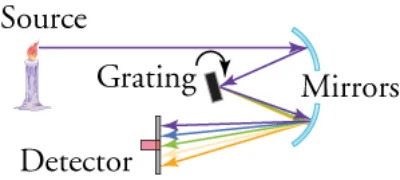
Diffraction gratings are used in spectroscopes to separate a light source into its component wavelengths. When a material is heated to incandescence, it gives off wavelengths of light characteristic of the chemical makeup of the material. A pure substance will produce a spectrum that is unique, thus allowing identification of the substance. Spectroscopes are also used to measure wavelengths both shorter and longer than visible light. Such instruments have become especially useful to astronomers and chemists. Figure 17.18 shows a diagram of a spectroscope.
回折格子は分光器で、光源をそれを作っている波長に分けるのに使われる。物質が白熱するまで熱せられると、その物質の化学的な組成に特有の波長の光を放つ。純粋な物質は独特のスペクトルを作り、それによって物質を見分けられる。分光器は、可視光より短い波長も長い波長も測るのに使われる。そうした器械はとくに天文学者と化学者にとって役立つものとなっている。図17.18に分光器の図を示す。
Light diffracts as it moves through space, bending around obstacles and interfering constructively and destructively. While diffraction allows light to be used as a spectroscopic tool, it also limits the detail we can obtain in images.
光は空間を進むにつれて回折し、障害物のまわりで曲がり、強め合う干渉と弱め合う干渉をする。回折のおかげで光は分光の道具として使えるが、同時にそれは像で得られる細部を制限もする。
Why are diffraction gratings used in spectroscopes rather than just two slits?
分光器で、ただの二つのすきまではなく回折格子が使われるのはなぜか。
a. The bands produced by diffraction gratings are dimmer but sharper than the bands produced by two slits.b. The bands produced by diffraction gratings are brighter, though less sharp, than the bands produced by two slits.
a. 回折格子が作る帯は、二つのすきまが作る帯より暗いが鋭いから。b. 回折格子が作る帯は、二つのすきまが作る帯より明るいが、鋭さは劣るから。
c. The bands produced by diffraction gratings are brighter and sharper than the bands produced by two slits.d. The bands produced by diffraction gratings are dimmer and less sharp, but more widely dispersed, than the bands produced by two slits.
c. 回折格子が作る帯は、二つのすきまが作る帯より明るく鋭いから。d. 回折格子が作る帯は、二つのすきまが作る帯より暗く鋭さも劣るが、より広く分散するから。
Figure 17.19 (a) shows the effect of passing light through a small circular aperture. Instead of a bright spot with sharp edges, a spot with a fuzzy edge surrounded by circles of light is obtained. This pattern is caused by diffraction similar to that produced by a single slit. Light from different parts of the circular aperture interferes constructively and destructively. The effect is most noticeable when the aperture is small, but the effect is there for large apertures, too.
図17.19(a)は、光を小さな円形の開口に通した効果を示す。縁のはっきりした明るい点ではなく、ぼやけた縁を持つ点が光の輪に囲まれたものが得られる。この模様は、単一のすきまが作るのと似た回折によるものである。円形の開口の違う部分からの光が、強め合ったり弱め合ったりする。この効果は開口が小さいときに最も目立つが、大きな開口でも起こる。
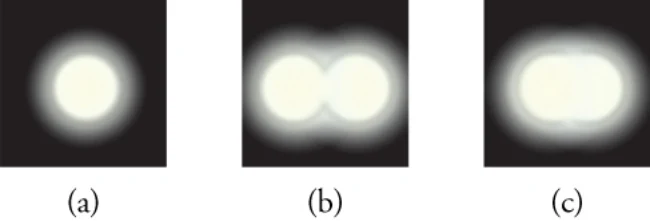
How does diffraction affect the detail that can be observed when light passes through an aperture? Figure 17.19 (b) shows the diffraction pattern produced by two point light sources that are close to one another. The pattern is similar to that for a single point source, and it is just barely possible to tell that there are two light sources rather than one. If they are closer together, as in Figure 17.19 (c), you cannot distinguish them, thus limiting the detail, or resolution, you can obtain. That limit is an inescapable consequence of the wave nature of light.
光が開口を通り抜けるとき、回折は観測できる細部にどう影響するか。図17.19(b)は、互いに近い二つの点光源が作る回折の模様を示す。模様は一つの点光源のものと似ており、光源が一つではなく二つあるとかろうじて分かる程度である。図17.19(c)のようにさらに近ければ区別できず、こうして得られる細部、すなわち分解能が制限される。この限界は光の波としての性質から逃れられない帰結である。
There are many situations in which diffraction limits the resolution. The acuity of vision is limited because light passes through the pupil, the circular aperture of the eye. Be aware that the diffraction-like spreading of light is due to the limited diameter of a light beam, not the interaction with an aperture. Thus light passing through a lens with a diameter of D shows the diffraction effect and spreads, blurring the image, just as light passing through an aperture of diameter D does. Diffraction limits the resolution of any system having a lens or mirror. Telescopes are also limited by diffraction, because of the finite diameter, D, of their primary mirror.
回折が分解能を制限する場面は数多くある。視力の鋭さは、光が目の円形の開口である瞳孔を通ることで制限される。回折のような光の広がりは、開口との相互作用ではなく光束の直径が有限であることによる点に注意しよう。したがって、直径Dのレンズを通る光は、直径Dの開口を通る光と同じように回折の効果を示して広がり、像をぼやけさせる。回折は、レンズや鏡を持つあらゆる系の分解能を制限する。望遠鏡も、主鏡の直径Dが有限であるために回折によって制限される。
Calculations Involving Diffraction Gratings and Resolution回折格子と分解能に関する計算
Early in the chapter, it was mentioned that when light passes from one medium to another, its speed and wavelength change, but its frequency remains constant. The equation
章の初めのほうで、光がある媒質から別の媒質へ進むと速さと波長は変わるが振動数は変わらないと述べた。式
shows how to the wavelength in a given medium, , is related to the wavelength in a vacuum, , and the refractive index, n, of the medium. The equation is useful for calculating the change in wavelength of a monochromatic laser beam in various media. The analysis of a diffraction grating is very similar to that for a double slit. As you know from the discussion of double slits in Young’s double-slit experiment, light is diffracted by, and spreads out after passing through, each slit. Rays travel at an angle relative to the incident direction. Each ray travels a different distance to a common point on a screen far away. The rays start in phase, and they can be in or out of phase when they reach a screen, depending on the difference in the path lengths traveled. Each ray travels a distance that differs by from that of its neighbor, where d is the distance between slits. If equals an integral number of wavelengths, the rays all arrive in phase, and constructive interference (a maximum) is obtained. Thus, the condition necessary to obtain constructive interference for a diffraction grating is
は、ある媒質中の波長が、真空中の波長と媒質の屈折率nにどう結びつくかを示す。この式は、いろいろな媒質中での単色のレーザー光束の波長の変化を計算するのに役立つ。回折格子の分析は二重スリットのものとよく似ている。ヤングの二重スリットの実験での二重スリットの議論から分かるように、光はそれぞれのすきまで回折し、通り抜けたあと広がる。光線は入射の向きに対して角度で進む。それぞれの光線は、遠くのスクリーン上の共通の点まで違う距離を進む。光線は同位相で出発し、進んだ道筋の長さの差に応じて、スクリーンに届くとき同位相にも逆位相にもなりうる。それぞれの光線は隣のものとだけ違う距離を進む。ここでdはすきまどうしの距離である。が波長の整数倍に等しければ、光線はすべて同位相で届き、強め合う干渉(極大)が得られる。したがって、回折格子で強め合う干渉を得るのに必要な条件は
where d is the distance between slits in the grating, is the wavelength of the light, and m is the order of the maximum. Note that this is exactly the same equation as for two slits separated by d. However, the slits are usually closer in diffraction gratings than in double slits, producing fewer maxima at larger angles.
である。ここでdは格子のすきまどうしの距離、は光の波長、mは極大の次数である。これはdだけ離れた二つのすきまの場合とまったく同じ式であることに注意しよう。ただし、回折格子のすきまは二重スリットよりふつう近いので、大きな角度により少ない極大ができる。
Diffraction Grating This video (https://www.openstax.org/l/28diffraction) explains the geometry behind the diffraction pattern produced by a diffraction grating.
回折格子 この動画(https://www.openstax.org/l/28diffraction)は、回折格子が作る回折の模様の背後にある幾何を説明する。
Diffraction grating | Light waves | Physics | Khan Academy (https://www.openstax.org/l/28diffraction)
回折格子|光の波|物理|カーンアカデミー(https://www.openstax.org/l/28diffraction)
Watch Physics: Diffraction Grating. This video explains diffraction of light through several holes.Access multimedia content (http://openstax.org/books/physics/pages/17-2-applications-of-diffraction-interference-and-coherence) The equation that gives the points of constructive interference produced by a diffraction grating is . Why does that equation look familiar?
物理を見る:回折格子。この動画はいくつもの孔を通る光の回折を説明する。マルチメディア教材はこちら(http://openstax.org/books/physics/pages/17-2-applications-of-diffraction-interference-and-coherence) 回折格子が作る強め合う干渉の点を与える式はである。この式に見覚えがあるのはなぜか。
a. It is the same as the equation for destructive interference for a double-slit diffraction pattern.b. It is the same as the equation for constructive interference for a double-slit diffraction pattern.c. It is the same as the equation for constructive interference for a single-slit diffraction pattern.d. It is the same as the equation for destructive interference for a single-slit diffraction pattern.
a. 二重スリットの回折の模様で弱め合う干渉の式と同じだから。b. 二重スリットの回折の模様で強め合う干渉の式と同じだから。c. 単スリットの回折の模様で強め合う干渉の式と同じだから。d. 単スリットの回折の模様で弱め合う干渉の式と同じだから。
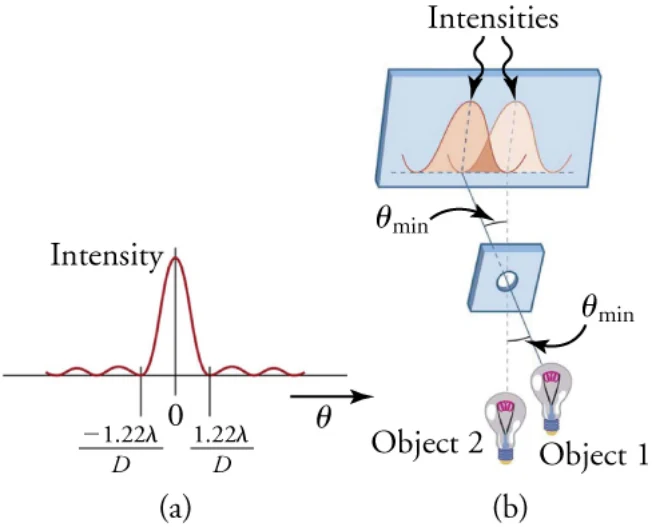
Just what is the resolution limit of an aperture or lens? To answer that question, consider the diffraction pattern for a circular aperture, which, similar to the diffraction pattern of light passing through a slit, has a central maximum that is wider and brighter than the maxima surrounding it (see Figure 17.19 (a)). It can be shown that, for a circular aperture of diameter D, the first minimum in the diffraction pattern occurs at , provided that the aperture is large compared with the wavelength of light, which is the case for most optical instruments. The accepted criterion for determining the diffraction limit to resolution based on diffraction was developed by Lord Rayleigh in the 19th century. The Rayleigh criterion for the diffraction limit to resolution states that two images are just resolvable when the center of the diffraction pattern of one is directly over the first minimum of the diffraction pattern of the other. See Figure 17.20 (b). The first minimum is at an angle of , so that two point objects are just resolvable if they are separated by the angle
開口やレンズの分解能の限界とは何か。この問いに答えるために、円形の開口の回折の模様を考えよう。それは、すきまを通る光の回折の模様と同じように、まわりの極大より広く明るい中央の極大を持つ(図17.19(a)を見よ)。直径Dの円形の開口について、開口が光の波長にくらべて大きければ——ほとんどの光学器械はそうである——回折の模様の最初の極小はに現れることが示せる。回折による分解能の限界を決める、認められた基準は、19世紀にレイリー卿によって作られた。分解能の回折による限界に関するレイリーの基準は、一方の回折の模様の中心が、もう一方の回折の模様の最初の極小のちょうど真上に来るとき、二つの像はかろうじて分解できると述べる。図17.20(b)を見よ。最初の極小は角度にあるので、二つの点状の物は、次の角度だけ離れていればかろうじて分解できる。
where is the wavelength of the light (or other electromagnetic radiation) and D is the diameter of the aperture, lens, mirror, etc., with which the two objects are observed. In the expression above, has units of radians.
ここでは光(あるいは他の電磁放射)の波長、Dは二つの物を観測する開口・レンズ・鏡などの直径である。上の式での単位はラジアンである。
SNAP LAB身近な実験Resolution分解能
• A sheet of white paper• A black pen or pencil• A measuring tape
・白い紙一枚・黒いペンか鉛筆・巻き尺
Instructions
手引き
Procedure手順
1. Draw two lines several mm apart on a white sheet of paper.2. Move away from the sheet as it is held upright, and measure the distance at which you can just distinguish (resolve) the lines as separate.3. Use to calculate D the diameter of your pupil. Use the distance between the lines and the
1. 白い紙に数mm離して二本の線を引く。2. 紙を立てて持ち、そこから離れていって、線を別々のものとしてかろうじて見分けられる(分解できる)距離を測る。3. を使って瞳孔の直径Dを計算する。線どうしの距離と、
maximum distance at which they were resolved to calculate . Use the average wavelength for visible light as the value for . 4. Compare your answer to the average pupil diameter of 3 mm.
分解できた最大の距離を使ってを計算する。の値には可視光の平均の波長を使う。 4. 答えを瞳孔の平均の直径3 mmと比べる。
Describe resolution in terms of minima and maxima of diffraction patterns.
分解能を回折の模様の極小と極大の言葉で述べよ。
a. The limit for resolution is when the minimum of the pattern for one of the lines is directly over the first minimum of the pattern for the other line.b. The limit for resolution is when the maximum of the pattern for one of the lines is directly over the first minimum of the pattern for the other line.c. The limit for resolution is when the maximum of the pattern for one of the lines is directly over the second minimum of the pattern for the other line.d. The limit for resolution is when the minimum of the pattern for one of the lines is directly over the second maximum of the pattern for the other line.
a. 分解の限界は、一方の線の模様の極小が、もう一方の線の模様の最初の極小のちょうど真上に来るときである。b. 分解の限界は、一方の線の模様の極大が、もう一方の線の模様の最初の極小のちょうど真上に来るときである。c. 分解の限界は、一方の線の模様の極大が、もう一方の線の模様の二番目の極小のちょうど真上に来るときである。d. 分解の限界は、一方の線の模様の極小が、もう一方の線の模様の二番目の極大のちょうど真上に来るときである。
Change of Wavelength A monochromatic laser beam of green light with a wavelength of 550 nm passes from air to water. The refractive index of water is 1.33. What will be the wavelength of the light after it enters the water?Strategy
波長の変化 波長550 nmの緑の単色レーザー光束が空気から水へ入る。水の屈折率は1.33である。水に入ったあとの光の波長はいくらになるか。方針
You can assume that the refractive index of air is the same as that of light in a vacuum because they are so close. You then have all the information you need to solve for .
空気の屈折率は真空中の光のものにとても近いので、同じとみなしてよい。そうすればを求めるのに必要な情報がすべてそろう。
Solution解答
Discussion考察
The refractive index of air is 1.0003, so the approximation holds for three significant figures. You would not see the light change color, however. Color is determined by frequency, not wavelength.
空気の屈折率は1.0003なので、有効数字3桁ではこの近似が成り立つ。ただし光の色が変わるのは見えない。色は波長ではなく振動数で決まるからである。
Diffraction Grating A diffraction grating has 2000 lines per centimeter. At what angle will the first-order maximum form for green light with a wavelength of 520 nm?
回折格子 ある回折格子は1センチメートルあたり2000本の線を持つ。波長520 nmの緑の光について、1次の極大はどの角度にできるか。
Strategy方針
You are given enough information to calculate d, and you are given the values of and m. You will have to find the arcsin of a number to find .
dを計算するのに十分な情報が与えられ、とmの値も与えられている。を求めるには、ある数の逆正弦を求めねばならない。
Solution解答
First find d.
まずdを求める。
Rearrange the equation for constructive interference conditions for a diffraction grating, and substitute the known values.
回折格子の強め合う干渉の条件の式を変形し、分かっている値を代入する。
Discussion考察
This angle seems reasonable for the first maximum. Recall that the meaning of sin‒1 (or arcsin) is the angle with a sine that is (the unknown). Remember that the value of will not be greater than 1 for any value of .
この角度は最初の極大として妥当に思える。sin-1(すなわちarcsin)の意味は、正弦が(その未知の値)である角ということを思い出そう。のどんな値についても、の値が1より大きくなることはないことを覚えておこう。
Resolution What is the minimum angular spread of a 633-nm-wavelength He-Ne laser beam that is originally 1.00 mm in diameter? Strategy
分解能 もとの直径が1.00 mmの、波長633 nmのHe-Neレーザー光束の、最小の角の広がりはいくらか。 方針
The diameter of the beam is the same as if it were coming through an aperture of that size, so D = 1.00 mm. You are given , and you must solve for .
光束の直径は、その大きさの開口を通ってきた場合と同じなので、D = 1.00 mmである。が与えられており、について解けばよい。
Solution解答
Discussion考察
The conversion factor for radians to degrees is 1.000 radian = 57.3°. The spread is very small and would not be noticeable over short distances. The angle represents the angular separation of the central maximum and the first minimum.
ラジアンから度への換算は1.000ラジアン = 57.3°である。広がりはとても小さく、短い距離では気づかないだろう。この角は、中央の極大と最初の極小の角度の隔たりを表す。
Practice Problems練習問題
6A beam of yellow light has a wavelength of 600 nm in a vacuum and a wavelength of 397 nm in Plexiglas. What is the refractive index of Plexiglas?
6ある黄色い光の束は、真空中で波長600 nm、プレキシガラス中で波長397 nmである。プレキシガラスの屈折率はいくらか。
a. 1.51b. 2.61c. 3.02d. 3.77
a. 1.51b. 2.61c. 3.02d. 3.77
7What is the angle between two just-resolved points of light for a 3.00 mm diameter pupil, assuming an average wavelength of 550 nm?
7平均の波長を550 nmとして、直径3.00 mmの瞳孔で、かろうじて分解できる二つの光の点の間の角度はいくらか。
a. 224 radb. 183 radc. 1.83 × 10⁻⁴ radd. 2.24 × 10⁻⁴ rad
a. 224 radb. 183 radc. 1.83 × 10⁻⁴ radd. 2.24 × 10⁻⁴ rad
Check Your Understanding理解の確認
8How is an interference pattern formed by a diffraction grating different from the pattern formed by a double slit?
8回折格子が作る干渉の模様は、二重スリットが作る模様とどう違うか。
a. The pattern is colorful.b. The pattern is faded.
a. 模様が色鮮やかである。b. 模様が薄い。
c. The pattern is sharper.d. The pattern is curved.
c. 模様が鋭い。d. 模様が曲がっている。
9A beam of light always spreads out. Why can a beam not be produced with parallel rays to prevent spreading?a. Light is always polarized.b. Light is always reflected.
9光の束はつねに広がる。広がりを防ぐために平行な光線だけの束を作れないのはなぜか。a. 光はつねに偏っているから。b. 光はつねに反射するから。
c. Light is always refracted.d. Light is always diffracted.
c. 光はつねに屈折するから。d. 光はつねに回折するから。
10Compare interference patterns formed by a double slit and by a diffraction grating in terms of brightness and narrowness of bands.
10二重スリットと回折格子が作る干渉の模様を、帯の明るさと細さの点で比べよ。
a. The pattern formed by a diffraction grating has broader and brighter bands.b. The pattern formed by a diffraction grating has broader and duller bands.
a. 回折格子が作る模様のほうが帯が太く明るい。b. 回折格子が作る模様のほうが帯が太く暗い。
c. The pattern formed by a diffraction grating has narrower and duller bands.d. The pattern formed by a diffraction grating has narrower and brighter bands.
c. 回折格子が作る模様のほうが帯が細く暗い。d. 回折格子が作る模様のほうが帯が細く明るい。
11Describe the slits in a diffraction grating in terms of number and spacing, as compared to a two-slit diffraction setup.
11回折格子のすきまを、二重スリットの回折の仕掛けとくらべて、数と間隔の点で述べよ。
a. The slits in a diffraction grating are broader, with space between them that is greater than the separation of the two slits in two-slit diffraction.b. The slits in a diffraction grating are broader, with space between them that is the same as the separation of the two slits in two-slit diffraction.c. The slits in a diffraction grating are narrower, with space between them that is the same as the separation of the two slits in two-slit diffraction.d. The slits in a diffraction grating are narrower, with space between them that is greater than the separation of the two slits in two-slit diffraction.
a. 回折格子のすきまはより広く、その間隔は二重スリットの回折での二つのすきまの隔たりより大きい。b. 回折格子のすきまはより広く、その間隔は二重スリットの回折での二つのすきまの隔たりと同じである。c. 回折格子のすきまはより狭く、その間隔は二重スリットの回折での二つのすきまの隔たりと同じである。d. 回折格子のすきまはより狭く、その間隔は二重スリットの回折での二つのすきまの隔たりより大きい。