第17章回折と干渉Diffraction and Interference原書 p.541–566
17.1 Understanding Diffraction and Interference17.1 回折と干渉を理解する
SECTION LEARNING OBJECTIVES By the end of this section, you will be able to do the following:
この節の学習目標 この節を終えると、次のことができるようになる。
• Explain wave behavior of light, including diffraction and interference, including the role of constructive and destructive interference in Young’s single-slit and double-slit experiments• Perform calculations involving diffraction and interference, in particular the wavelength of light using data from a two-slit interference pattern
・回折と干渉を含む光の波としてのふるまいを、ヤングの単スリットと二重スリットの実験における強め合う干渉と弱め合う干渉の役割を含めて説明する・回折と干渉に関する計算、とくに二重スリットの干渉の模様のデータから光の波長を求める計算を行う
Section Key Termsこの節の重要語
diffractionHuygens’s principlemonochromaticwavefront
回折ホイヘンスの原理単色の波面
Diffraction and Interference回折と干渉
We know that visible light is the type of electromagnetic wave to which our eyes responds. As we have seen previously, light obeys the equation
可視光は、私たちの目が応える型の電磁波であることは分かっている。すでに見たとおり、光は次の式に従う。
where m/s is the speed of light in vacuum, f is the frequency of the electromagnetic wave in Hz (or s–1), and is its wavelength in m. The range of visible wavelengths is approximately 380 to 750 nm. As is true for all waves, light travels in straight lines and acts like a ray when it interacts with objects several times as large as its wavelength. However, when it interacts with smaller objects, it displays its wave characteristics prominently.Interference is the identifying behavior of a wave.
ここで m/sは真空中の光の速さ、fはHz(すなわちs-1)で表した電磁波の振動数、はmで表したその波長である。可視の波長の範囲はおよそ380から750 nmである。あらゆる波と同じく、光は直線に沿って進み、波長の何倍もの大きさの物と作用し合うときには光線のようにふるまう。しかし、より小さな物と作用し合うときには、波としての特徴をはっきり示す。干渉は波を見分けるふるまいである。
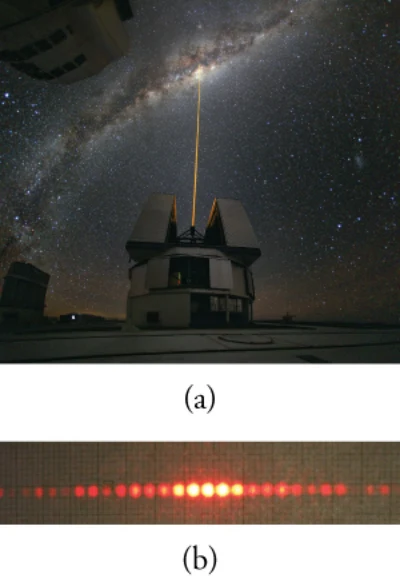
In Figure 17.2, both the ray and wave characteristics of light can be seen. The laser beam emitted by the observatory represents ray behavior, as it travels in a straight line. Passing a pure, one-wavelength beam through vertical slits with a width close to the wavelength of the beam reveals the wave character of light. Here we see the beam spreading out horizontally into a pattern of bright and dark regions that are caused by systematic constructive and destructive interference. As it is characteristic of wave behavior, interference is observed for water waves, sound waves, and light waves.
図17.2には、光を光線として捉えたときの性質と、波として捉えたときの性質の両方が現れている。天文台から出たレーザー光がまっすぐ進む様子は、光線の考え方で説明できる。一方、単色の光を、その波長と同程度の幅を持つ縦のスリットに通すと、光は水平方向に広がる。さらに、光が強め合う場所と弱め合う場所が規則的に現れ、明暗の模様ができる。これが干渉である。干渉は波に特有の性質であり、水面の波や音波にも見られる。
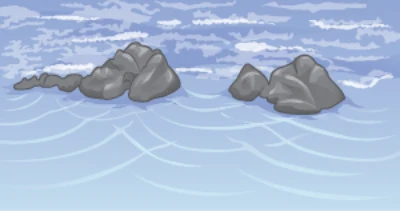
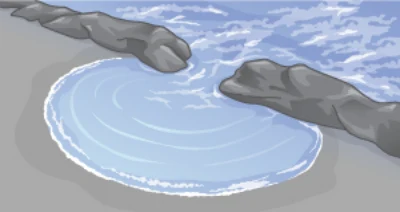
That interference is a characteristic of energy propagation by waves is demonstrated more convincingly by water waves. Figure 17.3 shows water waves passing through gaps between some rocks. You can easily see that the gaps are similar in width to the wavelength of the waves and that this causes an interference pattern as the waves pass beyond the gaps. A cross-section across the waves in the foreground would show the crests and troughs characteristic of an interference pattern.
干渉が波によるエネルギーの伝わり方の特徴であることは、水の波でいっそう説得力をもって示される。図17.3は、いくつかの岩の間のすきまを通り抜ける水の波を示す。すきまの幅が波の波長と同じくらいであり、そのために波がすきまを越えたところで干渉の模様ができているのが簡単に見て取れる。手前の波を横切る断面をとれば、干渉の模様の特徴である山と谷が現れるだろう。
Light has wave characteristics in various media as well as in a vacuum. When light goes from a vacuum to some medium, such as water, its speed and wavelength change, but its frequency, f, remains the same. The speed of light in a medium is , where n is its index of refraction. If you divide both sides of the equation by n, you get . Therefore, , where is the wavelength in a medium, and
光は真空中だけでなく、いろいろな媒質の中でも波としての特徴を持つ。光が真空から水などの媒質へ入ると、速さと波長は変わるが、振動数fは変わらない。媒質中の光の速さはである。ここでnはその屈折率である。式の両辺をnで割ればが得られる。したがってとなる。ここでは媒質中の波長であり、
where is the wavelength in vacuum and n is the medium’s index of refraction. It follows that the wavelength of light is smaller in any medium than it is in vacuum. In water, for example, which has n = 1.333, the range of visible wavelengths is (380 nm)/1.333 to (760 nm)/1.333, or 285–570 nm. Although wavelengths change while traveling from one medium to another, colors do not, since colors are associated with frequency.
ここでは真空中の波長、nは媒質の屈折率である。したがって、どの媒質の中でも光の波長は真空中より短い。たとえばn = 1.333の水では、可視の波長の範囲は(380 nm)/1.333から(760 nm)/1.333、すなわち285〜570 nmである。ある媒質から別の媒質へ進むときに波長は変わるが、色は変わらない。色は振動数に結びついているからである。
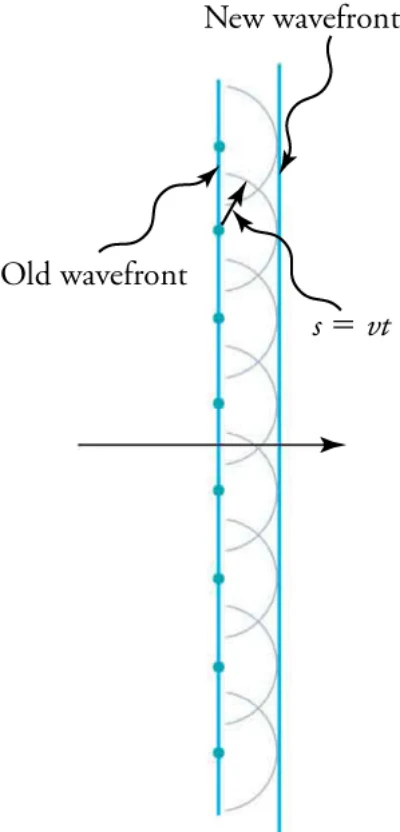
The Dutch scientist Christiaan Huygens (1629–1695) developed a useful technique for determining in detail how and where waves propagate. He used wavefronts, which are the points on a wave’s surface that share the same, constant phase (such as all the points that make up the crest of a water wave). Huygens’s principle states, “Every point on a wavefront is a source of wavelets that spread out in the forward direction at the same speed as the wave itself. The new wavefront is a line tangent to all of the wavelets.”
オランダの科学者クリスティアーン・ホイヘンス(1629–1695)は、波がどのように、どこへ伝わっていくかを詳しく決める便利な方法を考え出した。彼は波面を使った。波面とは、波の面上で同じ一定の位相を持つ点(たとえば水の波の山を作るすべての点)である。ホイヘンスの原理はこう述べる。「波面上のすべての点は、波そのものと同じ速さで前方へ広がっていく素元波の源である。新しい波面は、すべての素元波に接する線である。」
Figure 17.4 shows how Huygens’s principle is applied. A wavefront is the long edge that moves; for example, the crest or the trough. Each point on the wavefront emits a semicircular wave that moves at the propagation speed v. These are drawn later at a time, t, so that they have moved a distance . The new wavefront is a line tangent to the wavelets and is where the wave is located at time t. Huygens’s principle works for all types of waves, including water waves, sound waves, and light waves. It will be useful not only in describing how light waves propagate, but also in how they interfere.
図17.4はホイヘンスの原理の使い方を示す。波面とは動いていく長い縁、たとえば山や谷である。波面上のそれぞれの点が、伝播の速さvで動く半円の波を出す。それらは時間tのあと、距離だけ進んだ形で描かれている。新しい波面は素元波に接する線であり、時刻tに波がある場所である。ホイヘンスの原理は、水の波・音波・光の波を含むあらゆる種類の波に成り立つ。光の波がどう伝わるかを述べるだけでなく、どう干渉するかを述べるのにも役立つ。
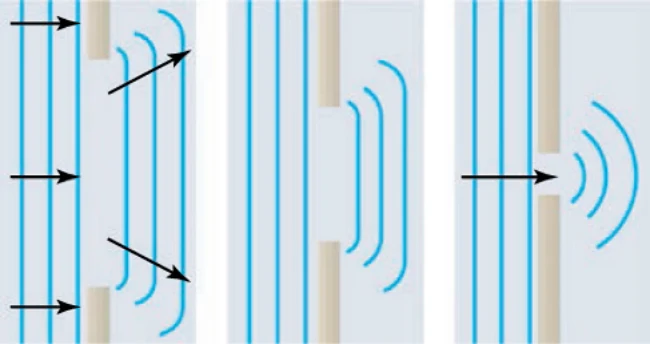
What happens when a wave passes through an opening, such as light shining through an open door into a dark room? For light, you expect to see a sharp shadow of the doorway on the floor of the room, and you expect no light to bend around corners into other parts of the room. When sound passes through a door, you hear it everywhere in the room and, thus, you understand that sound spreads out when passing through such an opening. What is the difference between the behavior of sound waves and light waves in this case? The answer is that the wavelengths that make up the light are very short, so that the light acts like a ray. Sound has wavelengths on the order of the size of the door, and so it bends around corners.
開いた戸から暗い部屋へ光が差すときのように、波が開口を通り抜けるとどうなるか。光については、床に戸口のくっきりした影ができ、光が角を曲がって部屋の他の部分へ回り込むことはないと思うだろう。音が戸を通り抜けるときは部屋のどこでも聞こえるので、そうした開口を通り抜けるとき音は広がると分かる。この場合、音波と光の波のふるまいの違いは何か。答えは、光を作っている波長がとても短いので、光は光線のようにふるまうということである。音は戸の大きさ程度の波長を持つので、角を曲がる。
If light passes through smaller openings, often called slits, you can use Huygens’s principle to show that light bends as sound does (see Figure 17.5). The bending of a wave around the edges of an opening or an obstacle is called diffraction. Diffraction is a wave characteristic that occurs for all types of waves. If diffraction is observed for a phenomenon, it is evidence that the phenomenon is produced by waves. Thus, the horizontal diffraction of the laser beam after it passes through slits in Figure 17.2 is evidence that light has the properties of a wave.
スリットと呼ばれる細い開口を光が通るとき、光が音のように回り込むことを、ホイヘンスの原理によって説明できる(図17.5)。波が開口や障害物の縁を回り込んで広がる現象を回折という。回折は、あらゆる種類の波に共通する性質である。したがって、ある現象で回折が観測されれば、それは波の性質を持つ証拠となる。図17.2で、スリットを通ったレーザー光が水平方向へ広がるのも、光の波としての性質を示している。
Once again, water waves present a familiar example of a wave phenomenon that is easy to observe and understand, as shown in Figure 17.6.
ここでもまた、水の波は、観察も理解もしやすい波の現象のなじみ深い例を与える。図17.6を見よ。
Single-Slit Interference This video works through the math needed to predict diffraction patterns that are caused by single-slit interference.
単スリットの干渉 この動画は、単スリットの干渉によって生じる回折の模様を予測するのに必要な数学を追っていく。
Access multimedia content (http://openstax.org/books/physics/pages/17-1-understanding-diffraction-and-interference) Which values of m denote the location of destructive interference in a single-slit diffraction pattern?
マルチメディア教材はこちら(http://openstax.org/books/physics/pages/17-1-understanding-diffraction-and-interference) 単スリットの回折の模様で、弱め合う干渉の位置を表すmの値はどれか。
a. whole integers, excluding zerob. whole integers
a. 0を除く整数b. 整数
c. real numbers excluding zerod. real numbers
c. 0を除く実数d. 実数
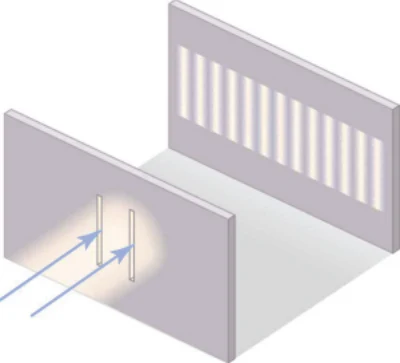
The fact that Huygens’s principle worked was not considered enough evidence to prove that light is a wave. People were also reluctant to accept light’s wave nature because it contradicted the ideas of Isaac Newton, who was still held in high esteem. The acceptance of the wave character of light came after 1801, when the English physicist and physician Thomas Young (1773–1829) did his now-classic double-slit experiment (see Figure 17.7).
ホイヘンスの原理がうまくいくことは、光が波であることを証明するのに十分な証拠とはみなされなかった。当時なお高く敬われていたアイザック・ニュートンの考えに反するので、光が波であることを受け入れるのをためらう人も多かった。光の波としての性格が受け入れられたのは1801年より後、イギリスの物理学者で医師のトマス・ヤング(1773–1829)が、いまや古典となった二重スリットの実験を行ってからである(図17.7を見よ)。
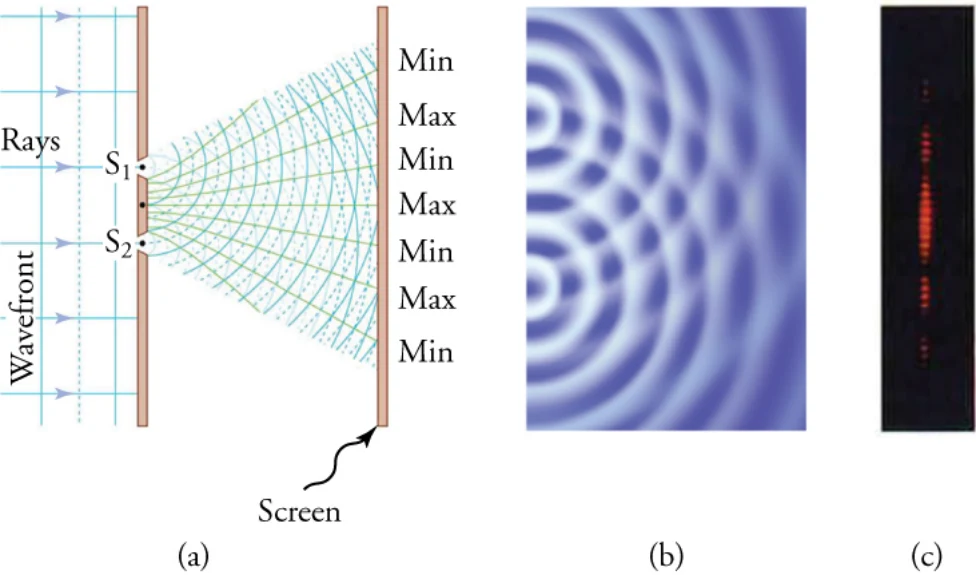
When light passes through narrow slits, it is diffracted into semicircular waves, as shown in Figure 17.8 (a). Pure constructive interference occurs where the waves line up crest to crest or trough to trough. Pure destructive interference occurs where they line up crest to trough. The light must fall on a screen and be scattered into our eyes for the pattern to be visible. An analogous pattern for water waves is shown in Figure 17.8 (b). Note that regions of constructive and destructive interference move out from the slits at well-defined angles to the original beam. Those angles depend on wavelength and the distance between the slits, as you will see below.
光が細いすきまを通ると、図17.8(a)に示すように半円の波に回折される。波が山と山、谷と谷で揃うところで純粋に強め合う干渉が起こる。山と谷が揃うところで純粋に弱め合う干渉が起こる。模様が見えるためには、光がスクリーンにあたって私たちの目へ散乱されねばならない。水の波の同じような模様を図17.8(b)に示す。強め合う干渉と弱め合う干渉の領域が、もとの光束に対してはっきり決まった角度でスリットから広がっていくことに注意しよう。その角度は、下で見るように、波長とスリットどうしの距離による。
VIRTUAL PHYSICSシミュレーションWave Interference波の干渉
This simulation (https://openstax.org/l/28interference) demonstrates most of the wave phenomena discussed in this section. First, observe interference between two sources of electromagnetic radiation without adding slits. See how water waves, sound, and light all show interference patterns. Stay with light waves and use only one source. Create diffraction patterns with one slit and then with two. You may have to adjust slit width to see the pattern.
このシミュレーション(https://openstax.org/l/28interference)は、この節で論じた波の現象のほとんどを示す。まず、スリットを足さずに二つの電磁放射の源の間の干渉を観察しよう。水の波も音も光も干渉の模様を示すことが分かる。光の波のままで、源を一つだけ使う。スリット一つ、次に二つで回折の模様を作ろう。模様を見るにはスリットの幅を調節する必要があるかもしれない。
Visually compare the slit width to the wavelength. When do you get the best-defined diffraction pattern?
スリットの幅を波長と目で比べよう。最もはっきりした回折の模様が得られるのはどんなときか。
a. when the slit width is larger than the wavelength b. when the slit width is smaller than the wavelength c. when the slit width is comparable to the wavelengthd. when the slit width is infinite
a. スリットの幅が波長より大きいときb. スリットの幅が波長より小さいときc. スリットの幅が波長と同じくらいのときd. スリットの幅が無限大のとき
Calculations Involving Diffraction and Interference回折と干渉に関する計算
The fact that the wavelength of light of one color, or monochromatic light, can be calculated from its two-slit diffraction pattern in Young’s experiments supports the conclusion that light has wave properties. To understand the basis of such calculations, consider how two waves travel from the slits to the screen. Each slit is a different distance from a given point on the screen. Thus different numbers of wavelengths fit into each path. Waves start out from the slits in phase (crest to crest), but they will end up out of phase (crest to trough) at the screen if the paths differ in length by half a wavelength, interfering destructively. If the paths differ by a whole wavelength, then the waves arrive in phase (crest to crest) at the screen, interfering constructively. More generally, if the paths taken by the two waves differ by any half-integral number of wavelengths , then destructive interference occurs. Similarly, if the paths taken by the two waves differ by any integral number of wavelengths , then constructive interference occurs.
ヤングの実験で、一つの色の光すなわち単色光の波長が、その二重スリットの回折の模様から計算できるという事実は、光が波の性質を持つという結論を裏づける。そうした計算の土台を理解するために、二つの波がスリットからスクリーンまでどう進むかを考えよう。スクリーン上のある点までの距離は、スリットごとに違う。したがって、それぞれの道筋に収まる波長の数も違う。波は同位相(山と山)でスリットから出発するが、道筋の長さが半波長違えば、スクリーンでは逆位相(山と谷)になり、弱め合う干渉をする。道筋が一波長違えば、波は同位相(山と山)でスクリーンに届き、強め合う干渉をする。より一般に、二つの波がたどる道筋が半整数倍の波長だけ違えば、弱め合う干渉が起こる。同じように、二つの波がたどる道筋が整数倍の波長だけ違えば、強め合う干渉が起こる。
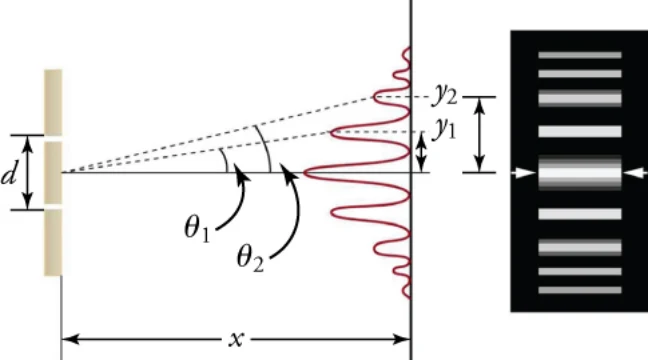
Figure 17.9 shows how to determine the path-length difference for waves traveling from two slits to a common point on a screen. If the screen is a large distance away compared with the distance between the slits, then the angle between the path and a line from the slits perpendicular to the screen (see the figure) is nearly the same for each path. That approximation and simple trigonometry show the length difference, , to be , where d is the distance between the slits,
図17.9は、二つのスリットからスクリーン上の共通の点へ進む波の道筋の長さの差をどう求めるかを示す。スリットどうしの距離にくらべてスクリーンがずっと遠くにあれば、道筋と、スリットからスクリーンに垂直に引いた線との間の角度(図を見よ)は、どちらの道筋でもほぼ同じである。この近似と簡単な三角法によって、長さの差がであることが分かる。ここでdはスリットどうしの距離である。
To obtain constructive interference for a double slit, the path-length difference must be an integral multiple of the wavelength, or
二重スリットで強め合う干渉を得るには、道筋の長さの差が波長の整数倍でなければならない。すなわち
Similarly, to obtain destructive interference for a double slit, the path-length difference must be a half-integral multiple of the wavelength, or
同じように、二重スリットで弱め合う干渉を得るには、道筋の長さの差が波長の半整数倍でなければならない。すなわち
The number m is the order of the interference. For example, m = 4 is fourth-order interference.
数mは干渉の次数である。たとえばm = 4なら4次の干渉である。
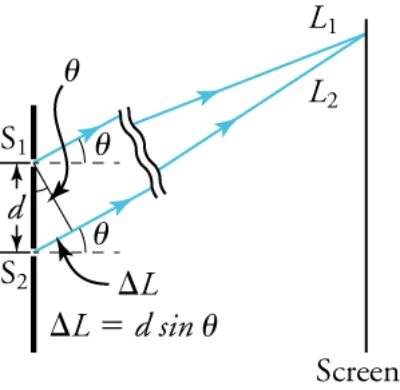
Figure 17.10 shows how the intensity of the bands of constructive interference decreases with increasing angle.
図17.10は、強め合う干渉の帯の強さが角度が大きくなるにつれてどう減るかを示す。
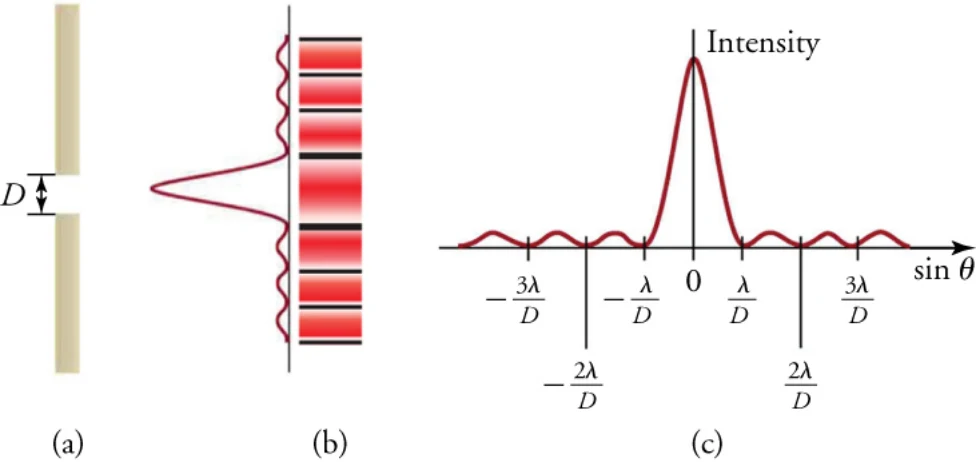
Light passing through a single slit forms a diffraction pattern somewhat different from that formed by double slits. Figure 17.11 shows a single-slit diffraction pattern. Note that the central maximum is larger than those on either side, and that the intensity decreases rapidly on either side.
単一のスリットを通り抜けた光は、二重スリットが作るのとはいくぶん違う回折の模様を作る。図17.11に単スリットの回折の模様を示す。中央の極大が両側のものより大きく、両側では強さが急速に減ることに注意しよう。
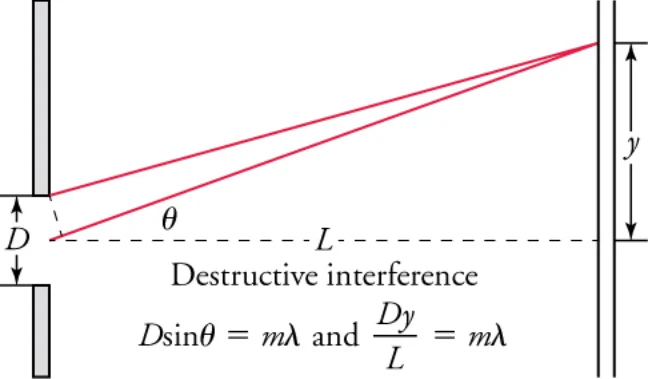
The analysis of single-slit diffraction is illustrated in Figure 17.12. Assuming the screen is very far away compared with the size of the slit, rays heading toward a common destination are nearly parallel. That approximation allows a series of trigonometric operations that result in the equations for the minima produced by destructive interference.
単スリットの回折の分析を図17.12に示す。スリットの大きさにくらべてスクリーンがとても遠いとすると、共通の行き先へ向かう光線はほぼ平行である。この近似によって一連の三角法の操作が可能になり、弱め合う干渉が生む極小の式が得られる。
or
あるいは
When rays travel straight ahead, they remain in phase and a central maximum is obtained. However, when rays travel at an angle relative to the original direction of the beam, each ray travels a different distance to the screen, and they can arrive in or out of phase. Thus, a ray from the center travels a distance farther than the ray from the top edge of the slit, they arrive out of phase, and they interfere destructively. Similarly, for every ray between the top and the center of the slit, there is a ray between the center and the bottom of the slit that travels a distance farther to the common point on the screen, and so interferes destructively. Symmetrically, there will be another minimum at the same angle below the direct ray.
光線がまっすぐ進むときは同位相のままで、中央の極大が得られる。しかし、光線がもとの光束の向きに対して角度で進むと、光線ごとにスクリーンまでの距離が違い、同位相でも逆位相でも届きうる。したがって、中央からの光線はスリットの上端からの光線より距離だけ長く進み、逆位相で届いて弱め合う干渉をする。同じように、スリットの上端と中央の間のどの光線についても、中央と下端の間に、スクリーン上の共通の点まで距離だけ長く進み、したがって弱め合う干渉をする光線がある。対称に、直進する光線の下の同じ角度にもう一つの極小ができる。
Below we summarize the equations needed for the calculations to follow.
これから行う計算に必要な式を以下にまとめる。
The speed of light in a vacuum, c, the wavelength of the light, , and its frequency, f, are related as follows.
真空中の光の速さc、光の波長、その振動数fは次のように結びついている。
The wavelength of light in a medium, , compared to its wavelength in a vacuum, , is given by
媒質中の光の波長は、真空中の波長とくらべて次で与えられる。
To calculate the positions of constructive interference for a double slit, the path-length difference must be an integral multiple, m, of the wavelength.
二重スリットで強め合う干渉の位置を計算するには、道筋の長さの差が波長の整数倍mでなければならない。
where d is the distance between the slits and is the angle between a line from the slits to the maximum and a line perpendicular to the barrier in which the slits are located. To calculate the positions of destructive interference for a double slit, the path-length difference must be a half-integral multiple of the wavelength:
ここでdはスリットどうしの距離、はスリットから極大へ引いた線と、スリットのある障壁に垂直な線の間の角度である。二重スリットで弱め合う干渉の位置を計算するには、道筋の長さの差が波長の半整数倍でなければならない。
For a single-slit diffraction pattern, the width of the slit, D, the distance of the first (m = 1) destructive interference minimum, y, the distance from the slit to the screen, L, and the wavelength, , are given by
単スリットの回折の模様では、スリットの幅D、最初の(m = 1)弱め合う干渉の極小までの距離y、スリットからスクリーンまでの距離L、そして波長が次で与えられる。
Also, for single-slit diffraction,
また、単スリットの回折では
where is the angle between a line from the slit to the minimum and a line perpendicular to the screen, and m is the order of the minimum.
となる。ここではスリットから極小へ引いた線とスクリーンに垂直な線の間の角度、mは極小の次数である。
Two-Slit Interference Suppose you pass light from a He-Ne laser through two slits separated by 0.0100 mm, and you find that the third bright line on a screen is formed at an angle of 10.95º relative to the incident beam. What is the wavelength of the light?Strategy
二重スリットの干渉 He-Neレーザーからの光を0.0100 mm離れた二つのスリットに通したところ、スクリーン上の三番目の明るい線が入射した光束に対して10.95°の角度にできた。この光の波長はいくらか。方針
The third bright line is due to third-order constructive interference, which means that m = 3. You are given d = 0.0100 mm and = 10.95º. The wavelength can thus be found using the equation for constructive interference.
三番目の明るい線は3次の強め合う干渉によるもので、m = 3である。d = 0.0100 mm、 = 10.95°が与えられている。したがって、強め合う干渉の式を使って波長を求められる。
Solution解答
The equation is . Solving for the wavelength, , gives
式はである。波長について解くと
Substituting known values yields
分かっている値を代入すると
Discussion考察
To three digits, 633 nm is the wavelength of light emitted by the common He-Ne laser. Not by coincidence, this red color is similar to that emitted by neon lights. More important, however, is the fact that interference patterns can be used to measure wavelength. Young did that for visible wavelengths. His analytical technique is still widely used to measure electromagnetic spectra. For a given order, the angle for constructive interference increases with , so spectra (measurements of intensity versus wavelength) can be obtained.
3桁では、633 nmがふつうのHe-Neレーザーが出す光の波長である。偶然ではなく、この赤い色はネオンサインが出す色に似ている。しかしより大切なのは、干渉の模様が波長を測るのに使えるという事実である。ヤングは可視の波長についてそれを行った。彼の分析の手法は、いまも電磁スペクトルを測るのに広く使われている。決まった次数では、強め合う干渉の角度がとともに大きくなるので、スペクトル(波長に対する強さの測定)が得られる。
Single-Slit Diffraction Visible light of wavelength 550 nm falls on a single slit and produces its second diffraction minimum at an angle of 45.0° relative to the incident direction of the light. What is the width of the slit?Strategy
単スリットの回折 波長550 nmの可視光が単一のスリットにあたり、光の入射の向きに対して45.0°の角度に2次の回折の極小を作る。このスリットの幅はいくらか。方針
From the given information, and assuming the screen is far away from the slit, you can use the equation to find D.
与えられた情報から、またスクリーンがスリットから遠いとして、式を使ってDを求められる。
Solution解答
Quantities given are = 550 nm, m = 2, and = 45.0°. Solving the equation for D and substituting known values gives
与えられた量は = 550 nm、m = 2、 = 45.0°である。式をDについて解き、分かっている値を代入すると
Discussion考察
You see that the slit is narrow (it is only a few times greater than the wavelength of light). That is consistent with the fact that light must interact with an object comparable in size to its wavelength in order to exhibit significant wave effects, such as this single-slit diffraction pattern.
このスリットが細い(光の波長のわずか数倍しかない)ことが分かる。これは、この単スリットの回折の模様のような目立った波の効果を示すには、光がその波長と同じくらいの大きさの物と作用し合わねばならないという事実と辻褄が合う。
Practice Problems練習問題
1Monochromatic light from a laser passes through two slits separated by . The third bright line on a screen is formed at an angle of relative to the incident beam. What is the wavelength of the light?a. b.
1レーザーからの単色光が離れた二つのスリットを通る。スクリーン上の三番目の明るい線が、入射した光束に対しての角度にできる。この光の波長はいくらか。a. b.
2What is the width of a single slit through which 610-nm orange light passes to form a first diffraction minimum at an angle of 30.0°?
2610 nmのオレンジ色の光が通って30.0°の角度に1次の回折の極小を作る単一のスリットの幅はいくらか。
a. 0.863 µmb. 0.704 µmc. 0.610 µmd. 1.22 µm
a. 0.863 µmb. 0.704 µmc. 0.610 µmd. 1.22 µm
Check Your Understanding理解の確認
3Which aspect of a beam of monochromatic light changes when it passes from a vacuum into water, and how does it change?
3単色光の光束が真空から水へ入るとき、何が変わり、どう変わるか。
a. The wavelength first decreases and then increases.b. The wavelength first increases and then decreases.c. The wavelength increases.d. The wavelength decreases.
a. 波長がまず短くなり、それから長くなる。b. 波長がまず長くなり、それから短くなる。c. 波長が長くなる。d. 波長が短くなる。
4Go outside in the sunlight and observe your shadow. It has fuzzy edges, even if you do not. Is this a diffraction effect? Explain.
4日なたへ出て自分の影を観察しよう。自分の輪郭がぼやけていなくても、影の縁はぼやけている。これは回折の効果か。説明せよ。
a. This is a diffraction effect. Your whole body acts as the origin for a new wavefront.b. This is a diffraction effect. Every point on the edge of your shadow acts as the origin for a new wavefront.c. This is a refraction effect. Your whole body acts as the origin for a new wavefront.d. This is a refraction effect. Every point on the edge of your shadow acts as the origin for a new wavefront.
a. これは回折の効果である。体全体が新しい波面の源としてはたらく。b. これは回折の効果である。影の縁のすべての点が新しい波面の源としてはたらく。c. これは屈折の効果である。体全体が新しい波面の源としてはたらく。d. これは屈折の効果である。影の縁のすべての点が新しい波面の源としてはたらく。
5Which aspect of monochromatic green light changes when it passes from a vacuum into diamond, and how does it change?
5単色の緑の光が真空からダイヤモンドへ入るとき、何が変わり、どう変わるか。
a. The wavelength first decreases and then increases.b. The wavelength first increases and then decreases.c. The wavelength increases.d. The wavelength decreases.
a. 波長がまず短くなり、それから長くなる。b. 波長がまず長くなり、それから短くなる。c. 波長が長くなる。d. 波長が短くなる。