第11章熱エネルギー、熱、仕事Thermal Energy, Heat, and Work原書 p.339–368
11.2 Heat, Specific Heat, and Heat Transfer11.2 熱、比熱、熱の移動
SECTION LEARNING OBJECTIVES By the end of this section, you will be able to do the following:
この節の学習目標 この節を終えると、次のことができるようになる。
• Explain heat, heat capacity, and specific heat• Distinguish between conduction, convection, and radiation• Solve problems involving specific heat and heat transfer
・熱、熱容量、比熱を説明する・伝導、対流、放射を区別する・比熱と熱の移動に関する問題を解く
Section Key Termsこの節の重要語
conductionconvectionheat capacityradiationspecific heat
伝導対流熱容量放射比熱
Heat Transfer, Specific Heat, and Heat Capacity熱の移動、比熱、熱容量
We learned in the previous section that temperature is proportional to the average kinetic energy of atoms and molecules in a substance, and that the average internal kinetic energy of a substance is higher when the substance’s temperature is higher.
前の節で、温度が物質の中の原子と分子の平均の運動エネルギーに比例すること、そして物質の温度が高いほど内部の平均の運動エネルギーが大きいことを学んだ。
If two objects at different temperatures are brought in contact with each other, energy is transferred from the hotter object (that is, the object with the greater temperature) to the colder (lower temperature) object, until both objects are at the same temperature. There is no net heat transfer once the temperatures are equal because the amount of heat transferred from one object to the other is the same as the amount of heat returned. One of the major effects of heat transfer is temperature change: Heating increases the temperature while cooling decreases it. Experiments show that the heat transferred to or from a substance depends on three factors—the change in the substance’s temperature, the mass of the substance, and certain physical properties related to the phase of the substance.
温度の違う二つの物体を接触させると、両者の温度が等しくなるまで、熱いほう(すなわち温度の高いほう)から冷たいほう(温度の低いほう)へエネルギーが移る。温度が等しくなれば、一方から他方へ移る熱の量と戻ってくる熱の量が同じになるので、正味の熱の移動はなくなる。熱の移動の大きな効果の一つが温度の変化である。加熱は温度を上げ、冷却は温度を下げる。実験によれば、物質へ、あるいは物質から移る熱は三つの要因、すなわち物質の温度変化、物質の質量、そして物質の相に関わるある物理的性質による。
The equation for heat transfer Q is
熱の移動Qの式は次のとおりである。
where m is the mass of the substance and ΔT is the change in its temperature, in units of Celsius or Kelvin. The symbol c stands for specific heat, and depends on the material and phase. The specific heat is the amount of heat necessary to change the temperature of 1.00 kg of mass by 1.00 ºC. The specific heat c is a property of the substance; its SI unit is J/(kg K) or J/(kg ). The temperature change ( ) is the same in units of kelvins and degrees Celsius (but not degrees Fahrenheit). Specific heat is closely related to the concept of heat capacity. Heat capacity is the amount of heat necessary to change the temperature of a substance by 1.00 . In equation form, heat capacity C is , where m is mass and c is specific heat. Note that heat capacity is the same as specific heat, but without any dependence on mass. Consequently, two objects made up of the same material but with different masses will have different heat capacities. This is because the heat capacity is a property of an object, but specific heat is a property of any object made of the same material.
ここでmは物質の質量、ΔTはその温度変化で、単位はセルシウスかケルビンである。記号cは比熱を表し、物質と相による。比熱とは、質量1.00 kgの温度を1.00 ℃変えるのに必要な熱の量である。比熱cは物質の性質であり、SI単位はJ/(kg·K)またはJ/(kg·)である。温度変化()は、ケルビンでもセルシウス度でも同じ値になる(ただしファーレンハイト度では違う)。比熱は熱容量という概念と密接に関わる。熱容量とは、ある物体の温度を1.00変えるのに必要な熱の量である。式で書けば、熱容量Cはである。ここでmは質量、cは比熱である。熱容量は比熱と同じだが、質量への依存がない点が違うことに注意しよう。したがって、同じ材料でできていても質量の違う二つの物体は、熱容量が違う。熱容量が物体の性質であるのに対し、比熱は同じ材料でできたあらゆる物体に共通する性質だからである。
Values of specific heat must be looked up in tables, because there is no simple way to calculate them. Table 11.2 gives the values of specific heat for a few substances as a handy reference. We see from this table that the specific heat of water is five times that of glass, which means that it takes five times as much heat to raise the temperature of 1 kg of water than to raise the temperature of 1 kg of glass by the same number of degrees.
比熱の値は簡単に計算する方法がないので、表で調べなければならない。表11.2に、手元の参照用としていくつかの物質の比熱の値を示す。この表から、水の比熱がガラスの5倍であることが分かる。これは、1 kgの水の温度を同じ度数だけ上げるには、1 kgのガラスの5倍の熱が要るということである。
SNAP LAB身近な実験Temperature Change of Land and Water陸と水の温度変化
What heats faster, land or water? You will answer this question by taking measurements to study differences in specific heat capacity.
陸と水では、どちらが速く温まるか。測定を行って比熱容量の違いを調べ、この問いに答える。
• Open flame—Tie back all loose hair and clothing before igniting an open flame. Follow all of your teacher's instructions on how to ignite the flame. Never leave an open flame unattended. Know the location of fire safety equipment in the laboratory.
・裸火——火をつける前に、垂れた髪と衣服はすべてまとめておくこと。火のつけ方は先生の指示にすべて従うこと。裸火から目を離さないこと。実験室の消火設備の場所を知っておくこと。
• Sand or soil• Water• Oven or heat lamp• Two small jars• Two thermometers
・砂または土・水・オーブンか熱ランプ・小さな瓶2個・温度計2本
Instructions
手引き
Procedure手順
1. Place equal masses of dry sand (or soil) and water at the same temperature into two small jars. (The average density of soil or sand is about 1.6 times that of water, so you can get equal masses by using 50 percent more water by volume.)2. Heat both substances (using an oven or a heat lamp) for the same amount of time.3. Record the final temperatures of the two masses.4. Now bring both jars to the same temperature by heating for a longer period of time.5. Remove the jars from the heat source and measure their temperature every 5 minutes for about 30 minutes.
1. 同じ質量の乾いた砂(または土)と水を、同じ温度で二つの小さな瓶に入れる。(土や砂の平均密度は水のおよそ1.6倍なので、体積で50パーセント多く水を使えば質量を揃えられる。)2. 両方を(オーブンか熱ランプで)同じ時間だけ加熱する。3. 二つの最終的な温度を記録する。4. 次に、より長く加熱して両方の瓶を同じ温度にする。5. 瓶を熱源から外し、30分ほどの間、5分ごとに温度を測る。
Soil has an approximate specific heat of 800 J / kg °C. A farmer monitors both the soil temperature of his field and the temperature of a nearby pond as winter sets in. Will the field or the pond reach 0 °C first and why?
土の比熱はおよそ800 J/(kg·℃)である。ある農家が、冬に入るころ、自分の畑の土の温度と近くの池の温度の両方を見張っている。畑と池では、どちらが先に0 ℃に達するか。またそれはなぜか。
a. The pond will reach 0 °C first because of water’s greater specific heat.b. The field will reach 0 °C first because of soil’s lower specific heat.
a. 水の比熱のほうが大きいので、池が先に0 ℃に達する。b. 土の比熱のほうが小さいので、畑が先に0 ℃に達する。
c. They will reach 0° C at the same time because they are exposed to the same weather.d. The water will take longer to heat as well as to cool. This tells us that the specific heat of water is greater than that of land.
c. 同じ天候にさらされているので、同時に0 ℃に達する。d. 水は温まるのにも冷えるのにも長くかかる。このことは、水の比熱が陸より大きいことを教えてくれる。
Conduction, Convection, and Radiation伝導、対流、放射
Whenever there is a temperature difference, heat transfer occurs. Heat transfer may happen rapidly, such as through a cooking pan, or slowly, such as through the walls of an insulated cooler.
温度差があるところではどこでも熱の移動が起こる。熱の移動は、調理鍋を通してのように速く起こることもあれば、断熱したクーラーボックスの壁を通してのようにゆっくり起こることもある。
There are three different heat transfer methods: conduction, convection, and radiation. At times, all three may happen simultaneously. See Figure 11.3.
熱の移動には伝導、対流、放射という三つのしかたがある。三つが同時に起こることもある。図11.3を見よ。
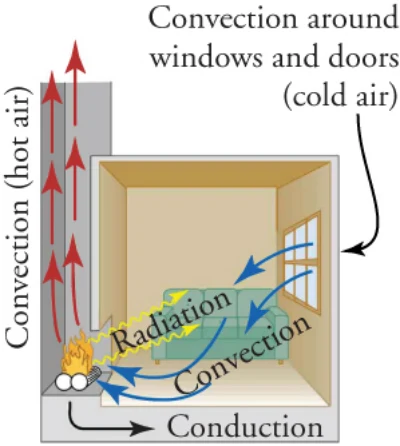
Conduction is heat transfer through direct physical contact. Heat transferred between the electric burner of a stove and the bottom of a pan is transferred by conduction. Sometimes, we try to control the conduction of heat to make ourselves more comfortable. Since the rate of heat transfer is different for different materials, we choose fabrics, such as a thick wool sweater, that slow down the transfer of heat away from our bodies in winter.
伝導とは、直接に触れ合うことによる熱の移動である。コンロの電熱器と鍋底の間で移る熱は伝導によるものである。私たちは、より快適でいるために熱の伝導を制御しようとすることがある。熱の移動の速さは材料によって違うので、冬には、厚いウールのセーターのように体から熱が逃げるのを遅らせる生地を選ぶ。
As you walk barefoot across the living room carpet, your feet feel relatively comfortable…until you step onto the kitchen’s tile floor. Since the carpet and tile floor are both at the same temperature, why does one feel colder than the other? This is explained by different rates of heat transfer: The tile material removes heat from your skin at a greater rate than the carpeting, which makes it feel colder.
居間のカーペットの上を裸足で歩くと足はわりあい心地よいが、台所のタイルの床に踏み出したとたんに変わる。カーペットもタイルの床も同じ温度なのに、なぜ一方が冷たく感じるのか。これは熱の移動の速さの違いで説明される。タイルの材質はカーペットより速く皮膚から熱を奪うので、冷たく感じるのである。
Some materials simply conduct thermal energy faster than others. In general, metals (like copper, aluminum, gold, and silver) are good heat conductors, whereas materials like wood, plastic, and rubber are poor heat conductors.
熱エネルギーを他より速く伝える材料がある。一般に金属(銅、アルミニウム、金、銀など)は熱をよく伝え、木・プラスチック・ゴムのような材料は熱をあまり伝えない。
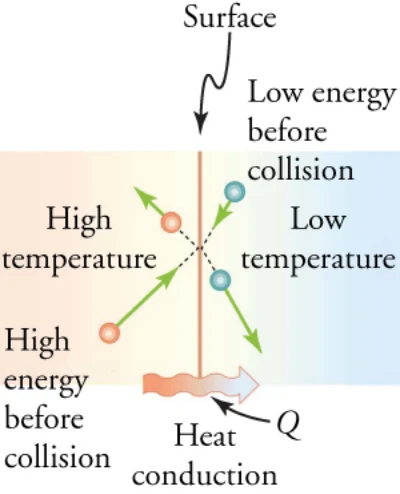
Figure 11.4 shows particles (either atoms or molecules) in two bodies at different temperatures. The (average) kinetic energy of a particle in the hot body is higher than in the colder body. If two particles collide, energy transfers from the particle with greater kinetic energy to the particle with less kinetic energy. When two bodies are in contact, many particle collisions occur, resulting in a net flux of heat from the higher-temperature body to the lower-temperature body. The heat flux depends on the temperature difference . Therefore, you will get a more severe burn from boiling water than from hot tap water.
図11.4は、温度の違う二つの物体の中の粒子(原子または分子)を示している。熱いほうの物体の粒子の(平均の)運動エネルギーは、冷たいほうより大きい。二つの粒子が衝突すると、運動エネルギーの大きい粒子から小さい粒子へエネルギーが移る。二つの物体が接触しているとき、粒子の衝突が数多く起こり、その結果、温度の高いほうから低いほうへ正味の熱の流れが生じる。熱の流れは温度差による。だから、熱い水道水よりも沸騰した湯のほうがひどいやけどになる。
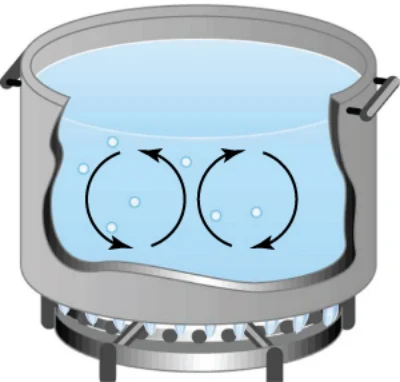
Convection is heat transfer by the movement of a fluid. This type of heat transfer happens, for example, in a pot boiling on the stove, or in thunderstorms, where hot air rises up to the base of the clouds.
対流とは、流体の移動による熱の移動である。この型の熱の移動は、たとえばコンロの上で沸騰する鍋の中や、熱い空気が雲の底へ上っていく雷雨の中で起こる。
TIPS FOR SUCCESS In everyday language, the term fluid is usually taken to mean liquid. For example, when you are sick and the doctor tells you to “push fluids,” that only means to drink more beverages—not to breath more air. However, in physics, fluid means a liquid or a gas. Fluids move differently than solid material, and even have their own branch of physics, known as fluid dynamics, that studies how they move.
学習のポイント 日常の言葉では、fluid(流体)はふつう液体を指す。たとえば病気のときに医者が「水分をとりなさい」と言うのは、飲み物をもっと飲めという意味であって、空気をもっと吸えという意味ではない。しかし物理では、流体は液体または気体を意味する。流体は固体の物質とは違う動き方をし、その動きを扱う流体力学という物理の一分野まで持っている。
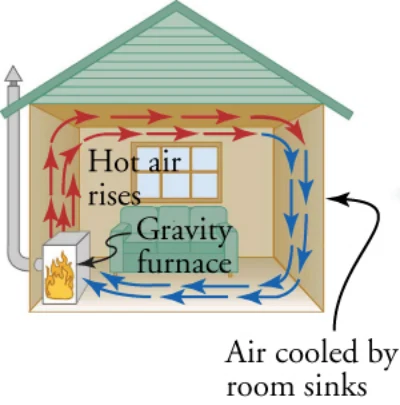
As the temperature of fluids increase, they expand and become less dense. For example, Figure 11.4 could represent the wall of a balloon with different temperature gases inside the balloon than outside in the environment. The hotter and thus faster moving gas particles inside the balloon strike the surface with more force than the cooler air outside, causing the balloon to expand. This decrease in density relative to its environment creates buoyancy (the tendency to rise). Convection is driven by buoyancy—hot air rises because it is less dense than the surrounding air.
流体は温度が上がると膨張し、密度が小さくなる。たとえば図11.4は、風船の中と外の環境で気体の温度が違う場合の、風船の膜を表しているとも読める。風船の中のより熱く、したがって速く動く気体の粒子は、外の冷たい空気より大きな力で膜を打つので、風船は膨らむ。周囲に対して密度が小さくなることが浮力(上昇しようとする傾向)を生む。対流は浮力によって駆動される。熱い空気が上るのは、周囲の空気より密度が小さいからである。
Sometimes, we control the temperature of our homes or ourselves by controlling air movement. Sealing leaks around doors with weather stripping keeps out the cold wind in winter. The house in Figure 11.5 and the pot of water on the stove in Figure 11.6 are both examples of convection and buoyancy by human design. Ocean currents and large-scale atmospheric circulation transfer energy from one part of the globe to another, and are examples of natural convection.
私たちは、空気の動きを制御することで家や自分の温度を調節することがある。戸のまわりの隙間を隙間テープでふさげば、冬の冷たい風を締め出せる。図11.5の家も、図11.6のコンロの上の鍋も、人の設計による対流と浮力の例である。海流や大規模な大気の循環は、地球のある部分から別の部分へエネルギーを運んでおり、自然の対流の例である。
Radiation is a form of heat transfer that occurs when electromagnetic radiation is emitted or absorbed.Electromagnetic radiation includes radio waves, microwaves, infrared radiation, visible light, ultraviolet radiation, X-rays, and gamma rays, all of which have different wavelengths and amounts of energy (shorter wavelengths have higher frequency and more energy).
放射とは、電磁波が放出されたり吸収されたりすることで起こる熱の移動である。電磁波には電波、マイクロ波、赤外線、可視光、紫外線、X線、ガンマ線が含まれ、それぞれ波長とエネルギーの量が違う(波長が短いほど振動数が高くエネルギーが大きい)。
You can feel the heat transfer from a fire and from the sun. Similarly, you can sometimes tell that the oven is hot without touching its door or looking inside—it may just warm you as you walk by. Another example is thermal radiation from the human body; people are constantly emitting infrared radiation, which is not visible to the human eye, but is felt as heat.
火や太陽からの熱の移動は感じ取れる。同じように、扉に触れも中を覗きもせずにオーブンが熱いと分かることがある。そばを通っただけで温かさを感じるからである。もう一つの例が人体からの熱放射である。人はたえず赤外線を出しており、それは目には見えないが熱として感じられる。
Radiation is the only method of heat transfer where no medium is required, meaning that the heat doesn’t need to come into direct contact with or be transported by any matter. The space between Earth and the sun is largely empty, without any possibility of heat transfer by convection or conduction. Instead, heat is transferred by radiation, and Earth is warmed as it absorbs electromagnetic radiation emitted by the sun.
放射は、媒質を必要としない唯一の熱の移動のしかたである。すなわち、熱が物質に直接触れたり物質に運ばれたりする必要がない。地球と太陽の間の空間はほとんど何もなく、対流や伝導で熱が移動する余地はない。かわりに熱は放射で移動し、地球は太陽が放つ電磁波を吸収して温められる。
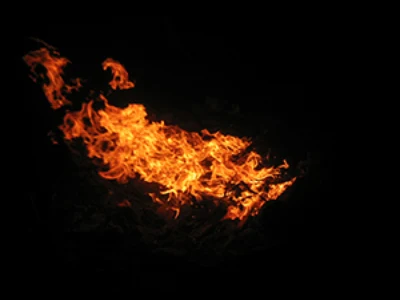
All objects absorb and emit electromagnetic radiation (see Figure 11.7). The rate of heat transfer by radiation depends mainly on the color of the object. Black is the most effective absorber and radiator, and white is the least effective. People living in hot climates generally avoid wearing black clothing, for instance. Similarly, black asphalt in a parking lot will be hotter than adjacent patches of grass on a summer day, because black absorbs better than green. The reverse is also true—black radiates better than green. On a clear summer night, the black asphalt will be colder than the green patch of grass, because black radiates energy faster than green. In contrast, white is a poor absorber and also a poor radiator. A white object reflects nearly all radiation, like a mirror.
あらゆる物体が電磁波を吸収し、また放出する(図11.7を見よ)。放射による熱の移動の速さは、おもに物体の色による。黒が最もよく吸収し、最もよく放射し、白が最も苦手である。たとえば暑い土地に住む人は、ふつう黒い服を避ける。同じように、夏の日には駐車場の黒いアスファルトが、隣の芝生よりも熱くなる。黒は緑よりよく吸収するからである。逆もまた成り立つ——黒は緑よりよく放射する。晴れた夏の夜には、黒いアスファルトのほうが緑の芝生より冷たくなる。黒は緑より速くエネルギーを放射するからである。これに対して白は、吸収も放射も苦手である。白い物体は、鏡のようにほとんどの放射を反射する。
VIRTUAL PHYSICSシミュレーションEnergy Forms and Changesエネルギーの形と変化
In this animation (https://openstax.org/l/28energyForms), you will explore heat transfer with different materials. Experiment with heating and cooling the iron, brick, and water. This is done by dragging and dropping the object onto the pedestal and then holding the lever either to Heat or Cool. Drag a thermometer beside each object to measure its temperature—you can watch how quickly it heats or cools in real time.
このアニメーション(https://openstax.org/l/28energyForms)では、いろいろな材料での熱の移動を調べる。鉄、れんが、水を温めたり冷やしたりしてみよう。物体を台の上へドラッグ&ドロップし、レバーを「加熱」または「冷却」に保つ。それぞれの物体のそばに温度計をドラッグして温度を測れば、どれだけ速く温まり、また冷えるかをその場で見ることができる。
Now let’s try transferring heat between objects. Heat the brick and then place it in the cool water. Now heat the brick again, but then place it on top of the iron. What do you notice?
次に、物体どうしの間で熱を移してみよう。れんがを温めてから冷たい水の中に入れる。もう一度れんがを温め、今度は鉄の上に置く。何に気づくだろうか。
Selecting the fast forward option lets you speed up the heat transfers, to save time.
早送りを選べば熱の移動を速められるので、時間を節約できる。
Compare how quickly the different materials are heated or cooled. Based on these results, what material do you think has the greatest specific heat? Why? Which has the smallest specific heat? Can you think of a real-world situation where you would want to use an object with large specific heat?
それぞれの材料がどれだけ速く温まり、また冷えるかを比べよう。この結果から、比熱が最も大きいのはどの材料だと思うか。それはなぜか。最も小さいのはどれか。比熱の大きい物体を使いたくなる現実の場面を思いつけるだろうか。
a. Water will take the longest, and iron will take the shortest time to heat, as well as to cool. Objects with greater specific heat would be desirable for insulation. For instance, woolen clothes with large specific heat would prevent heat loss from the body.b. Water will take the shortest, and iron will take the longest time to heat, as well as to cool. Objects with greater specific heat would be desirable for insulation. For instance, woolen clothes with large specific heat would prevent heat loss from the body.c. Brick will take shortest and iron will take longest time to heat up as well as to cool down. Objects with greater specific heat would be desirable for insulation. For instance, woolen clothes with large specific heat would prevent heat loss from the body.d. Water will take shortest and brick will take longest time to heat up as well as to cool down. Objects with greater specific heat would be desirable for insulation. For instance, woolen clothes with large specific heat would prevent heat loss from the body.
a. 温めるのにも冷やすのにも、水が最も長くかかり、鉄が最も短い。比熱の大きい物体は断熱に向く。たとえば比熱の大きい毛織の衣服は、体からの熱の逃げを防ぐ。b. 温めるのにも冷やすのにも、水が最も短く、鉄が最も長くかかる。比熱の大きい物体は断熱に向く。たとえば比熱の大きい毛織の衣服は、体からの熱の逃げを防ぐ。c. 温めるのにも冷やすのにも、れんがが最も短く、鉄が最も長くかかる。比熱の大きい物体は断熱に向く。たとえば比熱の大きい毛織の衣服は、体からの熱の逃げを防ぐ。d. 温めるのにも冷やすのにも、水が最も短く、れんがが最も長くかかる。比熱の大きい物体は断熱に向く。たとえば比熱の大きい毛織の衣服は、体からの熱の逃げを防ぐ。
Solving Heat Transfer Problems熱の移動の問題を解く
Calculating the Required Heat: Heating Water in an Aluminum Pan A 0.500 kg aluminum pan on a stove is used to heat 0.250 L of water from 20.0 to 80.0 . (a) How much heat is required? What percentage of the heat is used to raise the temperature of (b) the pan and (c) the water?Strategy
必要な熱を計算する:アルミの鍋で水を温める コンロの上の0.500 kgのアルミ鍋で、0.250 Lの水を20.0 から80.0 まで温める。(a)必要な熱はいくらか。(b)鍋と(c)水の温度を上げるのに使われた熱は、それぞれ全体の何パーセントか。方針
The pan and the water are always at the same temperature. When you put the pan on the stove, the temperature of the water and the pan is increased by the same amount. We use the equation for heat transfer for the given temperature change and masses of water and aluminum. The specific heat values for water and aluminum are given in the previous table.
鍋と水はつねに同じ温度である。鍋をコンロにかけると、水と鍋の温度は同じだけ上がる。与えられた温度変化と、水およびアルミの質量に対して、熱の移動の式を使う。水とアルミの比熱の値は前の表にある。
Solution to (a)(a)の解答
Because the water is in thermal contact with the aluminum, the pan and the water are at the same temperature.
水はアルミと熱的に接しているので、鍋と水は同じ温度である。
1. Calculate the temperature difference.
1. 温度差を計算する。
2. Calculate the mass of water using the relationship between density, mass, and volume. Density is mass per unit volume, or . Rearranging this equation, solve for the mass of water.
2. 密度・質量・体積の関係を使って水の質量を計算する。密度とは単位体積あたりの質量、すなわちである。この式を変形して水の質量について解く。
3. Calculate the heat transferred to the water. Use the specific heat of water in the previous table.
3. 水へ移った熱を計算する。前の表にある水の比熱を使う。
4. Calculate the heat transferred to the aluminum. Use the specific heat for aluminum in the previous table.
4. アルミへ移った熱を計算する。前の表にあるアルミの比熱を使う。
5. Find the total transferred heat.
5. 移った熱の合計を求める。
Solution to (b)(b)の解答
The percentage of heat going into heating the pan is
鍋を温めるのに使われた熱の割合は
Solution to (c)(c)の解答
The percentage of heat going into heating the water is
水を温めるのに使われた熱の割合は
Discussion考察
In this example, most of the total heat transferred is used to heat the water, even though the pan has twice as much mass. This is because the specific heat of water is over four times greater than the specific heat of aluminum.Therefore, it takes a bit more than twice as much heat to achieve the given temperature change for the water than for the aluminum pan.
この例では、鍋の質量が水の2倍あるにもかかわらず、移った熱の大半が水を温めるのに使われている。水の比熱がアルミの4倍以上あるからである。したがって、同じ温度変化を起こすのに、水にはアルミの鍋の2倍を少し超える熱が要る。
Water can absorb a tremendous amount of energy with very little resulting temperature change. This property of water allows for life on Earth because it stabilizes temperatures. Other planets are less habitable because wild temperature swings make for a harsh environment. You may have noticed that climates closer to large bodies of water, such as oceans, are milder than climates landlocked in the middle of a large continent. This is due to the climate-moderating effect of water’s large heat capacity—water stores large amounts of heat during hot weather and releases heat gradually when it’s cold outside.
水は、温度をほとんど変えずに途方もない量のエネルギーを吸収できる。この水の性質は温度を安定させるので、地球の生命を可能にしている。他の惑星は、激しい温度の振れが過酷な環境を作るため、住みにくい。海のような大きな水のかたまりに近い気候のほうが、大陸の真ん中で海から隔たった気候より穏やかなことに気づいたことがあるだろう。これは水の大きな熱容量が気候を和らげる働きによる——水は暑いときに大量の熱を蓄え、外が寒くなると少しずつ熱を放す。
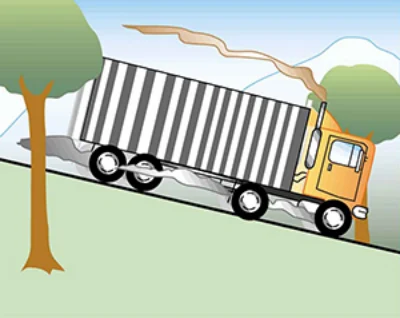
Calculating Temperature Increase: Truck Brakes Overheat on Downhill Runs When a truck headed downhill brakes, the brakes must do work to convert the gravitational potential energy of the truck to internal energy of the brakes. This conversion prevents the gravitational potential energy from being converted into kinetic energy of the truck, and keeps the truck from speeding up and losing control. The increased internal energy of the brakes raises their temperature. When the hill is especially steep, the temperature increase may happen too quickly and cause the brakes to overheat.Calculate the temperature increase of 100 kg of brake material with an average specific heat of 800 J/kg from a 10,000 kg truck descending 75.0 m (in vertical displacement) at a constant speed.
温度上昇を計算する:下り坂でトラックのブレーキが過熱する 下り坂に向かうトラックがブレーキをかけるとき、ブレーキはトラックの重力による位置エネルギーをブレーキの内部エネルギーへ変える仕事をしなければならない。この変換によって、位置エネルギーがトラックの運動エネルギーへ変わるのが防がれ、トラックが速度を上げて制御を失うのを防いでいる。ブレーキの内部エネルギーが増えると、その温度が上がる。坂がとくに急なとき、温度の上昇が速すぎてブレーキが過熱することがある。10,000 kgのトラックが(鉛直方向に)75.0 m降りるのを一定の速さで行うとき、平均の比熱が800 J/kg のブレーキ材100 kgの温度上昇を計算せよ。
Strategy方針
We first calculate the gravitational potential energy (Mgh) of the truck, and then find the temperature increase produced in the brakes.
まずトラックの重力による位置エネルギー(Mgh)を計算し、それからブレーキに生じる温度上昇を求める。
Solution解答
1. Calculate the change in gravitational potential energy as the truck goes downhill.
1. トラックが坂を降りるときの重力による位置エネルギーの変化を計算する。
2. Calculate the temperature change from the heat transferred by rearranging the equation to solve for
2. 式を変形してについて解き、移った熱から温度変化を計算する。
where m is the mass of the brake material (not the entire truck). Insert the values Q = 7.35×10⁶ J (since the heat transfer is equal to the change in gravitational potential energy), m 100 kg, and c 800 J/kg to find
ここでmは(トラック全体ではなく)ブレーキ材の質量である。Q = 7.35×10⁶ J(熱の移動は重力による位置エネルギーの変化に等しいから)、m 100 kg、c 800 J/kg を入れると
Discussion考察
This temperature is close to the boiling point of water. If the truck had been traveling for some time, then just before the descent, the brake temperature would likely be higher than the ambient temperature. The temperature increase in the descent would likely raise the temperature of the brake material above the boiling point of water, which would be hard on the brakes. This is why truck drivers sometimes use a different technique for called “engine braking” to avoid burning their brakes during steep descents. Engine braking is using the slowing forces of an engine in low gear rather than brakes to slow down.
この温度は水の沸点に近い。トラックがしばらく走っていたなら、坂を下り始める直前のブレーキの温度は、周囲の気温より高くなっているだろう。下りでの温度上昇によって、ブレーキ材の温度は水の沸点を超えると考えられ、ブレーキには過酷である。トラックの運転手が、急な下り坂でブレーキを焼かないために「エンジンブレーキ」という別のやり方を使うことがあるのはこのためである。エンジンブレーキとは、ブレーキではなく低いギアに入れたエンジンの減速する力を使って速度を落とすことである。
Practice Problems練習問題
5How much heat does it take to raise the temperature of 10.0 kg of water by 1.0 °C ?
510.0 kgの水の温度を1.0 ℃上げるには、どれだけの熱が要るか。
a. 84 Jb. 42 J
a. 84 Jb. 42 J
c. 84 kJd. 42 kJ
c. 84 kJd. 42 kJ
6Calculate the change in temperature of 1.0 kg of water that is initially at room temperature if 3.0 kJ of heat is added.
6はじめ室温にある1.0 kgの水に3.0 kJの熱を加えたときの温度変化を計算せよ。
a. 358 °Cb. 716 °Cc. 0.36 °Cd. 0.72 °C
a. 358 ℃b. 716 ℃c. 0.36 ℃d. 0.72 ℃
Check Your Understanding理解の確認
7What causes heat transfer?a. The mass difference between two objects causes heat transfer.b. The density difference between two objects causes heat transfer.
7熱の移動を起こすのは何か。a. 二つの物体の質量の差が熱の移動を起こす。b. 二つの物体の密度の差が熱の移動を起こす。
c. The temperature difference between two systems causes heat transfer.d. The pressure difference between two objects causes heat transfer.
c. 二つの系の温度の差が熱の移動を起こす。d. 二つの物体の圧力の差が熱の移動を起こす。
8When two bodies of different temperatures are in contact, what is the overall direction of heat transfer?a. The overall direction of heat transfer is from the higher-temperature object to the lower-temperature object.b. The overall direction of heat transfer is from the lower-temperature object to the higher-temperature object.c. The direction of heat transfer is first from the lower-temperature object to the higher-temperature object, then back again to the lower-temperature object, and so-forth, until the objects are in thermal equilibrium.d. The direction of heat transfer is first from the higher-temperature object to the lower-temperature object, then back again to the higher-temperature object, and so-forth, until the objects are in thermal equilibrium.
8温度の違う二つの物体が接しているとき、熱の移動の全体としての向きはどちらか。a. 熱の移動の全体としての向きは、温度の高い物体から低い物体へである。b. 熱の移動の全体としての向きは、温度の低い物体から高い物体へである。c. 熱の移動の向きは、まず温度の低い物体から高い物体へ、次にまた低い物体へ、と繰り返し、熱平衡に達するまで続く。d. 熱の移動の向きは、まず温度の高い物体から低い物体へ、次にまた高い物体へ、と繰り返し、熱平衡に達するまで続く。
9What are the different methods of heat transfer?a. conduction, radiation, and reflectionb. conduction, reflection, and convection
9熱の移動のしかたにはどんなものがあるか。a. 伝導、放射、反射b. 伝導、反射、対流
c. convection, radiation, and reflectiond. conduction, radiation, and convection
c. 対流、放射、反射d. 伝導、放射、対流
10True or false—Conduction and convection cannot happen simultaneouslya. Trueb. False
10正誤問題——伝導と対流は同時には起こりえない。a. 正b. 誤