第11章熱エネルギー、熱、仕事Thermal Energy, Heat, and Work原書 p.339–368
11.3 Phase Change and Latent Heat11.3 相変化と潜熱
SECTION LEARNING OBJECTIVES By the end of this section, you will be able to do the following:
この節の学習目標 この節を終えると、次のことができるようになる。
• Explain changes in heat during changes of state, and describe latent heats of fusion and vaporization• Solve problems involving thermal energy changes when heating and cooling substances with phase changes
・状態変化のときの熱の変化を説明し、融解の潜熱と気化の潜熱を述べる・相変化をともなう物質の加熱・冷却における熱エネルギーの変化に関する問題を解く
Section Key Termsこの節の重要語
condensationfreezinglatent heatsublimationlatent heat of fusionlatent heat of vaporizationmeltingvaporizationphase changephase diagramplasma
凝縮凝固潜熱昇華融解の潜熱気化の潜熱融解気化相変化相図プラズマ
Phase Changes相変化
So far, we have learned that adding thermal energy by heat increases the temperature of a substance. But surprisingly, there are situations where adding energy does not change the temperature of a substance at all! Instead, the additional thermal energy acts to loosen bonds between molecules or atoms and causes a phase change. Because this energy enters or leaves a system during a phase change without causing a temperature change in the system, it is known as latent heat (latent means hidden).
ここまで、熱によって熱エネルギーを加えると物質の温度が上がることを学んできた。ところが驚いたことに、エネルギーを加えても物質の温度がまったく変わらない場合がある。そのとき、加えられた熱エネルギーは分子や原子の間の結びつきをゆるめる働きをし、相変化を起こす。このエネルギーは、相変化のあいだ系の温度を変えずに系へ入り、また出ていくので、潜熱と呼ばれる(潜とは隠れているという意味である)。
The three phases of matter that you frequently encounter are solid, liquid and gas (see Figure 11.8). Solid has the least energetic state; atoms in solids are in close contact, with forces between them that allow the particles to vibrate but not change position with neighboring particles. (These forces can be thought of as springs that can be stretched or compressed, but not easily broken.)
よく出会う物質の三つの相は、固体、液体、気体である(図11.8を見よ)。固体は最もエネルギーの低い状態である。固体の中の原子はごく近くで接していて、その間にはたらく力によって粒子は振動できるが、隣の粒子と位置を入れ替えることはできない。(この力は、伸び縮みはするが簡単には切れないばねだと考えるとよい。)
Liquid has a more energetic state, in which particles can slide smoothly past one another and change neighbors, although they are still held together by their mutual attraction.
液体はもう少しエネルギーの高い状態で、粒子どうしがなめらかに滑り合い、隣を入れ替えられる。とはいえ互いの引力によってまとまってはいる。
Gas has a more energetic state than liquid, in which particles are broken free of their bonds. Particles in gases are separated by distances that are large compared with the size of the particles.
気体は液体よりさらにエネルギーの高い状態で、粒子が結びつきから解き放たれている。気体の中の粒子どうしは、粒子の大きさにくらべて大きな距離で隔てられている。
The most energetic state of all is plasma. Although you may not have heard much about plasma, it is actually the most common state of matter in the universe—stars are made up of plasma, as is lightning. The plasma state is reached by heating a gas to the point where particles are pulled apart, separating the electrons from the rest of the particle. This produces an ionized gas that is a combination of the negatively charged free electrons and positively charged ions, known as plasma.
最もエネルギーの高い状態がプラズマである。プラズマの話はあまり聞いたことがないかもしれないが、実は宇宙で最もありふれた物質の状態であり、恒星はプラズマでできているし、稲妻もそうである。プラズマの状態は、気体を、粒子が引き裂かれて電子が粒子の残りから離れるところまで加熱すると得られる。こうして負の電荷を持つ自由電子と正の電荷を持つイオンが混ざったイオン化した気体ができる。これがプラズマである。
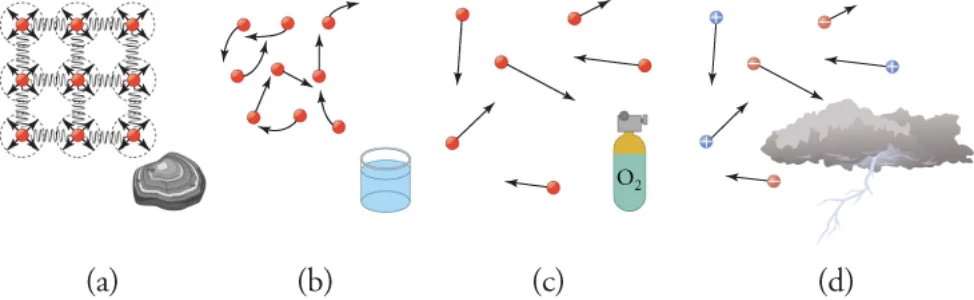
During a phase change, matter changes from one phase to another, either through the addition of energy by heat and the transition to a more energetic state, or from the removal of energy by heat and the transition to a less energetic state.
相変化のとき、物質はある相から別の相へ変わる。熱によってエネルギーを加えられてよりエネルギーの高い状態へ移るか、熱によってエネルギーを奪われてよりエネルギーの低い状態へ移るかのどちらかである。
Phase changes to a more energetic state include the following:
よりエネルギーの高い状態への相変化には次のものがある。
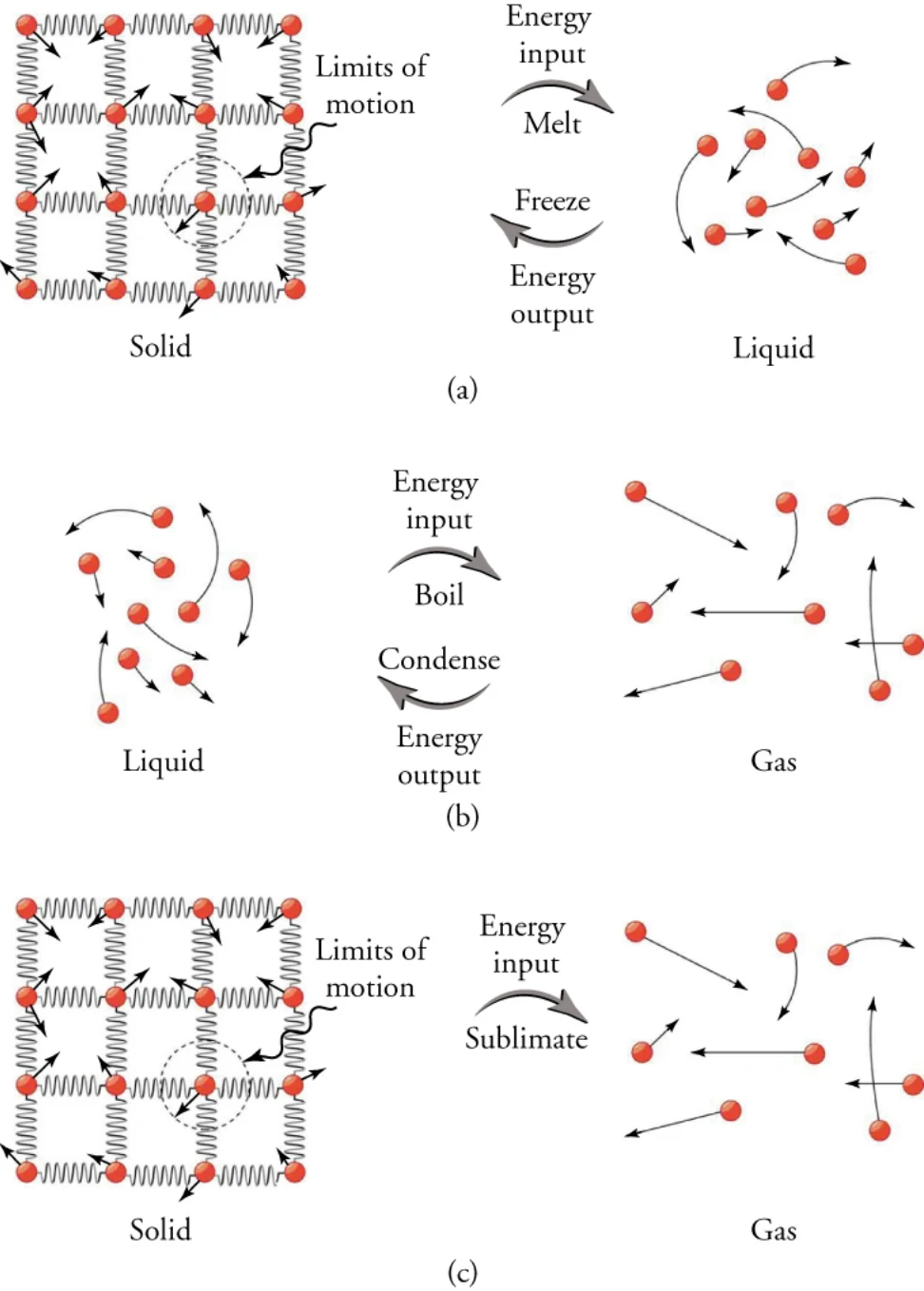
• Melting—Solid to liquid• Vaporization—Liquid to gas (included boiling and evaporation)• Sublimation—Solid to gas• IonizationGas to plasma
・融解——固体から液体へ・気化——液体から気体へ(沸騰と蒸発を含む)・昇華——固体から気体へ・イオン化——気体からプラズマへ
Phase changes to a less energetic state are as follows:
よりエネルギーの低い状態への相変化は次のとおりである。
• Condensation—Gas to liquid• Freezing—Liquid to solid• Recombination—Plasma to gas• DepositionGas to solid
・凝縮——気体から液体へ・凝固——液体から固体へ・再結合——プラズマから気体へ・凝華——気体から固体へ
Energy is required to melt a solid because the bonds between the particles in the solid must be broken. Since the energy involved in a phase changes is used to break bonds, there is no increase in the kinetic energies of the particles, and therefore no rise in temperature. Similarly, energy is needed to vaporize a liquid to overcome the attractive forces between particles in the liquid. There is no temperature change until a phase change is completed. The temperature of a cup of soda and ice that is initially at 0 stays at 0 until all of the ice has melted. In the reverse of these processes—freezing and condensation—energy is released from the latent heat (see Figure 11.9).
固体を融かすにはエネルギーが要る。固体の中の粒子どうしの結びつきを断たねばならないからである。相変化に関わるエネルギーは結びつきを断つのに使われるので、粒子の運動エネルギーは増えず、したがって温度も上がらない。同じように、液体を気化させるには、液体の中の粒子間の引力に打ち勝つエネルギーが要る。相変化が終わるまで温度は変わらない。はじめ0 にあるソーダと氷の入ったカップの温度は、氷がすべて融けきるまで0 のままである。これらの逆の過程——凝固と凝縮——では、潜熱としてエネルギーが放出される(図11.9を見よ)。
The heat, Q, required to change the phase of a sample of mass m is
質量mの試料の相を変えるのに必要な熱Qは
(for vaporization/condensation),
(気化・凝縮の場合)
where is the latent heat of fusion, and is the latent heat of vaporization. The latent heat of fusion is the amount of heat needed to cause a phase change between solid and liquid. The latent heat of vaporization is the amount of heat needed to cause a phase change between liquid and gas. and are coefficients that vary from substance to substance, depending on the strength of intermolecular forces, and both have standard units of J/kg. See Table 11.3 for values of and of different substances.
ここでは融解の潜熱、は気化の潜熱である。融解の潜熱とは、固体と液体の間の相変化を起こすのに必要な熱の量である。気化の潜熱とは、液体と気体の間の相変化を起こすのに必要な熱の量である。とは、分子間力の強さに応じて物質ごとに違う係数であり、いずれも標準の単位はJ/kgである。さまざまな物質のとの値は表11.3を見よ。
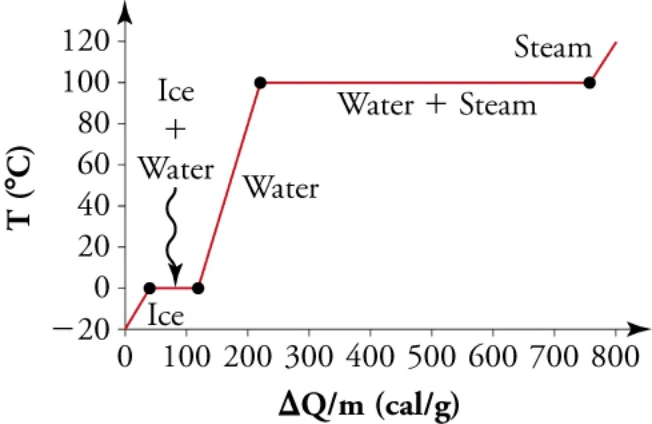
Let’s consider the example of adding heat to ice to examine its transitions through all three phases—solid to liquid to gas. A phase diagram indicating the temperature changes of water as energy is added is shown in Figure 11.10. The ice starts out at −20 , and its temperature rises linearly, absorbing heat at a constant rate until it reaches 0 Once at this temperature, the ice gradually melts, absorbing 334 kJ/kg. The temperature remains constant at 0 during this phase change. Once all the ice has melted, the temperature of the liquid water rises, absorbing heat at a new constant rate. At 100 , the water begins to boil and the temperature again remains constant while the water absorbs 2256 kJ/kg during this phase change. When all the liquid has become steam, the temperature rises again at a constant rate.
氷に熱を加える例を考えて、固体から液体、液体から気体という三つの相すべての移り変わりを調べてみよう。エネルギーを加えたときの水の温度変化を示す相図を図11.10に示す。氷は−20 から始まり、その温度は一定の割合で熱を吸収しながら直線的に上がり、0 に達する。この温度になると氷は少しずつ融け、334 kJ/kgを吸収する。この相変化のあいだ、温度は0 のまま変わらない。氷がすべて融けきると、液体の水の温度が、新たな一定の割合で熱を吸収しながら上がっていく。100 で水は沸騰し始め、この相変化のあいだ2256 kJ/kgを吸収しながら、温度はふたたび一定のままとなる。液体がすべて水蒸気になると、温度はまた一定の割合で上がる。
We have seen that vaporization requires heat transfer to a substance from its surroundings. Condensation is the reverse process, where heat in transferred away from a substance to its surroundings. This release of latent heat increases the temperature of the surroundings. Energy must be removed from the condensing particles to make a vapor condense. This is why condensation occurs on cold surfaces: the heat transfers energy away from the warm vapor to the cold surface. The energy is exactly the same as that required to cause the phase change in the other direction, from liquid to vapor, and so it can be calculated from . Latent heat is also released into the environment when a liquid freezes, and can be calculated from .
気化には、物質が周囲から熱を受け取ることが要るのを見た。凝縮はその逆の過程で、物質から周囲へ熱が移る。この潜熱の放出は周囲の温度を上げる。蒸気を凝縮させるには、凝縮する粒子からエネルギーを取り去らねばならない。冷たい面で結露が起こるのはこのためである。熱が、温かい蒸気から冷たい面へエネルギーを移すのである。このエネルギーは、逆向き、すなわち液体から蒸気への相変化を起こすのに必要なエネルギーとちょうど同じであり、したがってから計算できる。液体が凍るときにも潜熱が周囲へ放出され、から計算できる。
Ice cream is certainly easy enough to buy at the supermarket, but for the hardcore ice cream enthusiast, that may not be satisfying enough. Going through the process of making your own ice cream lets you invent your own flavors and marvel at the physics firsthand (Figure 11.11).
アイスクリームはスーパーで買えば済むのはたしかだが、筋金入りの愛好家にはそれでは物足りないかもしれない。自分でアイスクリームを作る過程を通れば、自分だけの味を考え出し、物理をその場で目の当たりにできる(図11.11)。
The first step to making homemade ice cream is to mix heavy cream, whole milk, sugar, and your flavor of choice; it could be as simple as cocoa powder or vanilla extract, or as fancy as pomegranates or pistachios.
手作りアイスクリームの第一歩は、生クリーム、全乳、砂糖、そして好みの風味を混ぜることである。ココアパウダーやバニラエッセンスのように簡単なものでも、ザクロやピスタチオのように凝ったものでもよい。
The next step is to pour the mixture into a container that is deep enough that you will be able to churn the mixture without it spilling over, and that is also freezer-safe. After placing it in the freezer, the ice cream has to be stirred vigorously every 45 minutes for four to five hours. This slows the freezing process and prevents the ice cream from turning into a solid block of ice. Most people prefer a soft creamy texture instead of one giant popsicle.
次に、混ぜてもあふれない程度に深く、冷凍しても大丈夫な容器へ混合物を注ぐ。冷凍庫に入れたあと、四、五時間のあいだ45分ごとに勢いよくかき混ぜなければならない。これは凍る過程を遅らせ、アイスクリームが一つの氷の塊になるのを防ぐ。たいていの人は、巨大なアイスキャンディーより、やわらかくクリーミーな舌ざわりを好む。
As it freezes, the cream undergoes a phase change from liquid to solid. By now, we’re experienced enough to know that this means that the cream must experience a loss of heat. Where does that heat go? Due to the temperature difference between the freezer and the ice cream mixture, heat transfers thermal energy from the ice cream to the air in the freezer. Once the temperature in the freezer rises enough, the freezer is cooled by pumping excess heat outside into the kitchen.
凍っていくとき、クリームは液体から固体への相変化を起こす。ここまで来れば、それはクリームが熱を失うはずだということを意味すると分かる。その熱はどこへ行くのか。冷凍庫とアイスクリームの混合物の温度差によって、熱がアイスクリームから冷凍庫の中の空気へ熱エネルギーを移す。冷凍庫の中の温度が十分に上がると、余分な熱が台所へ汲み出されて冷凍庫が冷やされる。
A faster way to make ice cream is to chill it by placing the mixture in a plastic bag, surrounded by another plastic bag half full of ice. (You can also add a teaspoon of salt to the outer bag to lower the temperature of the ice/salt mixture.) Shaking the bag for five minutes churns the ice cream while cooling it evenly. In this case, the heat transfers energy out of the ice cream mixture and into the ice during the phase change.
もっと速くアイスクリームを作るには、混合物をビニール袋に入れ、その外を氷を半分入れた別のビニール袋で包んで冷やす。(外側の袋に小さじ一杯の塩を加えれば、氷と塩の混合物の温度を下げられる。)袋を5分間振れば、均一に冷やしながらアイスクリームをかき混ぜられる。この場合、相変化のあいだ、熱はアイスクリームの混合物からエネルギーを取り出して氷へ移す。
This video (http://www.openstax.org/l/28icecream) gives a demonstration of how to make home-made ice cream using ice and plastic bags.
この動画(http://www.openstax.org/l/28icecream)は、氷とビニール袋で手作りアイスクリームを作るやり方を実演している。
Why does the ice bag method work so much faster than the freezer method for making ice cream?
アイスクリームを作るのに、氷の袋のやり方が冷凍庫のやり方よりずっと速いのはなぜか。
a. Ice has a smaller specific heat than the surrounding air in a freezer. Hence, it absorbs more energy from the ice-cream mixture.b. Ice has a smaller specific heat than the surrounding air in a freezer. Hence, it absorbs less energy from the ice-cream mixture.c. Ice has a greater specific heat than the surrounding air in a freezer. Hence, it absorbs more energy from the ice-cream mixture.d. Ice has a greater specific heat than the surrounding air in a freezer. Hence, it absorbs less energy from the ice-cream mixture.
a. 氷は冷凍庫の中の空気より比熱が小さい。したがってアイスクリームの混合物からより多くのエネルギーを吸収する。b. 氷は冷凍庫の中の空気より比熱が小さい。したがってアイスクリームの混合物から吸収するエネルギーは少ない。c. 氷は冷凍庫の中の空気より比熱が大きい。したがってアイスクリームの混合物からより多くのエネルギーを吸収する。d. 氷は冷凍庫の中の空気より比熱が大きい。したがってアイスクリームの混合物から吸収するエネルギーは少ない。
Calculating Heat Required for a Phase Change Calculate a) how much energy is needed to melt 1.000 kg of ice at 0 (freezing point), and b) how much energy is required to vaporize 1.000 kg of water at 100 (boiling point).Strategy FOR (A)
相変化に必要な熱を計算する (a)0 (凝固点)の氷1.000 kgを融かすのにどれだけのエネルギーが要るか、(b)100 (沸点)の水1.000 kgを気化させるのにどれだけのエネルギーが要るかを計算せよ。(a)の方針
Using the equation for the heat required for melting, and the value of the latent heat of fusion of water from the previous table, we can solve for part (a).
融解に必要な熱の式と、前の表にある水の融解の潜熱の値を使えば、(a)を解ける。
Solution to (a)(a)の解答
The energy to melt 1.000 kg of ice is
氷1.000 kgを融かすエネルギーは
Strategy FOR (B)(b)の方針
To solve part (b), we use the equation for heat required for vaporization, along with the latent heat of vaporization of water from the previous table.
(b)を解くには、気化に必要な熱の式と、前の表にある水の気化の潜熱を使う。
Solution to (b)(b)の解答
The energy to vaporize 1.000 kg of liquid water is
液体の水1.000 kgを気化させるエネルギーは
Discussion考察
The amount of energy need to melt a kilogram of ice (334 kJ) is the same amount of energy needed to raise the temperature of 1.000 kg of liquid water from 0 to 79.8 . This example shows that the energy for a phase change is enormous compared to energy associated with temperature changes. It also demonstrates that the amount of energy needed for vaporization is even greater.
氷1キログラムを融かすのに必要なエネルギー(334 kJ)は、液体の水1.000 kgの温度を0 から79.8 まで上げるのに必要なエネルギーと同じである。この例は、相変化のためのエネルギーが、温度変化にともなうエネルギーにくらべて途方もなく大きいことを示している。また、気化に必要なエネルギーはそれよりさらに大きいことも示している。
Calculating Final Temperature from Phase Change: Cooling Soda with Ice Cubes Ice cubes are used to chill a soda at 20 and with a mass of . The ice is at 0 and the total mass of the ice cubes is 0.018 kg. Assume that the soda is kept in a foam container so that heat loss can be ignored, and that the soda has the same specific heat as water. Find the final temperature when all of the ice has melted. Strategy
相変化から最終温度を計算する:氷でソーダを冷やす 20 、質量のソーダを氷で冷やす。氷は0 にあり、氷全体の質量は0.018 kgである。ソーダは発泡スチロールの容器に入っていて熱の逃げは無視でき、ソーダの比熱は水と同じだとする。氷がすべて融けたときの最終温度を求めよ。 方針
The ice cubes are at the melting temperature of 0 . Heat is transferred from the soda to the ice for melting. Melting of ice occurs in two steps: first, the phase change occurs and solid (ice) transforms into liquid water at the melting temperature; then, the temperature of this water rises. Melting yields water at 0 , so more heat is transferred from the soda to this water until they are the same temperature. Since the amount of heat leaving the soda is the same as the amount of heat transferred to the ice.
氷は融ける温度である0 にある。融解のために熱がソーダから氷へ移る。氷の融解は二段階で起こる。まず相変化が起こり、固体(氷)が融ける温度で液体の水に変わる。次にこの水の温度が上がる。融解は0 の水を生むので、両者が同じ温度になるまで、ソーダからこの水へさらに熱が移る。ソーダから出ていく熱の量は、氷へ移る熱の量と同じだから、
The heat transferred to the ice goes partly toward the phase change (melting), and partly toward raising the temperature after melting. Recall from the last section that the relationship between heat and temperature change is . For the ice, the temperature change is . The total heat transferred to the ice is therefore
氷へ移った熱は、一部が相変化(融解)に、一部が融けたあとの温度上昇に使われる。前の節から、熱と温度変化の関係がであったことを思い出そう。氷については、温度変化はである。したがって氷へ移った熱の合計は
Since the soda doesn’t change phase, but only temperature, the heat given off by the soda is
ソーダは相を変えず温度が変わるだけなので、ソーダが放出する熱は
Since ,
だから、
Bringing all terms involving to the left-hand-side of the equation, and all other terms to the right-hand-side, we can solve for .
を含む項をすべて式の左辺に、それ以外の項をすべて右辺に集めれば、について解ける。
Substituting the known quantities
既知の量を代入すると
Discussion考察
This example shows the enormous energies involved during a phase change. The mass of the ice is about 7 percent the mass of the soda, yet it causes a noticeable change in the soda’s temperature.
この例は、相変化に関わるエネルギーが途方もないことを示している。氷の質量はソーダの質量の7パーセントほどしかないのに、ソーダの温度に目に見える変化を起こしている。
TIPS FOR SUCCESS If the ice were not already at the freezing point, we would also have to factor in how much energy would go into raising its temperature up to 0 , before the phase change occurs. This would be a realistic scenario, because the temperature of ice is often below 0 .
学習のポイント 氷がまだ凝固点になければ、相変化が起こる前に、その温度を0 まで上げるのにどれだけのエネルギーが要るかも勘定に入れねばならない。氷の温度は0 より低いことが多いので、これは現実にありうる場合である。
Practice Problems練習問題
11How much energy is needed to melt 2.00 kg of ice at 0 °C ?a. 334 kJb. 336 kJ
110 ℃の氷2.00 kgを融かすには、どれだけのエネルギーが要るか。a. 334 kJb. 336 kJ
c. 167 kJd. 668 kJ
c. 167 kJd. 668 kJ
12If of energy is just enough to melt of a substance, what is the substance’s latent heat of fusion?
12のエネルギーが、ある物質をちょうど融かすのに足りるとすると、その物質の融解の潜熱はいくらか。
Check Your Understanding理解の確認
13What is latent heat?a. It is the heat that must transfer energy to or from a system in order to cause a mass change with a slight change in the temperature of the system.b. It is the heat that must transfer energy to or from a system in order to cause a mass change without a temperature change in the system.c. It is the heat that must transfer energy to or from a system in order to cause a phase change with a slight change in the temperature of the system.d. It is the heat that must transfer energy to or from a system in order to cause a phase change without a temperature change in the system.
13潜熱とは何か。a. 系の温度をわずかに変えながら質量の変化を起こすために、系へ、あるいは系から移らねばならない熱である。b. 系の温度を変えずに質量の変化を起こすために、系へ、あるいは系から移らねばならない熱である。c. 系の温度をわずかに変えながら相変化を起こすために、系へ、あるいは系から移らねばならない熱である。d. 系の温度を変えずに相変化を起こすために、系へ、あるいは系から移らねばならない熱である。
14In which phases of matter are molecules capable of changing their positions?a. gas, liquid, solidb. liquid, plasma, solid
14分子が位置を変えられるのは、物質のどの相か。a. 気体、液体、固体b. 液体、プラズマ、固体
c. liquid, gas, plasmad. plasma, gas, solid
c. 液体、気体、プラズマd. プラズマ、気体、固体