第11章熱エネルギー、熱、仕事Thermal Energy, Heat, and Work原書 p.339–368
11.1 Temperature and Thermal Energy11.1 温度と熱エネルギー
SECTION LEARNING OBJECTIVES By the end of this section, you will be able to do the following:
この節の学習目標 この節を終えると、次のことができるようになる。
• Explain that temperature is a measure of internal kinetic energy• Interconvert temperatures between Celsius, Kelvin, and Fahrenheit scales
・温度が内部の運動エネルギーを測るものであることを説明する・セルシウス、ケルビン、ファーレンハイトの各目盛りの間で温度を換算する
Section Key Termsこの節の重要語
absolute zeroCelsius scaledegree Celsiusthermal energydegree FahrenheitFahrenheit scaleheatkelvin (K)Kelvin scaletemperature
絶対零度セルシウス目盛りセルシウス度熱エネルギーファーレンハイト度ファーレンハイト目盛り熱ケルビン(K)ケルビン目盛り温度
Temperature温度
What is temperature? It’s one of those concepts so ingrained in our everyday lives that, although we know what it means intuitively, it can be hard to define. It is tempting to say that temperature measures heat, but this is not strictly true. Heat is the transfer of energy due to a temperature difference. Temperature is defined in terms of the instrument we use to tell us how hot or cold an object is, based on a mechanism and scale invented by people. Temperature is literally defined as what we measure on a thermometer.
温度とは何だろうか。日常では直感的に分かっていても、正確に定義するとなると難しい。「温度は熱を測ったもの」と言いたくなるが、温度と熱は別の概念である。熱とは、温度差によって移動するエネルギーをいう。温度を測るには、物体の温かさ・冷たさに応じて変化する性質を利用し、目盛りを定めた温度計を使う。ここでは、温度計で測られる量として温度を捉える。
Heat is often confused with temperature. For example, we may say that the heat was unbearable, when we actually mean that the temperature was high. This is because we are sensitive to the flow of energy by heat, rather than the temperature. Since heat, like work, transfers energy, it has the SI unit of joule (J).
熱はしばしば温度と混同される。たとえば「熱が耐えがたかった」と言うとき、私たちが実際に意味しているのは温度が高かったということである。これは、私たちが温度そのものよりも、熱によるエネルギーの流れに敏感だからである。熱は仕事と同じくエネルギーを移すので、SI単位はジュール(J)である。
Atoms and molecules are constantly in motion, bouncing off one another in random directions. Recall that kinetic energy is the energy of motion, and that it increases in proportion to velocity squared. Without going into mathematical detail, we can say that thermal energy—the energy associated with heat—is the average kinetic energy of the particles (molecules or atoms) in a substance. Faster moving molecules have greater kinetic energies, and so the substance has greater thermal energy, and thus a higher temperature. The total internal energy of a system is the sum of the kinetic and potential energies of its atoms and molecules. Thermal energy is one of the subcategories of internal energy, as is chemical energy.
原子と分子はたえず動き回り、無秩序な向きに互いにぶつかり合っている。運動エネルギーは運動のエネルギーであり、速度の2乗に比例して増えることを思い出そう。数学的な細部に立ち入らずに言えば、熱エネルギー——熱に結びついたエネルギー——とは、物質の中の粒子(分子や原子)の平均の運動エネルギーである。速く動く分子ほど運動エネルギーが大きく、したがって物質の熱エネルギーは大きく、温度は高い。系の全内部エネルギーは、その原子と分子の運動エネルギーと位置エネルギーの和である。熱エネルギーは、化学エネルギーと同じく、内部エネルギーの下位の区分の一つである。
To measure temperature, some scale must be used as a standard of measurement. The three most commonly used temperature scales are the Fahrenheit, Celsius, and Kelvin scales. Both the Fahrenheit scale and Celsius scale are relative temperature scales, meaning that they are made around a reference point. For example, the Celsius scale uses the freezing point of water as its reference point; all measurements are either lower than the freezing point of water by a given number of degrees (and have a negative sign), or higher than the freezing point of water by a given number of degrees (and have a positive sign). The boiling point of water is 100 for the Celsius scale, and its unit is the degree Celsius ).
温度を測るには、測定の基準としての目盛りが要る。最もよく使われる三つの温度目盛りが、ファーレンハイト、セルシウス、ケルビンの目盛りである。ファーレンハイト目盛りもセルシウス目盛りも相対的な温度目盛りであり、基準点を軸に作られている。たとえばセルシウス目盛りは水の凝固点を基準点とする。すべての測定値は、水の凝固点より何度低いか(負の符号を付ける)、何度高いか(正の符号を付ける)で表される。セルシウス目盛りでは水の沸点が100であり、その単位はセルシウス度()である。
On the Fahrenheit scale, the freezing point of water is at 32 , and the boiling point is at 212 . The unit of temperature on this scale is the degree Fahrenheit ). Note that the difference in degrees between the freezing and boiling points is greater for the Fahrenheit scale than for the Celsius scale. Therefore, a temperature difference of one degree Celsius is greater than a temperature difference of one degree Fahrenheit. Since 100 Celsius degrees span the same range as 180 Fahrenheit degrees, one degree on the Celsius scale is 1.8 times larger than one degree on the Fahrenheit scale (because ). This relationship can be used to convert between temperatures in Fahrenheit and Celsius (see Figure 11.2).
ファーレンハイト目盛りでは、水の凝固点が32、沸点が212である。この目盛りの温度の単位はファーレンハイト度()である。凝固点と沸点の間の度数の差は、セルシウス目盛りよりファーレンハイト目盛りのほうが大きいことに注意しよう。したがって、セルシウス1度の温度差は、ファーレンハイト1度の温度差より大きい。セルシウスの100度がファーレンハイトの180度と同じ幅にあたるので、セルシウス目盛りの1度はファーレンハイト目盛りの1度の1.8倍である(だから)。この関係を使えば、ファーレンハイトとセルシウスの温度を換算できる(図11.2を見よ)。
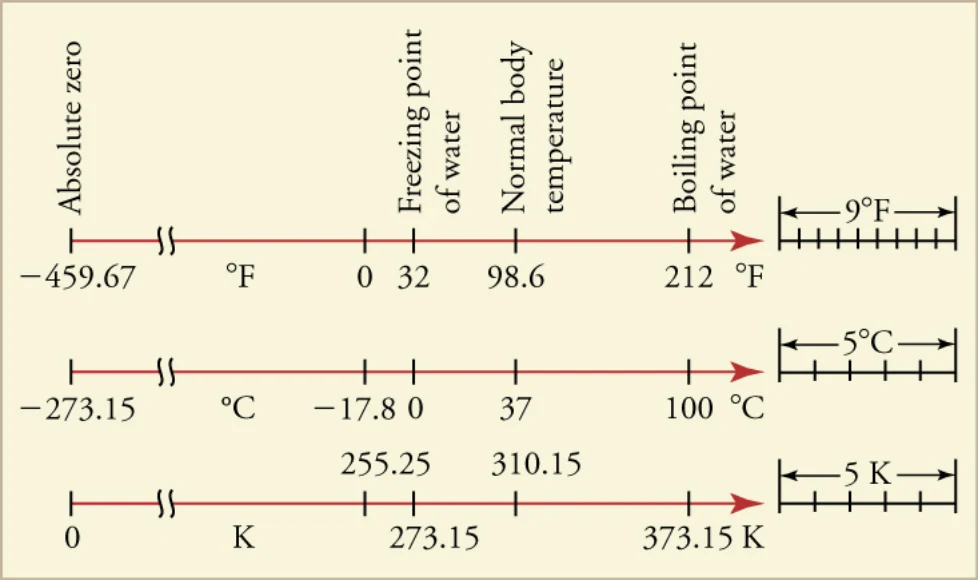
The Kelvin scale is the temperature scale that is commonly used in science because it is an absolute temperature scale. This means that the theoretically lowest-possible temperature is assigned the value of zero. Zero degrees on the Kelvin scale is known as absolute zero; it is theoretically the point at which there is no molecular motion to produce thermal energy. On the original Kelvin scale first created by Lord Kelvin, all temperatures have positive values, making it useful for scientific work. The official temperature unit on this scale is the kelvin, which is abbreviated as K. The freezing point of water is 273.15 K, and the boiling point of water is 373.15 K.
ケルビン目盛りは、絶対温度の目盛りであるため、科学でよく使われる温度目盛りである。絶対温度の目盛りとは、理論上ありうる最低の温度に0の値を与えたものである。ケルビン目盛りの0度は絶対零度と呼ばれ、理論上、熱エネルギーを生む分子の運動がまったくなくなる点である。ケルビン卿が最初に作ったもとのケルビン目盛りでは、すべての温度が正の値をとり、科学の仕事に便利である。この目盛りの公式の温度の単位はケルビンで、Kと略される。水の凝固点は273.15 K、沸点は373.15 Kである。
Although absolute zero is possible in theory, it cannot be reached in practice. The lowest temperature ever created and measured during a laboratory experiment was K, at Helsinki University of Technology in Finland. In comparison, the coldest recorded temperature for a place on Earth’s surface was 183 K (–89 °C ), at Vostok, Antarctica, and the coldest known place (outside the lab) in the universe is the Boomerang Nebula, with a temperature of 1 K. Luckily, most of us humans will never have to experience such extremes.
絶対零度は理論上ありうるが、実際に到達することはできない。実験室で作られ測定された最低の温度は、フィンランドのヘルシンキ工科大学での Kである。比べてみると、地表で記録された最低の温度は南極のボストーク基地での183 K(−89 ℃)であり、(実験室の外で)宇宙で知られている最も冷たい場所はブーメラン星雲で、温度は1 Kである。幸い、私たち人間のほとんどはこうした極端を経験せずにすむ。
The average normal body temperature is 98.6 (37.0 ), but people have been known to survive with body temperatures ranging from 75 to 111 (24 to 44 ).
平均的な正常体温は98.6(37.0)だが、75から111(24から44)の体温で生き延びた人も知られている。
Comparing Celsius and Fahrenheit Temperature Scales This video shows how the Fahrenheit and Celsius temperature scales compare to one another.
セルシウス目盛りとファーレンハイト目盛りを比べる この動画は、ファーレンハイト目盛りとセルシウス目盛りが互いにどう対応するかを示す。
Comparing Celsius and Fahrenheit temperature scales | Pre-Algebra | Khan Academy (https://www.openstax.org/l/ 02celfahtemp)
セルシウスとファーレンハイトの温度目盛りを比べる|代数入門|カーンアカデミー(https://www.openstax.org/l/02celfahtemp)
Watch Physics: Comparing Celsius and Fahrenheit Temperature Scales. This video makes a comparison between the Celsius and Fahrenheit temperature scales.Access multimedia content (http://openstax.org/books/physics/pages/11-1-temperature-and-thermal-energy) Even without the number labels on the thermometer, you could tell which side is marked Fahrenheit and which is Celsius by how the degree marks are spaced. Why?
物理を見る:セルシウス目盛りとファーレンハイト目盛りを比べる この動画はセルシウス目盛りとファーレンハイト目盛りを比べる。マルチメディア教材はこちら(http://openstax.org/books/physics/pages/11-1-temperature-and-thermal-energy) 温度計に数字が振られていなくても、目盛りの間隔からどちらがファーレンハイトでどちらがセルシウスか見分けられる。なぜか。
a. The separation between two consecutive divisions on the Fahrenheit scale is greater than a similar separation on the Celsius scale, because each degree Fahrenheit is equal to degrees Celsius.b. The separation between two consecutive divisions on the Fahrenheit scale is smaller than the similar separation on the Celsius scale, because each degree Celsius is equal to degrees Fahrenheit.c. The separation between two consecutive divisions on the Fahrenheit scale is greater than a similar separation on the Celsius scale, because each degree Fahrenheit is equal to degrees Celsius.d. The separation between two consecutive divisions on the Fahrenheit scale is smaller than a similar separation on the Celsius scale, because each degree Celsius is equal to degrees Fahrenheit.
a. ファーレンハイト目盛りの隣り合う目盛りの間隔は、セルシウス目盛りの同じ間隔より広い。ファーレンハイト1度がセルシウス度にあたるから。b. ファーレンハイト目盛りの隣り合う目盛りの間隔は、セルシウス目盛りの同じ間隔より狭い。セルシウス1度がファーレンハイト度にあたるから。c. ファーレンハイト目盛りの隣り合う目盛りの間隔は、セルシウス目盛りの同じ間隔より広い。ファーレンハイト1度がセルシウス度にあたるから。d. ファーレンハイト目盛りの隣り合う目盛りの間隔は、セルシウス目盛りの同じ間隔より狭い。セルシウス1度がファーレンハイト度にあたるから。
Converting Between Celsius, Kelvin, and Fahrenheit Scalesセルシウス、ケルビン、ファーレンハイトの間の換算
While the Fahrenheit scale is still the most commonly used scale in the United States, the majority of the world uses Celsius, and scientists prefer Kelvin. It’s often necessary to convert between these scales. For instance, if the TV meteorologist gave the local weather report in kelvins, there would likely be some confused viewers! Table 11.1 gives the equations for conversion between the three temperature scales.
アメリカではファーレンハイト目盛りが今も最もよく使われているが、世界の大半はセルシウスを使い、科学者はケルビンを好む。これらの目盛りの間で換算が必要になることは多い。たとえばテレビの気象予報士が地元の天気をケルビンで伝えたら、戸惑う視聴者が出るだろう。表11.1に、三つの温度目盛りの間の換算式を示す。
Converting between Temperature Scales: Room Temperature Room temperature is generally defined to be 25 (a) What is room temperature in (b) What is it in K?
温度目盛りの換算:室温 室温はふつう25と定められる。(a)室温はでいくらか。(b)Kでいくらか。
Strategy方針
To answer these questions, all we need to do is choose the correct conversion equations and plug in the known values.
これらの問いに答えるには、正しい換算式を選んで既知の値を入れるだけでよい。
Solution for (a)(a)の解答
1. Choose the right equation. To convert from to , use the equation
1. 正しい式を選ぶ。からへ換算するには、次の式を使う。
2. Plug the known value into the equation and solve.
2. 既知の値を式に入れて解く。
Solution for (b)(b)の解答
1. Choose the right equation. To convert from to K, use the equation
1. 正しい式を選ぶ。からKへ換算するには、次の式を使う。
2. Plug the known value into the equation and solve.
2. 既知の値を式に入れて解く。
Discussion考察
Living in the United States, you are likely to have more of a sense of what the temperature feels like if it’s described as 77 than as 25 (or 298 K, for that matter).
アメリカに住んでいるなら、25(あるいは298 K)と言われるより、77と言われたほうが、その温度がどんな感じかつかみやすいだろう。
Converting Between Temperature Scales: The Reaumur Scale The Reaumur scale is a temperature scale that was used widely in Europe in the 18th and 19th centuries. On the Reaumur temperature scale, the freezing point of water is 0 and the boiling temperature is 80 If “room temperature” is 25 on the Celsius scale, what is it on the Reaumur scale?Strategy
温度目盛りの換算:レオミュール目盛り レオミュール目盛りは、18世紀と19世紀のヨーロッパで広く使われた温度目盛りである。レオミュール目盛りでは、水の凝固点が0、沸点が80である。「室温」がセルシウス目盛りで25のとき、レオミュール目盛りではいくらか。方針
To answer this question, we must compare the Reaumur scale to the Celsius scale. The difference between the freezing point and boiling point of water on the Reaumur scale is 80 . On the Celsius scale, it is 100 . Therefore, 100 . Both scales start at 0 for freezing, so we can create a simple formula to convert between temperatures on the two scales.
この問いに答えるには、レオミュール目盛りをセルシウス目盛りと比べねばならない。レオミュール目盛りでの水の凝固点と沸点の差は80である。セルシウス目盛りでは100である。したがって100となる。どちらの目盛りも凝固点を0としているので、二つの目盛りの温度を換算する簡単な式を作れる。
Solution解答
1. Derive a formula to convert from one scale to the other.
1. 一方の目盛りから他方へ換算する式を導く。
2. Plug the known value into the equation and solve.
2. 既知の値を式に入れて解く。
Discussion考察
As this example shows, relative temperature scales are somewhat arbitrary. If you wanted, you could create your own temperature scale!
この例が示すとおり、相対的な温度目盛りはいくぶん恣意的である。その気になれば、自分の温度目盛りを作ることもできる。
Practice Problems練習問題
1What is 12.0 °C in kelvins?a. 112.0 Kb. 273.2 K
112.0 ℃はケルビンでいくらか。a. 112.0 Kb. 273.2 K
c. 12.0 Kd. 285.2 K
c. 12.0 Kd. 285.2 K
2What is 32.0 °C in degrees Fahrenheit?a. 57.6 °Fb. 25.6 °F
232.0 ℃はファーレンハイト度でいくらか。a. 57.6 °Fb. 25.6 °F
c. 305.2 °Fd. 89.6 °F
c. 305.2 °Fd. 89.6 °F
TIPS FOR SUCCESS Sometimes it is not so easy to guess the temperature of the air accurately. Why is this? Factors such as humidity and wind speed affect how hot or cold we feel. Wind removes thermal energy from our bodies at a faster rate than usual, making us feel colder than we otherwise would; on a cold day, you may have heard the TV weather person refer to the wind chill.On humid summer days, people tend to feel hotter because sweat doesn’t evaporate from the skin as efficiently as it does on dry days, when the evaporation of sweat cools us off.
学習のポイント 空気の温度を正確に当てるのは、必ずしも簡単ではない。なぜだろうか。湿度や風速といった要因が、暑さ寒さの感じ方を左右するからである。風は体から熱エネルギーをふだんより速く奪うので、実際より寒く感じさせる。寒い日に、テレビの気象担当者が「体感温度」に触れるのを聞いたことがあるだろう。じめじめした夏の日に暑く感じやすいのは、乾いた日ほど汗が皮膚から効率よく蒸発しないからである。乾いた日には汗の蒸発が体を冷やしてくれる。
Check Your Understanding理解の確認
3What is thermal energy?a. The thermal energy is the average potential energy of the particles in a system.b. The thermal energy is the total sum of the potential energies of the particles in a system.
3熱エネルギーとは何か。a. 熱エネルギーとは、系の中の粒子の平均の位置エネルギーである。b. 熱エネルギーとは、系の中の粒子の位置エネルギーの総和である。
c. The thermal energy is the average kinetic energy of the particles due to the interaction among the particles in a system.d. The thermal energy is the average kinetic energy of the particles in a system.
c. 熱エネルギーとは、系の中の粒子どうしの相互作用による粒子の平均の運動エネルギーである。d. 熱エネルギーとは、系の中の粒子の平均の運動エネルギーである。
4What is used to measure temperature?a. a galvanometerb. a manometer
4温度を測るのに使われるのはどれか。a. 検流計b. マノメーター
c. a thermometerd. a voltmeter
c. 温度計d. 電圧計