第9章仕事、エネルギー、単純機械Work, Energy, and Simple Machines原書 p.287–314
Chapter Review章のまとめ
Concept Items概念の問題
9.1 Work, Power, and the Work–Energy Theorem 1Is it possible for the sum of kinetic energy and potential energy of an object to change without work having been done on the object? Explain.
9.1 仕事、仕事率、仕事・エネルギー定理 1物体に仕事がなされないまま、その運動エネルギーと位置エネルギーの和が変わることはありうるか。説明せよ。
a. No, because the work-energy theorem states that work done on an object is equal to the change in kinetic energy, and change in KE requires a change in velocity. It is assumed that mass is constant.b. No, because the work-energy theorem states that work done on an object is equal to the sum of kinetic energy, and the change in KE requires a change in displacement. It is assumed that mass is constant.c. Yes, because the work-energy theorem states that work done on an object is equal to the change in kinetic energy, and change in KE requires a change in velocity. It is assumed that mass is constant.d. Yes, because the work-energy theorem states that work done on an object is equal to the sum of kinetic energy, and the change in KE requires a change in displacement. It is assumed that mass is constant.
a. ありえない。仕事・エネルギー定理は、物体になされた仕事が運動エネルギーの変化に等しいと述べ、運動エネルギーの変化には速度の変化が要るから。質量は一定とする。b. ありえない。仕事・エネルギー定理は、物体になされた仕事が運動エネルギーの和に等しいと述べ、運動エネルギーの変化には変位の変化が要るから。質量は一定とする。c. ありうる。仕事・エネルギー定理は、物体になされた仕事が運動エネルギーの変化に等しいと述べ、運動エネルギーの変化には速度の変化が要るから。質量は一定とする。d. ありうる。仕事・エネルギー定理は、物体になされた仕事が運動エネルギーの和に等しいと述べ、運動エネルギーの変化には変位の変化が要るから。質量は一定とする。
2Define work for one-dimensional motion.a. Work is defined as the ratio of the force over the distance.b. Work is defined as the sum of the force and the distance.c. Work is defined as the square of the force over the distance.
2一次元の運動について仕事を定義せよ。a. 仕事は、力を距離で割ったものとして定義される。b. 仕事は、力と距離の和として定義される。c. 仕事は、力の2乗を距離で割ったものとして定義される。
ideal mechanical advantage (inclined plane)
理想的な機械的利得(斜面)
ideal mechanical advantage (wedge)
理想的な機械的利得(くさび)
ideal mechanical advantage (pulley)
理想的な機械的利得(滑車)
ideal mechanical advantage (screw)
理想的な機械的利得(ねじ)
input work
入力の仕事
output work
出力の仕事
efficiency output
効率
d. Work is defined as the product of the force and the distance.
d. 仕事は、力と距離の積として定義される。
3A book with a mass of 0.30 kg falls 2 m from a shelf to the floor. This event is described by the work–energy theorem:
3質量0.30 kgの本が、棚から床へ2 m落ちる。この出来事は仕事・エネルギー定理で表される。
enough information to calculate the speed with which the book hits the floor.
本が床に当たるときの速さを計算するのに十分な情報があるかどうかを説明せよ。
a. The mass of the book, m, and distance, d, are stated. F is the weight of the book mg . v1 is the initial velocity and v2 is the final velocity. The final velocity is the only unknown quantity.b. The mass of the book, m, and distance, d, are stated. F is the weight of the book mg . v1 is the final velocity and v2 is the initial velocity. The final velocity is the only unknown quantity.c. The mass of the book, m, and distance, d, are stated. F is the weight of the book mg . v1 is the initial velocity and v2 is the final velocity. The final velocity and the initial velocities are the only unknown quantities.d. The mass of the book, m, and distance, d, are stated. F is the weight of the book mg . v1 is the final velocity and v2 is the initial velocity. The final velocity and the initial velocities are the only unknown quantities.
a. 本の質量mと距離dは与えられている。Fは本の重さmgである。v1は初めの速度、v2は終わりの速度である。分からないのは終わりの速度だけである。b. 本の質量mと距離dは与えられている。Fは本の重さmgである。v1は終わりの速度、v2は初めの速度である。分からないのは終わりの速度だけである。c. 本の質量mと距離dは与えられている。Fは本の重さmgである。v1は初めの速度、v2は終わりの速度である。分からないのは終わりの速度と初めの速度だけである。d. 本の質量mと距離dは与えられている。Fは本の重さmgである。v1は終わりの速度、v2は初めの速度である。分からないのは終わりの速度と初めの速度だけである。
9.2 Mechanical Energy and Conservation of Energy 4Describe the changes in KE and PE of a person jumping up and down on a trampoline.
9.2 力学的エネルギーとエネルギーの保存 4トランポリンの上で跳びはねる人の運動エネルギーと位置エネルギーの変化を述べよ。
a. While going up, the person’s KE would change to PE. While coming down, the person’s PE would change to KE.b. While going up, the person’s PE would change to KE. While coming down, the person’s KE would change to PE.c. While going up, the person’s KE would not change, but while coming down, the person’s PE would change to KE.d. While going up, the person’s PE would change to KE, but while coming down, the person’s KE would not change.
a. 上がるときは運動エネルギーが位置エネルギーに変わる。下りるときは位置エネルギーが運動エネルギーに変わる。b. 上がるときは位置エネルギーが運動エネルギーに変わる。下りるときは運動エネルギーが位置エネルギーに変わる。c. 上がるときは運動エネルギーは変わらないが、下りるときは位置エネルギーが運動エネルギーに変わる。d. 上がるときは位置エネルギーが運動エネルギーに変わるが、下りるときは運動エネルギーは変わらない。
5You know the height from which an object is dropped. Which equation could you use to calculate the velocity as the object hits the ground?
5物を落とす高さが分かっている。物が地面に当たるときの速度を計算するには、どの式を使えばよいか。
6The starting line of a cross country foot race is at the bottom of a hill. Which form(s) of mechanical
6クロスカントリー競走のスタート線は丘のふもとにある。スタートの号砲が鳴ったとき、走者の力学的エネルギーのうち変わるのは
Critical Thinking Items批判的に考える問題
9.1 Work, Power, and the Work–Energy Theorem 9Which activity requires a person to exert force on an object that causes the object to move but does not change the kinetic or potential energy of the object?
9.1 仕事、仕事率、仕事・エネルギー定理 9次のうち、物体に力を及ぼして動かすが、その物体の運動エネルギーも位置エネルギーも変えない活動はどれか。
a. Moving an object to a greater height with accelerationb. Moving an object to a greater height without accelerationc. Carrying an object with acceleration at the same heightd. Carrying an object without acceleration at the same height
a. 物を加速させながら高いところへ動かすb. 物を加速させずに高いところへ動かすc. 物を加速させながら同じ高さで運ぶd. 物を加速させずに同じ高さで運ぶ
10Which statement explains how it is possible to carry books to school without changing the kinetic or potential energy of the books or doing any work?
10本の運動エネルギーも位置エネルギーも変えず、仕事もせずに、本を学校へ運ぶことがどうして可能なのかを説明しているのはどれか。
a. By moving the book without acceleration and keeping the height of the book constantb. By moving the book with acceleration and keeping the height of the book constantc. By moving the book without acceleration and changing the height of the book
a. 本を加速させずに動かし、本の高さを一定に保つことによってb. 本を加速させながら動かし、本の高さを一定に保つことによってc. 本を加速させずに動かし、本の高さを変えることによって
energy of the runners will change when the starting gun is fired?
どの形か
a. Kinetic energy onlyb. Potential energy only
a. 運動エネルギーだけb. 位置エネルギーだけ
c. Both kinetic and potential energyd. Neither kinetic nor potential energy
c. 運動エネルギーと位置エネルギーの両方d. 運動エネルギーも位置エネルギーも変わらない
9.3 Simple Machines 7How does a simple machine make work easier?a. It reduces the input force and the output force.b. It reduces the input force and increases the output force.c. It increases the input force and reduces the output force.d. It increases the input force and the output force.
9.3 単純機械 7単純機械はどうやって仕事を楽にするのか。a. 入力の力も出力の力も減らす。b. 入力の力を減らし、出力の力を増やす。c. 入力の力を増やし、出力の力を減らす。d. 入力の力も出力の力も増やす。
8Which type of simple machine is a knife?a. A rampb. A wedge
8ナイフはどの型の単純機械か。a. 斜面b. くさび
c. A pulleyd. A screw
c. 滑車d. ねじ
d. By moving the book with acceleration and changing the height of the book
d. 本を加速させながら動かし、本の高さを変えることによって
9.2 Mechanical Energy and Conservation of Energy 11True or false—A cyclist coasts down one hill and up another hill until she comes to a stop. The point at which the bicycle stops is lower than the point at which it started coasting because part of the original potential energy has been converted to a quantity of heat and this makes the tires of the bicycle warm.
9.2 力学的エネルギーとエネルギーの保存 11正誤問題——ある自転車乗りが、惰性で一つの丘を下り、別の丘を上って止まる。自転車が止まった点が、惰性で走り出した点より低いのは、もとの位置エネルギーの一部が熱に変わり、それが自転車のタイヤを温めるからである。
a. Trueb. False
a. 正b. 誤
9.3 Simple Machines 12We think of levers being used to decrease effort force. Which of the following describes a lever that requires a large effort force which causes a smaller force to act over a large distance and explains how it works?
9.3 単純機械 12てこは努力の力を減らすために使うものだと考えがちである。次のうち、大きな努力の力を要し、それによってより小さな力が長い距離にわたってはたらくてこを述べ、その働きを説明しているのはどれか。
a. Anything that is swung by a handle, such as a hammer or racket. Force is applied near the fulcrum over a short distance, which makes the other end move rapidly over a long distance.
a. ハンマーやラケットのように、柄で振るもの。力は支点の近くで短い距離にわたって加えられ、それによって反対側の端が長い距離を素早く動く。
b. Anything that is swung by a handle, such as a hammer or racket. Force is applied far from the fulcrum over a large distance, which makes the other end move rapidly over a long distance.c. A lever used to lift a heavy stone. Force is applied near the fulcrum over a short distance, which makes the other end lift a heavy object easily.d. A lever used to lift a heavy stone. Force is applied far from the fulcrum over a large distance, which makes the other end lift a heavy object easily
b. ハンマーやラケットのように、柄で振るもの。力は支点から遠いところで長い距離にわたって加えられ、それによって反対側の端が長い距離を素早く動く。c. 重い石を持ち上げるのに使うてこ。力は支点の近くで短い距離にわたって加えられ、それによって反対側の端が重い物を楽に持ち上げる。d. 重い石を持ち上げるのに使うてこ。力は支点から遠いところで長い距離にわたって加えられ、それによって反対側の端が重い物を楽に持ち上げる。
13A baseball bat is a lever. Which of the following explains how a baseball bat differs from a lever like a pry bar?
13野球のバットはてこである。次のうち、野球のバットがバールのようなてことどう違うかを説明しているのはどれか。
Problems問題
9.1 Work, Power, and the Work–Energy Theorem 14A baseball player exerts a force of on a ball for a distance of as he throws it. If the ball has a mass of , what is its velocity as it leaves his hand?
9.1 仕事、仕事率、仕事・エネルギー定理 14ある野球選手が、ボールを投げる際にの距離にわたっての力を及ぼす。ボールの質量がだとすると、手を離れるときの速度はいくらか。
15A boy pushes his little sister on a sled. The sled accelerates from 0 to 3.2 m/s . If the combined mass of his sister and the sled is 40.0 kg and 18 W of power were generated, how long did the boy push the sled?
15少年が妹をそりに乗せて押す。そりは0から3.2 m/sまで加速する。妹とそりの合計質量が40.0 kgで、18 Wの仕事率が生じたとすると、少年は何秒間そりを押したか。
a. 205 sb. 128 sc. 23 sd. 11 s
a. 205 sb. 128 sc. 23 sd. 11 s
9.2 Mechanical Energy and Conservation of Energy 16What is the kinetic energy of a bullet traveling at a velocity of ?a. b.
9.2 力学的エネルギーとエネルギーの保存 16速度で飛ぶ質量の弾丸の運動エネルギーはいくらか。a. b.
a. In a baseball bat, effort force is smaller and is applied over a large distance, while the resistance force is smaller and is applied over a long distance.b. In a baseball bat, effort force is smaller and is applied over a large distance, while the resistance force is smaller and is applied over a short distance.c. In a baseball bat, effort force is larger and is applied over a short distance, while the resistance force is smaller and is applied over a long distance.d. In a baseball bat, effort force is larger and is applied over a short distance, while the resistance force is smaller and is applied over a short distance.
a. 野球のバットでは、努力の力は小さく長い距離にわたって加えられ、抵抗の力も小さく長い距離にわたってはたらく。b. 野球のバットでは、努力の力は小さく長い距離にわたって加えられ、抵抗の力は小さく短い距離にわたってはたらく。c. 野球のバットでは、努力の力は大きく短い距離にわたって加えられ、抵抗の力は小さく長い距離にわたってはたらく。d. 野球のバットでは、努力の力は大きく短い距離にわたって加えられ、抵抗の力は小さく短い距離にわたってはたらく。
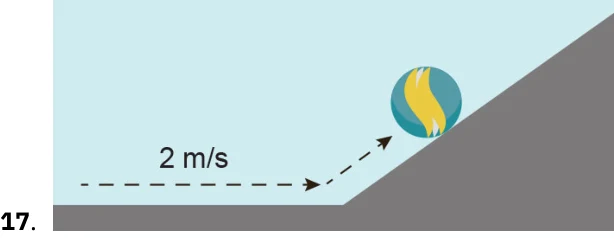
A marble is rolling across a flat surface with a velocity of 2 m/s. It begins to roll up a ramp.Ignoring rotational kinetic energy and friction, what will be the vertical height of the marble when it comes to a stop before rolling back down?
ビー玉が平らな面の上を速度2 m/sで転がっている。それが斜面を上り始める。回転の運動エネルギーと摩擦を無視するとき、転がり戻る前に止まったときのビー玉の鉛直方向の高さはいくらか。
18The potential energy stored in a compressed spring is , where k is the force
18縮められたばねに蓄えられる位置エネルギーはである。ここでkは力の
constant and x is the distance the spring is compressed from the equilibrium position. Four experimental setups described below can be used to determine the force constant of a spring. Which one(s) require measurement of the fewest number of variables to determine k?Assume the acceleration due to gravity is known. I. An object is propelled vertically by a compressed spring.II. An object is propelled horizontally on a frictionless surface by a compressed spring.III. An object is statically suspended from a spring.
定数、xはばねがつり合いの位置から縮められた距離である。下に述べる四つの実験の仕組みは、ばねの力の定数を決めるのに使える。kを決めるのに測る変数の数が最も少なくて済むのはどれか。重力加速度は分かっているものとする。I. 縮めたばねで物体を鉛直に打ち出す。II. 縮めたばねで、摩擦のない面の上を物体が水平に打ち出される。III. 物体をばねから静かにつるす。
IV. An object suspended from a spring is set into oscillatory motion.
IV. ばねからつるした物体を振動させる。
a. I onlyb. III only
a. Iだけb. IIIだけ
c. I and II onlyd. III and IV only
c. IとIIだけd. IIIとIVだけ
9.3 Simple Machines 19A man is using a wedge to split a block of wood by hitting the wedge with a hammer. This drives the wedge into the wood creating a crack in the wood. When he hits the wedge with a force of 400 N it travels 4 cm into the wood. This caused the wedge to exert a force of 1,400 N sideways increasing the width of the crack by 1 cm . What is the efficiency of the wedge?
9.3 単純機械 19ある男が、くさびをハンマーで叩いて木の塊を割ろうとしている。これによってくさびが木に打ち込まれ、木に割れ目ができる。400 Nの力でくさびを叩くと、くさびは木の中へ4 cm進む。これによってくさびが横向きに1,400 Nの力を及ぼし、割れ目の幅が1 cm広がった。このくさびの効率はいくらか。
a. 0.875 percentb. 0.14
a. 0.875パーセントb. 0.14
c. 0.751
c. 0.751
Performance Task実践課題
9.3 Simple Machines 21Conservation of Energy and Energy Transfer; Cause and Effect; and S&EP, Planning and Carrying Out Investigations Plan an investigation to measure the mechanical advantage of simple machines and compare to the IMA of the machine. Also measure the efficiency of each machine studied. Design an investigation to make these measurements for these simple machines: lever, inclined plane, wheel and axle and a pulley system. In addition to these machines, include a spring scale, a tape measure, and a weight with a loop on top that can be attached to the hook on the spring scale. A spring scale is shown in the image.
9.3 単純機械 21エネルギーの保存と移動、原因と結果、そして科学的な探究の実践(調査の計画と実行) 単純機械の機械的利得を測り、その機械のIMAと比べる調査を計画せよ。調べた各機械の効率も測ること。てこ、斜面、輪軸、滑車の仕組みについて、これらの測定を行う調査を設計せよ。これらの機械に加えて、ばねばかり、巻き尺、そしてばねばかりのフックに掛けられる輪の付いたおもりを使う。ばねばかりを図に示す。
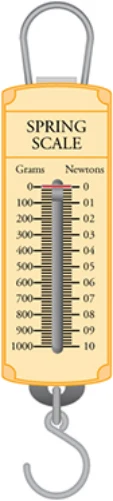
A spring scale measures weight, not mass.
ばねばかりは質量ではなく重さを測る。
d. 87.5 percent
d. 87.5パーセント
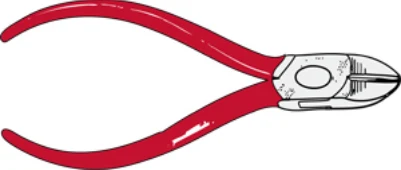
20An electrician grips the handles of a wire cutter, like the one shown, 10 cm from the pivot and places a wire between the jaws 2 cm from the pivot. If the cutter blades are 2 cm wide and 0.3 cm thick, what is the overall IMA of this complex machine?
20ある電気工が、図のようなワイヤーカッターの柄を支点から10 cmのところで握り、支点から2 cmのところの刃の間に電線を置く。刃の幅が2 cm、厚さが0.3 cmだとすると、この複合機械の全体のIMAはいくらか。
a. 1.34b. 1.53c. 33.3d. 33.5
a. 1.34b. 1.53c. 33.3d. 33.5
LEVER: Beginning with the lever, explain how you would measure input force, output force, effort arm, and resistance arm. Also explain how you would find the distance the load travels and the distance over which the effort force is applied. Explain how you would use this data to determine IMA and efficiency.INCLINED PLANE: Make measurements to determine IMA and efficiency of an inclined plane. Explain how you would use the data to calculate these values. Which property do you already know? Note that there are no effort and resistance arm measurements, but there are height and length measurements.WHEEL AND AXLE: Again, you will need two force measurements and four distance measurements. Explain how you would use these to calculate IMA and efficiency.SCREW: You will need two force measurements, two distance traveled measurements, and two length measurements. You may describe a screw like the one shown in Figure 9.10 or you could use a screw and screw driver.(Measurements would be easier for the former). Explain how you would use these to calculate IMA and efficiency.PULLEY SYSTEM: Explain how you would determine the IMA and efficiency of the four-pulley system shown in Figure 9.11. Why do you only need two distance measurements for this machine?
てこ:まずてこから始め、入力の力、出力の力、努力の腕、抵抗の腕をどう測るかを説明せよ。また、荷が動く距離と、努力の力を加える距離をどう求めるかも説明せよ。これらのデータを使ってIMAと効率をどう決めるかを説明せよ。斜面:斜面のIMAと効率を求めるための測定を行え。そのデータをどう使ってこれらの値を計算するかを説明せよ。すでに分かっている性質はどれか。ここには努力の腕と抵抗の腕の測定はないが、高さと長さの測定があることに注意すること。輪軸:ここでも力の測定が二つ、距離の測定が四つ必要になる。それらを使ってIMAと効率をどう計算するかを説明せよ。ねじ:力の測定が二つ、進んだ距離の測定が二つ、長さの測定が二つ必要になる。図9.10に示すようなねじを取り上げてもよいし、ねじとドライバーを使ってもよい(測定は前者のほうが楽だろう)。それらを使ってIMAと効率をどう計算するかを説明せよ。滑車の仕組み:図9.11に示す四つの滑車からなる仕組みのIMAと効率をどう求めるかを説明せよ。この機械では、なぜ距離の測定が二つで済むのか。
Design a table that compares the efficiency of the five simple machines. Make predictions as to
五つの単純機械の効率を比べる表を設計せよ。