第9章仕事、エネルギー、単純機械Work, Energy, and Simple Machines原書 p.287–314
Test Prep実力テスト
Multiple Choice選択問題
9.1 Work, Power, and the Work–Energy Theorem 22. Which expression represents power? a. b.9.1 仕事、仕事率、仕事・エネルギー定理 22. 仕事率を表す式はどれか。 a. b.
23The work–energy theorem states that the change in the kinetic energy of an object is equal to what?
23仕事・エネルギー定理は、物体の運動エネルギーの変化が何に等しいと述べているか。
a. The work done on the objectb. The force applied to the object
a. 物体になされた仕事b. 物体に加えられた力
c. The loss of the object’s potential energyd. The object’s total mechanical energy minus its kinetic energy
c. 物体の位置エネルギーの減少d. 物体の全力学的エネルギーから運動エネルギーを引いたもの
24A runner at the start of a race generates 250 W of power as he accelerates to 5 m/s . If the runner has a mass of 60 kg, how long did it take him to reach that speed?
24レースの出発で、ある走者が5 m/sまで加速する間に250 Wの仕事率を生む。この走者の質量が60 kgだとすると、その速さに達するまでに何秒かかったか。
a. 0.33 sb. 0.83 sc. 1.2 sd. 3.0 s
a. 0.33 sb. 0.83 sc. 1.2 sd. 3.0 s
25A car’s engine generates 100,000 W of power as it exerts a force of 10,000 N. How long does it take the car to travel 100 m?
25ある車のエンジンが10,000 Nの力を及ぼしながら100,000 Wの仕事率を生む。この車が100 m進むのに何秒かかるか。
a. 0.001 sb. 0.01 s
a. 0.001 sb. 0.01 s
c. 10 sd. 1,000 s
c. 10 sd. 1,000 s
9.2 Mechanical Energy and Conservation of Energy 26Why is this expression for kinetic energy incorrect? .a. The constant is missing.b. The term should not be squared.
9.2 力学的エネルギーとエネルギーの保存 26運動エネルギーのこの式はなぜ誤りか。a. 定数が抜けている。b. の項は2乗すべきでない。
c. The expression should be divided by .d. The energy lost to friction has not been subtracted.
c. 式をで割るべきである。d. 摩擦で失われるエネルギーが引かれていない。
27What is the kinetic energy of a object moving at ?
27で動いている質量の物体の運動エネルギーはいくらか。
the most and least efficient machines.
最も効率がよい機械と最も悪い機械を予測せよ。
28Which statement best describes the PE-KE transformations for a javelin, starting from the instant the javelin leaves the thrower's hand until it hits the ground.
28やりが投げ手の手を離れた瞬間から地面に当たるまでの、位置エネルギーと運動エネルギーの移り変わりを最もよく述べているのはどれか。
a. Initial PE is transformed to KE until the javelin reaches the high point of its arc. On the way back down, KE is transformed into PE. At every point in the flight, mechanical energy is being transformed into heat energy.b. Initial KE is transformed to PE until the javelin reaches the high point of its arc. On the way back down, PE is transformed into KE. At every point in the flight, mechanical energy is being transformed into heat energy.c. Initial PE is transformed to KE until the javelin reaches the high point of its arc. On the way back down, there is no transformation of mechanical energy. At every point in the flight, mechanical energy is being transformed into heat energy.d. Initial KE is transformed to PE until the javelin reaches the high point of its arc. On the way back down, there is no transformation of mechanical energy. At every point in the flight, mechanical energy is being transformed into heat energy.
a. やりが弧の最高点に達するまで、初めの位置エネルギーが運動エネルギーへ移り変わる。下りでは運動エネルギーが位置エネルギーへ移り変わる。飛行中のどの点でも、力学的エネルギーは熱エネルギーへ移り変わっている。b. やりが弧の最高点に達するまで、初めの運動エネルギーが位置エネルギーへ移り変わる。下りでは位置エネルギーが運動エネルギーへ移り変わる。飛行中のどの点でも、力学的エネルギーは熱エネルギーへ移り変わっている。c. やりが弧の最高点に達するまで、初めの位置エネルギーが運動エネルギーへ移り変わる。下りでは力学的エネルギーの移り変わりは起こらない。飛行中のどの点でも、力学的エネルギーは熱エネルギーへ移り変わっている。d. やりが弧の最高点に達するまで、初めの運動エネルギーが位置エネルギーへ移り変わる。下りでは力学的エネルギーの移り変わりは起こらない。飛行中のどの点でも、力学的エネルギーは熱エネルギーへ移り変わっている。
29At the beginning of a roller coaster ride, the roller coaster car has an initial energy mostly in the form of PE. Which statement explains why the fastest speeds of the car will be at the lowest points in the ride?
29ジェットコースターの走行の初め、車両は主に位置エネルギーの形で初めのエネルギーを持っている。車両の速さが走行中の最も低い点で最大になるのはなぜかを説明しているのはどれか。
a. At the bottom of the slope kinetic energy is at its maximum value and potential energy is at its minimum value.b. At the bottom of the slope potential energy is at its maximum value and kinetic energy is at its minimum value.
a. 坂の下では運動エネルギーが最大、位置エネルギーが最小になるから。b. 坂の下では位置エネルギーが最大、運動エネルギーが最小になるから。
c. At the bottom of the slope both kinetic and potential energy reach their maximum valuesd. At the bottom of the slope both kinetic and potential energy reach their minimum values.
c. 坂の下では運動エネルギーも位置エネルギーも最大になるから。d. 坂の下では運動エネルギーも位置エネルギーも最小になるから。
9.3 Simple Machines 30A large radius divided by a small radius is the expression used to calculate the IMA of what?a. A screwb. A pulley
9.3 単純機械 30大きい半径を小さい半径で割る式は、何のIMAを計算するのに使われるか。a. ねじb. 滑車
c. A wheel and axled. An inclined plane.
c. 輪軸d. 斜面
31 .
31
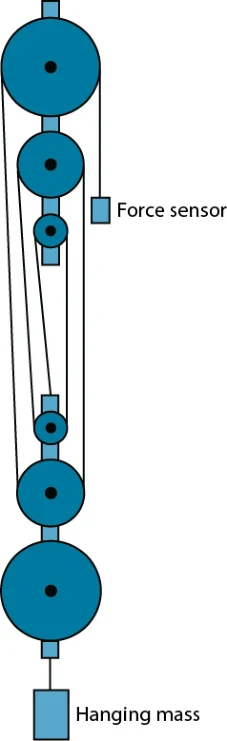
(credit: modification of work by Shona Leonard|/DocPlayer)
(Shona Leonard|/DocPlayerの図をもとに改変)
Study the given pulley system.
示された滑車の仕組みを見よ。
How much force is needed to lift an object with a mass of 50 kg using this system? (Take Earth's g as 10 m/s2.)
この仕組みを使って質量50 kgの物を持ち上げるには、どれだけの力が必要か。(地球のgは10 m/s2とする。)
a. 83 N.b. 100 N.c. 125 N.d. 133 N.
a. 83 Nb. 100 Nc. 125 Nd. 133 N
32Which statement correctly describes the simple machines, like the crank in the image, that make up an Archimedes screw and the forces it applies?
32図のクランクのような、アルキメデスのねじを構成する単純機械と、それが及ぼす力を正しく述べているのはどれか。
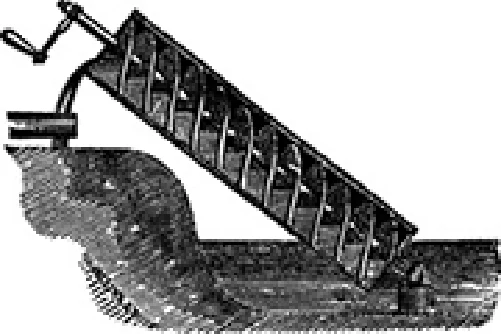
a. The crank is a wedge in which the IMA is the length of the tube divided by the radius of the tube. The applied force is the effort force and the weight of the water is the resistance force.b. The crank is an inclined plane in which the IMA is the length of the tube divided by the radius of the tube. The applied force is the effort force and the weight of the water is the resistance force.c. The crank is a wheel and axle. The effort force of the crank becomes the resistance force of the screw.d. The crank is a wheel and axle. The resistance force of the crank becomes the effort force of the screw.
a. クランクはくさびであり、そのIMAは管の長さを管の半径で割ったものである。加えた力が努力の力、水の重さが抵抗の力である。b. クランクは斜面であり、そのIMAは管の長さを管の半径で割ったものである。加えた力が努力の力、水の重さが抵抗の力である。c. クランクは輪軸である。クランクの努力の力が、ねじの抵抗の力になる。d. クランクは輪軸である。クランクの抵抗の力が、ねじの努力の力になる。
33. Refer to the pulley system on right in the image. Assume this pulley system is an ideal machine.How hard would you have to pull on the rope to lift a 120 N load?How many meters of rope would you have to pull out of the system to lift the load 1 m?
33. 図の右側の滑車の仕組みを見よ。この滑車の仕組みが理想的な機械だとする。120 Nの荷を持ち上げるには、ロープをどれだけの力で引かねばならないか。荷を1 m持ち上げるには、この仕組みからロープを何メートル引き出さねばならないか。
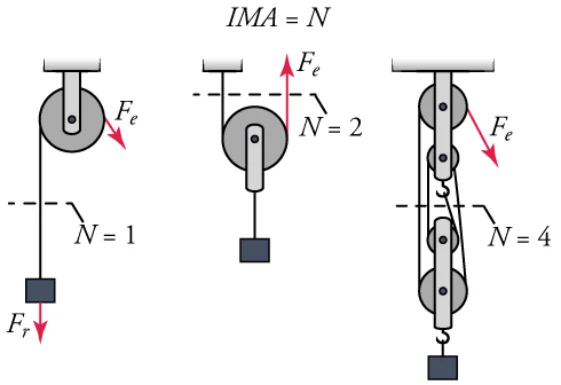
a. 480 N 4 mb. 480 N m
a. 480 N、4 mb. 480 N、 m
c. 30 N 4 md. 30 N
c. 30 N、4 md. 30 N
Short Answer記述式
9.1 Work, Power, and the Work–Energy Theorem 34Describe two ways in which doing work on an object can increase its mechanical energy.
9.1 仕事、仕事率、仕事・エネルギー定理 34物体に仕事をすることで、その力学的エネルギーを増やす二つの方法を述べよ。
a. Raising an object to a higher elevation does work as it increases its PE; increasing the speed of an object does work as it increases its KE.b. Raising an object to a higher elevation does work as it increases its KE; increasing the speed of an object does work as it increases its PE.c. Raising an object to a higher elevation does work as it increases its PE; decreasing the speed of an object does work as it increases its KE.d. Raising an object to a higher elevation does work as it increases its KE; decreasing the speed of an object does work as it increases its PE.
a. 物体を高いところへ上げると、位置エネルギーが増えるので仕事をしたことになる。物体の速さを増すと、運動エネルギーが増えるので仕事をしたことになる。b. 物体を高いところへ上げると、運動エネルギーが増えるので仕事をしたことになる。物体の速さを増すと、位置エネルギーが増えるので仕事をしたことになる。c. 物体を高いところへ上げると、位置エネルギーが増えるので仕事をしたことになる。物体の速さを減らすと、運動エネルギーが増えるので仕事をしたことになる。d. 物体を高いところへ上げると、運動エネルギーが増えるので仕事をしたことになる。物体の速さを減らすと、位置エネルギーが増えるので仕事をしたことになる。
35True or false—While riding a bicycle up a gentle hill, it is fairly easy to increase your potential energy, but to increase your kinetic energy would make you feel exhausted.
35正誤問題——ゆるやかな丘を自転車で上るとき、位置エネルギーを増やすのはかなり楽だが、運動エネルギーを増やそうとすると疲れ果てるだろう。
a. Trueb. False
a. 正b. 誤
36Which statement best explains why running on a track with constant speed at 3 m/s is not work, but climbing a mountain at 1 m/s is work?
363 m/sの一定の速さでトラックを走るのは仕事ではないのに、1 m/sで山を登るのは仕事である。それはなぜかを最もよく説明しているのはどれか。
a. At constant speed, change in the kinetic energy is zero but climbing a mountain produces change in the potential energy.b. At constant speed, change in the potential energy is zero, but climbing a mountain produces change in the kinetic energy.c. At constant speed, change in the kinetic energy is finite, but climbing a mountain produces no change in the potential energy.d. At constant speed, change in the potential energy is finite, but climbing a mountain produces no change in the kinetic energy.
a. 一定の速さでは運動エネルギーの変化が0だが、山を登れば位置エネルギーが変わるから。b. 一定の速さでは位置エネルギーの変化が0だが、山を登れば運動エネルギーが変わるから。c. 一定の速さでは運動エネルギーの変化が有限だが、山を登っても位置エネルギーは変わらないから。d. 一定の速さでは位置エネルギーの変化が有限だが、山を登っても運動エネルギーは変わらないから。
37You start at the top of a hill on a bicycle and coast to the bottom without applying the brakes. By the time you reach the bottom of the hill, work has been done on you and your bicycle,
37丘の頂上から自転車でブレーキをかけずに惰性で下る。ふもとに着くころには、あなたと自転車に仕事がなされている。
If is the mass of you and your bike, what are and ?a. is your speed at the top of the hill, and is your speed at the bottom.b. is your speed at the bottom of the hill, and is your speed at the top.c. is your displacement at the top of the hill, and is your displacement at the bottom.d. is your displacement at the bottom of the hill, and is your displacement at the top.
をあなたと自転車の質量とすると、とは何か。a. は丘の頂上でのあなたの速さ、はふもとでの速さである。b. は丘のふもとでのあなたの速さ、は頂上での速さである。c. は丘の頂上でのあなたの変位、はふもとでの変位である。d. は丘のふもとでのあなたの変位、は頂上での変位である。
9.2 Mechanical Energy and Conservation of Energy 38True or false—The formula for gravitational potential energy can be used to explain why joules, J, are equivalent to kg × m2 / s2 . Show your work.
9.2 力学的エネルギーとエネルギーの保存 38正誤問題——重力による位置エネルギーの式を使えば、ジュール(J)が kg × m2/s2 に等しい理由を説明できる。計算過程も示せ。
a. Trueb. False
a. 正b. 誤
39Which statement best explains why accelerating a car from to quadruples its kinetic energy?
39車をからへ加速させると運動エネルギーが4倍になる。それはなぜかを最もよく説明しているのはどれか。
a. Because kinetic energy is directly proportional to the square of the velocity.b. Because kinetic energy is inversely proportional to the square of the velocity.c. Because kinetic energy is directly proportional to the fourth power of the velocity.d. Because kinetic energy is inversely proportional to the fourth power of the velocity.
a. 運動エネルギーが速度の2乗に比例するから。b. 運動エネルギーが速度の2乗に反比例するから。c. 運動エネルギーが速度の4乗に比例するから。d. 運動エネルギーが速度の4乗に反比例するから。
40A coin falling through a vacuum loses no energy to friction, and yet, after it hits the ground, it has lost all its potential and kinetic energy. Which statement best explains why the law of conservation of energy is still valid in this case?a. When the coin hits the ground, the ground gains potential energy that quickly changes to thermal energy.b. When the coin hits the ground, the ground gains kinetic energy that quickly changes to thermal energy.c. When the coin hits the ground, the ground
40真空中を落ちる硬貨は摩擦でエネルギーを失わないが、それでも地面に当たったあとには位置エネルギーも運動エネルギーもすべて失っている。この場合でもエネルギー保存の法則がなお成り立つのはなぜかを最もよく説明しているのはどれか。a. 硬貨が地面に当たると、地面は位置エネルギーを得て、それが素早く熱エネルギーに変わる。b. 硬貨が地面に当たると、地面は運動エネルギーを得て、それが素早く熱エネルギーに変わる。c. 硬貨が地面に当たると、地面は
gains thermal energy that quickly changes to kinetic energy. d. When the coin hits the ground, the ground gains thermal energy that quickly changes to potential energy.
熱エネルギーを得て、それが素早く運動エネルギーに変わる。 d. 硬貨が地面に当たると、地面は熱エネルギーを得て、それが素早く位置エネルギーに変わる。
41True or false—A marble rolls down a slope from height h1 and up another slope to height h2, where (h2 < h1). The difference mg(h1 – h2) is equal to the heat lost due to the friction.
41正誤問題——ビー玉が高さh1の斜面を転がり下り、別の斜面を高さh2(h2 < h1)まで上る。差 mg(h1 - h2)は、摩擦によって失われた熱に等しい。
a. Trueb. False
a. 正b. 誤
9.3 Simple Machines 42Why would you expect the lever shown in the top image to have a greater efficiency than the inclined plane shown in the bottom image?
9.3 単純機械 42上の図のてこが、下の図の斜面より効率が高いと考えられるのはなぜか。
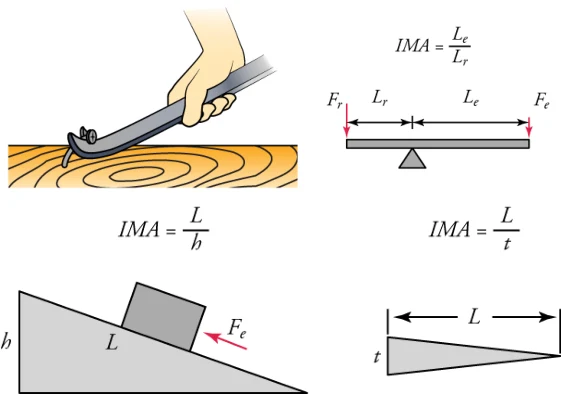
a. The resistance arm is shorter in case of the inclined plane.b. The effort arm is shorter in case of the inclined plane.c. The area of contact is greater in case of the inclined plane.
a. 斜面のほうが抵抗の腕が短いから。b. 斜面のほうが努力の腕が短いから。c. 斜面のほうが接触する面積が大きいから。
43Why is the wheel on a wheelbarrow not a simple machine in the same sense as the simple machine in the image?
43手押し車の車輪が、図の単純機械と同じ意味での単純機械でないのはなぜか。
Extended Response論述式
9.1 Work, Power, and the Work–Energy Theorem 46Work can be negative as well as positive because an object or system can do work on its surroundings as well as have work done on it. Which of the following statements describes: a situation in which an object does work on its surroundings by decreasing its velocity and a situation in which an object can do work on its surroundings by decreasing its altitude?
9.1 仕事、仕事率、仕事・エネルギー定理 46物体や系は、仕事をされるだけでなく周囲に仕事をすることもできるので、仕事は正にも負にもなりうる。次のうち、物体が速度を減らすことで周囲に仕事をする状況と、高度を下げることで周囲に仕事をする状況を述べているのはどれか。
a. A gasoline engine burns less fuel at a
a. ガソリンエンジンは遅い速さのほうが
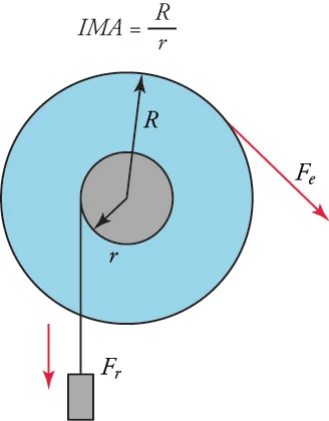
a. The wheel on the wheelbarrow has no fulcrum.b. The center of the axle is not the fulcrum for the wheels of a wheelbarrow.c. The wheelbarrow differs in the way in which load is attached to the axle.d. The wheelbarrow has less resistance force than a wheel and axle design.
a. 手押し車の車輪には支点がないから。b. 手押し車の車輪では、軸の中心が支点ではないから。c. 手押し車は、荷が軸に取り付けられているしかたが違うから。d. 手押し車は、輪軸の設計より抵抗の力が小さいから。
44A worker pulls down on one end of the rope of a pulley system with a force of 75 N to raise a hay bale tied to the other end of the rope. If she pulls the rope down 2.0 m and the bale raises 1.0 m, what else would you have to know to calculate the efficiency of the pulley system?
44ある作業者が滑車の仕組みのロープの一端を75 Nの力で引き下げ、ロープのもう一端に結ばれた干し草の俵を持ち上げる。彼女がロープを2.0 m引き下げて俵が1.0 m上がったとすると、この滑車の仕組みの効率を計算するには、ほかに何が分かっていなければならないか。
a. the weight of the workerb. the weight of the hay bale
a. 作業者の体重b. 干し草の俵の重さ
c. the radius of the pulleyd. the height of the pulley from ground
c. 滑車の半径d. 地面からの滑車の高さ
45True or false—A boy pushed a box with a weight of 300 N up a ramp. He said that, because the ramp was 1.0 m high and 3.0 m long, he must have been pushing with force of exactly 100 N.a. Trueb. False
45正誤問題——ある少年が重さ300 Nの箱を斜面に沿って押し上げた。彼は、斜面の高さが1.0 m、長さが3.0 mなのだから、自分はちょうど100 Nの力で押していたはずだ、と言った。a. 正b. 誤
slower speed. Solar cells capture sunlight to generate electricity.b. A hybrid car charges its batteries as it decelerates. Falling water turns a turbine to generate electricity.c. Airplane flaps use air resistance to slow down for landing. Rising steam turns a turbine to generate electricity.
燃料の消費が少ない。太陽電池は日光を捉えて電気を作る。b. ハイブリッド車は減速するときに電池を充電する。落ちる水がタービンを回して電気を作る。c. 飛行機のフラップは空気抵抗を使って着陸のために減速する。上る蒸気がタービンを回して電気を作る。
d. An electric train requires less electrical energy as it decelerates. A parachute captures air to slow a skydiver’s fall.
d. 電車は減速するとき必要な電気エネルギーが少ない。パラシュートは空気を捉えてスカイダイバーの落下を遅らせる。
47A boy is pulling a girl in a child’s wagon at a constant speed. He begins to pull harder, which increases the speed of the wagon. Which of the following describes two ways you could calculate the change in energy of the wagon and girl if you had all the information you needed?
47少年が女の子を子ども用の荷車に乗せて一定の速さで引いている。彼はより強く引き始め、荷車の速さが増す。必要な情報がすべてあるとして、荷車と女の子のエネルギーの変化を計算する二つの方法を述べているのはどれか。
a. Calculate work done from the force and the velocity. Calculate work done from the change in the potential energy of the system.b. Calculate work done from the force and the displacement. Calculate work done from the change in the potential energy of the system.c. Calculate work done from the force and the velocity. Calculate work done from the change in the kinetic energy of the system.d. Calculate work done from the force and the displacement. Calculate work done from the change in the kinetic energy of the system.
a. 力と速度から仕事を計算する。系の位置エネルギーの変化から仕事を計算する。b. 力と変位から仕事を計算する。系の位置エネルギーの変化から仕事を計算する。c. 力と速度から仕事を計算する。系の運動エネルギーの変化から仕事を計算する。d. 力と変位から仕事を計算する。系の運動エネルギーの変化から仕事を計算する。
9.2 Mechanical Energy and Conservation of Energy 48. Acceleration due to gravity on the moon is 1.6 m/s2 or about 16% of the value of g on Earth. If an astronaut on the moon threw a moon rock to a height of 7.8 m, what would be its velocity as it struck the moon’s surface?How would the fact that the moon has no atmosphere affect the velocity of the falling moon rock? Explain your answer.
9.2 力学的エネルギーとエネルギーの保存 48. 月面での重力加速度は1.6 m/s2で、地球のgのおよそ16パーセントである。月面の宇宙飛行士が月の石を7.8 mの高さまで投げ上げたとすると、月面に当たるときの速度はいくらか。月に大気がないことは、落ちてくる月の石の速度にどう影響するか。答えを説明せよ。
a. The velocity of the rock as it hits the ground would be 5.0 m/s. Due to the lack of air friction, there would be complete transformation of the potential energy into the kinetic energy as the rock hits the moon’s surface.b. The velocity of the rock as it hits the ground would be 5.0 m/s. Due to the lack of air friction, there would be incomplete transformation of the potential energy into the kinetic energy as the rock hits the moon’s surface.c. The velocity of the rock as it hits the ground would be 12 m/s. Due to the lack of air friction, there would be complete
a. 石が地面に当たるときの速度は5.0 m/sである。空気の摩擦がないので、石が月面に当たるとき位置エネルギーが完全に運動エネルギーへ移り変わる。b. 石が地面に当たるときの速度は5.0 m/sである。空気の摩擦がないので、石が月面に当たるとき位置エネルギーの運動エネルギーへの移り変わりは不完全である。c. 石が地面に当たるときの速度は12 m/sである。空気の摩擦がないので、石が月面に当たるとき位置エネルギーが
transformation of the potential energy into the kinetic energy as the rock hits the moon’s surface.d. The velocity of the rock as it hits the ground would be 12 m/s. Due to the lack of air friction, there would be incomplete transformation of the potential energy into the kinetic energy as the rock hits the moon’s surface.
完全に運動エネルギーへ移り変わる。d. 石が地面に当たるときの速度は12 m/sである。空気の摩擦がないので、石が月面に当たるとき位置エネルギーの運動エネルギーへの移り変わりは不完全である。
49A boulder rolls from the top of a mountain, travels across a valley below, and rolls part way up the ridge on the opposite side. Describe all the energy transformations taking place during these events and identify when they happen.
49大きな岩が山の頂上から転がり落ち、下の谷を横切り、反対側の尾根を途中まで上る。この間に起こるエネルギーの移り変わりをすべて述べ、それぞれがいつ起こるかを答えよ。
a. As the boulder rolls down the mountainside, KE is converted to PE. As the boulder rolls up the opposite slope, PE is converted to KE. The boulder rolls only partway up the ridge because some of the PE has been converted to thermal energy due to friction.b. As the boulder rolls down the mountainside, KE is converted to PE. As the boulder rolls up the opposite slope, KE is converted to PE. The boulder rolls only partway up the ridge because some of the PE has been converted to thermal energy due to friction.c. As the boulder rolls down the mountainside, PE is converted to KE. As the boulder rolls up the opposite slope, PE is converted to KE. The boulder rolls only partway up the ridge because some of the PE has been converted to thermal energy due to friction.d. As the boulder rolls down the mountainside, PE is converted to KE. As the boulder rolls up the opposite slope, KE is converted to PE. The boulder rolls only partway up the ridge because some of the PE has been converted to thermal energy due to friction.
a. 岩が山腹を転がり下るとき、運動エネルギーが位置エネルギーに変わる。反対側の斜面を上るとき、位置エネルギーが運動エネルギーに変わる。位置エネルギーの一部が摩擦によって熱エネルギーに変わったので、岩は尾根を途中までしか上らない。b. 岩が山腹を転がり下るとき、運動エネルギーが位置エネルギーに変わる。反対側の斜面を上るとき、運動エネルギーが位置エネルギーに変わる。位置エネルギーの一部が摩擦によって熱エネルギーに変わったので、岩は尾根を途中までしか上らない。c. 岩が山腹を転がり下るとき、位置エネルギーが運動エネルギーに変わる。反対側の斜面を上るとき、位置エネルギーが運動エネルギーに変わる。位置エネルギーの一部が摩擦によって熱エネルギーに変わったので、岩は尾根を途中までしか上らない。d. 岩が山腹を転がり下るとき、位置エネルギーが運動エネルギーに変わる。反対側の斜面を上るとき、運動エネルギーが位置エネルギーに変わる。位置エネルギーの一部が摩擦によって熱エネルギーに変わったので、岩は尾根を途中までしか上らない。
9.3 Simple Machines 50To dig a hole, one holds the handles together and thrusts the blades of a posthole digger, like the one in the image, into the ground. Next, the handles are pulled apart, which squeezes the dirt between them, making it possible to remove the dirt from the hole. This complex machine is composed of two pairs of two different simple machines. Identify and describe the parts that are simple machines and explain how you would find the IMA of each type of simple machine.
9.3 単純機械 50穴を掘るには、図のような穴掘り器の柄を合わせて持ち、刃を地面に突き入れる。次に柄を左右に開くと、刃の間に土が挟み込まれ、穴から土を取り出せる。この複合機械は、二種類の単純機械の対を二組組み合わせたものである。単純機械にあたる部分を挙げて述べ、それぞれの型の単純機械のIMAをどう求めるかを説明せよ。

a. Each handle and its attached blade is a lever with the fulcrum at the hinge. Each blade is a wedge. The IMA of a lever would be the length of the handle divided by the length of the blade. The IMA of the wedges would be the length of the blade divided by its width.b. Each handle and its attached to blade is a lever with the fulcrum at the end. Each blade is a wedge. The IMA of a lever would be the length of the handle divided by the length of the blade. The IMA of the wedges would be the length of the blade divided by its width.c. Each handle and its attached blade is a lever with the fulcrum at the hinge. Each blade is a wedge. The IMA of a lever would be the length of the
a. 各々の柄とそれに付いた刃が、蝶番を支点とするてこである。各々の刃はくさびである。てこのIMAは柄の長さを刃の長さで割ったもの、くさびのIMAは刃の長さをその幅で割ったものになる。b. 各々の柄とそれに付いた刃が、端を支点とするてこである。各々の刃はくさびである。てこのIMAは柄の長さを刃の長さで割ったもの、くさびのIMAは刃の長さをその幅で割ったものになる。c. 各々の柄とそれに付いた刃が、蝶番を支点とするてこである。各々の刃はくさびである。てこのIMAは
handle multiplied by the length of the blade. The IMA of the wedges would be the length of the blade multiplied by its width.d. Each handle and its attached blade is a lever with the fulcrum at the end. Each blade is a wedge.The IMA of a lever would be the length of the handle multiplied by the length of the blade. The IMA of the wedges would be the length of the blade multiplied by its width.
柄の長さと刃の長さを掛けたもの、くさびのIMAは刃の長さとその幅を掛けたものになる。d. 各々の柄とそれに付いた刃が、端を支点とするてこである。各々の刃はくさびである。てこのIMAは柄の長さと刃の長さを掛けたもの、くさびのIMAは刃の長さとその幅を掛けたものになる。
51A wooden crate is pulled up a ramp that is 1.0 m high and 6.0 m long. The crate is attached to a rope that is wound around an axle with a radius of 0.020 m . The axle is turned by a 0.20 m long handle. What is the overall IMA of the complex machine?
51木箱が、高さ1.0 m、長さ6.0 mの斜面に沿って引き上げられる。木箱は、半径0.020 mの軸に巻かれたロープに結ばれている。軸は長さ0.20 mの取っ手で回す。この複合機械の全体のIMAはいくらか。
A. 6B. 10C. 16D. 60
A. 6B. 10C. 16D. 60