第9章仕事、エネルギー、単純機械Work, Energy, and Simple Machines原書 p.287–314
9.3 Simple Machines9.3 単純機械
SECTION LEARNING OBJECTIVES By the end of this section, you will be able to do the following:
この節の学習目標 この節を終えると、次のことができるようになる。
• Describe simple and complex machines• Calculate mechanical advantage and efficiency of simple and complex machines
・単純機械と複合機械を述べる・単純機械と複合機械の機械的利得と効率を計算する
Section Key Termsこの節の重要語
complex machineefficiency outputideal mechanical advantageinclined planeinput worklevermechanical advantageoutput workpulleyscrewsimple machinewedgewheel and axle
複合機械 効率 理想的な機械的利得 斜面 入力の仕事てこ 機械的利得 出力の仕事 滑車 ねじ単純機械 くさび 輪軸
Simple Machines単純機械
Simple machines make work easier, but they do not decrease the amount of work you have to do. Why can’t simple machines change the amount of work that you do? Recall that in closed systems the total amount of energy is conserved. A machine cannot increase the amount of energy you put into it. So, why is a simple machine useful? Although it cannot change the amount of work you do, a simple machine can change the amount of force you must apply to an object, and the distance over which you apply the force. In most cases, a simple machine is used to reduce the amount of force you must exert to do work. The down side is that you must exert the force over a greater distance, because the product of force and distance, fd, (which equals work) does not change.
単純機械は仕事を楽にするが、しなければならない仕事の量を減らしはしない。なぜ単純機械は仕事の量を変えられないのか。閉じた系では全エネルギーが保存されることを思い出そう。機械は、あなたが注ぎ込んだエネルギーの量を増やすことはできない。では、なぜ単純機械は役に立つのか。仕事の量は変えられないが、単純機械は、物体に加えねばならない力の大きさと、その力を加える距離を変えられる。たいていの場合、単純機械は仕事をするのに加えねばならない力を減らすために使われる。その代わり、力をより長い距離にわたって加えねばならない。力と距離の積fd(これが仕事に等しい)は変わらないからである。
Let’s examine how this works in practice. In Figure 9.7(a), the worker uses a type of lever to exert a small force over a large distance, while the pry bar pulls up on the nail with a large force over a small distance. Figure 9.7(b) shows how a lever works mathematically. The effort force, applied at Fe, lifts the load (the resistance force) which is pushing down at Fr. The triangular pivot is called the fulcrum; the part of the lever between the fulcrum and Fe is the effort arm, Le; and the part to the left is the resistance arm, Lr. The mechanical advantage is a number that tells us how many times a simple machine multiplies the effort force. The ideal mechanical advantage, IMA, is the mechanical advantage of a perfect machine with no loss of useful work caused by friction between moving parts. The equation for IMA is shown in Figure 9.7(b).
これが実際にどう働くかを見よう。図9.7(a)では、作業者がてこの一種を使って小さな力を長い距離にわたって加え、その一方でバールは大きな力を短い距離にわたって釘に及ぼしている。図9.7(b)は、てこの働きを数学的に示している。Feに加えられる力(努力の力)が、Frで下向きに押している荷(抵抗の力)を持ち上げる。三角形の支点をふしんという。てこのうち支点とFeの間の部分が努力の腕Le、左側の部分が抵抗の腕Lrである。機械的利得とは、単純機械が努力の力を何倍にするかを示す数である。理想的な機械的利得IMAとは、可動部の摩擦によって有用な仕事を失わない完全な機械の機械的利得である。IMAの式を図9.7(b)に示す。
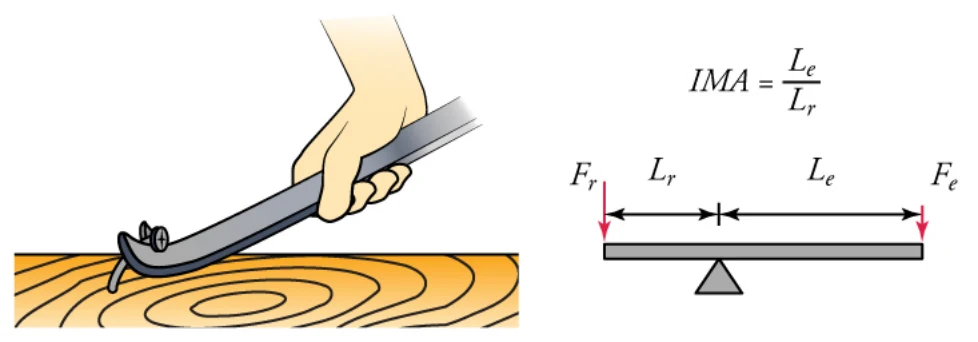
In general, the IMA = the resistance force, Fr, divided by the effort force, Fe. IMA also equals the distance over which the effort is applied, de, divided by the distance the load travels, dr.
一般に IMA = 抵抗の力Fr ÷ 努力の力Fe である。IMAはまた、努力を加える距離deを、荷が動く距離drで割ったものにも等しい。
Getting back to conservation of energy, for any simple machine, the work put into the machine, Wi, equals the work the machine puts out, Wo. Combining this with the information in the paragraphs above, we can write
エネルギーの保存に話を戻すと、どんな単純機械でも、機械に注ぎ込まれた仕事Wiは、機械が出す仕事Woに等しい。これを上の段落の情報と組み合わせると、次のように書ける。
The equations show how a simple machine can output the same amount of work while reducing the amount of effort force by increasing the distance over which the effort force is applied.
これらの式は、努力の力を加える距離を長くすることで、単純機械が同じ量の仕事を出しながら努力の力を減らせることを示している。
Introduction to Mechanical Advantage This video shows how to calculate the IMA of a lever by three different methods: (1) from effort force and resistance force; (2) from the lengths of the lever arms, and; (3) from the distance over which the force is applied and the distance the load moves.
機械的利得の入門 この動画は、てこのIMAを三つの違うやり方で計算する方法を示す。(1)努力の力と抵抗の力から、(2)てこの腕の長さから、(3)力を加える距離と荷が動く距離から。
Introduction to mechanical advantage | Work and energy | Physics | Khan Academy (https://www.youtube.com/ embed/pfzJ-z5Ij48)
機械的利得の入門|仕事とエネルギー|物理|カーンアカデミー(https://www.youtube.com/embed/pfzJ-z5Ij48)
Two children of different weights are riding a seesaw. How do they position themselves with respect to the pivot point (the fulcrum) so that they are balanced?
体重の違う二人の子どもがシーソーに乗っている。つり合わせるには、支点に対してどう位置をとればよいか。
a. The heavier child sits closer to the fulcrum.b. The heavier child sits farther from the fulcrum.
a. 重いほうの子が支点に近く座る。b. 重いほうの子が支点から遠く座る。
c. Both children sit at equal distance from the fulcrum.d. Since both have different weights, they will never be in balance.
c. 二人とも支点から等しい距離に座る。d. 体重が違うのだから、決してつり合わない。
Some levers exert a large force to a short effort arm. This results in a smaller force acting over a greater distance at the end of the resistance arm. Examples of this type of lever are baseball bats, hammers, and golf clubs. In another type of lever, the fulcrum is at the end of the lever and the load is in the middle, as in the design of a wheelbarrow.
てこの中には、短い努力の腕に大きな力を加えるものもある。この場合、抵抗の腕の端では、より小さな力がより長い距離にわたってはたらく。この型のてこの例が、野球のバット、ハンマー、ゴルフクラブである。別の型のてこでは、手押し車の設計のように、支点がてこの端にあり、荷が真ん中にある。
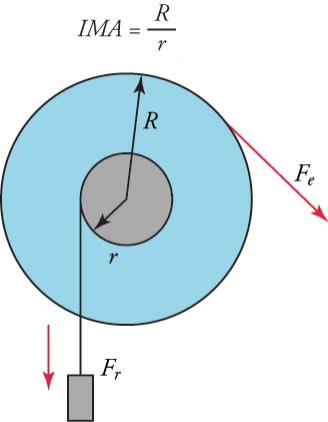
The simple machine shown in Figure 9.8 is called a wheel and axle. It is actually a form of lever. The difference is that the effort arm can rotate in a complete circle around the fulcrum, which is the center of the axle. Force applied to the outside of the wheel causes a greater force to be applied to the rope that is wrapped around the axle. As shown in the figure, the ideal mechanical advantage is calculated by dividing the radius of the wheel by the radius of the axle. Any crank-operated device is an example of a wheel and axle.
図9.8に示す単純機械を輪軸という。これも実はてこの一種である。違うのは、努力の腕が支点(軸の中心)のまわりを一周できることである。輪の外側に加えられた力は、軸に巻かれたロープにより大きな力を及ぼす。図に示すとおり、理想的な機械的利得は輪の半径を軸の半径で割って計算する。クランクで動かす装置はどれも輪軸の例である。
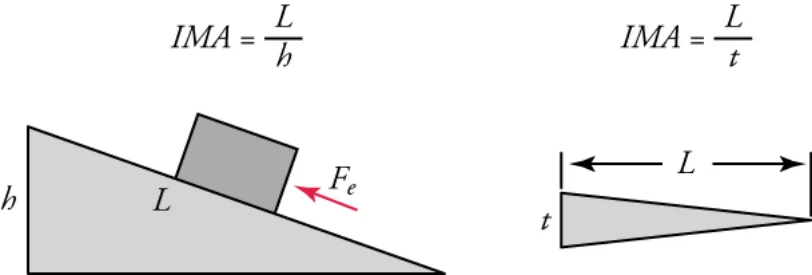
An inclined plane and a wedge are two forms of the same simple machine. A wedge is simply two inclined planes back to back. Figure 9.9 shows the simple formulas for calculating the IMAs of these machines. All sloping, paved surfaces for walking or driving are inclined planes. Knives and axe heads are examples of wedges.
斜面とくさびは、同じ単純機械の二つの形である。くさびとは、要するに二つの斜面を背中合わせにしたものである。図9.9に、これらの機械のIMAを計算する簡単な式を示す。歩いたり走ったりするための傾いた舗装面はすべて斜面である。ナイフや斧の刃はくさびの例である。
The screw shown in Figure 9.10 is actually a lever attached to a circular inclined plane. Wood screws (of course) are also examples of screws. The lever part of these screws is a screw driver. In the formula for IMA, the distance between screw threads is called pitch and has the symbol P.
図9.10に示すねじは、実は円柱状の斜面に取り付けられたてこである。木ねじも(もちろん)ねじの例である。これらのねじのてこにあたる部分がドライバーである。IMAの式で、ねじ山どうしの間隔をピッチといい、記号Pで表す。
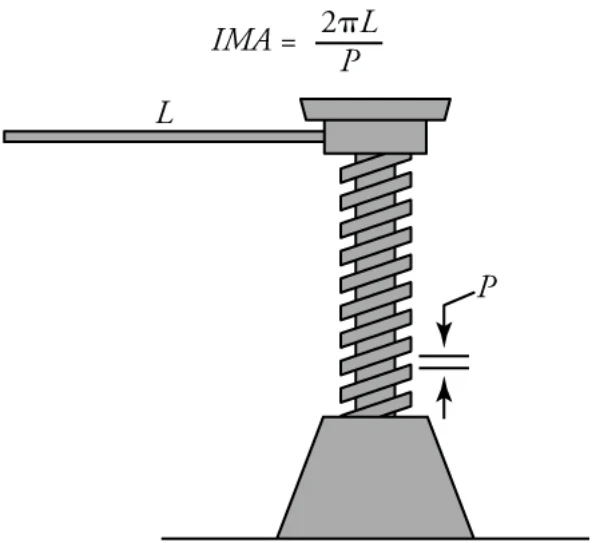
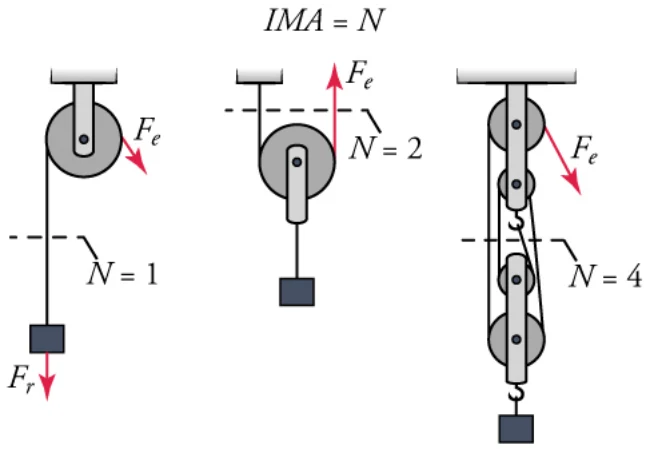
Figure 9.11 shows three different pulley systems. Of all simple machines, mechanical advantage is easiest to calculate for pulleys. Simply count the number of ropes supporting the load. That is the IMA. Once again we have to exert force over a longer distance to multiply force. To raise a load 1 meter with a pulley system you have to pull N meters of rope. Pulley systems are often used to raise flags and window blinds and are part of the mechanism of construction cranes.
図9.11に三種類の滑車の仕組みを示す。あらゆる単純機械の中で、滑車は機械的利得を最も計算しやすい。荷を支えているロープの本数を数えるだけでよい。それがIMAである。ここでもまた、力を何倍にするには長い距離にわたって力を加えねばならない。滑車の仕組みで荷を1メートル持ち上げるには、ロープをNメートル引かねばならない。滑車の仕組みは、旗やブラインドを上げるのによく使われ、建設用クレーンの仕掛けの一部でもある。
Mechanical Advantage of Inclined Planes and Pulleys The first part of this video shows how to calculate the IMA of pulley systems. The last part shows how to calculate the IMA of an inclined plane.
斜面と滑車の機械的利得 この動画の前半は滑車の仕組みのIMAの計算のしかたを示す。後半は斜面のIMAの計算のしかたを示す。
Mechanical advantage (part 3) | Work and energy | Physics | Khan Academy (https://openstax.org/l/02mechadvant)
機械的利得(その3)|仕事とエネルギー|物理|カーンアカデミー(https://openstax.org/l/02mechadvant)
GRASP CHECK How could you use a pulley system to lift a light load to great height?a. Reduce the radius of the pulley.b. Increase the number of pulleys.
理解の確認 軽い荷を高いところまで持ち上げるには、滑車の仕組みをどう使えばよいか。a. 滑車の半径を小さくする。b. 滑車の数を増やす。
c. Decrease the number of ropes supporting the load.d. Increase the number of ropes supporting the load.
c. 荷を支えるロープの本数を減らす。d. 荷を支えるロープの本数を増やす。
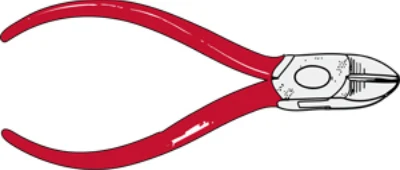
A complex machine is a combination of two or more simple machines. The wire cutters in Figure 9.12 combine two levers and two wedges. Bicycles include wheel and axles, levers, screws, and pulleys. Cars and other vehicles are combinations of many machines.
複合機械とは、二つ以上の単純機械を組み合わせたものである。図9.12のワイヤーカッターは、二つのてこと二つのくさびを組み合わせている。自転車には輪軸、てこ、ねじ、滑車が含まれる。車をはじめとする乗り物は、多くの機械の組み合わせである。
Calculating Mechanical Advantage and Efficiency of Simple Machines単純機械の機械的利得と効率を計算する
In general, the IMA = the resistance force, Fr, divided by the effort force, Fe. IMA also equals the distance over which the effort is applied, de, divided by the distance the load travels, dr.
一般に IMA = 抵抗の力Fr ÷ 努力の力Fe である。IMAはまた、努力を加える距離deを、荷が動く距離drで割ったものにも等しい。
Refer back to the discussions of each simple machine for the specific equations for the IMA for each type of machine.
機械の型ごとのIMAの具体的な式については、各単純機械の説明に戻って確かめてほしい。
No simple or complex machines have the actual mechanical advantages calculated by the IMA equations. In real life, some of the applied work always ends up as wasted heat due to friction between moving parts. Both the input work (Wi) and output work (Wo) are the result of a force, F, acting over a distance, d.
単純機械にも複合機械にも、IMAの式で計算されるとおりの実際の機械的利得を持つものはない。現実には、加えた仕事の一部はつねに、可動部の摩擦による無駄な熱になってしまう。入力の仕事(Wi)も出力の仕事(Wo)も、力Fが距離dにわたってはたらいた結果である。
The efficiency output of a machine is simply the output work divided by the input work, and is usually multiplied by 100 so that it is expressed as a percent.
機械の効率は、単に出力の仕事を入力の仕事で割ったものであり、ふつうは100を掛けて百分率で表す。
Look back at the pictures of the simple machines and think about which would have the highest efficiency. Efficiency is related to friction, and friction depends on the smoothness of surfaces and on the area of the surfaces in contact. How would lubrication affect the efficiency of a simple machine?
単純機械の図に戻って、どれが最も効率が高そうかを考えてみよう。効率は摩擦に関わり、摩擦は面のなめらかさと接触する面の面積による。潤滑は単純機械の効率にどう効くだろうか。
Efficiency of a Lever The input force of 11 N acting on the effort arm of a lever moves 0.4 m, which lifts a 40 N weight resting on the resistance arm a distance of 0.1 m. What is the efficiency of the machine?Strategy
てこの効率 てこの努力の腕にはたらく11 Nの入力の力が0.4 m動き、抵抗の腕に載った40 Nの重りを0.1 m持ち上げる。この機械の効率はいくらか。方針
State the equation for efficiency of a simple machine, and calculate Wo and Wi. Both work values are the product Fd.
単純機械の効率の式を書き、WoとWiを計算する。どちらの仕事も積Fdである。
Solution解答
= (11)(0.4) = 4.4 J and = (40)(0.1) = 4.0 J, then
= (11)(0.4) = 4.4 J、 = (40)(0.1) = 4 J なので、
Discussion考察
Efficiency in real machines will always be less than 100 percent because of work that is converted to unavailable heat by friction and air resistance. Wo and Wi can always be calculated as a force multiplied by a distance, although these quantities are not always as obvious as they are in the case of a lever.
実際の機械の効率は、摩擦と空気抵抗によって使えない熱に変わる仕事があるため、つねに100パーセント未満になる。WoとWiはつねに力と距離の積として計算できる。ただし、てこの場合ほどこれらの量が見て取りやすいとは限らない。
12. If a pulley system can lift a 200N load with an effort force of 52 N and has an efficiency of almost 100 percent, how many ropes are supporting the load?
12. ある滑車の仕組みが52 Nの努力の力で200 Nの荷を持ち上げられ、効率がほぼ100パーセントだとすると、荷を支えているロープは何本か。
a. 1 rope is required because the actual mechanical advantage is 0.26.b. 1 rope is required because the actual mechanical advantage is 3.80.
a. 実際の機械的利得が0.26なので、ロープは1本必要である。b. 実際の機械的利得が3.80なので、ロープは1本必要である。
c. 4 ropes are required because the actual mechanical advantage is 0.26.d. 4 ropes are required because the actual mechanical advantage is 3.80.
c. 実際の機械的利得が0.26なので、ロープは4本必要である。d. 実際の機械的利得が3.80なので、ロープは4本必要である。
Check Your Understanding理解の確認
13True or false—The efficiency of a simple machine is always less than 100 percent because some small fraction of the input work is always converted to heat energy due to friction.
13正誤問題——単純機械の効率がつねに100パーセント未満なのは、入力の仕事のごく一部がつねに摩擦によって熱エネルギーに変わるからである。
a. Trueb. False
a. 正b. 誤
14The circular handle of a faucet is attached to a rod that opens and closes a valve when the handle is turned. If the rod has a diameter of 1 cm and the IMA of the machine is 6, what is the radius of the handle?
14蛇口の円い取っ手が、回すと弁を開閉する軸に取り付けられている。軸の直径が1 cmで、この機械のIMAが6のとき、取っ手の半径はいくらか。
A. 0.08 cmB. 0.17 cmC. 3.0 cmD. 6.0 cm
A. 0.08 cmB. 0.17 cmC. 3.0 cmD. 6.0 cm