第9章仕事、エネルギー、単純機械Work, Energy, and Simple Machines原書 p.287–314
9.2 Mechanical Energy and Conservation of Energy9.2 力学的エネルギーとエネルギーの保存
SECTION LEARNING OBJECTIVES By the end of this section, you will be able to do the following:
この節の学習目標 この節を終えると、次のことができるようになる。
• Explain the law of conservation of energy in terms of kinetic and potential energy• Perform calculations related to kinetic and potential energy. Apply the law of conservation of energy
・運動エネルギーと位置エネルギーの言葉でエネルギー保存の法則を説明する・運動エネルギーと位置エネルギーに関する計算を行い、エネルギー保存の法則を当てはめる
Section Key Termsこの節の重要語
law of conservation of energy
エネルギー保存の法則
Mechanical Energy and Conservation of Energy力学的エネルギーとエネルギーの保存
We saw earlier that mechanical energy can be either potential or kinetic. In this section we will see how energy is transformed from one of these forms to the other. We will also see that, in a closed system, the sum of these forms of energy remains constant.
力学的エネルギーには位置エネルギーと運動エネルギーがあることを先に見た。この節では、エネルギーがこの二つの形の間でどう移り変わるかを見る。また、閉じた系ではこれらの形のエネルギーの和が一定に保たれることも見る。
Quite a bit of potential energy is gained by a roller coaster car and its passengers when they are raised to the top of the first hill. Remember that the potential part of the term means that energy has been stored and can be used at another time. You will see that this stored energy can either be used to do work or can be transformed into kinetic energy. For example, when an object that has gravitational potential energy falls, its energy is converted to kinetic energy. Remember that both work and energy are expressed in joules.
ジェットコースターの車両と乗客は、最初の丘の頂上まで持ち上げられるとき、かなりの位置エネルギーを得る。位置エネルギーという語の「potential(潜在的)」の部分は、エネルギーが蓄えられていて別のときに使えることを意味するのだった。この蓄えられたエネルギーは、仕事をするのに使えるし、運動エネルギーに移り変わることもできる。たとえば重力による位置エネルギーを持つ物体が落ちるとき、そのエネルギーは運動エネルギーに変わる。仕事もエネルギーもジュールで表されることを思い出そう。
Refer back to Figure 9.3. The amount of work required to raise the TV from point A to point B is equal to the amount of gravitational potential energy the TV gains from its height above the ground. This is generally true for any object raised above the ground. If all the work done on an object is used to raise the object above the ground, the amount of work equals the object’s gain in gravitational potential energy. However, note that because of the work done by friction, these energy–work transformations are never perfect. Friction causes the loss of some useful energy. In the discussions to follow, we will use the approximation that transformations are frictionless.
図9.3に戻ろう。テレビを点Aから点Bへ持ち上げるのに必要な仕事の量は、テレビが地面からの高さによって得る重力による位置エネルギーの量に等しい。これは、地面から持ち上げられるどんな物体についても一般に成り立つ。物体にした仕事がすべてその物体を地面から持ち上げるのに使われるなら、仕事の量は物体が得る重力による位置エネルギーに等しい。ただし、摩擦がする仕事のせいで、こうしたエネルギーと仕事の移り変わりは決して完全ではないことに注意しよう。摩擦は、使えるエネルギーの一部を失わせる。以下の議論では、移り変わりが摩擦なしに起こるという近似を使う。
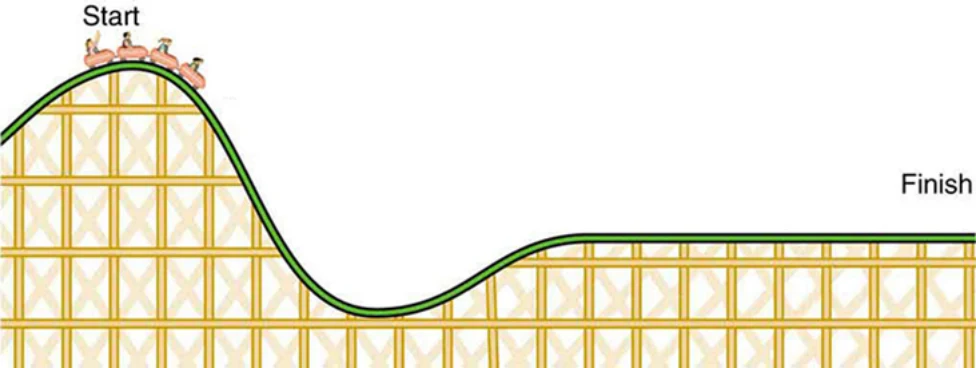
Now, let’s look at the roller coaster in Figure 9.6. Work was done on the roller coaster to get it to the top of the first rise; at this point, the roller coaster has gravitational potential energy. It is moving slowly, so it also has a small amount of kinetic energy. As the car descends the first slope, its PE is converted to KE. At the low point much of the original PE has been transformed to KE, and speed is at a maximum. As the car moves up the next slope, some of the KE is transformed back into PE and the car slows down.
では、図9.6のジェットコースターを見よう。最初の坂の頂上へ上げるために、コースターに仕事がなされた。この時点でコースターは重力による位置エネルギーを持っている。ゆっくり動いているので、わずかな運動エネルギーも持っている。車両が最初の坂を下るにつれ、位置エネルギーは運動エネルギーに変わる。最も低い点では、もとの位置エネルギーの多くが運動エネルギーに変わっており、速さは最大になる。車両が次の坂を上るにつれ、運動エネルギーの一部が位置エネルギーに戻り、車両は遅くなる。
VIRTUAL PHYSICSシミュレーションEnergy Skate Park Basicsエネルギー・スケートパークの基礎
This simulation (https://openstax.org/l/28skatepark) shows how kinetic and potential energy are related, in a scenario similar to the roller coaster. Observe the changes in KE and PE by clicking on the bar graph boxes. Also try the three differently shaped skate parks. Drag the skater to the track to start the animation.
このシミュレーション(https://openstax.org/l/28skatepark)は、ジェットコースターに似た場面で、運動エネルギーと位置エネルギーがどう結びついているかを示す。棒グラフの箱をクリックして、運動エネルギーと位置エネルギーの変化を観察しよう。形の違う三つのスケートパークも試してみよう。スケーターをコースへドラッグするとアニメーションが始まる。
This simulation (http://phet.colorado.edu/en/simulation/energy-skate-park-basics) shows how kinetic and potential energy are related, in a scenario similar to the roller coaster. Observe the changes in KE and PE by clicking on the bar graph boxes. Also try the three differently shaped skate parks. Drag the skater to the track to start the animation. The bar graphs show how KE and PE are transformed back and forth. Which statement best explains what happens to the mechanical energy of the system as speed is increasing?
このシミュレーション(http://phet.colorado.edu/en/simulation/energy-skate-park-basics)は、ジェットコースターに似た場面で、運動エネルギーと位置エネルギーがどう結びついているかを示す。棒グラフの箱をクリックして、運動エネルギーと位置エネルギーの変化を観察しよう。形の違う三つのスケートパークも試してみよう。スケーターをコースへドラッグするとアニメーションが始まる。棒グラフは、運動エネルギーと位置エネルギーが互いに移り変わるようすを示す。速さが増していくとき系の力学的エネルギーに何が起こるかを、最もよく説明しているのはどれか。
a. The mechanical energy of the system increases, provided there is no loss of energy due to friction. The energy would transform to kinetic energy when the speed is increasing.b. The mechanical energy of the system remains constant provided there is no loss of energy due to friction. The energy would transform to kinetic energy when the speed is increasing.c. The mechanical energy of the system increases provided there is no loss of energy due to friction. The energy would transform to potential energy when the speed is increasing.d. The mechanical energy of the system remains constant provided there is no loss of energy due to friction. The energy would transform to potential energy when the speed is increasing.
a. 摩擦によるエネルギーの損失がなければ、系の力学的エネルギーは増える。速さが増すとき、エネルギーは運動エネルギーへ移り変わる。b. 摩擦によるエネルギーの損失がなければ、系の力学的エネルギーは一定に保たれる。速さが増すとき、エネルギーは運動エネルギーへ移り変わる。c. 摩擦によるエネルギーの損失がなければ、系の力学的エネルギーは増える。速さが増すとき、エネルギーは位置エネルギーへ移り変わる。d. 摩擦によるエネルギーの損失がなければ、系の力学的エネルギーは一定に保たれる。速さが増すとき、エネルギーは位置エネルギーへ移り変わる。
On an actual roller coaster, there are many ups and downs, and each of these is accompanied by transitions between kinetic and potential energy. Assume that no energy is lost to friction. At any point in the ride, the total mechanical energy is the same, and it is equal to the energy the car had at the top of the first rise. This is a result of the law of conservation of energy, which says that, in a closed system, total energy is conserved—that is, it is constant. Using subscripts 1 and 2 to represent initial and final energy, this law is expressed as
実際のジェットコースターには上りと下りが何度もあり、そのたびに運動エネルギーと位置エネルギーの間の移り変わりが伴う。摩擦でエネルギーが失われないとしよう。走行中のどの点でも、全力学的エネルギーは同じであり、最初の坂の頂上で車両が持っていたエネルギーに等しい。これはエネルギー保存の法則の帰結であり、この法則は、閉じた系では全エネルギーが保存される、すなわち一定である、と述べる。初めと終わりのエネルギーを表すのに添字1と2を使うと、この法則は次のように表される。
Either side equals the total mechanical energy. The phrase in a closed system means we are assuming no energy is lost to the surroundings due to friction and air resistance. If we are making calculations on dense falling objects, this is a good assumption. For the roller coaster, this assumption introduces some inaccuracy to the calculation.
どちらの辺も全力学的エネルギーに等しい。「閉じた系では」という言い回しは、摩擦や空気抵抗によって周囲へエネルギーが失われないと仮定していることを意味する。密度の大きい落下物について計算するなら、これはよい仮定である。ジェットコースターの場合、この仮定は計算にいくらかの不正確さを持ち込む。
Calculations involving Mechanical Energy and Conservation of Energy力学的エネルギーとエネルギー保存に関わる計算
TIPS FOR SUCCESS When calculating work or energy, use units of meters for distance, newtons for force, kilograms for mass, and seconds for time. This will assure that the result is expressed in joules.
学習のポイント 仕事やエネルギーを計算するときは、距離にメートル、力にニュートン、質量にキログラム、時間に秒の単位を使うこと。そうすれば結果がジュールで表される。
Conservation of Energy This video discusses conversion of PE to KE and conservation of energy. The scenario is very similar to the roller coaster and the skate park. It is also a good explanation of the energy changes studied in the snap lab.
エネルギーの保存 この動画は、位置エネルギーから運動エネルギーへの移り変わりと、エネルギーの保存を論じる。場面はジェットコースターやスケートパークによく似ている。身近な実験で調べたエネルギーの変化のよい説明にもなっている。
Conservation of energy | Work and energy | Physics | Khan Academy (https://openstax.org/l/02consernrgz)
エネルギーの保存|仕事とエネルギー|物理|カーンアカデミー(https://openstax.org/l/02consernrgz)
Did you expect the speed at the bottom of the slope to be the same as when the object fell straight down? Which statement best explains why this is not exactly the case in real-life situations?
坂の下での速さが、物体をまっすぐ落としたときと同じになると予想しただろうか。現実の場面では厳密にはそうならないのはなぜか、最もよく説明しているのはどれか。
a. The speed was the same in the scenario in the animation because the object was sliding on the ice, where there is large amount of friction. In real life, much of the mechanical energy is lost as heat caused by friction.b. The speed was the same in the scenario in the animation because the object was sliding on the ice, where there is small amount of friction. In real life, much of the mechanical energy is lost as heat caused by friction.c. The speed was the same in the scenario in the animation because the object was sliding on the ice, where there is large amount of friction. In real life, no mechanical energy is lost due to conservation of the mechanical energy.d. The speed was the same in the scenario in the animation because the object was sliding on the ice, where there is small amount of friction. In real life, no mechanical energy is lost due to conservation of the mechanical energy.
a. アニメーションの場面で速さが同じだったのは、物体が摩擦の大きい氷の上を滑っていたからである。現実には、力学的エネルギーの多くが摩擦による熱として失われる。b. アニメーションの場面で速さが同じだったのは、物体が摩擦の小さい氷の上を滑っていたからである。現実には、力学的エネルギーの多くが摩擦による熱として失われる。c. アニメーションの場面で速さが同じだったのは、物体が摩擦の大きい氷の上を滑っていたからである。現実には、力学的エネルギーの保存によってエネルギーは失われない。 d. アニメーションの場面で速さが同じだったのは、物体が摩擦の小さい氷の上を滑っていたからである。現実には、力学的エネルギーの保存によってエネルギーは失われない。
Applying the Law of Conservation of Energy A 10 kg rock falls from a 20 m cliff. What is the kinetic and potential energy when the rock has fallen 10 m? Strategy
エネルギー保存の法則を当てはめる 質量10 kgの岩が20 mの崖から落ちる。岩が10 m落ちたときの運動エネルギーと位置エネルギーはいくらか。 方針
Choose the equation.
式を選ぶ。
List the knowns.
分かっている量を挙げる。
m = 10 kg, v1 = 0, g = 9.80
m = 10 kg、v1 = 0、g = 9.80
h1 = 20 m, h2 = 10 m
h1 = 20 m、h2 = 10 m
Identify the unknowns.
分からない量を洗い出す。
KE2 and PE2
KE2とPE2
Substitute the known values into the equation and solve for the unknown variables.
既知の値を式に代入し、分からない変数について解く。
Solution解答
Discussion考察
Alternatively, conservation of energy equation could be solved for v2 and KE2 could be calculated. Note that m could also be eliminated.
別のやり方として、エネルギー保存の式をv2について解き、KE2を計算することもできる。なおmも消去できる。
TIPS FOR SUCCESS Note that we can solve many problems involving conversion between KE and PE without knowing the mass of the object in question. This is because kinetic and potential energy are both proportional to the mass of the object. In a situation where KE = PE, we know that mgh = (1/2)mv2.Dividing both sides by m and rearranging, we have the relationship
学習のポイント 運動エネルギーと位置エネルギーの間の移り変わりに関する問題の多くは、対象の物体の質量が分からなくても解けることに注意しよう。運動エネルギーも位置エネルギーも物体の質量に比例するからである。KE = PE となる状況では mgh = (1/2)mv2 だと分かっている。両辺をmで割って整理すれば、次の関係が得られる。
2gh = v2.
2gh = v2
Practice Problems練習問題
5A child slides down a playground slide. If the slide is 3 m high and the child weighs 300 N, how much potential energy does the child have at the top of the slide? (Round g to )a. 0 Jb. 100 J
5子どもが公園の滑り台を滑り降りる。滑り台の高さが3 m、子どもの重さが300 Nのとき、滑り台の上で子どもが持つ位置エネルギーはいくらか。(gはに丸めること。)a. 0 Jb. 100 J
c. 300 Jd. 900 J
c. 300 Jd. 900 J
6A 0.2 kg apple on an apple tree has a potential energy of 10 J. It falls to the ground, converting all of its PE to kinetic energy. What is the velocity of the apple just before it hits the ground?
6リンゴの木になっている質量0.2 kgのリンゴが、位置エネルギー10 Jを持っている。それが地面に落ち、位置エネルギーがすべて運動エネルギーに変わる。地面に当たる直前のリンゴの速度はいくらか。
a. 0 m/sb. 2 m/s
a. 0 m/sb. 2 m/s
c. 10 m/sd. 50 m/s
c. 10 m/sd. 50 m/s
SNAP LAB身近な実験Converting Potential Energy to Kinetic Energy位置エネルギーを運動エネルギーに変える
In this activity, you will calculate the potential energy of an object and predict the object’s speed when all that potential energy has been converted to kinetic energy. You will then check your prediction.
この活動では、ある物体の位置エネルギーを計算し、その位置エネルギーがすべて運動エネルギーに変わったときの物体の速さを予測する。そのうえで予測を確かめる。
You will be dropping objects from a height. Be sure to stay a safe distance from the edge. Don’t lean over the railing too far. Make sure that you do not drop objects into an area where people or vehicles pass by. Make sure that dropping objects will not cause damage.
高いところから物を落とすことになる。必ず端から安全な距離をとること。手すりから身を乗り出しすぎないこと。人や車が通る場所へ物を落とさないようにすること。物を落として損害が出ないようにすること。
You will need the following:
次のものが必要である。
Materials for each pair of students:生徒二人一組あたりの材料
• Four marbles (or similar small, dense objects)• Stopwatch
・ビー玉4個(または同じような小さくて密度の大きい物)・ストップウォッチ
Materials for class:クラス全体の材料
• Metric measuring tape long enough to measure the chosen height• A scale
・選んだ高さを測れる長さのメートル法の巻き尺・はかり
Instructions
手引き
Procedure手順
1. Work with a partner. Find and record the mass of four small, dense objects per group.2. Choose a location where the objects can be safely dropped from a height of at least 15 meters. A bridge over water with a safe pedestrian walkway will work well.3. Measure the distance the object will fall.4. Calculate the potential energy of the object before you drop it using PE = mgh = (9.80)mh.5. Predict the kinetic energy and velocity of the object when it lands using PE = KE and so,
1. 二人一組で行う。各組で小さくて密度の大きい物を4個用意し、その質量を測って記録する。2. 少なくとも15メートルの高さから安全に物を落とせる場所を選ぶ。歩道が安全な、水面にかかる橋がよい。3. 物が落ちる距離を測る。4. 落とす前の物の位置エネルギーを PE = mgh = (9.80)mh で計算する。 5. PE = KE を使って、着地するときの物の運動エネルギーと速度を予測する。すなわち、
6. One partner drops the object while the other measures the time it takes to fall.7. Take turns being the dropper and the timer until you have made four measurements.8. Average your drop multiplied by and calculate the velocity of the object when it landed using v = at = gt = (9.80)t.9. Compare your results to your prediction.
6. 一方が物を落とし、もう一方が落ちるのにかかる時間を測る。7. 落とす係と計時係を交代しながら、4回測定する。8. 落下時間を平均し、v = at = gt = (9.80)t を使って着地したときの物の速度を計算する。9. 結果を予測と比べる。
7. Galileo’s experiments proved that, contrary to popular belief, heavy objects do not fall faster than light objects. How do the equations you used support this fact?
7. ガリレオの実験は、世間の思い込みに反して、重い物が軽い物より速く落ちるわけではないことを証明した。あなたが使った式は、この事実をどう裏づけているか。
a. Heavy objects do not fall faster than the light objects because while conserving the mechanical energy of the system, the mass term gets cancelled and the velocity is independent of the mass. In real life, the variation in the velocity of the different objects is observed because of the non-zero air resistance.b. Heavy objects do not fall faster than the light objects because while conserving the mechanical energy of the system, the mass term does not get cancelled and the velocity is dependent on the mass. In real life, the variation in the velocity of the different objects is observed because of the non-zero air resistance.c. Heavy objects do not fall faster than the light objects because while conserving the mechanical energy the system, the mass term gets cancelled and the velocity is independent of the mass. In real life, the variation in the velocity of the different objects is observed because of zero air resistance.d. Heavy objects do not fall faster than the light objects because while conserving the mechanical energy of the system, the mass term does not get cancelled and the velocity is dependent on the mass. In real life, the variation in the velocity of the different objects is observed because of zero air resistance.
a. 重い物が軽い物より速く落ちないのは、系の力学的エネルギーを保存させる際に質量の項が約分され、速度が質量によらなくなるからである。現実に物によって速度に違いが見られるのは、空気抵抗が0ではないからである。b. 重い物が軽い物より速く落ちないのは、系の力学的エネルギーを保存させる際に質量の項が約分されず、速度が質量に依存するからである。現実に物によって速度に違いが見られるのは、空気抵抗が0ではないからである。c. 重い物が軽い物より速く落ちないのは、系の力学的エネルギーを保存させる際に質量の項が約分され、速度が質量によらなくなるからである。現実に物によって速度に違いが見られるのは、空気抵抗が0だからである。d. 重い物が軽い物より速く落ちないのは、系の力学的エネルギーを保存させる際に質量の項が約分されず、速度が質量に依存するからである。現実に物によって速度に違いが見られるのは、空気抵抗が0だからである。
Check Your Understanding理解の確認
8Describe the transformation between forms of mechanical energy that is happening to a falling skydiver before her parachute opens.
8パラシュートを開く前の落下中のスカイダイバーに起きている、力学的エネルギーの形の間の移り変わりを述べよ。
a. Kinetic energy is being transformed into potential energy.b. Potential energy is being transformed into kinetic energy.c. Work is being transformed into kinetic energy.d. Kinetic energy is being transformed into work.
a. 運動エネルギーが位置エネルギーへ移り変わっている。b. 位置エネルギーが運動エネルギーへ移り変わっている。c. 仕事が運動エネルギーへ移り変わっている。d. 運動エネルギーが仕事へ移り変わっている。
9True or false—If a rock is thrown into the air, the increase in the height would increase the rock’s kinetic energy, and then the increase in the velocity as it falls to the ground would increase its potential energy.a. Trueb. False
9正誤問題——岩を空中へ投げると、高さが増すことで岩の運動エネルギーが増え、次に地面へ落ちるにつれて速度が増すことでその位置エネルギーが増える。a. 正b. 誤
10Identify equivalent terms for stored energy and energy of motion.
10蓄えられたエネルギーと運動のエネルギーにあたる語を答えよ。
a. Stored energy is potential energy, and energy of motion is kinetic energy.b. Energy of motion is potential energy, and stored energy is kinetic energy.
a. 蓄えられたエネルギーは位置エネルギー、運動のエネルギーは運動エネルギーである。b. 運動のエネルギーは位置エネルギー、蓄えられたエネルギーは運動エネルギーである。
c. Stored energy is the potential as well as the kinetic energy of the system.d. Energy of motion is the potential as well as the kinetic energy of the system.
c. 蓄えられたエネルギーは、系の位置エネルギーでもあり運動エネルギーでもある。d. 運動のエネルギーは、系の位置エネルギーでもあり運動エネルギーでもある。