第9章仕事、エネルギー、単純機械Work, Energy, and Simple Machines原書 p.287–314
9.1 Work, Power, and the Work–Energy Theorem9.1 仕事、仕事率、仕事・エネルギー定理
SECTION LEARNING OBJECTIVES By the end of this section, you will be able to do the following:• Describe and apply the work–energy theorem• Describe and calculate work and power
この節の学習目標 この節を終えると、次のことができるようになる。・仕事・エネルギー定理を述べ、当てはめる・仕事と仕事率を述べ、計算する
Section Key Termsこの節の重要語
energygravitational potential energyjoulekinetic energymechanical energypotential energypowerwattworkwork–energy theorem
エネルギー 重力による位置エネルギー ジュール 運動エネルギー 力学的エネルギー位置エネルギー 仕事率 ワット 仕事 仕事・エネルギー定理
The Work–Energy Theorem仕事・エネルギー定理
In physics, the term work has a very specific definition. Work is application of force, , to move an object over a distance, d, in the direction that the force is applied. Work, W, is described by the equation
物理では、仕事という語はきわめて限定された意味を持つ。仕事とは、力を加えて、その力の向きに物体を距離dだけ動かすことである。仕事Wは次の式で表される。
Some things that we typically consider to be work are not work in the scientific sense of the term. Let’s consider a few examples. Think about why each of the following statements is true.
私たちがふつう仕事だと思っているものの中には、科学の意味では仕事でないものがある。いくつか例を考えてみよう。次の各文がなぜ正しいのかを考えてほしい。
• Homework is not work.• Lifting a rock upwards off the ground is work.• Carrying a rock in a straight path across the lawn at a constant speed is not work.
・宿題は仕事ではない。・岩を地面から持ち上げるのは仕事である。・岩を抱えて芝生をまっすぐ一定の速さで運ぶのは仕事ではない。
The first two examples are fairly simple. Homework is not work because objects are not being moved over a distance. Lifting a rock up off the ground is work because the rock is moving in the direction that force is applied. The last example is less obvious. Recall from the laws of motion that force is not required to move an object at constant velocity. Therefore, while some force may be applied to keep the rock up off the ground, no net force is applied to keep the rock moving forward at constant velocity.
初めの二つはかなり簡単である。宿題は物を距離だけ動かしていないので仕事ではない。岩を地面から持ち上げるのは、岩が力の加わる向きに動くので仕事である。最後の例はそれほど明らかではない。運動の法則から、物体を一定の速度で動かすのに力は要らないことを思い出そう。したがって、岩を地面から浮かせておくのに何らかの力は加わっているとしても、岩を一定の速度で前へ動かし続けるための合力は加わっていない。
Work and energy are closely related. When you do work to move an object, you change the object’s energy. You (or an object) also expend energy to do work. In fact, energy can be defined as the ability to do work. Energy can take a variety of different forms, and one form of energy can transform to another. In this chapter we will be concerned with mechanical energy, which comes in two forms: kinetic energy and potential energy.
仕事とエネルギーは密接に結びついている。物を動かす仕事をすれば、その物のエネルギーが変わる。あなた(あるいはある物)は、仕事をするためにエネルギーを費やしもする。実のところ、エネルギーは仕事をする能力として定義できる。エネルギーはさまざまな形をとりえ、ある形のエネルギーは別の形へ移り変わりうる。この章では力学的エネルギーを扱う。力学的エネルギーには運動エネルギーと位置エネルギーの二つの形がある。
• Kinetic energy is also called energy of motion. A moving object has kinetic energy.• Potential energy, sometimes called stored energy, comes in several forms. Gravitational potential energy is the stored energy an object has as a result of its position above Earth’s surface (or another object in space). A roller coaster car at the top of a hill has gravitational potential energy.
・運動エネルギーは運動のエネルギーとも呼ばれる。動いている物体は運動エネルギーを持つ。・位置エネルギーは、蓄えられたエネルギーと呼ばれることもあり、いくつかの形がある。重力による位置エネルギーは、地表(あるいは宇宙にある別の天体)より上の位置にあることによって物体が持つ、蓄えられたエネルギーである。丘の頂上にあるジェットコースターの車両は重力による位置エネルギーを持つ。
Let’s examine how doing work on an object changes the object’s energy. If we apply force to lift a rock off the ground, we increase the rock’s potential energy, PE. If we drop the rock, the force of gravity increases the rock’s kinetic energy as the rock moves downward until it hits the ground.
物に仕事をすると、その物のエネルギーがどう変わるかを調べよう。力を加えて岩を地面から持ち上げれば、岩の位置エネルギーPEが増える。岩を落とせば、岩が地面に当たるまで下へ動く間に、重力が岩の運動エネルギーを増やす。
The force we exert to lift the rock is equal to its weight, w, which is equal to its mass, m, multiplied by acceleration due to gravity, g.
岩を持ち上げるのに私たちが及ぼす力は、その重さwに等しく、それは質量mに重力加速度gを掛けたものに等しい。
The work we do on the rock equals the force we exert multiplied by the distance, d, that we lift the rock. The work we do on the rock also equals the rock’s gain in gravitational potential energy, PEe.
私たちが岩にする仕事は、及ぼす力に岩を持ち上げる距離dを掛けたものに等しい。私たちが岩にする仕事はまた、岩が得る重力による位置エネルギーPEにも等しい。
Kinetic energy depends on the mass of an object and its velocity, v.
運動エネルギーは、物体の質量とその速度vによって決まる。
When we drop the rock the force of gravity causes the rock to fall, giving the rock kinetic energy. When work done on an object increases only its kinetic energy, then the net work equals the change in the value of the quantity .
岩を落とすと重力によって岩は落下し、岩に運動エネルギーを与える。物体にした仕事がその運動エネルギーだけを増やすとき、正味の仕事は量の変化に等しい。
This is a statement of the work–energy theorem, which is expressed mathematically as
これが仕事・エネルギー定理の内容であり、数式では次のように表される。
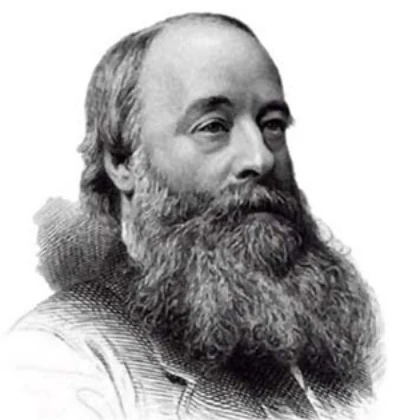
The subscripts 2 and 1 indicate the final and initial velocity, respectively. This theorem was proposed and successfully tested by James Joule, shown in Figure 9.2.
添字2と1は、それぞれ終わりの速度と初めの速度を示す。この定理は、図9.2に示すジェームズ・ジュールによって提案され、実験で確かめられた。
Does the name Joule sound familiar? The joule (J) is the metric unit of measurement for both work and energy. The measurement of work and energy with the same unit reinforces the idea that work and energy are related and can be converted into one another. 1.0 J = 1.0 N∙m, the units of force multiplied by distance. 1.0 N = 1.0 kg∙m/s2, so 1.0 J = 1.0 kg∙m2/s2. Analyzing the units of the term (1/2)mv2 will produce the same units for joules.
ジュールという名に聞き覚えはないだろうか。ジュール(J)は、仕事とエネルギーの両方を測るメートル法の単位である。仕事とエネルギーを同じ単位で測ることは、両者が結びついており互いに移り変わりうるという考えを裏づけている。1.0 J = 1.0 N∙m であり、これは力に距離を掛けた単位である。1.0 N = 1.0 kg∙m/s2 なので、1.0 J = 1.0 kg∙m2/s2 である。(1/2)mv2 の項の単位を調べても、ジュールと同じ単位になる。
Work and Energy This video explains the work energy theorem and discusses how work done on an object increases the object’s KE.
仕事とエネルギー この動画は仕事・エネルギー定理を説明し、物体にした仕事がその運動エネルギーをどう増やすかを論じる。
Introduction to work and energy | Work and energy | Physics | Khan Academy (https://openstax.org/l/02worknrgz)
仕事とエネルギーの入門|仕事とエネルギー|物理|カーンアカデミー(https://openstax.org/l/02worknrgz)
GRASP CHECK True or false—The energy increase of an object acted on only by a gravitational force is equal to the product of the object's weight and the distance the object falls.
理解の確認 正誤問題——重力だけを受けている物体のエネルギーの増加は、その物体の重さと落ちた距離の積に等しい。
a. Trueb. False
a. 正b. 誤
Calculations Involving Work and Power仕事と仕事率に関わる計算
In applications that involve work, we are often interested in how fast the work is done. For example, in roller coaster design, the amount of time it takes to lift a roller coaster car to the top of the first hill is an important consideration. Taking a half hour on the ascent will surely irritate riders and decrease ticket sales. Let’s take a look at how to calculate the time it takes to do work.
仕事の関わる場面では、仕事がどれくらい速く行われるかに関心があることが多い。たとえばジェットコースターの設計では、車両を最初の丘の頂上まで持ち上げるのにかかる時間が重要な検討事項である。上りに30分もかかれば、乗客はきっといらだち、切符の売れ行きも落ちる。仕事にかかる時間をどう計算するかを見てみよう。
Recall that a rate can be used to describe a quantity, such as work, over a period of time. Power is the rate at which work is done. In this case, rate means per unit of time. Power is calculated by dividing the work done by the time it took to do the work.
仕事のような量を、ある時間にわたって表すのに割合を使えることを思い出そう。仕事率とは、仕事が行われる割合である。この場合の割合とは、単位時間あたりという意味である。仕事率は、した仕事をそれにかかった時間で割って計算する。
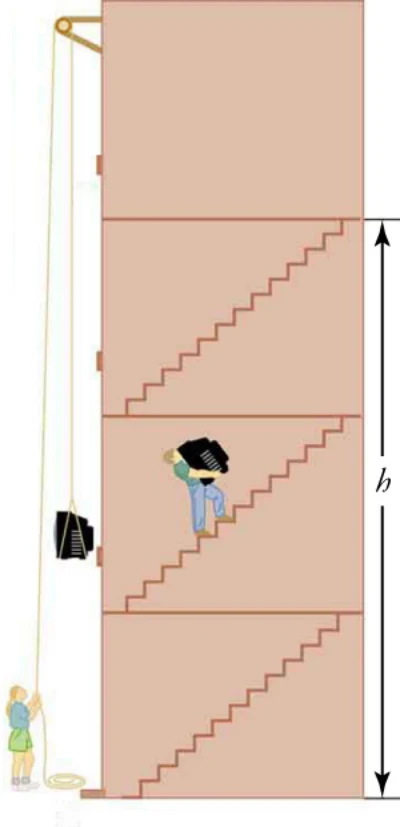
Let’s consider an example that can help illustrate the differences among work, force, and power. Suppose the woman in Figure 9.3 lifting the TV with a pulley gets the TV to the fourth floor in two minutes, and the man carrying the TV up the stairs takes five minutes to arrive at the same place. They have done the same amount of work on the TV, because they have moved the same mass over the same vertical distance, which requires the same amount of upward force. However, the woman using the pulley has generated more power. This is because she did the work in a shorter amount of time, so the denominator of the power formula, t, is smaller. (For simplicity’s sake, we will leave aside for now the fact that the man climbing the stairs has also done work on himself.)
仕事・力・仕事率の違いをはっきりさせる例を考えよう。図9.3で滑車を使ってテレビを持ち上げる女性が、2分で4階までテレビを上げ、階段でテレビを運ぶ男性が同じ場所に着くのに5分かかったとする。二人が行った仕事の量は同じである。同じ質量を同じ鉛直距離だけ動かしており、それには同じ大きさの上向きの力が要るからである。しかし滑車を使った女性のほうが大きな仕事率を生んでいる。彼女は短い時間で仕事をしたので、仕事率の式の分母tが小さいからである。(話を簡単にするため、階段を上る男性が自分自身にも仕事をしているという事実は、ここでは脇に置く。)
Power can be expressed in units of watts (W). This unit can be used to measure power related to any form of energy or work. You have most likely heard the term used in relation to electrical devices, especially light bulbs. Multiplying power by time gives the amount of energy. Electricity is sold in kilowatt-hours because that equals the amount of electrical energy consumed.
仕事率はワット(W)の単位で表せる。この単位は、どんな形のエネルギーや仕事に関わる仕事率を測るのにも使える。電気製品、とくに電球についてこの語を耳にしたことがあるだろう。仕事率に時間を掛ければエネルギーの量になる。電気がキロワット時で売られているのは、それが消費された電気エネルギーの量に等しいからである。
The watt unit was named after James Watt (1736–1819) (see Figure 9.4). He was a Scottish engineer and inventor who discovered how to coax more power out of steam engines.
ワットという単位はジェームズ・ワット(1736–1819)にちなむ(図9.4を見よ)。彼はスコットランドの技術者・発明家で、蒸気機関からより大きな仕事率を引き出す方法を見いだした。
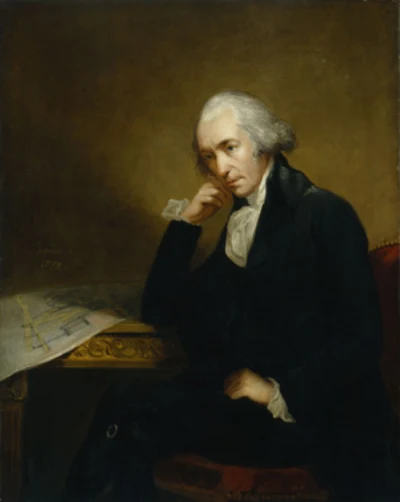
Watt’s Steam Engine James Watt did not invent the steam engine, but by the time he was finished tinkering with it, it was more useful.
ワットの蒸気機関 ジェームズ・ワットは蒸気機関を発明したわけではないが、彼が手を入れ終えたとき、それははるかに役に立つものになっていた。
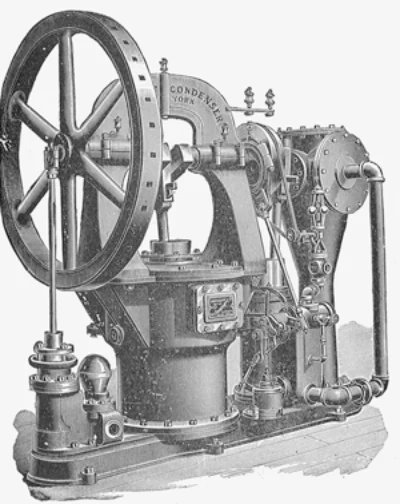
The first steam engines were not only inefficient, they only produced a back and forth, or reciprocal, motion. This was natural because pistons move in and out as the pressure in the chamber changes. This limitation was okay for simple tasks like pumping water or mashing potatoes, but did not work so well for moving a train. Watt was able build a steam engine that converted reciprocal motion to circular motion. With that one innovation, the industrial revolution was off and running. The world would never be the same. One of Watt's steam engines is shown in Figure 9.5. The video that follows the figure explains the importance of the steam engine in the industrial revolution.
最初期の蒸気機関は効率が悪かっただけでなく、行ったり来たりする往復運動しか生めなかった。ピストンは室内の圧力の変化に応じて出入りするのだから、これは当然である。この限界は、水を汲み上げたりジャガイモをつぶしたりといった単純な仕事には差し支えなかったが、列車を動かすにはうまくいかなかった。ワットは、往復運動を回転運動に変える蒸気機関を作ることができた。この一つの革新によって、産業革命が走り出した。世界は二度と同じではなくなった。ワットの蒸気機関の一つを図9.5に示す。図に続く動画は、産業革命における蒸気機関の重要性を説明している。
Watt's Role in the Industrial Revolution This video demonstrates how the watts that resulted from Watt's inventions helped make the industrial revolution possible and allowed England to enter a new historical era.
産業革命におけるワットの役割 この動画は、ワットの発明が生んだワット(仕事率)が、いかに産業革命を可能にし、イギリスを新しい歴史の時代へ入らせたかを示す。
Coal, Steam, and The Industrial Revolution: Crash Course World History #32 (https://www.youtube.com/embed/ zhL5DCizj5c)
石炭、蒸気、そして産業革命:クラッシュコース世界史 #32(https://www.youtube.com/embed/zhL5DCizj5c)
GRASP CHECK Which form of mechanical energy does the steam engine generate?a. Potential energyb. Kinetic energy
理解の確認 蒸気機関が生む力学的エネルギーはどの形か。a. 位置エネルギーb. 運動エネルギー
c. Nuclear energyd. Solar energy
c. 核エネルギーd. 太陽エネルギー
Before proceeding, be sure you understand the distinctions among force, work, energy, and power. Force exerted on an object over a distance does work. Work can increase energy, and energy can do work. Power is the rate at which work is done.
先へ進む前に、力・仕事・エネルギー・仕事率の区別をしっかり理解しておこう。物体に距離にわたって及ぼされた力は仕事をする。仕事はエネルギーを増やしうるし、エネルギーは仕事をしうる。仕事率は、仕事が行われる割合である。
Applying the Work–Energy Theorem An ice skater with a mass of 50 kg is gliding across the ice at a speed of 8 m/s when her friend comes up from behind and gives her a push, causing her speed to increase to 12 m/s. How much work did the friend do on the skater?
仕事・エネルギー定理を当てはめる 質量50 kgのスケーターが氷の上を8 m/sで滑っているとき、友人が後ろから来て押し、速さが12 m/sに増えた。友人はスケーターにどれだけの仕事をしたか。
Strategy方針
The work–energy theorem can be applied to the problem. Write the equation for the theorem and simplify it if possible.
この問題には仕事・エネルギー定理を当てはめられる。定理の式を書き、可能なら簡単にする。
Solution解答
Identify the variables. m = 50 kg,
変数を洗い出す。m = 50 kg、
Substitute.
代入する。
Discussion考察
Work done on an object or system increases its energy. In this case, the increase is to the skater’s kinetic energy. It follows that the increase in energy must be the difference in KE before and after the push.
物体や系にした仕事は、そのエネルギーを増やす。この場合、増えたのはスケーターの運動エネルギーである。したがってエネルギーの増加は、押される前と後の運動エネルギーの差でなければならない。
TIPS FOR SUCCESS This problem illustrates a general technique for approaching problems that require you to apply formulas: Identify the unknown and the known variables, express the unknown variables in terms of the known variables, and then enter all the known values.
学習のポイント この問題は、式を当てはめて解く問題への一般的な取り組み方を示している。すなわち、分からない変数と分かっている変数を見分け、分からない変数を分かっている変数で表し、そのうえで既知の値をすべて入れる、という手順である。
2. Identify which of the following actions generates more power. Show your work.
2. 次のどちらの行動のほうが大きな仕事率を生むかを答えよ。計算過程も示せ。
• carrying a TV to the second floor in or• carrying a watermelon to the second floor in ?
・のテレビをで2階へ運ぶ・のスイカをで2階へ運ぶ
a. Carrying a TV generates more power than carrying a watermelon to the same height because power is defined as work done times the time interval.b. Carrying a TV generates more power than carrying a watermelon to the same height because power is defined as the ratio of work done to the time interval.c. Carrying a watermelon generates more power than carrying a TV to the same height because power is defined as work done times the time interval.d. Carrying a watermelon generates more power than carrying a TV to the same height because power is defined as the ratio of work done and the time interval.
a. のテレビを運ぶほうが、同じ高さへのスイカを運ぶより大きな仕事率を生む。仕事率はした仕事と時間間隔の積として定義されるから。b. のテレビを運ぶほうが、同じ高さへのスイカを運ぶより大きな仕事率を生む。仕事率はした仕事と時間間隔の比として定義されるから。c. のスイカを運ぶほうが、同じ高さへのテレビを運ぶより大きな仕事率を生む。仕事率はした仕事と時間間隔の積として定義されるから。d. のスイカを運ぶほうが、同じ高さへのテレビを運ぶより大きな仕事率を生む。仕事率はした仕事と時間間隔の比として定義されるから。
Check Your Understanding理解の確認
3Identify two properties that are expressed in units of joules.a. work and forceb. energy and weight
3ジュールの単位で表される性質を二つ挙げよ。a. 仕事と力 b. エネルギーと重さ
c. work and energyd. weight and force
c. 仕事とエネルギーd. 重さと力
4When a coconut falls from a tree, work W is done on it as it falls to the beach. This work is described by the equation
4ヤシの実が木から落ちるとき、浜へ落ちるまでの間に実に仕事Wがなされる。この仕事は次の式で表される。
Identify the quantities F, d, m, v1, and v2 in this event.
この出来事における量F、d、m、v1、v2が何かを答えよ。
a. F is the force of gravity, which is equal to the weight of the coconut, d is the distance the nut falls, m is the mass of the earth, v1 is the initial velocity, and v2 is the velocity with which it hits the beach.b. F is the force of gravity, which is equal to the weight of the coconut, d is the distance the nut falls, m is the mass of the coconut, v1 is the initial velocity, and v2 is the velocity with which it hits the beach.c. F is the force of gravity, which is equal to the weight of the coconut, d is the distance the nut falls, m is the mass of the earth, v1 is the velocity with which it hits the beach, and v2 is the initial velocity.d. F is the force of gravity, which is equal to the weight of the coconut, d is the distance the nut falls, m is the mass of the coconut, v1 is the velocity with which it hits the beach, and v2 is the initial velocity.
a. Fはヤシの実の重さに等しい重力、dは実が落ちる距離、mは地球の質量、v1は初速度、v2は浜に当たるときの速度である。b. Fはヤシの実の重さに等しい重力、dは実が落ちる距離、mはヤシの実の質量、v1は初速度、v2は浜に当たるときの速度である。c. Fはヤシの実の重さに等しい重力、dは実が落ちる距離、mは地球の質量、v1は浜に当たるときの速度、v2は初速度である。d. Fはヤシの実の重さに等しい重力、dは実が落ちる距離、mはヤシの実の質量、v1は浜に当たるときの速度、v2は初速度である。