第4章力とニュートンの運動の法則Forces and Newton’s Laws of Motion原書 p.121–150
Test Prep実力テスト
Multiple Choice選択問題
4.1 Force 25Which of the following is a physical quantity that can be described by dynamics but not by kinematics?
4.1 力 25次のうち、運動学では記述できず動力学で記述できる物理量はどれか。
a. Velocityb. Accelerationc. Force
a. 速度b. 加速度c. 力
26Which of the following is used to represent an object in a free-body diagram?
26自由物体図で物体を表すのに使われるのはどれか。
a. A pointb. A line
a. 点b. 線
c. A vector
c. ベクトル
4.2 Newton's First Law of Motion: Inertia 27Which of the following does the friction force NOT depend on?
4.2 ニュートンの運動の第一法則:慣性 27摩擦力が依存しないのは次のうちどれか。
a. The normal force on the objectb. The nature of the contact surface
a. 物体にはたらく垂直抗力b. 接触面の性質
c. The speed of the objectd. The direction of the object's motion
c. 物体の速さd. 物体の運動の向き
28What is another name for Newton’s first law?a. Law of infinite motionb. Law of inertia
28ニュートンの第一法則の別名は何か。a. 無限運動の法則b. 慣性の法則
c. Law of friction
c. 摩擦の法則
29True or False—A rocket is launched into space and escapes Earth’s gravitational pull. It will continue to travel in a straight line until it is acted on by another force.
29正誤問題——あるロケットが宇宙へ打ち上げられ、地球の重力を振り切った。このロケットは、別の力を受けるまで一直線に進み続ける。
a. Trueb. False
a. 正b. 誤
accelerates at 18 m/s2, what is the magnitude of the force exerted by the person?
18 m/s2で加速するとき、その人が及ぼす力の大きさはいくらか。
a. −90 Nb. −80 Nc. 90 Nd. 100 N
a. −90 Nb. −80 Nc. 90 Nd. 100 N
is the acceleration of the car?a. 0.244 m/s2b. 0.265 m/s2c. 4.00 m/s2d. 4.10 m/s2
車の加速度はいくらか。a. 0.244 m/s2b. 0.265 m/s2c. 4.00 m/s2d. 4.10 m/s2
30A 2,000-kg car is sitting at rest in a parking lot. A bike and rider with a total mass of 60 kg are traveling along a road at 10 km/h. Which system has more inertia? Why?
30質量2,000 kgの車が駐車場に止まっている。自転車と乗り手の合計質量は60 kgで、道路を時速10 kmで走っている。どちらの系のほうが慣性が大きいか。またそれはなぜか。
a. The car has more inertia, as its mass is greater than the mass of the bike.b. The bike has more inertia, as its mass is greater than the mass of the car.c. The car has more inertia, as its mass is less than the mass of the bike.d. The bike has more inertia, as its mass is less than the mass of the car.
a. 車のほうが慣性が大きい。質量が自転車の質量より大きいから。b. 自転車のほうが慣性が大きい。質量が車の質量より大きいから。c. 車のほうが慣性が大きい。質量が自転車の質量より小さいから。d. 自転車のほうが慣性が大きい。質量が車の質量より小さいから。
4.3 Newton's Second Law of Motion 31In the equation for Newton’s second law, what does Fnet stand for?
4.3 ニュートンの運動の第二法則 31ニュートンの第二法則の式で、Fnetは何を表すか。
a. Internal forceb. Net external forcec. Frictional force
a. 内力b. 外力の合力c. 摩擦力
32What is the SI unit of force?a. Kgb. dyn
32力のSI単位はどれか。a. kgb. dyn
c. N
c. N
33What is the net external force on an object in freefall on Earth if you were to neglect the effect of air?
33空気の影響を無視するとき、地球上で自由落下している物体にはたらく外力の合力はいくらか。
a. The net force is zero.b. The net force is upward with magnitude mg.c. The net force is downward with magnitude mg.d. The net force is downward with magnitude
a. 合力は0である。b. 合力は上向きで大きさmgである。c. 合力は下向きで大きさmgである。d. 合力は下向きで大きさ
98 N.
98 Nである。
34Two people push a 2,000-kg car to get it started. An acceleration of at least 5.0 m/s2 is required to start the car. Assuming both people apply the same magnitude force, how much force will each need to apply if friction between the car and the road is 300 N?
34二人で2,000 kgの車を押してエンジンをかけようとする。かけるには少なくとも5.0 m/s2の加速度が要る。二人が同じ大きさの力を加えるとし、車と道路の間の摩擦が300 Nだとすると、一人あたりどれだけの力を加えねばならないか。
a. 4850 Nb. 5150 N
a. 4850 Nb. 5150 N
c. 97000 Nd. 10300 N
c. 97000 Nd. 10300 N
4.4 Newton's Third Law of Motion 35One object exerts a force of magnitude F1 on another object and experiences a force of magnitude F2 in return. What is true for F1 and F2?
4.4 ニュートンの運動の第三法則 35ある物体が別の物体に大きさF1の力を及ぼし、その返しに大きさF2の力を受ける。F1とF2について正しいのはどれか。
a. F1 > F2b. F1 < F2
a. F1 > F2b. F1 < F2
c. F1 = F2
c. F1 = F2
36A weight is suspended with a rope and hangs freely. In what direction is the tension on the
36おもりがロープでつるされ、自由にぶら下がっている。ロープにはたらく張力の向きは
Short Answer記述式
4.1 Force 39True or False—An external force is defined as a force generated outside the system of interest that acts on an object inside the system.
4.1 力 39正誤問題——外力とは、関心のある系の外で生じ、系の中の物体にはたらく力である。
a. Trueb. False
a. 正b. 誤
40By convention, which sign is assigned to an object moving downward?
40慣例として、下向きに動く物体にはどちらの符号を割り当てるか。
a. A positive sign ( )b. A negative sign ( )
a. 正の符号()b. 負の符号( )
c. Either a positive or negative sign ( )d. No sign is assigned
c. 正でも負でもよい()d. 符号は割り当てない
41A body is pushed downward by a force of 5 units and upward by a force of 2 units. How would you draw a free-body diagram to represent this?
41ある物体が5単位の力で下へ、2単位の力で上へ押されている。これを自由物体図でどう描くか。
a. Two force vectors acting at a point, both pointing up with lengths of 5 units and 2 unitsb. Two force vectors acting at a point, both pointing down with lengths of 5 units and 2 unitsc. Two force vectors acting at a point, one pointing up with a length of 5 units and the other pointing down with a length of 2 units
a. 1点にはたらく二本の力ベクトル。どちらも上向きで、長さは5単位と2単位。b. 1点にはたらく二本の力ベクトル。どちらも下向きで、長さは5単位と2単位。c. 1点にはたらく二本の力ベクトル。一方は上向きで長さ5単位、他方は下向きで長さ2単位。
rope?
どちらか。
a. parallel to the ropeb. perpendicular to the rope
a. ロープに平行b. ロープに垂直
37A person weighing 55 kg walks by applying 160 N of force on the ground, while pushing a 10-kg object. If the person accelerates at 2 m/s2, what is the force of friction experienced by the system consisting of the person and the object?
37質量55 kgの人が、10 kgの物体を押しながら、地面に160 Nの力を加えて歩く。この人が2 m/s2で加速するとき、人と物体からなる系が受ける摩擦力はいくらか。
a. 30 Nb. 50 N
a. 30 Nb. 50 N
c. 270 Nd. 290 N
c. 270 Nd. 290 N
38A 65-kg swimmer pushes on the pool wall and accelerates at 6 m/s2. The friction experienced by the swimmer is 100 N. What is the magnitude of the force that the swimmer applies on the wall?
38質量65 kgの泳者がプールの壁を押し、6 m/s2で加速する。泳者が受ける摩擦は100 Nである。泳者が壁に加える力の大きさはいくらか。
a. −490 Nb. −290 Nc. 290 Nd. 490 N
a. −490 Nb. −290 Nc. 290 Nd. 490 N
d. Two force vectors acting at a point, one pointing down with a length of 5 units and the other pointing up with a length of 2 units
d. 1点にはたらく二本の力ベクトル。一方は下向きで長さ5単位、他方は上向きで長さ2単位。
42A body is pushed eastward by a force of four units and southward by a force of three units. How would you draw a free-body diagram to represent this?
42ある物体が4単位の力で東へ、3単位の力で南へ押されている。これを自由物体図でどう描くか。
a. Two force vectors acting at a point, one pointing left with a length of 4 units and the other pointing down with a length of 3 unitsb. Two force vectors acting at a point, one pointing left with a length of 4 units and the other pointing up with a length of 3 unitsc. Two force vectors acting at a point, one pointing right with a length of 4 units and the other pointing down with a length of 3 unitsd. Two force vectors acting at a point, one pointing right with a length of 4 units and the other pointing up with a length of 3 units
a. 1点にはたらく二本の力ベクトル。一方は左向きで長さ4単位、他方は下向きで長さ3単位。b. 1点にはたらく二本の力ベクトル。一方は左向きで長さ4単位、他方は上向きで長さ3単位。c. 1点にはたらく二本の力ベクトル。一方は右向きで長さ4単位、他方は下向きで長さ3単位。d. 1点にはたらく二本の力ベクトル。一方は右向きで長さ4単位、他方は上向きで長さ3単位。
4.2 Newton's First Law of Motion: Inertia 43A body with mass m is pushed along a horizontal surface by a force F and is opposed by a frictional force f. How would you draw a free-body diagram to represent this situation?
4.2 ニュートンの運動の第一法則:慣性 43質量mの物体が力Fで水平な面の上を押され、摩擦力fに逆らわれている。この状況を自由物体図でどう描くか。
a. A dot with an arrow pointing right, labeled F, and an arrow pointing left, labeled f, that is of equal length or shorter than Fb. A dot with an arrow pointing right, labeled F, and an arrow pointing right, labeled f, that is of equal length or shorter than Fc. A dot with an arrow pointing right, labeled F, and a smaller arrow pointing up, labeled f, that is of equal length or longer than Fd. A dot with an arrow pointing right, labeled F, and a smaller arrow pointing down, labeled f, that is of equal length or longer than F
a. 点から右向きにFと書いた矢印、左向きにfと書いた、Fと同じか短い矢印。b. 点から右向きにFと書いた矢印、右向きにfと書いた、Fと同じか短い矢印。c. 点から右向きにFと書いた矢印、上向きにfと書いた、Fと同じか長い小さな矢印。d. 点から右向きにFと書いた矢印、下向きにfと書いた、Fと同じか長い小さな矢印。
44Two objects rest on a uniform surface. A person pushes both with equal force. If the first object starts to move faster than the second, what can be said about their masses?
44二つの物体が一様な面の上に置かれている。ある人が両方を同じ力で押す。一方が他方より速く動き出したとき、両者の質量について何が言えるか。
a. The mass of the first object is less than that of the second object.b. The mass of the first object is equal to the mass of the second object.c. The mass of the first object is greater than that of the second object.d. No inference can be made because mass and force are not related to each other.
a. 一方の質量は他方より小さい。b. 一方の質量は他方と等しい。c. 一方の質量は他方より大きい。d. 質量と力は無関係なので、何も言えない。
45Two similar boxes rest on a table. One is empty and the other is filled with pebbles. Without opening or lifting either, how can you tell which box is full? Why?
45似た二つの箱が机の上にある。一方は空で、他方は小石でいっぱいである。開けも持ち上げもせずに、どちらが詰まっているか見分けるにはどうするか。またそれはなぜか。
a. By applying an internal force; whichever box accelerates faster is lighter and so must be emptyb. By applying an internal force; whichever box accelerates faster is heavier and so the other box must be emptyc. By applying an external force; whichever box accelerates faster is lighter and so must be emptyd. By applying an external force; whichever box accelerates faster is heavier and so the other box must be empty
a. 内力を加える。速く加速するほうが軽いので、それが空である。b. 内力を加える。速く加速するほうが重いので、もう一方が空である。c. 外力を加える。速く加速するほうが軽いので、それが空である。d. 外力を加える。速く加速するほうが重いので、もう一方が空である。
46True or False—An external force is required to set a stationary object in motion in outer space away from all gravitational influences and atmospheric friction.a. Trueb. False
46正誤問題——重力の影響も大気の摩擦もまったくない宇宙空間で、静止した物体を動かし始めるには外力が要る。a. 正b. 誤
4.3 Newton's Second Law of Motion 47A steadily rolling ball is pushed in the direction from east to west, which causes the ball to move faster in the same direction. What is the direction of the acceleration?
4.3 ニュートンの運動の第二法則 47一定の速さで転がっているボールを東から西の向きに押すと、同じ向きにボールが速くなる。加速度の向きはどちらか。
a. North to southb. South to northc. East to westd. West to east
a. 北から南b. 南から北c. 東から西d. 西から東
48A ball travels from north to south at 60 km/h. After being hit by a bat, it travels from west to east at 60 km/h. Is there a change in velocity?a. Yes, because velocity is a scalar.b. Yes, because velocity is a vector.
48あるボールが北から南へ時速60 kmで進んでいる。バットに打たれたあと、西から東へ時速60 kmで進む。速度に変化はあるか。a. ある。速度はスカラーだから。b. ある。速度はベクトルだから。
c. No, because velocity is a scalar.d. No, because velocity is a vector
c. ない。速度はスカラーだから。d. ない。速度はベクトルだから。
49What is the weight of a 5-kg object on Earth and on the moon?
49質量5 kgの物体の、地球上と月面での重さはいくらか。
a. On Earth the weight is 1.67 N, and on the moon the weight is 1.67 N.b. On Earth the weight is 5 N, and on the moon the weight is 5 N.c. On Earth the weight is 49 N, and on the moon the weight is 8.35 N.d. On Earth the weight is 8.35 N, and on the moon the weight is 49 N.
a. 地球上でも月面でも1.67 N。b. 地球上でも月面でも5 N。c. 地球上では49 N、月面では8.35 N。d. 地球上では8.35 N、月面では49 N。
50An object weighs 294 N on Earth. What is its weight on the moon?
50ある物体の地球上での重さは294 Nである。月面での重さはいくらか。
a. 50.1 Nb. 30.0 Nc. 249 Nd. 1461 N
a. 50.1 Nb. 30.0 Nc. 249 Nd. 1461 N
4.4 Newton's Third Law of Motion 51A large truck with mass 30m crashes into a small sedan with mass m. If the truck exerts a force F on the sedan, what force will the sedan exert on the truck?
4.4 ニュートンの運動の第三法則 51質量30mの大型トラックが、質量mの小型セダンに衝突する。トラックがセダンに力Fを及ぼすとき、セダンはトラックにどれだけの力を及ぼすか。
b. F
b. F
c. 2Fd. 30F
c. 2Fd. 30F
52A fish pushes water backward with its fins. How does this propel the fish forward?
52魚はひれで水を後ろへ押す。これでなぜ魚は前へ進むのか。
a. The water exerts an internal force on the fish in the opposite direction, pushing the fish forward.b. The water exerts an external force on the fish in the opposite direction, pushing the fish forward.c. The water exerts an internal force on the fish in the same direction, pushing the fish forward.d. The water exerts an external force on the fish in the same direction, pushing the fish forward.
a. 水が魚に逆向きの内力を及ぼし、魚を前へ押すから。b. 水が魚に逆向きの外力を及ぼし、魚を前へ押すから。c. 水が魚に同じ向きの内力を及ぼし、魚を前へ押すから。d. 水が魚に同じ向きの外力を及ぼし、魚を前へ押すから。
53True or False—Tension is the result of opposite forces in a connector, such as a string, rope,
53正誤問題——張力とは、糸・ロープ・
Extended Response論述式
4.1 Force 55True or False—When two unequal forces act on a body, the body will not move in the direction of the weaker force.
4.1 力 55正誤問題——大きさの違う二つの力が物体にはたらくとき、物体は弱いほうの力の向きには動かない。
a. Trueb. False
a. 正b. 誤
56In the figure given, what is Frestore? What is its magnitude?
56図のFrestoreとは何か。またその大きさはいくらか。
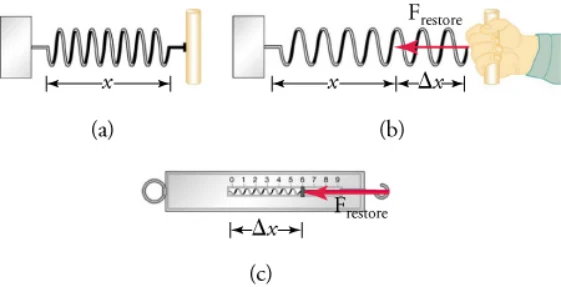
a. Frestore is the force exerted by the hand on the spring, and it pulls to the right. b. Frestore is the force exerted by the spring on the hand, and it pulls to the left. c. Frestore is the force exerted by the hand on the spring, and it pulls to the left. d. Frestore is the force exerted by the spring on the hand, and it pulls to the right.
a. Frestoreは手がばねに及ぼす力であり、右へ引く。 b. Frestoreはばねが手に及ぼす力であり、左へ引く。 c. Frestoreは手がばねに及ぼす力であり、左へ引く。 d. Frestoreはばねが手に及ぼす力であり、右へ引く。
4.2 Newton's First Law of Motion: Inertia 57Two people apply the same force from the same height to throw two identical balls in the air. Will the balls necessarily travel the same distance? Why or why not?
4.2 ニュートンの運動の第一法則:慣性 57二人が同じ高さから同じ力で、同じ二つのボールを空中へ投げる。二つのボールは必ず同じ距離を進むか。またそれはなぜか。
a. No, the balls will not necessarily travel the same distance because the gravitational force acting on them is different.
a. 進まない。二つにはたらく重力が違うから。
chain or cable, that pulls each point of the connector apart in the direction parallel to the length of the connector. At the ends of the connector, the tension pulls toward the center of the connector.
鎖・ケーブルのようなつなぎ手の中で、逆向きの力が生む結果である。この力は、つなぎ手の各点を、つなぎ手の長さに平行な向きに引き離す。つなぎ手の両端では、張力はつなぎ手の中央へ向かって引く。
a. Trueb. False
a. 正b. 誤
54True or False—Normal reaction is the force that opposes the force of gravity and acts in the direction of the force of gravity.
54正誤問題——垂直抗力とは、重力に逆らう力であり、重力と同じ向きにはたらく。
a. Trueb. False
a. 正b. 誤
b. No, the balls will not necessarily travel the same distance because the angle at which they are thrown may differ.c. Yes, the balls will travel the same distance because the gravitational force acting on them is the same.d. Yes, the balls will travel the same distance because the angle at which they are thrown may differ.
b. 進まない。投げる角度が違いうるから。c. 進む。二つにはたらく重力が同じだから。d. 進む。投げる角度が違いうるから。
58A person pushes a box from left to right and then lets the box slide freely across the floor. The box slows down as it slides across the floor. When the box is sliding freely, what is the direction of the net external force?
58ある人が箱を左から右へ押し、それから箱を床の上で自由に滑らせる。箱は滑るにつれて遅くなる。箱が自由に滑っているとき、外力の合力の向きはどちらか。
a. The net external force acts from left to right.b. The net external force acts from right to left.c. The net external force acts upward.d. The net external force acts downward.
a. 外力の合力は左から右へはたらく。b. 外力の合力は右から左へはたらく。c. 外力の合力は上向きにはたらく。d. 外力の合力は下向きにはたらく。
4.3 Newton's Second Law of Motion 59A 55-kg lady stands on a bathroom scale inside an elevator. The scale reads 70 kg. What do you know about the motion of the elevator?
4.3 ニュートンの運動の第二法則 59質量55 kgの女性が、エレベーターの中で体重計に乗っている。体重計は70 kgを示している。エレベーターの運動について何が分かるか。
a. The elevator must be accelerating upward.b. The elevator must be accelerating downward.c. The elevator must be moving upward with a constant velocity.d. The elevator must be moving downward with a constant velocity.
a. エレベーターは上向きに加速しているはずである。b. エレベーターは下向きに加速しているはずである。c. エレベーターは一定の速度で上へ動いているはずである。d. エレベーターは一定の速度で下へ動いているはずである。
60True or False—A skydiver initially accelerates in his jump. Later, he achieves a state of constant velocity called terminal velocity. Does this mean the skydiver becomes weightless?
60正誤問題——スカイダイバーは飛び降りた直後は加速する。のちに終端速度と呼ばれる一定の速度に達する。これは、そのスカイダイバーが無重量になったことを意味するか。
62Are rockets more efficient in Earth’s atmosphere or in outer space? Why?
62ロケットは地球の大気中と宇宙空間の、どちらでより効率よく働くか。それはなぜか。
4.4 Newton's Third Law of Motion 61How do rockets propel themselves in space?a. Rockets expel gas in the forward direction at high velocity, and the gas, which provides an internal force, pushes the rockets forward.b. Rockets expel gas in the forward direction at high velocity, and the gas, which provides an external force, pushes the rockets forward.c. Rockets expel gas in the backward direction at high velocity, and the gas, which is an internal force, pushes the rockets forward.d. Rockets expel gas in the backward direction at high velocity, and the gas, which provides an external force, pushes the rockets forward.
4.4 ニュートンの運動の第三法則 61ロケットは宇宙でどうやって自分を推進するのか。a. ロケットは気体を前向きに高速で吹き出し、その気体が内力を与えてロケットを前へ押す。b. ロケットは気体を前向きに高速で吹き出し、その気体が外力を与えてロケットを前へ押す。c. ロケットは気体を後ろ向きに高速で吹き出し、その気体が内力としてロケットを前へ押す。d. ロケットは気体を後ろ向きに高速で吹き出し、その気体が外力を与えてロケットを前へ押す。
a. Yesb. No
a. するb. しない
a. Rockets are more efficient in Earth’s atmosphere than in outer space because the air in Earth’s atmosphere helps to provide thrust for the rocket, and Earth has more air friction than outer space.b. Rockets are more efficient in Earth’s atmosphere than in outer space because the air in Earth’s atmosphere helps to provide thrust to the rocket, and Earth has less air friction than the outer space.c. Rockets are more efficient in outer space than in Earth’s atmosphere because the air in Earth’s atmosphere does not provide thrust but does create more air friction than in outer space.d. Rockets are more efficient in outer space than in Earth’s atmosphere because the air in Earth’s atmosphere does not provide thrust but does create less air friction than in outer space.
a. 地球の大気中のほうが効率がよい。大気中の空気がロケットに推力を与えるのを助け、しかも地球のほうが空気の摩擦が大きいから。b. 地球の大気中のほうが効率がよい。大気中の空気がロケットに推力を与えるのを助け、しかも地球のほうが空気の摩擦が小さいから。c. 宇宙空間のほうが効率がよい。大気中の空気は推力を与えないうえ、宇宙空間より空気の摩擦を大きくするから。d. 宇宙空間のほうが効率がよい。大気中の空気は推力を与えないうえ、宇宙空間より空気の摩擦を小さくするから。