第4章力とニュートンの運動の法則Forces and Newton’s Laws of Motion原書 p.121–150
4.1 Force4.1 力
SECTION LEARNING OBJECTIVES By the end of this section, you will be able to do the following:• Differentiate between force, net force, and dynamics• Draw a free-body diagram
この節の学習目標 この節を終えると、次のことができるようになる。・力、合力、動力学を区別する・自由物体図を描く
Section Key Termsこの節の重要語
dynamicsexternal forceforcefree-body diagramnet external forcenet force
動力学外力力自由物体図外力の合力合力
Defining Force and Dynamics力と動力学を定義する
Force is the cause of motion, and motion draws our attention. Motion itself can be beautiful, such as a dolphin jumping out of the water, the flight of a bird, or the orbit of a satellite. The study of motion is called kinematics, but kinematics describes only the way objects move—their velocity and their acceleration. Dynamics considers the forces that affect the motion of moving objects and systems. Newton’s laws of motion are the foundation of dynamics. These laws describe the way objects speed up, slow down, stay in motion, and interact with other objects. They are also universal laws: they apply everywhere on Earth as well as in space.
力は物体の運動を変化させる原因となる。水面から跳び上がるイルカ、飛ぶ鳥、周回する人工衛星など、運動には私たちの目を引く美しさがある。運動学は、速度や加速度を使って物体の動き方を記述する。それに対して動力学は、物体や系の運動と、それに影響する力との関係を調べる。動力学の基礎となるのが、ニュートンの運動の法則である。これらの法則は、物体が速くなる、遅くなる、運動を続けるといった振る舞いや、物体どうしの相互作用を説明する。同じ法則を、地球上でも宇宙でも用いることができる。
A force pushes or pulls an object. The object being moved by a force could be an inanimate object, a table, or an animate object, a person. The pushing or pulling may be done by a person, or even the gravitational pull of Earth. Forces have different magnitudes and directions; this means that some forces are stronger than others and can act in different directions. For example, a cannon exerts a strong force on the cannonball that is launched into the air. In contrast, a mosquito landing on your arm exerts only a small force on your arm.
力とは、物体を押したり引いたりする働きである。対象は机のような物でも、人のような生き物でもよい。力を及ぼすのも人に限らず、地球の重力なども含まれる。力は大きさと向きを持ち、それぞれの力によって強さも働く向きも異なる。たとえば、大砲が砲弾を打ち出すときには大きな力を及ぼすが、腕にとまった蚊が腕に及ぼす力はごく小さい。
When multiple forces act on an object, the forces combine. Adding together all of the forces acting on an object gives the total force, or net force. An external force is a force that acts on an object within the system from outside the system. This type of force is different than an internal force, which acts between two objects that are both within the system. The net external force combines these two definitions; it is the total combined external force. We discuss further details about net force, external force, and net external force in the coming sections.
1つの物体に複数の力が働くとき、それらをベクトルとして足し合わせたものを合力という。外力は、考えている系の外部から、系内の物体に及ぼされる力である。系内の物体どうしの間に働く内力と区別する。外力の合力は、系に働くすべての外力のベクトル和である。これらについては、この後の節で詳しく学ぶ。
Like displacements, velocities, and accelerations, forces are vectors that have magnitude and direction. We may represent a force as the sum of two vectors at right angles. These are its one-dimensional components, which we can represent by a signed scalar quantity. When we do so, we must choose a coordinate system and the direction along each axis that will be the positive direction. This choice must be the same for all vectors in the problem—forces, accelerations, etc.
力は、変位・速度・加速度と同じく、大きさと向きを持つベクトルである。平面内の力は、互いに直交する2方向の成分に分けて表せる。各成分は、正負の符号を持つ数で表される。そのため、まず座標軸と、それぞれの軸の正の向きを定める必要がある。1つの問題の中では、力にも加速度にも、同じ座標軸と向きの約束を使う。
Commonly, in a problem set in a vertical plane, horizontal and vertical axes are chosen as the two primary directions. The usual convention is to make the positive directions right and up. Sometimes a problem concerns a sloping plane, and it may be more convenient to choose axes parallel to the plane and normal to it. In this case, it is usual to take positive in each axis as the directions that tend upward.
鉛直面内の問題では、ふつう水平と鉛直の二方向を主な向きに選ぶ。慣例では右向きと上向きを正とする。斜面が関わる問題では、斜面に平行な軸とそれに垂直な軸を選ぶほうが便利なこともある。この場合は、各軸で上向きになるほうを正にとるのがふつうである。
Thus, a horizontal force of –3 N means pushing with 3 N to the left.
したがって、水平方向に−3 Nの力とは、左向きに3 Nで押すことを意味する。
Unknown values are taken to be in the positive direction, so if your calculation of a vertical force comes out as +5.2 N, then you know it is an upward force. A negative result means the force is downward.
分からない量は正の向きにあるものとして扱う。だから鉛直方向の力を計算して+5.2 Nと出たなら、それは上向きの力だと分かる。答えが負なら、その力は下向きである。
Free-Body Diagrams and Examples of Forces自由物体図と力の例
For our first example of force, consider an object hanging from a rope. This example gives us the opportunity to introduce a useful tool known as a free-body diagram. A free-body diagram represents the object being acted upon—that is, the free body—as a single point. Only the forces acting on the body (that is, external forces) are shown and are represented by vectors (which are drawn as arrows). These forces are the only ones shown because only external forces acting on the body affect its motion. We can ignore any internal forces within the body because they cancel each other out, as explained in the section on Newton’s third law of motion. Free-body diagrams are very useful for analyzing forces acting on an object.
力の最初の例として、ロープでつるされた物体を考えよう。この例は、自由物体図という便利な道具を紹介する機会を与えてくれる。自由物体図では、力を受けている物体——すなわち自由物体——を1点として表す。その物体にはたらく力(すなわち外力)だけを描き、ベクトル(矢印)で表す。これらの力だけを描くのは、物体にはたらく外力だけがその運動に影響するからである。物体内部の内力は互いに打ち消し合うので無視できる。これはニュートンの運動の第三法則の節で説明する。自由物体図は、物体にはたらく力を分析するのにきわめて役に立つ。
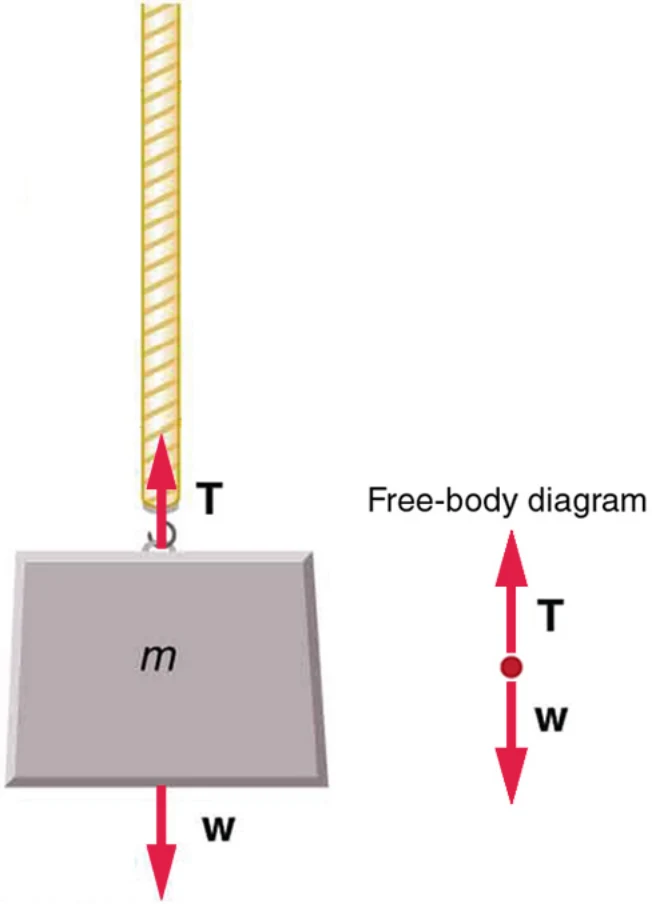
Figure 4.2 shows the force of tension in the rope acting in the upward direction, opposite the force of gravity. The forces are indicated in the free-body diagram by an arrow pointing up, representing tension, and another arrow pointing down, representing gravity. In a free-body diagram, the lengths of the arrows show the relative magnitude (or strength) of the forces. Because forces are vectors, they add just like other vectors. Notice that the two arrows have equal lengths in Figure 4.2, which means that the forces of tension and weight are of equal magnitude.Because these forces of equal magnitude act in opposite directions, they are perfectly balanced, so they add together to give a net force of zero.
図4.2は、ロープにはたらく張力が、重力とは逆の上向きにはたらくようすを示している。自由物体図では、張力を表す上向きの矢印と、重力を表す下向きの矢印で力が示されている。自由物体図では、矢印の長さが力の相対的な大きさ(強さ)を示す。力はベクトルなので、他のベクトルと同じように足し合わされる。図4.2では二つの矢印の長さが等しく、これは張力と重さの大きさが等しいことを意味する。大きさの等しいこれらの力が逆向きにはたらくので、完全につり合っており、足し合わせると合力は0になる。
Not all forces are as noticeable as when you push or pull on an object. Some forces act without physical contact, such as the pull of a magnet (in the case of magnetic force) or the gravitational pull of Earth (in the case of gravitational force).
物を押したり引いたりするときのように目に見える力ばかりではない。磁石の引力(磁気力の場合)や地球の重力(重力の場合)のように、接触せずにはたらく力もある。
In the next three sections discussing Newton’s laws of motion, we will learn about three specific types of forces: friction, the normal force, and the gravitational force. To analyze situations involving forces, we will create free-body diagrams to organize the framework of the mathematics for each individual situation.
次の三つの節でニュートンの運動の法則を論じる中で、摩擦力、垂直抗力、重力という三つの具体的な力について学ぶ。力の関わる場面を分析するために、それぞれの場面について数学の枠組みを整理する自由物体図を描いていく。
TIPS FOR SUCCESS Correctly drawing and labeling a free-body diagram is an important first step for solving a problem. It will help you visualize the problem and correctly apply the mathematics to solve the problem.
学習のポイント 自由物体図を正しく描き、記号を書き入れることが、問題を解く大事な第一歩である。そうすれば問題を思い描きやすくなり、数学を正しく当てはめて解けるようになる。
Check Your Understanding理解の確認
1What is kinematics?a. Kinematics is the study of motion.b. Kinematics is the study of the cause of motion.c. Kinematics is the study of dimensions.d. Kinematics is the study of atomic structures.
1運動学とは何か。a. 運動学は運動を扱う学問である。b. 運動学は運動の原因を扱う学問である。c. 運動学は次元を扱う学問である。d. 運動学は原子構造を扱う学問である。
2Do two bodies have to be in physical contact to exert a force upon one another?a. No, the gravitational force is a field force and does not require physical contact to exert a force.b. No, the gravitational force is a contact force and does not require physical contact to exert a force.c. Yes, the gravitational force is a field force and requires physical contact to exert a force.d. Yes, the gravitational force is a contact force and requires physical contact to exert a force.
2二つの物体が互いに力を及ぼし合うには、物理的に接触していなければならないか。a. いいえ。重力は場の力であり、力を及ぼすのに接触を必要としない。b. いいえ。重力は接触力であり、力を及ぼすのに接触を必要としない。c. はい。重力は場の力であり、力を及ぼすのに接触を必要とする。d. はい。重力は接触力であり、力を及ぼすのに接触を必要とする。
3What kind of physical quantity is force?a. Force is a scalar quantity.b. Force is a vector quantity.
3力はどんな種類の物理量か。a. 力はスカラー量である。b. 力はベクトル量である。
c. Force is both a vector quantity and a scalar quantity.d. Force is neither a vector nor a scalar quantity.
c. 力はベクトル量でもありスカラー量でもある。d. 力はベクトルでもスカラーでもない。
4Which forces can be represented in a free-body diagram?a. Internal forcesb. External forces
4自由物体図に描けるのはどの力か。a. 内力b. 外力
c. Both internal and external forcesd. A body that is not influenced by any force
c. 内力と外力の両方d. どんな力も受けていない物体