第4章力とニュートンの運動の法則Forces and Newton’s Laws of Motion原書 p.121–150
4.3 Newton's Second Law of Motion4.3 ニュートンの運動の第二法則
SECTION LEARNING OBJECTIVES By the end of this section, you will be able to do the following:
この節の学習目標 この節を終えると、次のことができるようになる。
• Describe Newton’s second law, both verbally and mathematically• Use Newton’s second law to solve problems
・ニュートンの第二法則を、言葉でも数式でも述べる・ニュートンの第二法則を使って問題を解く
Section Key Termsこの節の重要語
freefallNewton’s second law of motionweight
自由落下ニュートンの運動の第二法則重さ
Describing Newton’s Second Law of Motionニュートンの運動の第二法則を述べる
Newton’s first law considered bodies at rest or bodies in motion at a constant velocity. The other state of motion to consider is when an object is moving with a changing velocity, which means a change in the speed and/or the direction of motion. This type of motion is addressed by Newton’s second law of motion, which states how force causes changes in motion. Newton’s second law of motion is used to calculate what happens in situations involving forces and motion, and it shows the mathematical relationship between force, mass, and acceleration.Mathematically, the second law is most often written as
ニュートンの第一法則は、静止した物体と、一定の速度で動く物体を扱った。もう一つ考えるべき運動の状態は、物体が速度を変えながら動いている場合、すなわち運動の速さと向きの一方または両方が変わる場合である。この型の運動を扱うのがニュートンの運動の第二法則で、力がどのように運動の変化を引き起こすかを述べる。ニュートンの運動の第二法則は、力と運動の関わる場面で何が起こるかを計算するのに使われ、力・質量・加速度の数学的な関係を示す。数式では、第二法則はたいてい次のように書かれる。
where Fnet (or ∑F) is the net external force, m is the mass of the system, and a is the acceleration. Note that Fnet and ∑F are the same because the net external force is the sum of all the external forces acting on the system.
ここでFnet(または∑F)は外力の合力、mは系の質量、aは加速度である。外力の合力は系にはたらくすべての外力の和なので、Fnetと∑Fは同じものであることに注意しよう。
First, what do we mean by a change in motion? A change in motion is simply a change in velocity: the speed of an object can become slower or faster, the direction in which the object is moving can change, or both of these variables may change. A change in velocity means, by definition, that an acceleration has occurred. Newton’s first law says that only a nonzero net external force can cause a change in motion, so a net external force must cause an acceleration. Note that acceleration can refer to slowing down or to speeding up. Acceleration can also refer to a change in the direction of motion with no change in speed, because acceleration is the change in velocity divided by the time it takes for that change to occur, and velocity is defined by speed and direction.
まず、運動の変化とは何を意味するのか。運動の変化とは、単に速度の変化のことである。物体の速さが遅くなったり速くなったりする、物体の動く向きが変わる、あるいはその両方が変わる。速度の変化とは、定義により加速度が生じたということである。ニュートンの第一法則は、0でない外力の合力だけが運動の変化を引き起こしうると述べるので、外力の合力は加速度を生むはずである。加速度は、遅くなることも速くなることも指すことに注意しよう。加速度は、速さを変えずに運動の向きが変わることも指しうる。加速度とは速度の変化を、その変化が起きるのにかかった時間で割ったものであり、速度は速さと向きで決まるからである。
From the equation we see that force is directly proportional to both mass and acceleration, which makes sense. To accelerate two objects from rest to the same velocity, you would expect more force to be required to accelerate the more massive object. Likewise, for two objects of the same mass, applying a greater force to one would accelerate it to a greater velocity.
式から、力は質量にも加速度にも比例することが分かる。これは筋が通っている。二つの物体を静止から同じ速度まで加速するには、より重い物体を加速するほうが大きな力を要すると考えられる。同様に、質量の等しい二つの物体では、一方により大きな力を加えれば、より大きな速度まで加速される。
Now, let’s rearrange Newton’s second law to solve for acceleration. We get
では、ニュートンの第二法則を変形して加速度について解こう。次が得られる。
In this form, we can see that acceleration is directly proportional to force, which we write as
この形にすると、加速度が力に比例することが見て取れる。これを次のように書く。
where the symbol means proportional to.
ここで記号は「〜に比例する」という意味である。
This proportionality mathematically states what we just said in words: acceleration is directly proportional to the net external force. When two variables are directly proportional to each other, then if one variable doubles, the other variable must double. Likewise, if one variable is reduced by half, the other variable must also be reduced by half. In general, when one variable is multiplied by a number, the other variable is also multiplied by the same number. It seems reasonable that the acceleration of a system should be directly proportional to and in the same direction as the net external force acting on the system. An object experiences greater acceleration when acted on by a greater force.
この比例関係は、今しがた言葉で述べたこと、すなわち加速度は外力の合力に比例することを、数式で述べている。二つの変数が互いに比例するとき、一方が2倍になればもう一方も2倍にならねばならない。同じく、一方が半分になればもう一方も半分になる。一般に、一方の変数がある数倍されれば、もう一方も同じ数だけ倍される。系の加速度が、系にはたらく外力の合力に比例し、しかも同じ向きを持つというのは、もっともなことに思える。物体は、大きな力を受けるほど大きな加速度を受ける。
It is also clear from the equation that acceleration is inversely proportional to mass, which we write as
式からは、加速度が質量に反比例することも明らかである。これを次のように書く。
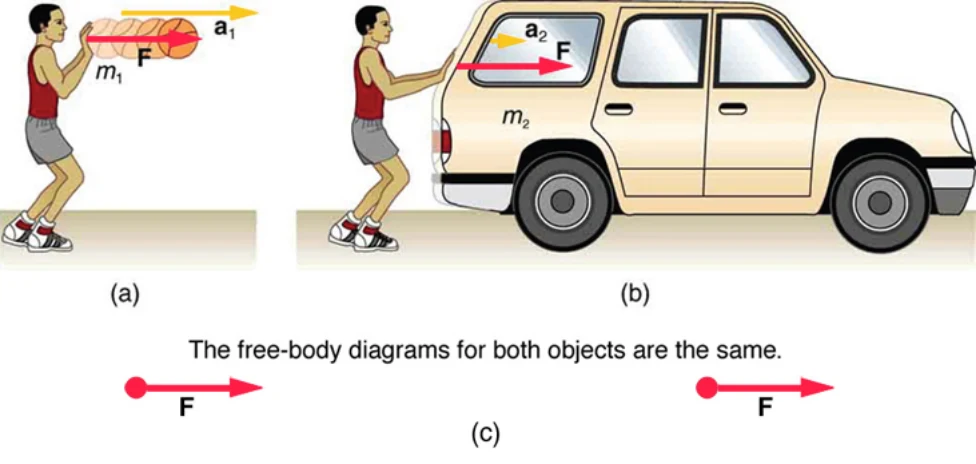
Inversely proportional means that if one variable is multiplied by a number, the other variable must be divided by the same number. Now, it also seems reasonable that acceleration should be inversely proportional to the mass of the system. In other words, the larger the mass (the inertia), the smaller the acceleration produced by a given force. This relationship is illustrated in Figure 4.5, which shows that a given net external force applied to a basketball produces a much greater acceleration than when applied to a car.
反比例するとは、一方の変数がある数倍されれば、もう一方は同じ数で割られねばならない、ということである。系の加速度が系の質量に反比例するのも、もっともに思える。言い換えれば、質量(慣性)が大きいほど、与えられた力が生む加速度は小さい。この関係を図4.5に示す。同じ外力の合力を加えても、バスケットボールに加えたほうが、車に加えたときよりはるかに大きな加速度を生む。
Applying Newton’s Second Lawニュートンの第二法則を使う
Before putting Newton’s second law into action, it is important to consider units. The equation is used to define the units of force in terms of the three basic units of mass, length, and time (recall that acceleration has units of length divided by time squared). The SI unit of force is called the newton (abbreviated N) and is the force needed to accelerate a 1-kg system at the rate of 1 m/s2. That is, because we have
ニュートンの第二法則を使う前に、単位を考えておくことが大切である。式は、質量・長さ・時間という三つの基本単位を使って力の単位を定義するのに使われる(加速度の単位は長さを時間の2乗で割ったものであることを思い出そう)。力のSI単位はニュートン(記号N)と呼ばれ、1 kgの系を1 m/s2の割合で加速するのに必要な力である。すなわちなので、次が成り立つ。
One of the most important applications of Newton’s second law is to calculate weight (also known as the gravitational force), which is usually represented mathematically as W. When people talk about gravity, they don’t always realize that it is an acceleration. When an object is dropped, it accelerates toward the center of Earth.Newton’s second law states that the net external force acting on an object is responsible for the acceleration of the object. If air resistance is negligible, the net external force on a falling object is only the gravitational force (i.e., the weight of the object).
ニュートンの第二法則の最も重要な応用の一つが、重さ(重力とも呼ばれる)の計算であり、数式ではふつうWで表される。人が重力の話をするとき、それが加速度であることに気づいていないことが多い。物体を落とすと、それは地球の中心へ向かって加速する。ニュートンの第二法則は、物体にはたらく外力の合力がその物体の加速度を生むと述べる。空気抵抗が無視できるなら、落下する物体にはたらく外力の合力は重力(すなわち物体の重さ)だけである。
Weight can be represented by a vector because it has a direction. Down is defined as the direction in which gravity pulls, so weight is normally considered a downward force. By using Newton’s second law, we can figure out the equation for weight.
重さは向きを持つのでベクトルで表せる。重力が引く向きを下と定めるので、重さはふつう下向きの力とみなされる。ニュートンの第二法則を使えば、重さの式を導ける。
Consider an object with mass m falling toward Earth. It experiences only the force of gravity (i.e., the gravitational force or weight), which is represented by W. Newton’s second law states that Because the only force acting on the object is the gravitational force, we have We know that the acceleration of an object due to gravity is g, so we have Substituting these two expressions into Newton’s second law gives
質量mの物体が地球へ落ちていくとしよう。それは重力(すなわち重さ)だけを受け、それをWと表す。ニュートンの第二法則はと述べる。物体にはたらく力は重力だけなので、である。重力による物体の加速度はgなので、である。この二つをニュートンの第二法則に代入すると、次が得られる。
This is the equation for weight—the gravitational force on a mass m. On Earth, so the weight (disregarding for now the direction of the weight) of a 1.0-kg object on Earth is
これが重さ、すなわち質量mにはたらく重力の式である。地球上ではなので、地球上の1.0 kgの物体の重さは(今は重さの向きは考えないことにして)次のようになる。
Although most of the world uses newtons as the unit of force, in the United States the most familiar unit of force is the pound (lb), where 1 N = 0.225 lb.
世界の大半は力の単位としてニュートンを使うが、アメリカで最もなじみのある力の単位はポンド(lb)であり、1 N = 0.225 lbである。
Recall that although gravity acts downward, it can be assigned a positive or negative value, depending on what the positive direction is in your chosen coordinate system. Be sure to take this into consideration when solving problems with weight. When the downward direction is taken to be negative, as is often the case, acceleration due to gravity becomes –g = −9.8 m/s2 and the weight force is –mg.
重力は下向きにはたらくが、選んだ座標系でどちらを正の向きとするかによって、正の値にも負の値にもなりうることを思い出そう。重さの関わる問題を解くときは、必ずこれを考えに入れること。よくあるように下向きを負ととると、重力加速度は−g = −9.8 m/s2、重さの力は−mgとなる。
When the net external force on an object is its weight, we say that it is in freefall. In this case, the only force acting on the object is the force of gravity. On the surface of Earth, when objects fall downward toward Earth, they are never truly in freefall because there is always some upward force due to air resistance that acts on the object (and there is also the buoyancy force of air, which is similar to the buoyancy force in water that keeps boats afloat).
物体にはたらく外力の合力がその物体の重さであるとき、その物体は自由落下していると言う。この場合、物体にはたらく力は重力だけである。地表では、物体が地球へ落ちていくとき、それが本当の自由落下であることはない。物体にはつねに空気抵抗による上向きの力がいくらかはたらくからである(さらに、船を浮かべる水の浮力に似た、空気の浮力もある)。
Gravity varies slightly over the surface of Earth, so the weight of an object depends very slightly on its location on Earth. Weight varies dramatically away from Earth’s surface. On the moon, for example, the acceleration due to gravity is only 1.67 m/s2. Because weight depends on the force of gravity, a 1.0-kg mass weighs 9.8 N on Earth and only about 1.7 N on the moon.
重力は地表の場所によってわずかに異なるので、物体の重さは地球上のどこにいるかによってごくわずかに変わる。地表を離れると、重さは劇的に変わる。たとえば月面では、重力加速度はわずか1.67 m/s2である。重さは重力の大きさで決まるので、1.0 kgの質量は地球上では9.8 Nの重さだが、月面ではおよそ1.7 Nしかない。
It is important to remember that weight and mass are very different, although they are closely related. Mass is the quantity of matter in an object (how much stuff there is, or how hard it is to accelerate it) and does not vary, but weight is the gravitational force on an object and is proportional to the force of gravity. It is easy to confuse the two, because our experience is confined to Earth, and the weight of an object is essentially the same no matter where you are on Earth. Adding to the confusion, the terms mass and weight are often used interchangeably in everyday language; for example, our medical records often show our weight in kilograms, but never in the correct unit of newtons.
重さと質量は密接に関係しているが、まったく違うものであることを忘れてはならない。質量は物体に含まれる物質の量(中身がどれだけあるか、加速させにくさがどれだけか)であって変わらないが、重さは物体にはたらく重力であり、重力の大きさに比例する。私たちの経験が地球に限られており、地球上のどこにいても物体の重さがほぼ同じであるために、この二つは混同されやすい。混乱に輪をかけるように、日常語では質量と重さがしばしば互換的に使われる。たとえば診療記録には体重がキログラムで書かれるが、正しい単位であるニュートンで書かれることはない。
SNAP LAB身近な実験Mass and Weight質量と重さ
In this activity, you will use a scale to investigate mass and weight.
この活動では、体重計を使って質量と重さを調べる。
• 1 bathroom scale• 1 table
・体重計1台・机1台
1. What do bathroom scales measure?2. When you stand on a bathroom scale, what happens to the scale? It depresses slightly. The scale contains springs that compress in proportion to your weight—similar to rubber bands expanding when pulled.3. The springs provide a measure of your weight (provided you are not accelerating). This is a force in newtons (or pounds). In most countries, the measurement is now divided by 9.80 to give a reading in kilograms, which is a of mass. The scale detects weight but is calibrated to display mass.4. If you went to the moon and stood on your scale, would it detect the same mass as it did on Earth?
1. 体重計は何を測っているのか。2. 体重計に乗ると、体重計はどうなるか。わずかに沈み込む。体重計の中にはばねが入っていて、重さに比例して縮む。輪ゴムを引っ張ると伸びるのと似ている。3. このばねが重さを測ってくれる(ただし加速していない場合に限る)。これはニュートン(またはポンド)で表される力である。今日ほとんどの国では、この測定値を9.80で割ってキログラムでの表示にしている。キログラムは質量の単位である。体重計は重さを検出しているが、質量を表示するよう目盛りが付けられている。4. 月へ行ってこの体重計に乗ったら、地球上と同じ質量を示すだろうか。
GRASP CHECK While standing on a bathroom scale, push down on a table next to you. What happens to the reading? Why?a. The reading increases because part of your weight is applied to the table and the table exerts a matching force on you that acts in the direction of your weight.b. The reading increases because part of your weight is applied to the table and the table exerts a matching force on you that acts in the direction opposite to your weight.c. The reading decreases because part of your weight is applied to the table and the table exerts a matching force on you that acts in the direction of your weight.d. The reading decreases because part of your weight is applied to the table and the table exerts a matching force on you that acts in the direction opposite to your weight.
理解の確認 体重計に乗ったまま、そばの机を下へ押すと、表示はどうなるか。またそれはなぜか。a. 体重の一部が机にかかり、机はそれに見合う力を、あなたの重さと同じ向きにあなたへ及ぼすので、表示は増える。b. 体重の一部が机にかかり、机はそれに見合う力を、あなたの重さと逆の向きにあなたへ及ぼすので、表示は増える。c. 体重の一部が机にかかり、机はそれに見合う力を、あなたの重さと同じ向きにあなたへ及ぼすので、表示は減る。d. 体重の一部が机にかかり、机はそれに見合う力を、あなたの重さと逆の向きにあなたへ及ぼすので、表示は減る。
TIPS FOR SUCCESS Only net external force impacts the acceleration of an object. If more than one force acts on an object and you calculate the acceleration by using only one of these forces, you will not get the correct acceleration for that object.
学習のポイント 物体の加速度に効くのは外力の合力だけである。物体に複数の力がはたらいているときに、そのうち一つだけを使って加速度を計算しても、その物体の正しい加速度は得られない。
Newton’s Second Law of Motion This video reviews Newton’s second law of motion and how net external force and acceleration relate to one another and to mass. It also covers units of force, mass, and acceleration, and reviews a worked-out example.
ニュートンの運動の第二法則 この動画は、ニュートンの運動の第二法則と、外力の合力・加速度・質量が互いにどう関係するかを復習する。力・質量・加速度の単位も扱い、例題を一つ解いてみせる。
Newton's second law of motion | Forces and Newton's laws of motion | Physics | Khan Academy (https://openstax.org/l/02newlawtwo)
ニュートンの運動の第二法則|力とニュートンの運動の法則|物理|カーンアカデミー(https://openstax.org/l/02newlawtwo)
GRASP CHECK True or False —If you want to reduce the acceleration of an object to half its original value, then you would need to reduce the net external force by half.
理解の確認 正誤問題——物体の加速度をもとの半分にしたければ、外力の合力を半分にすればよい。
a. Trueb. False
a. 正b. 誤
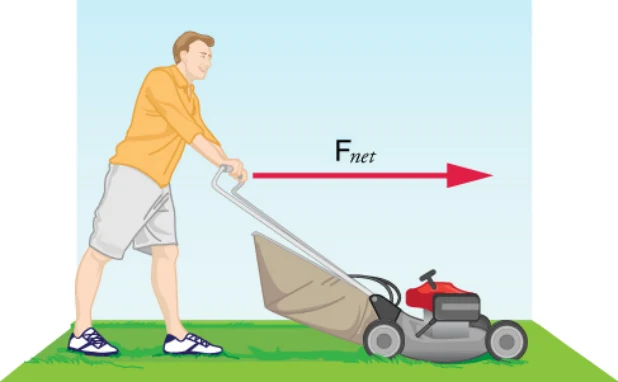
What Acceleration Can a Person Produce when Pushing a Lawn Mower? Suppose that the net external force (push minus friction) exerted on a lawn mower is 51 N parallel to the ground. The mass of the mower is 240 kg. What is its acceleration?
芝刈り機を押す人はどれだけの加速度を生めるか ある芝刈り機に及ぼされる外力の合力(押す力から摩擦を引いたもの)が、地面に平行に51 Nだとする。芝刈り機の質量は240 kgである。加速度はいくらか。
Strategy方針
Because Fnet and m are given, the acceleration can be calculated directly from Newton’s second law: Fnet = ma.
Fnetとmが与えられているので、加速度はニュートンの第二法則 Fnet = ma から直接計算できる。
Solution解答
Solving Newton’s second law for the acceleration, we find that the magnitude of the acceleration, a, is
ニュートンの第二法則を加速度について解くと、加速度の大きさaは次のようになる。
Entering the given values for net external force and mass gives
外力の合力と質量に与えられた値を入れると、次が得られる。
Inserting the units for N yields
Nの単位としてを入れると、次が得られる。
Discussion考察
The acceleration is in the same direction as the net external force, which is parallel to the ground and to the right. There is no information given in this example about the individual external forces acting on the system, but we can say something about their relative magnitudes. For example, the force exerted by the person pushing the mower must be greater than the friction opposing the motion, because we are given that the net external force is in the direction in which the person pushes. Also, the vertical forces must cancel if there is no acceleration in the vertical direction (the mower is moving only horizontally). The acceleration found is reasonable for a person pushing a mower; the mower’s speed must increase by 0.21 m/s every second, which is possible. The time during which the mower accelerates would not be very long because the person’s top speed would soon be reached. At this point, the person could push a little less hard, because he only has to overcome friction.
加速度は外力の合力と同じ向き、すなわち地面に平行で右向きである。この例では、系にはたらく個々の外力についての情報は与えられていないが、その相対的な大きさについては言えることがある。たとえば、外力の合力が人の押す向きにあると与えられているのだから、芝刈り機を押す人が及ぼす力は、運動を妨げる摩擦より大きくなければならない。また、鉛直方向に加速していない(芝刈り機は水平にしか動いていない)のだから、鉛直方向の力は打ち消し合わねばならない。求まった加速度は、人が芝刈り機を押す場合として妥当である。芝刈り機の速さは毎秒0.21 m/sずつ増すことになるが、これはありうる。人はすぐに最高の速さに達するので、加速している時間はさほど長くないだろう。その時点からは、摩擦に打ち勝つだけでよいので、押す力を少し弱められる。
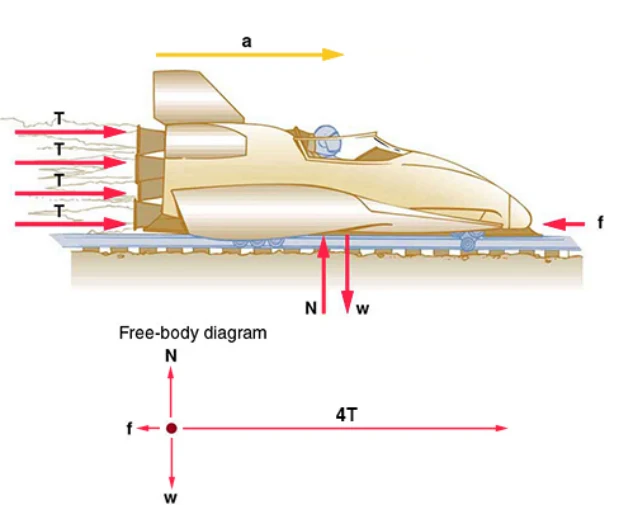
What Rocket Thrust Accelerates This Sled?Prior to manned space flights, rocket sleds were used to test aircraft, missile equipment, and physiological effects on humans at high accelerations. Rocket sleds consisted of a platform mounted on one or two rails and propelled by several rockets. Calculate the magnitude of force exerted by each rocket, called its thrust, T, for the four-rocket propulsion system shown below. The sled’s initial acceleration is the mass of the system is 2,100 kg, and the force of friction opposing the motion is 650 N.
このそりを加速させるロケット推力はいくらか有人宇宙飛行に先立ち、航空機やミサイル機器の試験や、高い加速度が人体に及ぼす影響の試験に、ロケットそりが使われた。ロケットそりは、1本または2本のレールに載せた台に、いくつかのロケットを取り付けたものである。下に示す4基のロケットによる推進系について、各ロケットが及ぼす力の大きさ、すなわち推力Tを計算せよ。そりの初めの加速度は、系の質量は2,100 kg、運動を妨げる摩擦力は650 Nである。
Strategy方針
The system of interest is the rocket sled. Although forces act vertically on the system, they must cancel because the system does not accelerate vertically. This leaves us with only horizontal forces to consider. We’ll assign the direction to the right as the positive direction. See the free-body diagram in Figure 4.8.
関心のある系はロケットそりである。系には鉛直方向にも力がはたらくが、系は鉛直方向に加速していないので、それらは打ち消し合わねばならない。したがって考えるべきは水平方向の力だけである。右向きを正とする。図4.8の自由物体図を見よ。
Solution解答
We start with Newton’s second law and look for ways to find the thrust T of the engines. Because all forces and acceleration are along a line, we need only consider the magnitudes of these quantities in the calculations. We begin with
ニュートンの第二法則から出発し、エンジンの推力Tを求める道筋を探す。力も加速度もすべて一直線上にあるので、計算ではこれらの量の大きさだけを考えればよい。次から始める。
where is the net external force in the horizontal direction. We can see from Figure 4.8 that the engine thrusts are in the same direction (which we call the positive direction), whereas friction opposes the thrust. In equation form, the net external force is
ここでは水平方向の外力の合力である。図4.8から、エンジンの推力はどれも同じ向き(これを正の向きと呼ぶ)であり、摩擦が推力に逆らっていることが分かる。式で書くと、外力の合力は次のようになる。
Newton’s second law tells us that Fnet= ma, so we get
ニュートンの第二法則は Fnet = ma と教えるので、次が得られる。
After a little algebra, we solve for the total thrust 4T:
少し式を整理して、推力の合計4Tについて解く。
which means that the individual thrust is
つまり1基あたりの推力は次のようになる。
Inserting the known values yields
分かっている値を入れると、次が得られる。
Discussion考察
The numbers are quite large, so the result might surprise you. Experiments such as this were performed in the early 1960s to test the limits of human endurance and to test the apparatus designed to protect fighter pilots in emergency ejections. Speeds of 1000 km/h were obtained, with accelerations of 45 g. (Recall that g, the acceleration due to gravity, is An acceleration of 45 g is which is approximately ) Living subjects are no longer used, and land speeds of 10,000 km/h have now been obtained with rocket sleds. In this example, as in the preceding example, the system of interest is clear. We will see in later examples that choosing the system of interest is crucial—and that the choice is not always obvious.
数がかなり大きいので、結果に驚くかもしれない。このような実験は1960年代初めに、人体が耐えられる限界を調べ、戦闘機のパイロットを緊急脱出時に守る装置を試験するために行われた。時速1000 kmの速さと45 gの加速度が得られた。(重力加速度gはであることを思い出そう。45 gの加速度は、すなわちおよそである。)今では生きた被験者は使われず、ロケットそりでは時速10,000 kmの地上速度が得られている。この例でも前の例でも、関心のある系ははっきりしていた。後の例では、関心のある系を選ぶことが決定的に重要であり、しかもその選び方がいつも自明とは限らないことを見ることになる。
Practice Problems練習問題
9If 1 N is equal to 0.225 lb, how many pounds is 5 N of force?a. 0.045 lbb. 1.125 lb
91 N = 0.225 lbだとすると、5 Nの力は何ポンドか。a. 0.045 lbb. 1.125 lb
c. 2.025 lbd. 5.000 lb
c. 2.025 lbd. 5.000 lb
10How much force needs to be applied to a 5-kg object for it to accelerate at 20 m/s2?a. 1 Nb. 10 N
10質量5 kgの物体を20 m/s2で加速させるには、どれだけの力を加えればよいか。a. 1 Nb. 10 N
c. 100 Nd. 1,000 N
c. 100 Nd. 1,000 N
Check Your Understanding理解の確認
11What is the mathematical statement for Newton’s second law of motion?a. F = mab. F = 2ma
11ニュートンの運動の第二法則を数式で書くとどうなるか。a. F = mab. F = 2ma
d. F = ma2
d. F = ma2
12Newton’s second law describes the relationship between which quantities?a. Force, mass, and timeb. Force, mass, and displacement
12ニュートンの第二法則は、どの量どうしの関係を述べているか。a. 力、質量、時間b. 力、質量、変位
c. Force, mass, and velocityd. Force, mass, and acceleration
c. 力、質量、速度d. 力、質量、加速度
13What is acceleration?a. Acceleration is the rate at which displacement changes.b. Acceleration is the rate at which force changes.
13加速度とは何か。a. 加速度は変位の変化する割合である。b. 加速度は力の変化する割合である。
c. Acceleration is the rate at which velocity changes.d. Acceleration is the rate at which mass changes.
c. 加速度は速度の変化する割合である。d. 加速度は質量の変化する割合である。