第4章力とニュートンの運動の法則Forces and Newton’s Laws of Motion原書 p.121–150
4.4 Newton's Third Law of Motion4.4 ニュートンの運動の第三法則
SECTION LEARNING OBJECTIVES By the end of this section, you will be able to do the following:
この節の学習目標 この節を終えると、次のことができるようになる。
• Describe Newton’s third law, both verbally and mathematically• Use Newton’s third law to solve problems
・ニュートンの第三法則を、言葉でも数式でも述べる・ニュートンの第三法則を使って問題を解く
Section Key Termsこの節の重要語
Newton’s third law of motionnormal forcetensionthrust
ニュートンの運動の第三法則垂直抗力張力推力
Describing Newton’s Third Law of Motionニュートンの運動の第三法則を述べる
If you have ever stubbed your toe, you have noticed that although your toe initiates the impact, the surface that you stub it on exerts a force back on your toe. Although the first thought that crosses your mind is probably “ouch, that hurt” rather than “this is a great example of Newton’s third law,” both statements are true.
足の指をぶつけたことがあるなら、ぶつけたのは自分の指のほうなのに、ぶつけた面のほうも指に力を返してくることに気づいているだろう。そのとき頭をよぎる最初の思いは、おそらく「これはニュートンの第三法則のよい例だ」ではなく「痛い」だろうが、どちらの文も真である。
This is exactly what happens whenever one object exerts a force on another—each object experiences a force that is the same strength as the force acting on the other object but that acts in the opposite direction. Everyday experiences, such as stubbing a toe or throwing a ball, are all perfect examples of Newton’s third law in action.
ある物体が別の物体に力を及ぼすときには、必ずこれが起こる。それぞれの物体が、相手にはたらく力と同じ大きさで、向きが逆の力を受けるのである。足の指をぶつける、ボールを投げるといった日常の経験は、どれもニュートンの第三法則がはたらいている完璧な例である。
Newton’s third law of motion states that whenever a first object exerts a force on a second object, the first object experiences a force equal in magnitude but opposite in direction to the force that it exerts.
ニュートンの運動の第三法則は、第一の物体が第二の物体に力を及ぼすとき、第一の物体は、自分が及ぼした力と大きさが等しく向きが逆の力を受ける、と述べる。
Newton’s third law of motion tells us that forces always occur in pairs, and one object cannot exert a force on another without experiencing the same strength force in return. We sometimes refer to these force pairs as action-reaction pairs, where the force exerted is the action, and the force experienced in return is the reaction (although which is which depends on your point of view).
ニュートンの運動の第三法則は、力はつねに対で現れること、そして物体は、同じ大きさの力を返り受けることなしに他の物体に力を及ぼすことはできないことを教えてくれる。この力の対を作用・反作用の対と呼ぶことがある。及ぼす力が作用、返り受ける力が反作用である(もっとも、どちらをどちらと呼ぶかは見る側の立場による)。
Newton’s third law is useful for figuring out which forces are external to a system. Recall that identifying external forces is important when setting up a problem, because the external forces must be added together to find the net force.
ニュートンの第三法則は、どの力が系にとって外力なのかを見分けるのに役立つ。合力を求めるには外力を足し合わせねばならないので、問題を立てるときに外力を見分けることが大切なのだった。
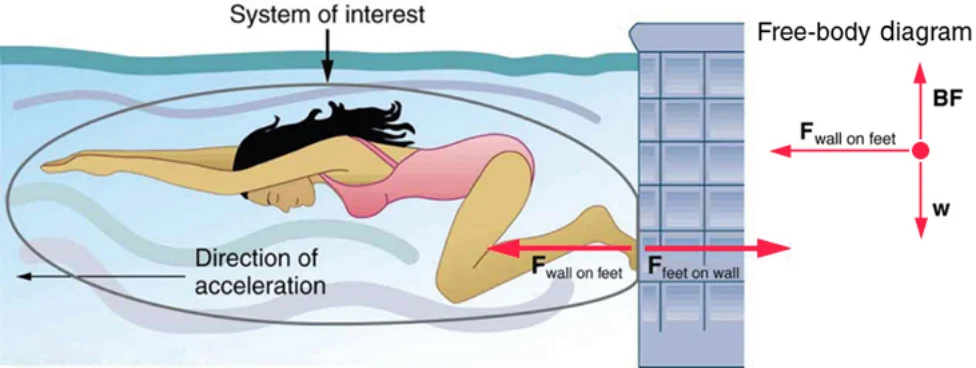
We can see Newton’s third law at work by looking at how people move about. Consider a swimmer pushing off from the side of a pool, as illustrated in Figure 4.8. She pushes against the pool wall with her feet and accelerates in the direction opposite to her push. The wall has thus exerted on the swimmer a force of equal magnitude but in the direction opposite that of her push. You might think that two forces of equal magnitude but that act in opposite directions would cancel, but they do not because they act on different systems.
人がどう動くかを見れば、ニュートンの第三法則がはたらいているのが分かる。図4.8のように、プールの壁を蹴って進む泳者を考えよう。彼女は足でプールの壁を押し、押した向きと逆の向きに加速する。つまり壁は、彼女の押す力と大きさが等しく向きが逆の力を泳者に及ぼしたのである。大きさが等しく向きが逆の二つの力は打ち消し合うと思うかもしれないが、そうはならない。二つの力は違う系にはたらいているからである。
In this case, there are two different systems that we could choose to investigate: the swimmer or the wall. If we choose the swimmer to be the system of interest, as in the figure, then is an external force on the swimmer and affects her motion. Because acceleration is in the same direction as the net external force, the swimmer moves in the direction of Because the swimmer is our system (or object of interest) and not the wall, we do not need to consider the force because it originates from the swimmer rather than acting on the swimmer. Therefore, does not directly affect the motion of the system and does not cancel Note that the swimmer pushes in the direction opposite to the direction in which she wants to move.
この場合、調べる系として選べるものが二つある。泳者か壁である。図のように泳者を関心のある系に選ぶなら、は泳者にはたらく外力であり、彼女の運動に影響する。加速度は外力の合力と同じ向きなので、泳者はの向きに動く。壁ではなく泳者が私たちの系(関心のある対象)なので、その力は考えに入れなくてよい。それは泳者から出ている力であって、泳者にはたらく力ではないからである。したがっては系の運動に直接には影響せず、を打ち消しもしない。泳者は、自分が動きたい向きと逆の向きに押していることに注意しよう。
Other examples of Newton’s third law are easy to find. As a teacher paces in front of a whiteboard, he exerts a force backward on the floor. The floor exerts a reaction force in the forward direction on the teacher that causes him to accelerate forward. Similarly, a car accelerates because the ground pushes forward on the car's wheels in reaction to the car's wheels pushing backward on the ground. You can see evidence of the wheels pushing backward when tires spin on a gravel road and throw rocks backward.
ニュートンの第三法則の例は他にもたやすく見つかる。教師がホワイトボードの前を行き来するとき、彼は床を後ろ向きに押している。床は教師に前向きの反作用の力を及ぼし、それが彼を前へ加速させる。同じように、車が加速するのは、車のタイヤが地面を後ろ向きに押すのに対して、地面が車のタイヤを前向きに押し返すからである。砂利道でタイヤが空転して石を後ろへ跳ね飛ばすとき、タイヤが後ろ向きに押している証拠を目にすることができる。
Another example is the force of a baseball as it makes contact with the bat. Helicopters create lift by pushing air down, creating an upward reaction force. Birds fly by exerting force on air in the direction opposite that in which they wish to fly. For example, the wings of a bird force air downward and backward in order to get lift and move forward. An octopus propels itself forward in the water by ejecting water backward through a funnel in its body, which is similar to how a jet ski is propelled. In these examples, the octopus or jet ski push the water backward, and the water, in turn, pushes the octopus or jet ski forward.
もう一つの例が、野球のボールがバットに当たるときの力である。ヘリコプターは空気を下へ押すことで揚力を生み、上向きの反作用の力を作り出す。鳥は、飛びたい向きと逆の向きに空気に力を及ぼして飛ぶ。たとえば鳥の翼は、揚力を得て前へ進むために、空気を下向きかつ後ろ向きに押す。タコは、体にある漏斗から水を後ろへ吹き出して水中を前へ進む。これはジェットスキーの進み方と似ている。これらの例では、タコやジェットスキーが水を後ろへ押し、水がお返しにタコやジェットスキーを前へ押している。
Applying Newton’s Third Lawニュートンの第三法則を使う
Forces are classified and given names based on their source, how they are transmitted, or their effects. In previous sections, we discussed the forces called push, weight, and friction. In this section, applying Newton’s third law of motion will allow us to explore three more forces: the normal force, tension, and thrust. However, because we haven’t yet covered vectors in depth, we’ll only consider one-dimensional situations in this chapter. Another chapter will consider forces acting in two dimensions. As we will see, we often apply the third law in conjunction with the second law in order to analyze the forces.
力は、その源、伝わり方、あるいは働きによって分類され、名前が付けられる。これまでの節では、押す力、重さ、摩擦という力を扱った。この節では、ニュートンの運動の第三法則を使うことで、さらに三つの力、すなわち垂直抗力、張力、推力を見ていく。ただしベクトルをまだ詳しく扱っていないので、この章では一次元の場面だけを考える。二次元にはたらく力は別の章で扱う。後で見るように、力を分析するには、第三法則を第二法則と組み合わせて使うことが多い。
The gravitational force (or weight) acts on objects at all times and everywhere on Earth. We know from Newton’s second law that a net force produces an acceleration; so, why is everything not in a constant state of freefall toward the center of Earth? The answer is the normal force. The normal force is the outward force that a surface applies to an object perpendicular to the surface, and it prevents the object from penetrating it. The normal force is a third law reaction force to the object’s force into the surface. In the case of an object at rest on a horizontal surface, it is the force needed to support the weight of that object. If an object on a flat surface is not accelerating, the net external force is zero and, as a consequence of Newton's second (not third!) law, the normal force has the same magnitude as the weight of the system but acts in the opposite direction. In equation form, we write that
重力(すなわち重さ)は、地球上のどこでも、いつでも物体にはたらいている。ニュートンの第二法則から、合力は加速度を生むと分かっている。ではなぜ、あらゆるものが地球の中心へ向かって自由落下し続けていないのか。その答えが垂直抗力である。垂直抗力とは、面が物体に、面に垂直に外向きに及ぼす力であり、物体が面にめり込むのを防いでいる。垂直抗力は、物体が面に及ぼす力に対する第三法則の反作用の力である。水平な面の上で静止している物体の場合、それはその物体の重さを支えるのに必要な力である。平らな面の上の物体が加速していないなら、外力の合力は0であり、ニュートンの第二法則(第三法則ではない!)の帰結として、垂直抗力は系の重さと同じ大きさで、逆向きにはたらく。式で書けば次のようになる。
Note that this equation is only true for a horizontal surface. This does not violate the third law since gravity and the normal force are not third law pairs.
この式は水平な面についてだけ成り立つことに注意しよう。重力と垂直抗力は第三法則の対ではないので、これは第三法則に反しない。
The word tension comes from the Latin word meaning to stretch. Tension is the force along the length of a flexible connector, such as a string, rope, chain, or cable. Regardless of the type of connector attached to the object of interest, one must remember that the connector can only pull (or exert tension) in the direction parallel to its length. Tension is a pull that acts parallel to the connector, and that acts in opposite directions at the two ends of the connector. This is possible because a flexible connector is simply a long series of action-reaction forces, except at the two ends where outside objects provide one member of the action-reaction forces.
張力(tension)という語は「引き伸ばす」を意味するラテン語に由来する。張力とは、糸・ロープ・鎖・ケーブルのような、曲げられるつなぎ手の長さ方向にはたらく力である。関心のある物体にどんな種類のつなぎ手が付いていようと、つなぎ手はその長さに平行な向きにしか引けない(張力を及ぼせない)ことを忘れてはならない。張力はつなぎ手に平行にはたらく引く力であり、つなぎ手の両端では互いに逆向きにはたらく。これが成り立つのは、曲げられるつなぎ手が、要するに作用・反作用の力が長く連なったものだからである。ただし両端では、外の物体が作用・反作用の一方を担う。
Consider a person holding a mass on a rope, as shown in Figure 4.9.
図4.9のように、ロープでおもりを支えている人を考えよう。
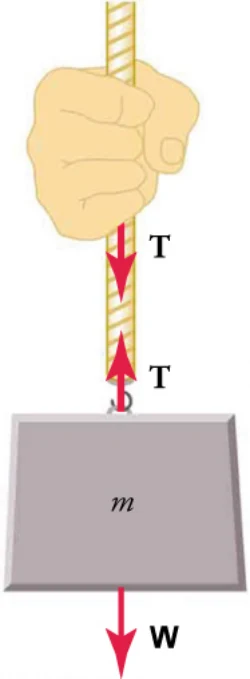
Tension in the rope must equal the weight of the supported mass, as we can prove by using Newton’s second law. If the 5.00 kg mass in the figure is stationary, then its acceleration is zero, so The only external forces acting on the mass are its weight W and the tension T supplied by the rope. Summing the external forces to find the net force, we obtain
ロープの張力は、支えられているおもりの重さに等しくなければならない。これはニュートンの第二法則を使って示せる。図の5.00 kgのおもりが静止しているなら加速度は0なので、である。おもりにはたらく外力は、その重さWとロープが与える張力Tだけである。合力を求めるために外力を足し合わせると、次が得られる。
where T and W are the magnitudes of the tension and weight, respectively, and their signs indicate direction, with up being positive. By substituting mg for Fnet and rearranging the equation, the tension equals the weight of the supported mass, just as you would expect
ここでTとWはそれぞれ張力と重さの大きさで、符号が向きを示す。上向きを正とする。Fnetにmgを代入して式を整理すると、予想どおり、張力は支えられているおもりの重さに等しくなる。
For a 5.00-kg mass (neglecting the mass of the rope), we see that
5.00 kgのおもりについて(ロープの質量は無視する)、次が得られる。
Another example of Newton’s third law in action is thrust. Rockets move forward by expelling gas backward at a high velocity. This means that the rocket exerts a large force backward on the gas in the rocket combustion chamber, and the gas, in turn, exerts a large force forward on the rocket in response. This reaction force is called thrust.
ニュートンの第三法則がはたらくもう一つの例が推力である。ロケットは、気体を高速で後ろへ吹き出すことで前へ進む。つまりロケットは、燃焼室の中の気体に後ろ向きの大きな力を及ぼし、その返しに気体がロケットに前向きの大きな力を及ぼす。この反作用の力を推力という。
TIPS FOR SUCCESS A common misconception is that rockets propel themselves by pushing on the ground or on the air behind them. They actually work better in a vacuum, where they can expel exhaust gases more easily.
学習のポイント ロケットは地面や後ろの空気を押して進む、というのはよくある誤解である。実際には真空中のほうがよく働く。排気をより楽に吹き出せるからである。
Math: Problem-Solving Strategy for Newton’s Laws of Motion The basics of problem solving, presented earlier in this text, are followed here with specific strategies for applying Newton’s laws of motion. These techniques also reinforce concepts that are useful in many other areas of physics.
数学:ニュートンの運動の法則のための問題の解き方 本書で先に示した問題の解き方の基本を、ここではニュートンの運動の法則を使う場合の具体的な手立てとともに述べる。これらの技法は、物理の他の多くの領域でも役に立つ考え方を身につけさせてくれる。
First, identify the physical principles involved. If the problem involves forces, then Newton’s laws of motion are involved, and it is important to draw a careful sketch of the situation. An example of a sketch is shown in Figure 4.10. Next, as in Figure 4.10, use vectors to represent all forces. Label the forces carefully, and make sure that their lengths are proportional to the magnitude of the forces and that the arrows point in the direction in which the forces act.
まず、関わっている物理原理を見定める。力が関わる問題ならニュートンの運動の法則が関わるので、状況をていねいに図に描くことが大切である。図の例を図4.10に示す。次に、図4.10のように、すべての力をベクトルで表す。力に注意深く記号を書き入れ、矢印の長さが力の大きさに比例していること、矢印が力のはたらく向きを指していることを確かめる。
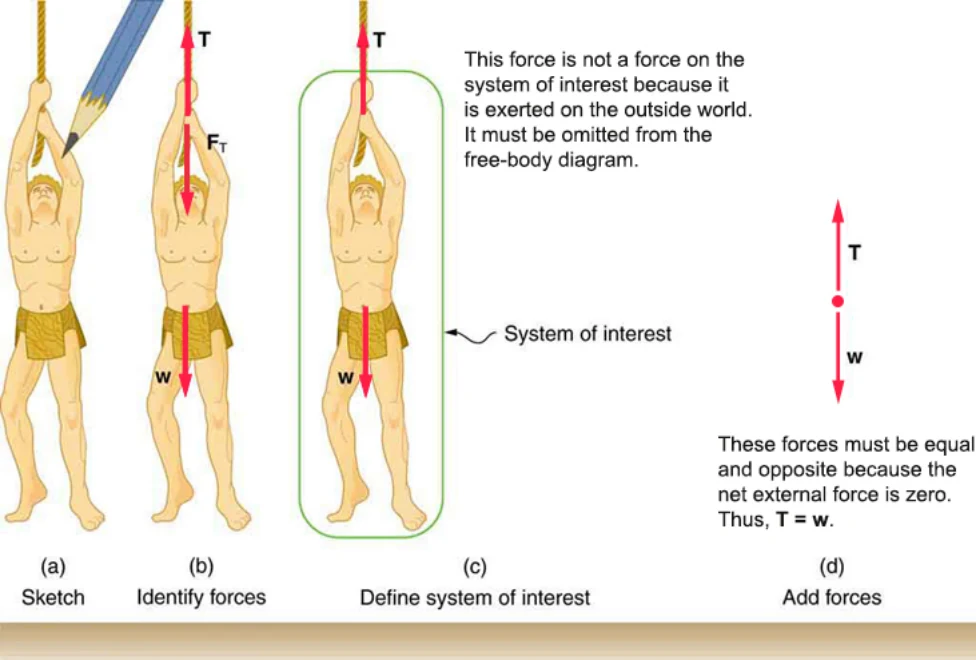
Next, make a list of knowns and unknowns and assign variable names to the quantities given in the problem. Figure out which variables need to be calculated; these are the unknowns. Now carefully define the system: which objects are of interest for the problem. This decision is important, because Newton’s second law involves only external forces. Once the system is identified, it’s possible to see which forces are external and which are internal (see Figure 4.10).
次に、分かっている量と分からない量の一覧を作り、問題で与えられた量に変数名を割り当てる。どの変数を計算せねばならないかを見定める。それが分からない量である。そのうえで系を注意深く定める。すなわち、この問題ではどの物体が関心の対象なのかを決める。ニュートンの第二法則には外力しか現れないので、この判断は重要である。系が定まれば、どの力が外力でどれが内力かが見えてくる(図4.10を見よ)。
If the system acts on an object outside the system, then you know that the outside object exerts a force of equal magnitude but in the opposite direction on the system.
系が系の外の物体に力を及ぼしているなら、その外の物体は、大きさが等しく向きが逆の力を系に及ぼしていると分かる。
A diagram showing the system of interest and all the external forces acting on it is called a free-body diagram. Only external forces are shown on free-body diagrams, not acceleration or velocity. Figure 4.10 shows a free-body diagram for the system of interest.
関心のある系と、それにはたらくすべての外力を示した図を自由物体図という。自由物体図には外力だけを描き、加速度や速度は描かない。図4.10に、関心のある系についての自由物体図を示す。
After drawing a free-body diagram, apply Newton’s second law to solve the problem. This is done in Figure 4.10 for the case of Tarzan hanging from a vine. When external forces are clearly identified in the free-body diagram, translate the forces into equation form and solve for the unknowns. Note that forces acting in opposite directions have opposite signs. By convention, forces acting downward or to the left are usually negative.
自由物体図を描いたら、ニュートンの第二法則を使って問題を解く。つるにぶら下がるターザンの場合について、それを図4.10で行っている。自由物体図で外力がはっきり見分けられたら、力を式の形に直し、分からない量について解く。逆向きにはたらく力は符号が逆になることに注意しよう。慣例として、下向きや左向きにはたらく力はふつう負にとる。
GRASP CHECK If a problem has more than one system of interest, more than one free-body diagram is required to describe the external forces acting on the different systems.
理解の確認 関心のある系が複数ある問題では、それぞれの系にはたらく外力を表すために、自由物体図も複数必要になる。
a. Trueb. False
a. 正b. 誤
Newton’s Third Law of Motion This video explains Newton’s third law of motion through examples involving push, normal force, and thrust (the force that propels a rocket or a jet).
ニュートンの運動の第三法則 この動画は、押す力、垂直抗力、そして推力(ロケットやジェット機を前へ進める力)を例に、ニュートンの運動の第三法則を説明する。
Access multimedia content (http://openstax.org/books/physics/pages/4-4-newtons-third-law-of-motion)
マルチメディア教材はこちら(http://openstax.org/books/physics/pages/4-4-newtons-third-law-of-motion)
GRASP CHECK If the astronaut in the video wanted to move upward, in which direction should he throw the object? Why?
理解の確認 動画の宇宙飛行士が上へ動きたいなら、物をどちらの向きに投げるべきか。またそれはなぜか。
a. He should throw the object upward because according to Newton’s third law, the object will then exert a force on him in the same direction (i.e., upward).b. He should throw the object upward because according to Newton’s third law, the object will then exert a force on him in the opposite direction (i.e., downward).c. He should throw the object downward because according to Newton’s third law, the object will then exert a force on him in the opposite direction (i.e., upward).d. He should throw the object downward because according to Newton’s third law, the object will then exert a force on him in the same direction (i.e., downward).
a. 上へ投げるべきである。ニュートンの第三法則により、物は彼に同じ向き(すなわち上向き)の力を及ぼすから。b. 上へ投げるべきである。ニュートンの第三法則により、物は彼に逆向き(すなわち下向き)の力を及ぼすから。c. 下へ投げるべきである。ニュートンの第三法則により、物は彼に逆向き(すなわち上向き)の力を及ぼすから。d. 下へ投げるべきである。ニュートンの第三法則により、物は彼に同じ向き(すなわち下向き)の力を及ぼすから。
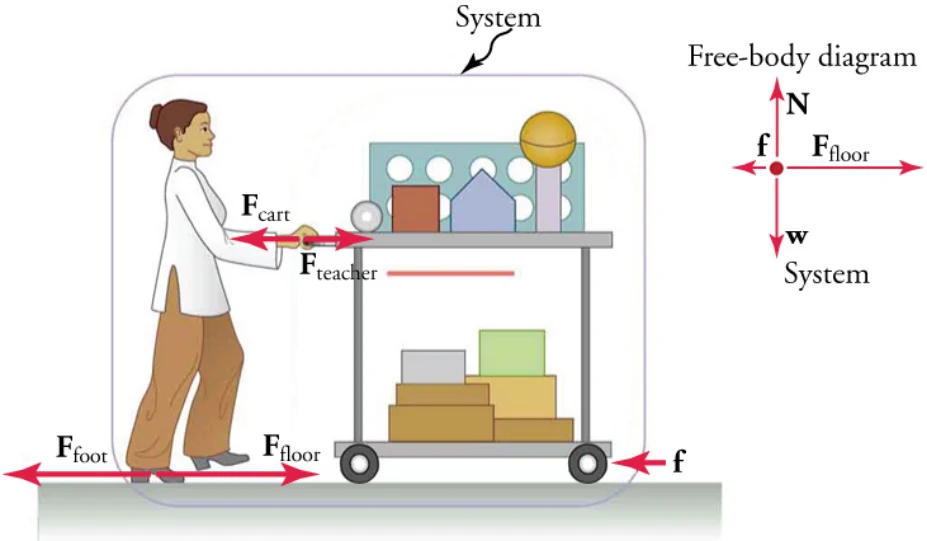
An Accelerating Equipment Cart A physics teacher pushes a cart of demonstration equipment to a classroom, as in Figure 4.11. Her mass is 65.0 kg, the cart’s mass is 12.0 kg, and the equipment’s mass is 7.0 kg. To push the cart forward, the teacher’s foot applies a force of 150 N in the opposite direction (backward) on the floor. Calculate the acceleration produced by the teacher. The force of friction, which opposes the motion, is 24.0 N.
加速する実験器具の台車 図4.11のように、ある物理教師が実験器具を載せた台車を教室へ押していく。彼女の質量は65.0 kg、台車の質量は12.0 kg、器具の質量は7.0 kgである。台車を前へ押すために、教師の足は床に対して逆向き(後ろ向き)に150 Nの力を加える。教師が生む加速度を計算せよ。運動を妨げる摩擦力は24.0 Nである。
Strategy方針
Because they accelerate together, we define the system to be the teacher, the cart, and the equipment. The teacher pushes backward with a force of 150 N. According to Newton’s third law, the floor exerts a forward force of 150 N on the system. Because all motion is horizontal, we can assume that no net force acts in the vertical direction, and the problem becomes one dimensional. As noted in the figure, the friction f opposes the motion and therefore acts opposite the direction of
三者は一緒に加速するので、系を教師と台車と器具と定める。教師は後ろ向きに150 Nの力で押す。ニュートンの第三法則により、床は系に前向きに150 Nの力を及ぼす。運動はすべて水平方向なので、鉛直方向には合力がはたらかないとしてよく、問題は一次元になる。図に示したとおり、摩擦fは運動を妨げるのでと逆向きにはたらく。
We should not include the forces , , or because these are exerted by the system, not on the system. We find the net external force by adding together the external forces acting on the system (see the free-body diagram in the figure) and then use Newton’s second law to find the acceleration.
、、の力は含めてはならない。これらは系が及ぼす力であって、系にはたらく力ではないからである。系にはたらく外力を足し合わせて外力の合力を求め(図の自由物体図を見よ)、それからニュートンの第二法則で加速度を求める。
Solution解答
Newton’s second law is
ニュートンの第二法則は次のとおりである。
The net external force on the system is the sum of the external forces: the force of the floor acting on the teacher, cart, and equipment (in the horizontal direction) and the force of friction. Because friction acts in the opposite direction, we assign it a negative value. Thus, for the net force, we obtain
系にはたらく外力の合力は、外力の和である。すなわち、床が教師・台車・器具に及ぼす(水平方向の)力と、摩擦力である。摩擦は逆向きにはたらくので負の値を与える。したがって合力は次のようになる。
The mass of the system is the sum of the mass of the teacher, cart, and equipment.
系の質量は、教師と台車と器具の質量の和である。
Insert these values of net F and m into Newton’s second law to obtain the acceleration of the system.
この合力Fと質量mをニュートンの第二法則に入れて、系の加速度を求める。
Discussion考察
None of the forces between components of the system, such as between the teacher’s hands and the cart, contribute to the net external force because they are internal to the system. Another way to look at this is to note that the forces between components of a system cancel because they are equal in magnitude and opposite in direction. For example, the force exerted by the teacher on the cart is of equal magnitude but in the opposite direction of the force exerted by the cart on the teacher. In this case, both forces act on the same system, so they cancel. Defining the system was crucial to solving this problem.
教師の手と台車の間の力のような、系の構成要素どうしの間の力は、系にとって内力なので外力の合力に寄与しない。別の見方をすれば、系の構成要素どうしの力は、大きさが等しく向きが逆なので打ち消し合う。たとえば教師が台車に及ぼす力は、台車が教師に及ぼす力と大きさが等しく向きが逆である。この場合、両方の力が同じ系にはたらくので、打ち消し合う。この問題を解くには、系を定めることが決定的に重要だった。
Practice Problems練習問題
14What is the equation for the normal force for a body with mass m that is at rest on a horizontal surface?a. N = mb. N = mg
14水平な面の上で静止している質量mの物体について、垂直抗力の式はどれか。a. N = mb. N = mg
c. N = mvd. N = g
c. N = mvd. N = g
15An object with mass m is at rest on the floor. What is the magnitude and direction of the normal force acting on it?
15質量mの物体が床の上で静止している。それにはたらく垂直抗力の大きさと向きはどうなるか。
a. N = mv in upward directionb. N = mg in upward direction
a. 上向きにN = mvb. 上向きにN = mg
c. N = mv in downward directiond. N = mg in downward direction
c. 下向きにN = mvd. 下向きにN = mg
Check Your Understanding理解の確認
16What is Newton’s third law of motion?a. Whenever a first body exerts a force on a second body, the first body experiences a force that is twice the magnitude and acts in the direction of the applied force.b. Whenever a first body exerts a force on a second body, the first body experiences a force that is equal in magnitude and acts in the direction of the applied force.c. Whenever a first body exerts a force on a second body, the first body experiences a force that is twice the magnitude but acts in the direction opposite the direction of the applied force.d. Whenever a first body exerts a force on a second body, the first body experiences a force that is equal in magnitude but acts in the direction opposite the direction of the applied force.
16ニュートンの運動の第三法則とは何か。a. 第一の物体が第二の物体に力を及ぼすとき、第一の物体は、加えた力の2倍の大きさで同じ向きの力を受ける。b. 第一の物体が第二の物体に力を及ぼすとき、第一の物体は、加えた力と大きさが等しく同じ向きの力を受ける。c. 第一の物体が第二の物体に力を及ぼすとき、第一の物体は、加えた力の2倍の大きさで逆向きの力を受ける。d. 第一の物体が第二の物体に力を及ぼすとき、第一の物体は、加えた力と大きさが等しく逆向きの力を受ける。
17Considering Newton’s third law, why don’t two equal and opposite forces cancel out each other?a. Because the two forces act in the same directionb. Because the two forces have different magnitudes
17ニュートンの第三法則を考えると、大きさが等しく向きが逆の二つの力が打ち消し合わないのはなぜか。a. 二つの力が同じ向きにはたらくからb. 二つの力の大きさが違うから
c. Because the two forces act on different systemsd. Because the two forces act in perpendicular directions
c. 二つの力が違う系にはたらくからd. 二つの力が互いに垂直な向きにはたらくから