第4章力とニュートンの運動の法則Forces and Newton’s Laws of Motion原書 p.121–150
4.2 Newton's First Law of Motion: Inertia4.2 ニュートンの運動の第一法則:慣性
SECTION LEARNING OBJECTIVES By the end of this section, you will be able to do the following:• Describe Newton’s first law and friction, and• Discuss the relationship between mass and inertia.
この節の学習目標 この節を終えると、次のことができるようになる。・ニュートンの第一法則と摩擦を説明する・質量と慣性の関係を論じる
Section Key Termsこの節の重要語
frictioninertialaw of inertiamassNewton’s first law of motionsystem
摩擦慣性慣性の法則質量ニュートンの運動の第一法則系
Newton’s First Law and Frictionニュートンの第一法則と摩擦
Newton’s first law of motion states the following:
ニュートンの運動の第一法則は次のように述べる。
1. A body at rest tends to remain at rest.2. A body in motion tends to remain in motion at a constant velocity unless acted on by a net external force. (Recall that constant velocity means that the body moves in a straight line and at a constant speed.)
1. 静止している物体は静止し続けようとする。2. 動いている物体は、外力の合力を受けない限り、一定の速度で動き続けようとする。(一定の速度とは、物体が一直線上を一定の速さで動くことを意味することを思い出そう。)
At first glance, this law may seem to contradict your everyday experience. You have probably noticed that a moving object will usually slow down and stop unless some effort is made to keep it moving. The key to understanding why, for example, a sliding box slows down (seemingly on its own) is to first understand that a net external force acts on the box to make the box slow down. Without this net external force, the box would continue to slide at a constant velocity (as stated in Newton’s first law of motion). What force acts on the box to slow it down? This force is called friction. Generally, friction is an external force that acts opposite to the direction of relative motion or to prevent slipping. We further identify different types of friction. Kinetic friction is a force by a surface parallel to the surface that opposes the motion of a sliding object and causes it to slow down. When the friction prevents the object from sliding, it is called static friction. Rolling resistance impedes the rolling of a wheel. Drag opposes and slows the motion of an object through a fluid (see Figure 4.3). Think of friction as a resistance to motion that slows things down.
この法則は、一見すると日常の経験に反するように思える。動いている物体は、動かし続けなければ、ふつう減速して止まるからだ。しかし、たとえば床を滑る箱が減速するのは、箱に外力の合力が働いているためである。その合力がなければ、ニュートンの第一法則が示すとおり、箱は一定の速度で滑り続ける。箱を減速させる力は摩擦力である。摩擦は、接触面どうしの相対的な滑りを妨げる向きに働く。すでに滑っている面の間に働くものを動摩擦、滑り出すのを妨げるものを静止摩擦という。車輪の転がりを妨げる転がり抵抗や、流体の中を進む物体に働く抗力も、運動に対する抵抗の例である(図4.3)。
Consider an air hockey table. When the air is turned off, the puck slides only a short distance before friction slows it to a stop. However, when the air is turned on, it lifts the puck slightly, so the puck experiences very little friction as it moves over the surface. With friction almost eliminated, the puck glides along with very little change in speed. On a frictionless surface, the puck would experience no net external force (ignoring air resistance, which is also a form of friction). Additionally, if we know enough about friction, we can accurately predict how quickly objects will slow down.
エアホッケー台を考えよう。空気を止めると、パックは少し滑っただけで摩擦に止められる。しかし空気を出すと、パックはわずかに浮き上がり、面の上を動くときに受ける摩擦がごく小さくなる。摩擦がほとんどなくなるので、パックは速さをほとんど変えずに滑っていく。摩擦のない面なら、パックは外力の合力をまったく受けないことになる(やはり摩擦の一種である空気抵抗は無視する)。さらに、摩擦について十分に分かっていれば、物体がどれくらい速く遅くなるかを正確に予測できる。
Now let’s think about another example. A man pushes a box across a floor at constant velocity by applying a force of +50 N. (The positive sign indicates that, by convention, the direction of motion is to the right.) What is the force of friction that opposes the motion? The force of friction must be −50 N. Why? According to Newton’s first law of motion, any object moving at constant velocity has no net external force acting upon it, which means that the sum of the forces acting on the object must be zero. The mathematical way to say that no net external force acts on an object is or So if the man applies +50 N of force, then the force of friction must be −50 N for the two forces to add up to zero (that is, for the two forces to cancel each other). Whenever you encounter the phrase at constant velocity, Newton’s first law tells you that the net external force is zero.
別の例を考えよう。ある男が+50 Nの力を加えて、箱を床の上で一定の速度で押していく。(正の符号は、慣例により運動の向きが右であることを示す。)この運動を妨げる摩擦力はいくらか。摩擦力は−50 Nでなければならない。なぜか。ニュートンの運動の第一法則によれば、一定の速度で動いている物体には外力の合力がはたらいていない。つまり、物体にはたらく力の和は0でなければならない。物体に外力の合力がはたらいていないことを数式で言うと、すなわちである。だから男が+50 Nの力を加えるなら、二つの力の和が0になる(すなわち互いに打ち消し合う)には、摩擦力は−50 Nでなければならない。「一定の速度で」という言い回しに出会ったら、ニュートンの第一法則は、外力の合力が0だと教えてくれる。
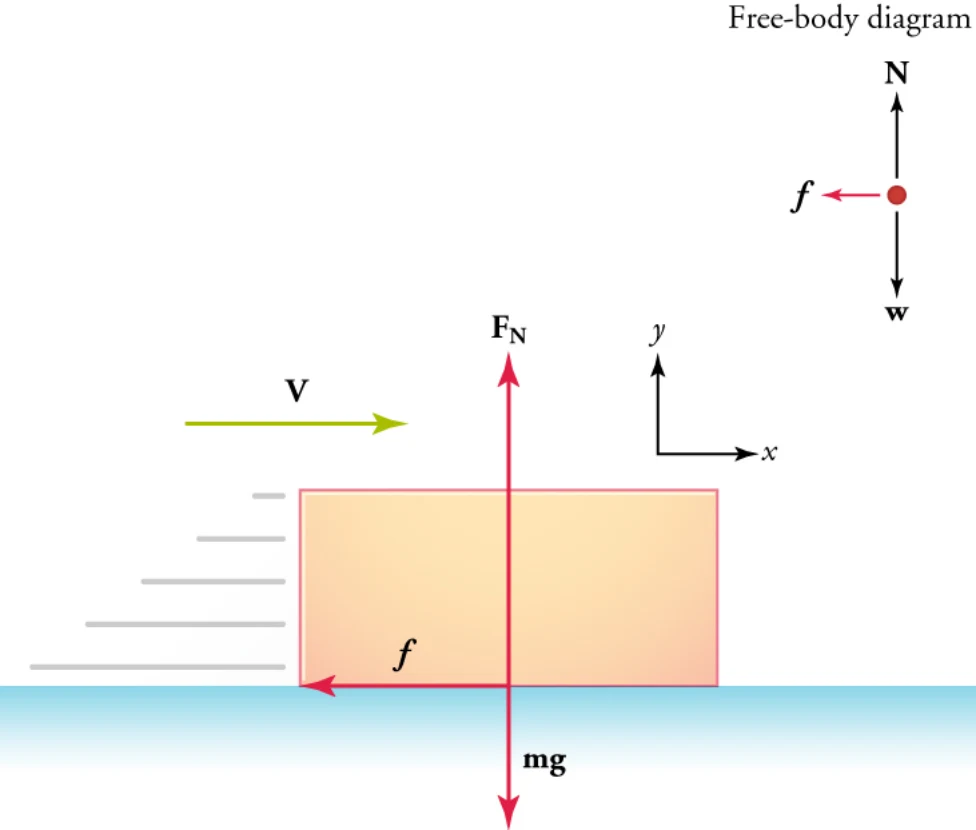
The force of friction depends on two factors: the coefficient of friction and the normal force. For any two surfaces that are in contact with one another, the coefficient of friction is a constant that depends on the nature of the surfaces. The normal force is the force exerted by a surface that pushes on an object out, perpendicular to the surface in response to the object’s pushing into the surface. The normal force prevents the object from penetrating the surface. In equation form, the force of friction is
摩擦力は二つの要因、すなわち摩擦係数と垂直抗力によって決まる。互いに接している二つの面について、摩擦係数はその面の性質で決まる定数である。垂直抗力とは、物体が面に押し込まれるのに応じて、面が物体を面に垂直に外向きに押し返す力である。垂直抗力があるから、物体は面にめり込まない。式で書けば、摩擦力は次のようになる。
where μ is the coefficient of friction and N is the normal force. (The coefficient of friction is discussed in more detail in another chapter, and the normal force is discussed in more detail in the section Newton's Third Law of Motion.)
ここでμは摩擦係数、Nは垂直抗力である。(摩擦係数は別の章で、垂直抗力は「ニュートンの運動の第三法則」の節で、さらに詳しく述べる。)
Recall from the section on Force that a net external force acts from outside on the object of interest. A more precise definition is that it acts on the system of interest. A system is one or more objects that you choose to study. It is important to define the system at the beginning of a problem to figure out which forces are external and need to be considered, and which are internal and can be ignored.
「力」の節で述べたとおり、外力の合力は関心のある物体に外から作用する。より正確に言えば、関心のある系に作用する。系とは、自分が調べようと選んだ一つまたは複数の物体のことである。どの力が外力で考えに入れる必要があり、どれが内力で無視できるのかを見分けるために、問題の初めに系を定めることが大切である。
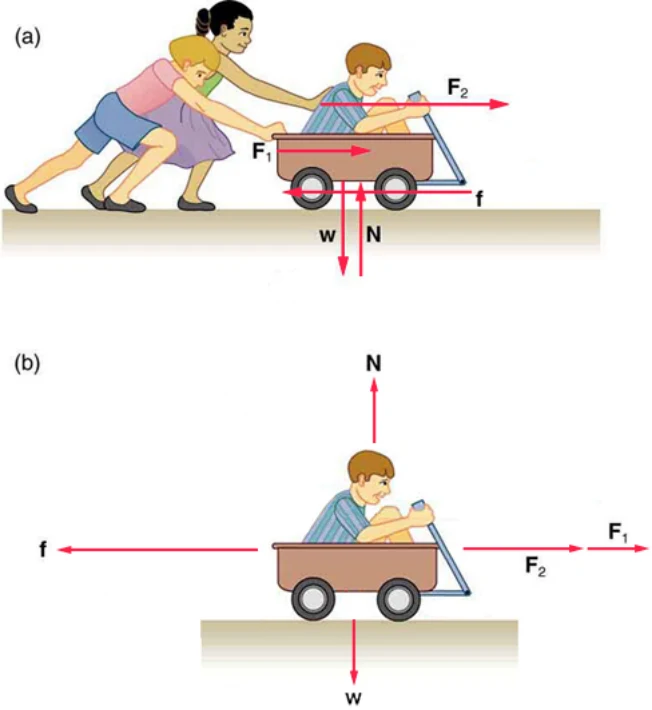
For example, in Figure 4.4 (a), two children push a third child in a wagon at a constant velocity. The system of interest is the wagon plus the small child, as shown in part (b) of the figure. The two children behind the wagon exert external forces on this system (F1, F2). Friction f acting on the wheels is another external force acting on the system. Two more external forces act on the system: the weight W of the system pulling down and the normal force N of the ground pushing up. Notice that the wagon is not accelerating vertically, so Newton’s first law tells us that the normal force balances the weight. Because the wagon is moving forward at a constant velocity, the force of
たとえば図4.4(a)では、二人の子どもが荷車に乗った三人目の子どもを一定の速度で押している。関心のある系は、図の(b)に示すとおり、荷車と小さな子どもである。荷車の後ろにいる二人の子どもは、この系に外力(F1、F2)を及ぼす。車輪にはたらく摩擦fも、系にはたらくもう一つの外力である。さらに二つの外力が系にはたらく。系を下へ引く重さWと、地面が上へ押す垂直抗力Nである。荷車は鉛直方向には加速していないので、ニュートンの第一法則から、垂直抗力が重さとつり合っていると分かる。荷車は一定の速度で前へ進んでいるので、
friction must have the same strength as the sum of the forces applied by the two children.
摩擦力は、二人の子どもが加える力の和と同じ大きさでなければならない。
Mass and Inertia質量と慣性
Inertia is the tendency for an object at rest to remain at rest, or for a moving object to remain in motion in a straight line with constant speed. This key property of objects was first described by Galileo. Later, Newton incorporated the concept of inertia into his first law, which is often referred to as the law of inertia.
慣性とは、静止している物体が静止し続けようとする、あるいは動いている物体が一定の速さで一直線に動き続けようとする性質である。物体のこの重要な性質を最初に述べたのはガリレオである。のちにニュートンは慣性という考えを第一法則に取り込んだ。この法則はしばしば慣性の法則と呼ばれる。
As we know from experience, some objects have more inertia than others. For example, changing the motion of a large truck is more difficult than changing the motion of a toy truck. In fact, the inertia of an object is proportional to the mass of the object. Mass is a measure of the amount of matter (or stuff) in an object. The quantity or amount of matter in an object is determined by the number and types of atoms the object contains. Unlike weight (which changes if the gravitational force changes), mass does not depend on gravity. The mass of an object is the same on Earth, in orbit, or on the surface of the moon. In practice, it is very difficult to count and identify all of the atoms and molecules in an object, so mass is usually not determined this way. Instead, the mass of an object is determined by comparing it with the standard kilogram. Mass is therefore expressed in kilograms.
経験から分かるとおり、物によって慣性の大きさは違う。たとえば大きなトラックの運動を変えるのは、おもちゃのトラックの運動を変えるより難しい。実際、物体の慣性はその質量に比例する。質量とは、物体に含まれる物質(中身)の量を測ったものである。物体に含まれる物質の量は、その物体が含む原子の数と種類で決まる。重さ(重力が変われば変わる)と違い、質量は重力に依存しない。物体の質量は、地球上でも軌道上でも月面でも同じである。実際には、物体の中の原子や分子をすべて数え上げて種類を見分けるのはきわめて難しいので、ふつう質量はこのやり方では決めない。かわりに、標準キログラムと比べることで物体の質量を決める。したがって質量はキログラムで表される。
TIPS FOR SUCCESS In everyday language, people often use the terms weight and mass interchangeably—but this is not correct. Weight is actually a force. (We cover this topic in more detail in the section Newton's Second Law of Motion.)
学習のポイント 日常の言葉では、重さと質量という語がしばしば互換的に使われるが、これは正しくない。重さは実は力である。(この話題は「ニュートンの運動の第二法則」の節でさらに詳しく扱う。)
Newton’s First Law of Motion This video contrasts the way we thought about motion and force in the time before Galileo’s concept of inertia and Newton’s first law of motion with the way we understand force and motion now.
ニュートンの運動の第一法則 この動画は、ガリレオの慣性の考えとニュートンの運動の第一法則が現れる前に人々が運動と力をどう考えていたかを、私たちが今日それをどう理解しているかと対比する。
Newton's first law of motion | Forces and Newton's laws of motion | Physics | Khan Academy (https://openstax.org/l/ 02newlawone)
ニュートンの運動の第一法則|力とニュートンの運動の法則|物理|カーンアカデミー(https://openstax.org/l/02newlawone)
GRASP CHECK Before we understood that objects have a tendency to maintain their velocity in a straight line unless acted upon by a net force, people thought that objects had a tendency to stop on their own. This happened because a specific force was not yet understood. What was that force?
理解の確認 合力を受けない限り物体は一直線上の速度を保とうとする、と理解される以前、人々は物体にはひとりでに止まる性質があると考えていた。それは、ある特定の力がまだ理解されていなかったために起きたことである。その力とは何か。
a. Gravitational forceb. Electrostatic forcec. Nuclear forced. Frictional force
a. 重力b. 静電気力c. 核力d. 摩擦力
VIRTUAL PHYSICSシミュレーションForces and Motion—Basics力と運動——基礎
In this simulation, you will first explore net force by placing blue people on the left side of a tug-of-war rope and red people on the right side of the rope (by clicking people and dragging them with your mouse). Experiment with changing the number and size of people on each side to see how it affects the outcome of the match and the net force. Hit the "Go!" button to start the match, and the “reset all” button to start over.
このシミュレーションでは、まず綱引きの綱の左側に青い人、右側に赤い人を置いて(人をクリックしてマウスでドラッグする)、合力を探る。両側の人数と大きさを変えて、それが勝負の結果と合力にどう影響するかを試してみよう。「Go!」ボタンで勝負を始め、「reset all」ボタンでやり直せる。
Next, click on the Friction tab. Try selecting different objects for the person to push. Slide the applied force button to the right to apply force to the right, and to the left to apply force to the left. The force will continue to be applied as long as you hold down the button. See the arrow representing friction change in magnitude and direction, depending on how much force you apply. Try increasing or decreasing the friction force to see how this change affects the motion.
次にFrictionのタブをクリックする。人に押させる物をいろいろ選んでみよう。applied forceのボタンを右へ滑らせれば右向きに、左へ滑らせれば左向きに力が加わる。ボタンを押し続けている間、力は加わり続ける。加える力の大きさに応じて、摩擦を表す矢印の大きさと向きが変わるのを見よう。摩擦力を増やしたり減らしたりして、それが運動にどう影響するかを試してみよう。
Access multimedia content (http://openstax.org/books/physics/pages/4-2-newtons-first-law-of-motion-inertia)
マルチメディア教材はこちら(http://openstax.org/books/physics/pages/4-2-newtons-first-law-of-motion-inertia)
GRASP CHECK Click on the tab for the Acceleration Lab and check the Sum of Forces option. Push the box to the right and then release. Notice which direction the sum of forces arrow points after the person stops pushing the box and lets it continue moving to the right on its own. At this point, in which direction is the net force, the sum of forces, pointing? Why?
理解の確認 Acceleration Labのタブをクリックし、Sum of Forcesの項目にチェックを入れる。箱を右へ押してから手を離す。人が押すのをやめ、箱が自分だけで右へ動き続けているとき、力の和を表す矢印がどちらを向くかに注目しよう。この時点で、合力、すなわち力の和はどちらを向いているか。それはなぜか。
a. The net force acts to the right because the applied external force acted to the right.b. The net force acts to the left because the applied external force acted to the left.
a. 加えられた外力が右向きだったので、合力は右向きにはたらく。b. 加えられた外力が左向きだったので、合力は左向きにはたらく。
c. The net force acts to the right because the frictional force acts to the right.d. The net force acts to the left because the frictional force acts to the left.
c. 摩擦力が右向きにはたらくので、合力は右向きにはたらく。d. 摩擦力が左向きにはたらくので、合力は左向きにはたらく。
Check Your Understanding理解の確認
5What does Newton’s first law state?a. A body at rest tends to remain at rest and a body in motion tends to remain in motion at a constant acceleration unless acted on by a net external force.b. A body at rest tends to remain at rest and a body in motion tends to remain in motion at a constant velocity unless acted on by a net external force.c. The rate of change of momentum of a body is directly proportional to the external force applied to the body.d. The rate of change of momentum of a body is inversely proportional to the external force applied to the body.
5ニュートンの第一法則は何を述べているか。a. 静止している物体は静止し続けようとし、動いている物体は、外力の合力を受けない限り一定の加速度で動き続けようとする。b. 静止している物体は静止し続けようとし、動いている物体は、外力の合力を受けない限り一定の速度で動き続けようとする。c. 物体の運動量の変化する割合は、その物体に加えられた外力に比例する。d. 物体の運動量の変化する割合は、その物体に加えられた外力に反比例する。
6According to Newton’s first law, a body in motion tends to remain in motion at a constant velocity. However, when you slide an object across a surface, the object eventually slows down and stops. Why?
6ニュートンの第一法則によれば、動いている物体は一定の速度で動き続けようとする。しかし物体を面の上で滑らせると、やがて遅くなって止まる。なぜか。
a. The object experiences a frictional force exerted by the surface, which opposes its motion.b. The object experiences the gravitational force exerted by Earth, which opposes its motion
a. 面から及ぼされる摩擦力を受け、それが運動を妨げるから。b. 地球から及ぼされる重力を受け、それが運動を妨げるから。
c. The object experiences an internal force exerted by the body itself, which opposes its motion.
c. 物体自身から及ぼされる内力を受け、それが運動を妨げるから。
d. The object experiences a pseudo-force from the body in motion, which opposes its motion.
d. 動いている物体からの見かけの力を受け、それが運動を妨げるから。
7What is inertia?a. Inertia is an object’s tendency to maintain its mass.b. Inertia is an object’s tendency to remain at rest.
7慣性とは何か。a. 慣性とは、物体が質量を保とうとする性質である。b. 慣性とは、物体が静止し続けようとする性質である。
c. Inertia is an object’s tendency to remain in motiond. Inertia is an object’s tendency to remain at rest or, if moving, to remain in motion.
c. 慣性とは、物体が動き続けようとする性質である。d. 慣性とは、物体が静止し続けようとし、動いているならば動き続けようとする性質である。
8What is mass? What does it depend on?a. Mass is the weight of an object, and it depends on the gravitational force acting on the object.b. Mass is the weight of an object, and it depends on the number and types of atoms in the object.
8質量とは何か。何によって決まるか。a. 質量とは物体の重さであり、物体にはたらく重力によって決まる。b. 質量とは物体の重さであり、物体に含まれる原子の数と種類によって決まる。
c. Mass is the quantity of matter contained in an object, and it depends on the gravitational force acting on the object.d. Mass is the quantity of matter contained in an object, and it depends on the number and types of atoms in the object.
c. 質量とは物体に含まれる物質の量であり、物体にはたらく重力によって決まる。d. 質量とは物体に含まれる物質の量であり、物体に含まれる原子の数と種類によって決まる。