第3章加速度Acceleration原書 p.97–120
3.2 Representing Acceleration with Equations and Graphs3.2 式とグラフで加速度を表す
SECTION LEARNING OBJECTIVES By the end of this section, you will be able to do the following:
この節の学習目標 この節を終えると、次のことができるようになる。
• Explain the kinematic equations related to acceleration and illustrate them with graphs• Apply the kinematic equations and related graphs to problems involving acceleration
・加速度に関わる運動学の式を説明し、グラフで図示する・運動学の式と関連するグラフを、加速度に関する問題に当てはめる
Section Key Termsこの節の重要語
acceleration due to gravitykinematic equationsuniform acceleration
重力加速度運動学の式一様な加速度
How the Kinematic Equations are Related to Acceleration運動学の式は加速度とどう結びついているか
We are studying concepts related to motion: time, displacement, velocity, and especially acceleration. We are only concerned with motion in one dimension. The kinematic equations that we will be using apply to conditions of constant acceleration, except where noted, and show how these concepts are related. Constant acceleration is acceleration that does not change over time. The first kinematic equation relates displacement d, average velocity , and time t.
私たちは運動に関わる概念、すなわち時間・変位・速度、とりわけ加速度を学んでいる。扱うのは一次元の運動だけである。これから使う運動学の式は、断りのある場合を除き、加速度が一定という条件のもとで成り立ち、これらの概念がどう結びついているかを示す。一定の加速度とは、時間とともに変わらない加速度のことである。一つ目の運動学の式は、変位d、平均速度、時間tを結びつける。
The initial displacement is often 0, in which case the equation can be written as
初めの変位は0であることが多く、その場合この式は次のように書ける。
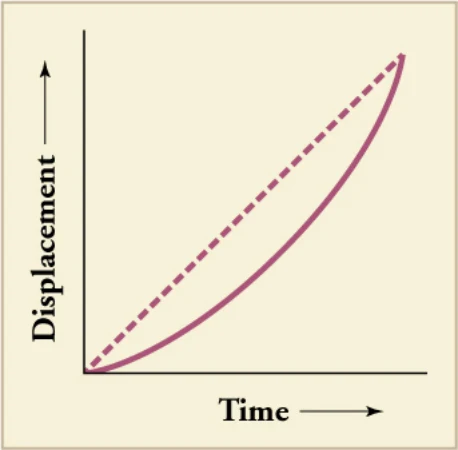
This equation, which is the definition of average velocity and valid for both constant and non-constant acceleration, says that average velocity is displacement per unit time. We will express velocity in meters per second. If we graph displacement versus time, as in Figure 3.6, the slope will be the velocity. Whenever a rate, such as velocity, is represented graphically, time is usually taken to be the independent variable and is plotted along the x axis.
この式は平均速度の定義そのものであり、加速度が一定でもそうでなくても成り立つ。平均速度とは単位時間あたりの変位である、と言っている。速度はメートル毎秒で表す。図3.6のように変位を時間に対して描けば、その傾きが速度になる。速度のような割合をグラフで表すときは、ふつう時間を独立変数としてx軸にとる。
The second kinematic equation, another expression for average velocity is simply the initial velocity plus the final velocity divided by two. This equation is only valid for constant acceleration.
二つ目の運動学の式は、平均速度の別の表し方で、単に初めの速度と終わりの速度を足して2で割ったものである。この式は加速度が一定のときにだけ成り立つ。
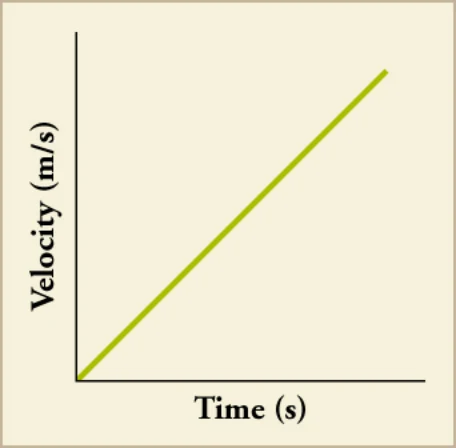
Now we come to our main focus of this chapter; namely, the kinematic equations that describe motion with constant acceleration. In the third kinematic equation, acceleration is the rate at which velocity increases, so velocity at any point equals initial velocity plus acceleration multiplied by time
さてここからが、この章の中心である。すなわち、一定の加速度を伴う運動を記述する運動学の式である。三つ目の運動学の式では、加速度は速度が増す割合なので、任意の時点の速度は、初めの速度に加速度と時間の積を足したものに等しい。
Note that this third kinematic equation does not have displacement in it. Therefore, if you do not know the displacement and are not trying to solve for a displacement, this equation might be a good one to use.
この三つ目の式には変位が含まれていないことに注意しよう。したがって、変位が分かっておらず、変位を求めようともしていないなら、この式が使いどころかもしれない。
The third kinematic equation is also represented by the graph in Figure 3.7.
三つ目の運動学の式は、図3.7のグラフでも表される。
The fourth kinematic equation shows how displacement is related to acceleration
四つ目の運動学の式は、変位が加速度とどう結びつくかを示す。
When starting at the origin, and, when starting from rest, , in which case the equation can be written as
原点から始めるときはであり、静止から始めるときはなので、その場合この式は次のように書ける。
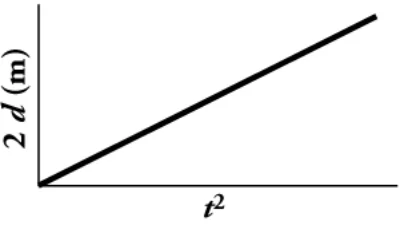
This equation tells us that, for constant acceleration, the slope of a plot of 2d versus t2 is acceleration, as shown in Figure 3.8.
この式は、加速度が一定のとき、2dをt2に対して描いたグラフの傾きが加速度になることを教えてくれる(図3.8)。
The fifth kinematic equation relates velocity, acceleration, and displacement
五つ目の運動学の式は、速度・加速度・変位を結びつける。
This equation is useful for when we do not know, or do not need to know, the time.
この式は、時間が分からないとき、あるいは時間を知る必要がないときに役に立つ。
When starting from rest, the fifth equation simplifies to
静止から始めるとき、五つ目の式は次のように簡単になる。
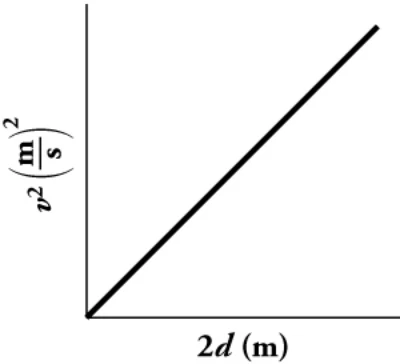
According to this equation, a graph of velocity squared versus twice the displacement will have a slope equal to acceleration.
この式によれば、速度の2乗を変位の2倍に対して描いたグラフは、傾きが加速度に等しくなる。
Note that, in reality, knowns and unknowns will vary. Sometimes you will want to rearrange a kinematic equation so that the knowns are the values on the axes and the unknown is the slope. Sometimes the intercept will not be at the origin (0,0). This will happen when v0 or d0 is not zero. This will be the case when the object of interest is already in motion, or the motion begins at some point other than at the origin of the coordinate system.
実際には、分かっている量と分からない量はさまざまである。分かっている量が軸の値になり、分からない量が傾きになるように、運動学の式を変形したくなることもある。切片が原点(0,0)にないこともある。これはv0やd0が0でないときに起こる。対象の物体がすでに動いている場合や、運動が座標系の原点以外のところから始まる場合がそれにあたる。
VIRTUAL PHYSICSシミュレーションThe Moving Man (Part 2)歩く人(その2)
Look at the Moving Man simulation (https://openstax.org/l/02moving_man) again and this time use the Charts view. Again, vary the velocity and acceleration by sliding the red and green markers along the scales. Keeping the velocity marker near zero will make the effect of acceleration more obvious. Observe how the graphs of position, velocity, and acceleration vary with time. Note which are linear plots and which are not.
「歩く人」のシミュレーション(https://openstax.org/l/02moving_man)をもう一度開き、今度はChartsの表示を使う。ここでも赤と緑の印を目盛りに沿って動かして、速度と加速度を変えてみよう。速度の印を0の近くに置いておくと、加速度の効果がはっきり見える。位置・速度・加速度のグラフが時間とともにどう変わるかを観察しよう。どれが直線のグラフで、どれがそうでないかに注意すること。
GRASP CHECK On a velocity versus time plot, what does the slope represent?a. Accelerationb. Displacement
理解の確認 速度–時間のグラフで、傾きは何を表すか。a. 加速度b. 変位
c. Distance coveredd. Instantaneous velocity
c. 進んだ道のりd. 瞬間速度
GRASP CHECK On a position versus time plot, what does the slope represent?a. Accelerationb. Displacement
理解の確認 位置–時間のグラフで、傾きは何を表すか。a. 加速度b. 変位
c. Distance coveredd. Instantaneous velocity
c. 進んだ道のりd. 瞬間速度
The kinematic equations are applicable when you have constant acceleration.
運動学の式は、加速度が一定のときに使える。
1. , or when d0 = 0
1. 、d0 = 0のときは
3. , or when v0 = 0
3. 、v0 = 0のときは
4. , or when d0 = 0 and v0 = 0
4. 、d0 = 0かつv0 = 0のときは
5. , or when d0 = 0 and v0 = 0
5. 、d0 = 0かつv0 = 0のときは
Applying Kinematic Equations to Situations of Constant Acceleration運動学の式を、加速度が一定の場面に当てはめる
107Problem-solving skills are essential to success in a science and life in general. The ability to apply broad physical principles, which are often represented by equations, to specific situations is a very powerful form of knowledge. It is much more powerful than memorizing a list of facts. Analytical skills and problem-solving abilities can be applied to new situations, whereas a list of facts cannot be made long enough to contain every possible circumstance. Essential analytical skills will be developed by solving problems in this text and will be useful for understanding physics and science in general throughout your life.
問題を解く力は、科学でも人生一般でも成功に欠かせない。式で表されることの多い広い物理原理を、個別の場面に当てはめられることは、きわめて強力な知識の形である。それは事実の一覧を暗記するよりはるかに強力だ。分析する力と問題を解く力は新しい場面にも当てはめられるが、事実の一覧は、ありうるすべての場合を含められるほど長くはできない。本書の問題を解くことで身につく分析の力は、生涯にわたって物理を、そして科学全般を理解するのに役立つだろう。
Problem-Solving Steps While no single step-by-step method works for every problem, the following general procedures facilitate problem solving and make the answers more meaningful. A certain amount of creativity and insight are required as well.
問題を解く手順 どんな問題にも通じる一つの手順というものはないが、次の一般的な手続きは、問題を解きやすくし、答えをより意味あるものにしてくれる。ある程度の創意と洞察も必要である。
1. Examine the situation to determine which physical principles are involved. It is vital to draw a simple sketch at the outset. Decide which direction is positive and note that on your sketch.2. Identify the knowns: Make a list of what information is given or can be inferred from the problem statement. Remember, not all given information will be in the form of a number with units in the problem. If something starts from rest, we know the initial velocity is zero. If something stops, we know the final velocity is zero.3. Identify the unknowns: Decide exactly what needs to be determined in the problem.4. Find an equation or set of equations that can help you solve the problem. Your list of knowns and unknowns can help here. For example, if time is not needed or not given, then the fifth kinematic equation, which does not include time, could be useful.5. Insert the knowns along with their units into the appropriate equation and obtain numerical solutions complete with units. This step produces the numerical answer; it also provides a check on units that can help you find errors. If the units of the answer are incorrect, then an error has been made.6. Check the answer to see if it is reasonable: Does it make sense? This final step is extremely important because the goal of physics is to accurately describe nature. To see if the answer is reasonable, check its magnitude, its sign, and its units. Are the significant figures correct?
1. 場面を吟味して、どの物理原理が関わっているかを見定める。最初に簡単な図を描くことがきわめて大切である。どちらの向きを正とするかを決め、それを図に書き込む。2. 分かっている量を洗い出す。問題文で与えられている情報、あるいはそこから推し量れる情報を書き出す。与えられた情報がすべて単位付きの数の形をしているとは限らないことを忘れずに。何かが静止から動き出すなら、初めの速度が0だと分かる。何かが止まるなら、終わりの速度が0だと分かる。3. 分からない量を洗い出す。問題で何を求めねばならないのかを正確に決める。4. 問題を解く助けになる式、あるいは式の組を見つける。分かっている量と分からない量の一覧がここで役に立つ。たとえば時間が要らない、あるいは与えられていないなら、時間を含まない五つ目の運動学の式が使えるかもしれない。5. 分かっている量を単位ごと適切な式に入れ、単位まで揃った数値の解を得る。この段階で数値の答えが出るとともに、単位の確認ができ、誤りを見つける助けになる。答えの単位が正しくないなら、どこかで間違えている。6. 答えが妥当かどうかを確かめる。筋が通っているか。物理の目的は自然を正確に記述することなので、この最後の段階はきわめて重要である。答えが妥当かどうかを見るには、その大きさ、符号、単位を確かめる。有効数字は正しいか。
Summary of Problem Solving問題の解き方のまとめ
• Determine the knowns and unknowns.• Find an equation that expresses the unknown in terms of the knowns. More than one unknown means more than one equation is needed.• Solve the equation or equations.• Be sure units and significant figures are correct.• Check whether the answer is reasonable.
・分かっている量と分からない量を決める。・分からない量を、分かっている量で表す式を見つける。分からない量が複数あれば、式も複数必要になる。・その式(または式の組)を解く。・単位と有効数字が正しいことを確かめる。・答えが妥当かどうかを確かめる。
The object of the sport of drag racing is acceleration. Period! The races take place from a standing start on a straight one-quarter-mile (402 m) track. Usually two cars race side by side, and the winner is the driver who gets the car past the quarter-mile point first. At the finish line, the cars may be going more than 300 miles per hour (134 m/s). The driver then deploys a parachute to bring the car to a stop because it is unsafe to brake at such high speeds. The cars, called dragsters, are capable of accelerating at 26 m/s2. By comparison, a typical sports car that is available to the general public can accelerate at about 5 m/s2.
ドラッグレースという競技の眼目は加速である。それに尽きる。レースは、まっすぐな4分の1マイル(402 m)のコースを、停止状態から発進して行われる。ふつうは2台が並んで走り、先に4分の1マイル地点を通過した運転手が勝つ。ゴール線では、車は時速300マイル(134 m/s)を超えていることもある。これほどの高速でブレーキをかけるのは危険なので、運転手はパラシュートを開いて車を止める。ドラッグスターと呼ばれるこれらの車は、26 m/s2で加速できる。これに比べて、一般に買える典型的なスポーツカーはおよそ5 m/s2で加速できる。
Several measurements are taken during each drag race:
ドラッグレースでは、毎回いくつかの量が測定される。
• Reaction time is the time between the starting signal and when the front of the car crosses the starting line.• Elapsed time is the time from when the vehicle crosses the starting line to when it crosses the finish line. The record is a little over 3 s.• Speed is the average speed during the last 20 m before the finish line. The record is a little under 400 mph.
・反応時間 スタート信号から、車の先端がスタート線を越えるまでの時間。・経過時間 車がスタート線を越えてからゴール線を越えるまでの時間。記録は3秒を少し超える程度である。・速さ ゴール線の手前20 mでの平均の速さ。記録は時速400マイルを少し下回る程度である。
The video shows a race between two dragsters powered by jet engines. The actual race lasts about four seconds and is near the end of the video (https://openstax.org/l/28dragsters).
この動画は、ジェットエンジンを積んだ2台のドラッグスターのレースである。実際のレースは4秒ほどで、動画の終わり近くにある(https://openstax.org/l/28dragsters)。
A dragster crosses the finish line with a velocity of . Assuming the vehicle maintained a constant acceleration from start to finish, what was its average velocity for the race?
あるドラッグスターが速度でゴール線を越えた。発進からゴールまで一定の加速度を保っていたとすると、このレースでの平均速度はいくらだったか。
Acceleration of a Dragster The time it takes for a dragster to cross the finish line is unknown. The dragster accelerates from rest at 26 m/s2 for a quarter mile (0.250 mi). What is the final velocity of the dragster?Strategy
ドラッグスターの加速度 ドラッグスターがゴール線を越えるまでにかかる時間は分かっていない。ドラッグスターは静止から26 m/s2で4分の1マイル(0.250マイル)加速する。ドラッグスターの終わりの速度はいくらか。方針
The equation is ideally suited to this task because it gives the velocity from acceleration and displacement, without involving the time.
式は、時間を使わずに加速度と変位から速度を与えてくれるので、この課題にうってつけである。
Solution解答
1. Convert miles to meters.
1. マイルをメートルに換算する。
2. Identify the known values. We know that v0 = 0 since the dragster starts from rest, and we know that the distance traveled, d − d0 is 402 m. Finally, the acceleration is constant at a = 26.0 m/s2.3. Insert the knowns into the equation and solve for v.
2. 分かっている値を洗い出す。ドラッグスターは静止から発進するのでv0 = 0、進んだ距離 d − d0 は402 mである。最後に、加速度は a = 26.0 m/s2 で一定である。3. 分かっている値を式に入れ、vについて解く。
Taking the square root gives us
平方根をとると次が得られる。
Discussion考察
145 m/s is about 522 km/hour or about 324 mi/h, but even this breakneck speed is short of the record for the quarter mile. Also, note that a square root has two values. We took the positive value because we know that the velocity must be in the same direction as the acceleration for the answer to make physical sense.
145 m/sはおよそ522 km/h、すなわち約324 mi/hだが、この目のくらむような速さでも4分の1マイルの記録には届かない。また、平方根には二つの値があることに注意しよう。答えが物理的に意味を持つには速度が加速度と同じ向きでなければならないと分かっているので、正の値をとった。
An examination of the equation can produce further insights into the general relationships among physical quantities:
式を吟味すると、物理量どうしの一般的な関係についてさらに見えてくるものがある。
• The final velocity depends on the magnitude of the acceleration and the distance over which it applies.• For a given acceleration, a car that is going twice as fast does not stop in twice the distance—it goes much further before it stops. This is why, for example, we have reduced speed zones near schools.
・終わりの速度は、加速度の大きさと、それが働く距離によって決まる。・加速度が同じなら、2倍の速さで走っている車は2倍の距離で止まるのではなく、止まるまでにはるかに長く進む。学校の近くに速度規制区域がある理由の一つはこれである。
Practice Problems練習問題
6Dragsters can reach a top speed of 145 m/s in only 4.45 s. Calculate the average acceleration for such a dragster.a. −32.6 m/s2b. 0 m/s2c. 32.6 m/s2d. 145 m/s2
6ドラッグスターはわずか4.45秒で最高速度145 m/sに達しうる。このドラッグスターの平均加速度を計算せよ。a. −32.6 m/s2b. 0 m/s2c. 32.6 m/s2d. 145 m/s2
7An Olympic-class sprinter starts a race with an acceleration of 4.50 m/s2. Assuming she can maintain that acceleration, what is her speed 2.40 s later?
7オリンピック級の短距離選手が、加速度4.50 m/s2でレースを走り出す。その加速度を保てるとすると、2.40秒後の速さはいくらか。
a. 4.50 m/sb. 10.8 m/sc. 19.6 m/sd. 44.1 m/s
a. 4.50 m/sb. 10.8 m/sc. 19.6 m/sd. 44.1 m/s
Constant Acceleration一定の加速度
In many cases, acceleration is not uniform because the force acting on the accelerating object is not constant over time. A situation that gives constant acceleration is the acceleration of falling objects. When air resistance is not a factor, all objects near Earth’s surface fall with an acceleration of about 9.80 m/s2. Although this value decreases slightly with increasing altitude, it may be assumed to be essentially constant. The value of 9.80 m/s2 is labeled g and is referred to as acceleration due to gravity. Gravity is the force that causes nonsupported objects to accelerate downward—or, more precisely, toward the center of Earth. The magnitude of this force is called the weight of the object and is given by mg where m is the mass of the object (in kg). In places other than on Earth, such as the Moon or on other planets, g is not 9.80 m/s2, but takes on other values. When using g for the acceleration a in a kinematic equation, it is usually given a negative sign because the acceleration due to gravity is downward.
多くの場合、加速する物体にはたらく力が時間とともに変わるため、加速度は一様ではない。加速度が一定になる場面の一つが、落下する物体の加速である。空気抵抗が効かないとき、地表付近のあらゆる物体はおよそ9.80 m/s2の加速度で落ちる。この値は高度が上がるとわずかに小さくなるが、事実上一定とみなしてよい。9.80 m/s2という値はgと書かれ、重力加速度と呼ばれる。重力とは、支えのない物体を下向きに、より正確には地球の中心へ向かって加速させる力である。この力の大きさをその物体の重さといい、mgで与えられる。ここでmは物体の質量(kg)である。月や他の惑星など地球以外の場所では、gは9.80 m/s2ではなく別の値をとる。運動学の式で加速度aとしてgを使うときは、重力加速度が下向きなので、ふつう負の符号を付ける。
When in a vehicle that accelerates rapidly, you experience a force on your entire body that accelerates your body. You feel this force in automobiles and slightly more on amusement park rides. For example, when you ride in a car that turns, the car applies a force on your body to make you accelerate in the direction in which the car is turning. If enough force is applied, you will accelerate at 9.80 m/s2. This is the same as the acceleration due to gravity, so this force is called one G.
急加速する乗り物に乗ると、体全体にはたらいて体を加速させる力を感じる。自動車の中でも感じるし、遊園地の乗り物ではもう少し強く感じる。たとえば曲がっていく車に乗っていると、車は体に力を及ぼし、車が曲がっていく向きに体を加速させる。十分な力がかかれば、あなたは9.80 m/s2で加速することになる。これは重力加速度と同じなので、この力を1Gと呼ぶ。
One G is the force required to accelerate an object at the acceleration due to gravity at Earth’s surface. Thus, one G for a paper cup is much less than one G for an elephant, because the elephant is much more massive and requires a greater force to make it accelerate at 9.80 m/s2. For a person, a G of about 4 is so strong that his or her face will distort as the bones accelerate forward through the loose flesh. Other symptoms at extremely high Gs include changes in vision, loss of consciousness, and even death. The space shuttle produces about 3 Gs during takeoff and reentry. Some roller coasters and dragsters produce forces of around 4 Gs for their occupants. A fighter jet can produce up to 12 Gs during a sharp turn.
1Gとは、物体を地表の重力加速度で加速させるのに必要な力である。したがって紙コップの1Gは、ゾウの1Gよりずっと小さい。ゾウのほうがはるかに重く、9.80 m/s2で加速させるにはより大きな力が要るからである。人間の場合、4G程度でも十分に強く、骨がゆるんだ肉の中を前へ加速していくので顔がゆがむ。きわめて高いGでは、視覚の変化、意識の喪失、さらには死といった症状も現れる。スペースシャトルは打ち上げと大気圏再突入の際に約3Gを生じ、ジェットコースターやドラッグスターの中には、乗る人に約4Gの力を与えるものもある。戦闘機は急旋回で最大12Gを生じうる。
Astronauts and fighter pilots must undergo G-force training in simulators. The video (https://www.youtube.com/ watch?v=DMKcO-T5Y4o) shows the experience of several people undergoing this training.
宇宙飛行士や戦闘機のパイロットは、シミュレーターでG負荷訓練を受けねばならない。この動画(https://www.youtube.com/watch?v=DMKcO-T5Y4o)は、この訓練を受ける何人かの体験を映したものである。
People, such as astronauts, who work with G forces must also be trained to experience zero G—also called free fall or weightlessness—which can cause queasiness. NASA has an aircraft that allows it occupants to experience about 25 s of free fall. The aircraft is nicknamed the Vomit Comet.
宇宙飛行士のようにG負荷を扱う人々は、無重量(自由落下、無重力とも呼ばれる)を体験する訓練も受けねばならない。これは吐き気を催すことがある。NASAには、乗る人が約25秒の自由落下を体験できる航空機がある。この機は「ゲロ彗星号」という愛称で呼ばれている。
GRASP CHECK A common way to describe acceleration is to express it in multiples of g, Earth's gravitational acceleration. If a dragster accelerates at a rate of 39.2 m/s2, how many g's does the driver experience?
理解の確認 加速度を表すのによく使われるのが、地球の重力加速度gの何倍かで表すやり方である。あるドラッグスターが39.2 m/s2の割合で加速するとき、運転手は何Gを受けているか。
a. 1.5 gb. 4.0 g
a. 1.5 gb. 4.0 g
c. 10.5 gd. 24.5 g
c. 10.5 gd. 24.5 g
Falling Objects A person standing on the edge of a high cliff throws a rock straight up with an initial velocity v0 of 13 m/s.(a) Calculate the position and velocity of the rock at 1.00, 2.00, and 3.00 seconds after it is thrown. Ignore the effect of air resistance.Strategy
落下する物体 高い崖のふちに立っている人が、初速度v0 = 13 m/sで石をまっすぐ上に投げる。(a)投げてから1.00秒後、2.00秒後、3.00秒後の石の位置と速度を計算せよ。空気抵抗の影響は無視する。方針
Sketch the initial velocity and acceleration vectors and the axes.
初速度と加速度のベクトル、そして軸を図に描く。
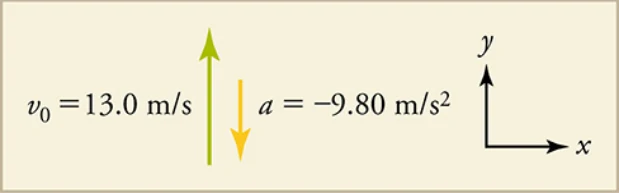
List the knowns: time t = 1.00 s, 2.00 s, and 3.00 s; initial velocity v0 = 13 m/s; acceleration a = g = –9.80 m/s2; and position y0 = 0 m
分かっている量を挙げる。時刻 t = 1.00 s、2.00 s、3.00 s。初速度 v0 = 13 m/s。加速度 a = g = −9.80 m/s2。位置 y0 = 0 m。
List the unknowns: y1, y2, and y3; v1, v2, and v3—where 1, 2, 3 refer to times 1.00 s, 2.00 s, and 3.00 s
分からない量を挙げる。y1、y2、y3 と v1、v2、v3(1、2、3はそれぞれ時刻1.00 s、2.00 s、3.00 sを指す)。
Choose the equations.
式を選ぶ。
These equations describe the unknowns in terms of knowns only.
これらの式は、分からない量を分かっている量だけで表している。
Solution解答
Discussion考察
The first two positive values for y show that the rock is still above the edge of the cliff, and the third negative y value shows that it has passed the starting point and is below the cliff. Remember that we set up to be positive. Any position with a positive value is above the cliff, and any velocity with a positive value is an upward velocity. The first value for v is positive, so the rock is still on the way up. The second and third values for v are negative, so the rock is on its way down.
yの初めの二つの値が正であることは、石がまだ崖のふちより上にあることを示し、三つ目のyが負であることは、石が出発点を通り過ぎて崖より下にあることを示す。上向きを正としたことを思い出そう。値が正の位置はすべて崖より上であり、値が正の速度はすべて上向きの速度である。vの一つ目の値は正なので、石はまだ上昇中である。二つ目と三つ目のvは負なので、石は落下中である。
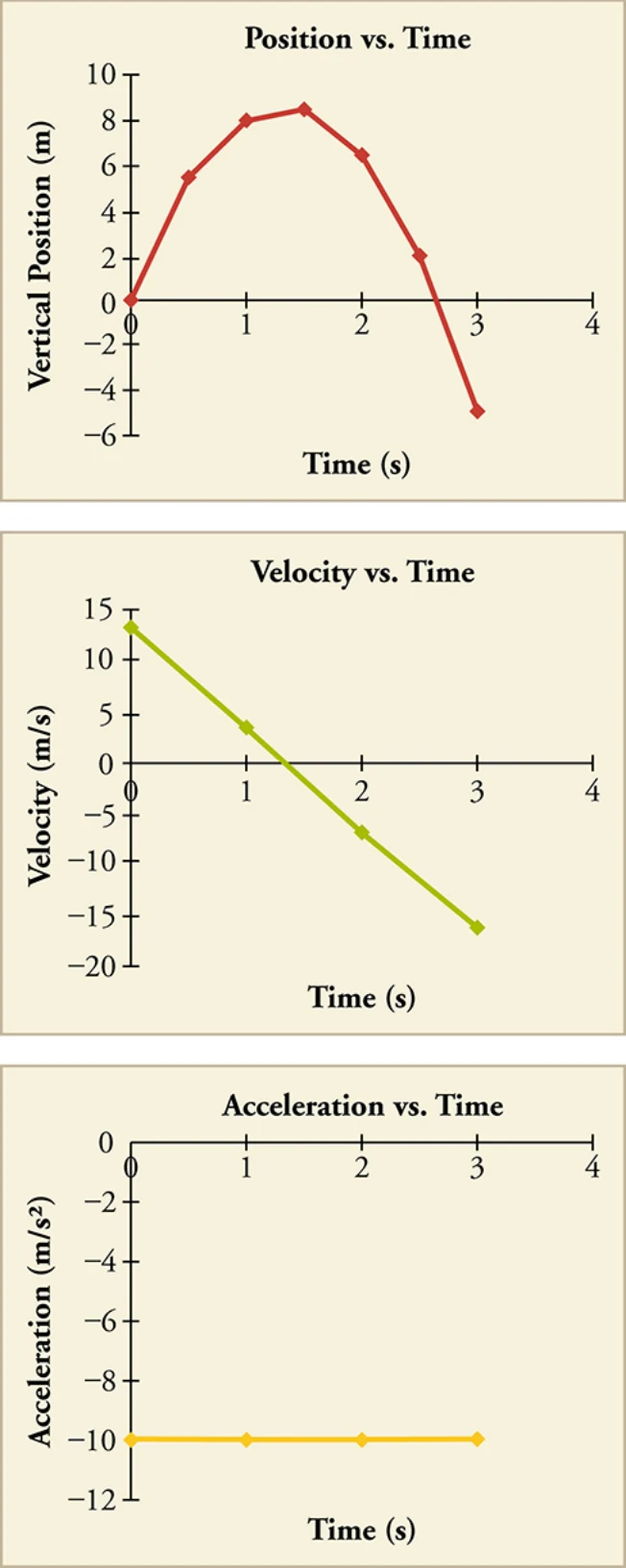
(b) Make graphs of position versus time, velocity versus time, and acceleration versus time. Use increments of 0.5 s in your graphs. Strategy
(b)位置–時間、速度–時間、加速度–時間のグラフを描け。グラフの刻みは0.5秒とする。 方針
Time is customarily plotted on the x-axis because it is the independent variable. Position versus time will not be linear, so calculate points for 0.50 s, 1.50 s, and 2.50 s. This will give a curve closer to the true, smooth shape.
時間は独立変数なので、慣例としてx軸にとる。位置–時間は直線にならないので、0.50 s、1.50 s、2.50 sの点も計算する。そうすれば、本当のなめらかな形に近い曲線が得られる。
Solution解答
The three graphs are shown in Figure 3.13.
三つのグラフを図3.13に示す。
Discussion考察
• y vs. t does not represent the two-dimensional parabolic path of a trajectory. The path of the rock is straight up and straight down. The slope of a line tangent to the curve at any point on the curve equals the velocity at that point—i.e., the instantaneous velocity.
・y–tのグラフは、放物線を描く二次元の飛跡を表しているのではない。石の道筋はまっすぐ上とまっすぐ下である。曲線上のある点で引いた接線の傾きは、その点における速度、すなわち瞬間速度に等しい。
• Note that the v vs. t line crosses the vertical axis at the initial velocity and crosses the horizontal axis at the time when the rock changes direction and begins to fall back to Earth. This plot is linear because acceleration is constant.• The a vs. t plot also shows that acceleration is constant; that is, it does not change with time.
・v–tの直線が縦軸と交わるのは初速度のところであり、横軸と交わるのは、石が向きを変えて地球へ落ち始める時刻であることに注意しよう。加速度が一定なので、このグラフは直線になる。・a–tのグラフも、加速度が一定であること、すなわち時間とともに変わらないことを示している。
Practice Problems練習問題
8A cliff diver pushes off horizontally from a cliff and lands in the ocean later. How fast was he going when he entered the water?
8ある崖からの飛び込み選手が崖を水平に蹴って飛び出し、後に海に入る。水に入ったとき、彼はどれくらいの速さだったか。
9A girl drops a pebble from a high cliff into a lake far below. She sees the splash of the pebble hitting the water later. How fast was the pebble going when it hit the water?a. b.
9ある少女が高い崖から、はるか下の湖へ小石を落とす。後に、小石が水に当たった飛沫が見えた。水に当たったとき、小石はどれくらいの速さだったか。a. b.
Check Your Understanding理解の確認
10Identify the four variables found in the kinematic equations.a. Displacement, Force, Mass, and Timeb. Acceleration, Displacement, Time, and Velocity
10運動学の式に出てくる四つの変数を挙げよ。a. 変位、力、質量、時間b. 加速度、変位、時間、速度
c. Final Velocity, Force, Initial Velocity, and Massd. Acceleration, Final Velocity, Force, and Initial Velocity
c. 終わりの速度、力、初めの速度、質量d. 加速度、終わりの速度、力、初めの速度
11Which of the following steps is always required to solve a kinematics problem?a. Find the force acting on the body.b. Find the acceleration of a body.
11運動学の問題を解くのに、つねに必要な段階は次のうちどれか。a. 物体にはたらく力を求める。b. 物体の加速度を求める。
c. Find the initial velocity of a body.d. Find a suitable kinematic equation and then solve for the unknown quantity.
c. 物体の初速度を求める。d. 適した運動学の式を見つけ、分からない量について解く。
12Which of the following provides a correct answer for a problem that can be solved using the kinematic equations?
12運動学の式で解ける問題に対して、正しい答えを与えているのはどれか。
a. A body starts from rest and accelerates at for . The body’s final velocity is .b. A body starts from rest and accelerates at for . The body’s final velocity is .c. A body with a mass of is acted upon by a force of . The acceleration of the body is .d. A body with a mass of is acted upon by a force of . The acceleration of the body is .
a. ある物体が静止からで加速する。終わりの速度はである。b. ある物体が静止からで加速する。終わりの速度はである。c. 質量の物体にの力がはたらく。物体の加速度はである。d. ある質量の物体にの力がはたらく。物体の加速度はである。