第3章加速度Acceleration原書 p.97–120
3.1 Acceleration3.1 加速度
SECTION LEARNING OBJECTIVES By the end of this section, you will be able to do the following:
この節の学習目標 この節を終えると、次のことができるようになる。
• Explain acceleration and determine the direction and magnitude of acceleration in one dimension• Analyze motion in one dimension using kinematic equations and graphic representations
・加速度を説明し、一次元における加速度の向きと大きさを決める・運動学の式とグラフによる表現を使って、一次元の運動を分析する
Section Key Termsこの節の重要語
average accelerationinstantaneous accelerationnegative acceleration
平均加速度瞬間加速度負の加速度
Defining Acceleration加速度を定義する
Throughout this chapter we will use the following terms: time, displacement, velocity, and acceleration. Recall that each of these terms has a designated variable and SI unit of measurement as follows:
この章を通じて、時間・変位・速度・加速度という語を使う。それぞれに次のように決まった変数とSI単位があることを思い出そう。
• Time: t, measured in seconds (s)• Displacement: Δd, measured in meters (m)• Velocity: v, measured in meters per second (m/s)• Acceleration: a, measured in meters per second per second (m/s2, also called meters per second squared)• Also note the following: ◦ Δ means change in ◦ The subscript 0 refers to an initial value; sometimes subscript i is instead used to refer to initial value. ◦ The subscript f refers to final value ◦ A bar over a symbol, such as , means average
・時間:t、秒(s)で測る・変位:Δd、メートル(m)で測る・速度:v、メートル毎秒(m/s)で測る・加速度:a、毎秒メートル毎秒(m/s2、「メートル毎秒の2乗」とも読む)で測る・さらに次に注意すること。 ◦ Δは「〜の変化」を意味する ◦ 添字0は初めの値を指す。初めの値を指すのに添字iを使うこともある。 ◦ 添字fは終わりの値を指す ◦ のように記号の上に付けた横棒は平均を意味する
Acceleration is the change in velocity divided by a period of time during which the change occurs. The SI units of velocity are m/s and the SI units for time are s, so the SI units for acceleration are m/s2. Average acceleration is given by
加速度とは、速度の変化を、その変化が起きた時間で割ったものである。速度のSI単位はm/s、時間のSI単位はsなので、加速度のSI単位はm/s2である。平均加速度は次で与えられる。
Average acceleration is distinguished from instantaneous acceleration, which is acceleration at a specific instant in time. The magnitude of acceleration is often not constant over time. For example, runners in a race accelerate at a greater rate in the first second of a race than during the following seconds. You do not need to know all the instantaneous accelerations at all times to calculate average acceleration. All you need to know is the change in velocity (i.e., the final velocity minus the initial velocity) and the change in time (i.e., the final time minus the initial time), as shown in the formula. A component of the average acceleration can be positive, negative, or zero. A negative acceleration component is simply an acceleration in the negative direction along that axis. When the motion is in one dimension, we often simply refer to this as negative acceleration, and acceleration in the positive direction as positive acceleration.
平均加速度は、ある瞬間における加速度である瞬間加速度と区別される。加速度の大きさは、時間とともに変わることが多い。たとえば競走の走者は、レースの最初の1秒間のほうが、その後の数秒間より大きな割合で加速する。平均加速度を計算するのに、すべての時刻の瞬間加速度を知る必要はない。式に示したとおり、速度の変化(すなわち終わりの速度から初めの速度を引いたもの)と時間の変化(すなわち終わりの時刻から初めの時刻を引いたもの)さえ分かればよい。平均加速度の成分は、正にも負にも0にもなりうる。加速度の成分が負であるとは、その軸に沿って負の向きの加速度だというだけのことである。運動が一次元のときは、これを単に負の加速度と呼び、正の向きの加速度を正の加速度と呼ぶことが多い。
Keep in mind that although acceleration points in the same direction as the change in velocity, it is not always in the direction of the velocity itself. When an object slows down, its acceleration is opposite to the direction of its velocity. In everyday language, this is called deceleration; but in physics, it is acceleration—whose direction happens to be opposite that of the velocity. For now, let us assume that motion to the right along the x-axis is positive and motion to the left is negative.
加速度は速度の変化と同じ向きを指すが、いつも速度そのものの向きとは限らないことを心に留めておこう。物体が遅くなるとき、その加速度は速度の向きと逆になる。日常の言葉ではこれを減速というが、物理ではこれも加速度であり、たまたま向きが速度と逆になっているだけである。当面、x軸に沿って右向きの運動を正、左向きを負としよう。
Figure 3.2 shows a car with positive acceleration in (a) and negative acceleration in (b). The arrows represent vectors showing both direction and magnitude of velocity and acceleration.
図3.2は、(a)で正の加速度、(b)で負の加速度を持つ車を示している。矢印は、速度と加速度の向きと大きさの両方を示すベクトルである。
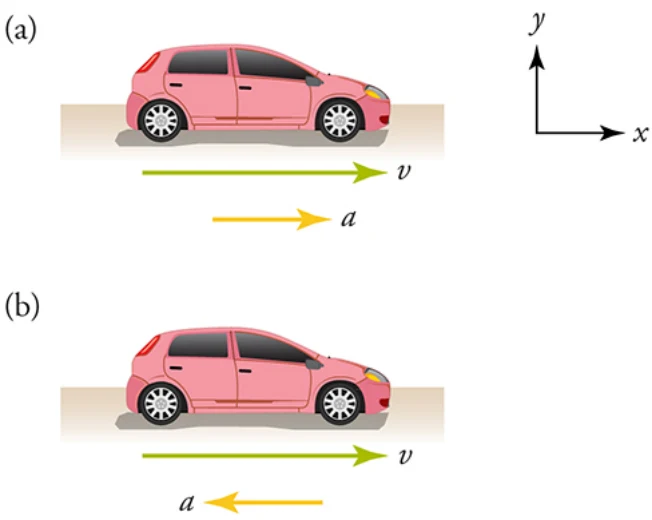
Velocity and acceleration are both vector quantities. Recall that vectors have both magnitude and direction. An object traveling at a constant speed does accelerate if it changes direction. So, turning the steering wheel of a moving car makes the car accelerate because the velocity changes direction.
速度も加速度もベクトル量である。ベクトルは大きさと向きの両方を持つことを思い出そう。一定の速さで進む物体でも、向きを変えれば加速していることになる。だから走っている車のハンドルを切れば、速度の向きが変わるので車は加速する。
VIRTUAL PHYSICSシミュレーションThe Moving Man歩く人
With this animation (https://openstax.org/l/02moving_man), you can produce both variations of acceleration and velocity shown in Figure 3.2, plus a few more variations. Vary the velocity and acceleration by sliding the red and green markers along the scales. Keeping the velocity marker near zero will make the effect of acceleration more obvious. Try changing acceleration from positive to negative while the man is moving. We will come back to this animation and look at the Charts view when we study graphical representation of motion.
このアニメーション(https://openstax.org/l/02moving_man)を使えば、図3.2に示した加速度と速度の二つの型に加えて、いくつか別の型も作り出せる。赤と緑の印を目盛りに沿って動かして、速度と加速度を変えてみよう。速度の印を0の近くに置いておくと、加速度の効果がはっきり見える。人が動いている間に加速度を正から負へ変えてみよう。運動のグラフによる表現を学ぶとき、このアニメーションに戻ってChartsの表示を見ることになる。
GRASP CHECK理解の確認
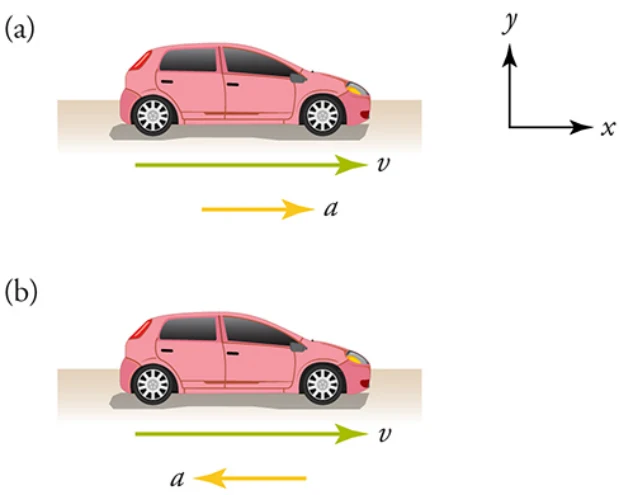
Which part, (a) or (b), is represented when the velocity vector is on the positive side of the scale and the acceleration vector is set on the negative side of the scale? What does the car’s motion look like for the given scenario?
速度ベクトルが目盛りの正の側にあり、加速度ベクトルが負の側に設定されているとき、表されているのは(a)と(b)のどちらか。この場合、車の運動はどんなふうに見えるか。
a. Part (a). The car is slowing down because the acceleration and the velocity vectors are acting in the opposite direction.b. Part (a). The car is speeding up because the acceleration and the velocity vectors are acting in the
a. (a)。加速度ベクトルと速度ベクトルが逆向きにはたらいているので、車は減速している。b. (a)。加速度ベクトルと速度ベクトルが
same direction.c. Part (b). The car is slowing down because the acceleration and velocity vectors are acting in the opposite directions.d. Part (b). The car is speeding up because the acceleration and the velocity vectors are acting in the same direction.
同じ向きにはたらいているので、車は加速している。c. (b)。加速度ベクトルと速度ベクトルが逆向きにはたらいているので、車は減速している。d. (b)。加速度ベクトルと速度ベクトルが同じ向きにはたらいているので、車は加速している。
Calculating Average Acceleration平均加速度を計算する
Look back at the equation for average acceleration. You can see that the calculation of average acceleration involves three values: change in time, (Δt); change in velocity, (Δv); and acceleration (a).
平均加速度の式を見返してみよう。平均加速度の計算には三つの値、すなわち時間の変化(Δt)、速度の変化(Δv)、加速度(a)が関わることがわかる。
Change in time is often stated as a time interval, and change in velocity can often be calculated by subtracting the initial velocity from the final velocity. Average acceleration is then simply change in velocity divided by change in time. Before you begin calculating, be sure that all distances and times have been converted to meters and seconds. Look at these examples of acceleration of a subway train.
時間の変化はしばしば時間間隔として与えられ、速度の変化はたいてい、終わりの速度から初めの速度を引けば計算できる。平均加速度は、単に速度の変化を時間の変化で割ったものである。計算を始める前に、すべての距離と時間がメートルと秒に換算されていることを確かめよう。地下鉄の列車の加速の例を見てみよう。
Recall that for analysis of motion in only one dimension, we do not need to use vectors. Instead, we can treat displacement, velocity, and acceleration as scalars. Unlike magnitudes, scalars can be positive or negative, so the sign can serve to tell us the direction along the one-dimensional axis.
一次元だけの運動を分析するのにベクトルを使う必要はないことを思い出そう。かわりに変位・速度・加速度をスカラーとして扱える。大きさと違ってスカラーは正にも負にもなれるので、符号が一次元の軸に沿った向きを教えてくれる。
An Accelerating Subway Train A subway train accelerates from rest to 30.0 km/h in 20.0 s. What is the average acceleration during that time interval? Strategy
加速する地下鉄の列車 ある地下鉄の列車が、静止から20.0秒で30.0 km/hまで加速する。この時間区間の平均加速度はいくらか。 方針
Start by making a simple sketch.
まず簡単な図を描くところから始める。
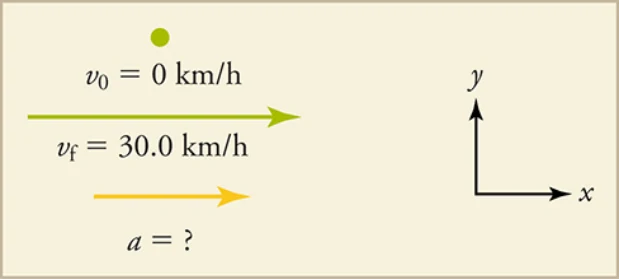
This problem involves four steps:
この問題は四つの段階からなる。
1. Convert to units of meters and seconds.2. Determine the change in velocity.3. Determine the change in time.4. Use these values to calculate the average acceleration. Solution
1. 単位をメートルと秒に換算する。2. 速度の変化を求める。3. 時間の変化を求める。4. これらの値を使って平均加速度を計算する。 解答
1. Identify the knowns. Be sure to read the problem for given information, which may not look like numbers. When the problem states that the train starts from rest, you can write down that the initial velocity is 0 m/s. Therefore, v0 = 0; vf = 30.0 km/h; and Δt = 20.0 s.2. Convert the units.
1. 分かっている量を洗い出す。与えられた情報を読み落とさないこと。数の形をしていないこともある。列車が静止から動き出すと問題文にあれば、初めの速度は0 m/sだと書き下せる。したがってv0 = 0、vf = 30.0 km/h、Δt = 20.0 sである。2. 単位を換算する。
3. Calculate change in velocity, where the plus sign means the change in velocity is to the right. 4. We know Δt, so all we have to do is insert the known values into the formula for average acceleration.
3. 速度の変化を計算する。 ここでプラスの符号は、速度の変化が右向きであることを意味する。 4. Δtが分かっているので、あとは平均加速度の式に既知の値を入れるだけである。
Discussion考察
The plus sign in the answer means that acceleration is to the right. This is a reasonable conclusion because the train starts from rest and ends up with a velocity directed to the right (i.e., positive). So, acceleration is in the same direction as the change in velocity, as it should be.
答えのプラスの符号は、加速度が右向きであることを意味する。列車は静止から動き出し、最後は右向き(すなわち正)の速度になるのだから、これは妥当な結論である。だから加速度は速度の変化と同じ向きであり、そうでなければならない。
An Accelerating Subway Train Now, suppose that at the end of its trip, the train slows to a stop in 8.00 s from a speed of 30.0 km/h. What is its average acceleration during this time? Strategy
加速する地下鉄の列車 今度は、旅の終わりにこの列車が30.0 km/hの速さから8.00秒で減速して停止するとする。この間の平均加速度はいくらか。 方針
Again, make a simple sketch.
ここでも簡単な図を描く。
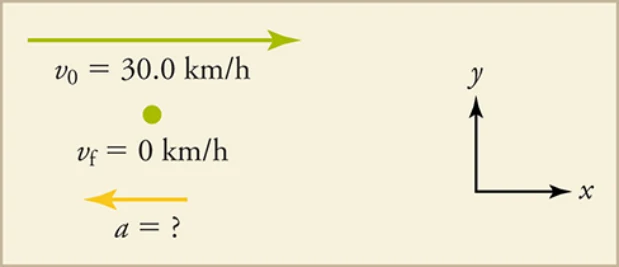
In this case, the train is decelerating and its acceleration is negative because it is pointing to the left. As in the previous example, we must find the change in velocity and change in time, then solve for acceleration.
この場合、列車は減速しており、加速度は左を向いているので負である。前の例と同じく、速度の変化と時間の変化を求めてから、加速度について解けばよい。
Solution解答
1. Identify the knowns: v0 = 30.0 km/h; vf = 0; and Δt = 8.00 s.2. Convert the units. From the first problem, we know that 30.0 km/h = 8.333 m/s.3. Calculate change in velocity, where the minus sign means that the change in velocity points to the left.4. We know Δt = 8.00 s, so all we have to do is insert the known values into the equation for average acceleration.
1. 分かっている量を洗い出す。v0 = 30.0 km/h、vf = 0、Δt = 8.00 s。2. 単位を換算する。前の問題から30.0 km/h = 8.333 m/sと分かっている。3. 速度の変化を計算する。 ここでマイナスの符号は、速度の変化が左を向いていることを意味する。4. Δt = 8.00 sと分かっているので、あとは平均加速度の式に既知の値を入れるだけである。
Discussion考察
The minus sign indicates that acceleration is to the left. This is reasonable because the train initially has a positive velocity in this problem, and a negative acceleration would reduce the velocity. Again, acceleration is in the same direction as the change in velocity, which is negative in this case. This acceleration can be called a deceleration because it has a direction opposite to the velocity.
マイナスの符号は、加速度が左向きであることを示す。この問題では列車が初めに正の速度を持っており、負の加速度なら速度を減らすことになるので、これは妥当である。ここでも加速度は速度の変化と同じ向きで、この場合それは負である。この加速度は、向きが速度と逆なので減速と呼んでもよい。
TIPS FOR SUCCESS学習のポイント
102• It is easier to get plus and minus signs correct if you always assume that motion is away from zero and toward positive values on the x-axis. This way v always starts off being positive and points to the right. If speed is increasing, then acceleration is positive and also points to the right. If speed is decreasing, then acceleration is negative and points to the left.• It is a good idea to carry two extra significant figures from step-to-step when making calculations. Do not round off with each step. When you arrive at the final answer, apply the rules of significant figures for the operations you carried out and round to the correct number of digits. Sometimes this will make your answer slightly more accurate.
・運動はつねに0から離れてx軸の正の値へ向かうものと決めておくと、プラスとマイナスの符号を正しく扱いやすい。こうすればvはつねに正から始まり、右を向く。速さが増しているなら加速度は正で、やはり右を向く。速さが減っているなら加速度は負で、左を向く。・計算をするときは、各段階で有効数字を2桁余分に持ち越しておくとよい。段階ごとに丸めてはいけない。最終的な答えに達したところで、行った演算に応じた有効数字の規則を当てはめ、正しい桁数に丸める。こうすると答えがわずかに正確になることがある。
2. A woman backs her car out of her garage with an acceleration of . How long does it take her to reach a speed of ?a. b.
2. ある女性が、加速度で車をガレージからバックで出す。速さに達するまでに何秒かかるか。a. b.
Acceleration This video shows the basic calculation of acceleration and some useful unit conversions.
加速度 この動画では、加速度の基本的な計算と、役に立つ単位換算をいくつか示す。
Acceleration | One-dimensional motion | Physics | Khan Academy (https://openstax.org/l/02accellerate)
加速度|一次元の運動|物理|カーンアカデミー(https://openstax.org/l/02accellerate)
Why is acceleration a vector quantity?
加速度がベクトル量なのはなぜか。
a. It is a vector quantity because it has magnitude as well as direction.b. It is a vector quantity because it has magnitude but no direction.
a. 大きさと向きの両方を持つのでベクトル量である。b. 大きさを持つが向きを持たないのでベクトル量である。
c. It is a vector quantity because it is calculated from distance and time.d. It is a vector quantity because it is calculated from speed and time.
c. 距離と時間から計算されるのでベクトル量である。d. 速さと時間から計算されるのでベクトル量である。
What will be the change in velocity each second if acceleration is 10 m/s/s?
加速度が10 m/s/sのとき、1秒ごとの速度の変化はいくらか。
a. An acceleration of means that every second, the velocity increases by .b. An acceleration of means that every second, the velocity decreases by .c. An acceleration of means that every , the velocity increases by .d. An acceleration of means that every , the velocity decreases by .
a. 加速度とは、1秒ごとに速度がずつ増えることを意味する。b. 加速度とは、1秒ごとに速度がずつ減ることを意味する。c. 加速度とは、ごとに速度がずつ増えることを意味する。d. 加速度とは、ごとに速度がずつ減ることを意味する。
SNAP LAB身近な実験Measure the Acceleration of a Bicycle on a Slope坂を下る自転車の加速度を測る
In this lab you will take measurements to determine if the acceleration of a moving bicycle is constant. If the acceleration is constant, then the following relationships hold: If , then and
この実験では、走っている自転車の加速度が一定かどうかを、測定によって確かめる。加速度が一定なら、次の関係が成り立つ。 もしなら、であり、
You will work in pairs to measure and record data for a bicycle coasting down an incline on a smooth, gentle slope. The data will consist of distances traveled and elapsed times.
二人一組になって、なめらかでゆるやかな坂を惰性で下る自転車について測定し、データを記録する。データは進んだ距離と経過時間である。
Find an open area to minimize the risk of injury during this lab.
けがの危険を減らすため、開けた場所を選んで行うこと。
• stopwatch• measuring tape• bicycle
・ストップウォッチ・巻き尺・自転車
1. Find a gentle, paved slope, such as an incline on a bike path. The more gentle the slope, the more accurate your data will likely be.2. Mark uniform distances along the slope, such as 5 m, 10 m, etc.3. Determine the following roles: the bike rider, the timer, and the recorder. The recorder should create a data table to collect the distance and time data.4. Have the rider at the starting point at rest on the bike. When the timer calls Start, the timer starts the stopwatch and the rider begins coasting down the slope on the bike without pedaling.5. Have the timer call out the elapsed times as the bike passes each marked point. The recorder should record the times in the data table. It may be necessary to repeat the process to practice roles and make necessary adjustments.6. Once acceptable data has been recorded, switch roles. Repeat Steps 3–5 to collect a second set of data.7. Switch roles again to collect a third set of data.8. Calculate average acceleration for each set of distance-time data. If your result for is not the same for different pairs of Δv and Δt, then acceleration is not constant.9. Interpret your results.
1. 自転車道の坂など、ゆるやかな舗装された坂を見つける。坂がゆるやかなほど、データはおそらく正確になる。2. 坂に沿って5 m、10 mなど、等間隔に印を付ける。3. 役割を決める。乗り手、計時係、記録係である。記録係は距離と時間のデータを集める表を作っておく。4. 乗り手は出発点で自転車にまたがって止まっている。計時係が「スタート」と言ったらストップウォッチを押し、乗り手はペダルをこがずに惰性で坂を下り始める。5. 自転車が各印を通過するたび、計時係が経過時間を読み上げる。記録係はその時間を表に記録する。役割に慣れ、必要な調整をするために、何度か繰り返す必要があるかもしれない。6. 満足のいくデータが取れたら、役割を交代する。手順3〜5を繰り返して2組目のデータを集める。7. もう一度役割を交代して3組目のデータを集める。8. 距離と時間の各組について平均加速度を計算する。ΔvとΔtの組が違うとの結果が同じにならないなら、加速度は一定ではない。9. 結果を解釈する。
GRASP CHECK If you graph the average velocity (y-axis) vs. the elapsed time (x-axis), what would the graph look like if acceleration is uniform?
理解の確認 平均速度(y軸)を経過時間(x軸)に対して描いたとき、加速度が一様ならグラフはどんな形になるか。
a. a horizontal line on the graphb. a diagonal line on the graph
a. 水平な直線b. 斜めの直線
c. an upward-facing parabola on the graphd. a downward-facing parabola on the graph
c. 上に開いた放物線d. 下に開いた放物線
Check Your Understanding理解の確認
3What are three ways an object can accelerate?a. By speeding up, maintaining constant velocity, or changing directionb. By speeding up, slowing down, or changing direction
3物体が加速する三つのしかたは何か。a. 速くなる、一定の速度を保つ、向きを変えるb. 速くなる、遅くなる、向きを変える
c. By maintaining constant velocity, slowing down, or changing directiond. By speeding up, slowing down, or maintaining constant velocity
c. 一定の速度を保つ、遅くなる、向きを変えるd. 速くなる、遅くなる、一定の速度を保つ
4What is the difference between average acceleration and instantaneous acceleration?a. Average acceleration is the change in displacement divided by the elapsed time; instantaneous acceleration is the acceleration at a given point in time.b. Average acceleration is acceleration at a given point in time; instantaneous acceleration is the change in displacement divided by the elapsed time.c. Average acceleration is the change in velocity divided by the elapsed time; instantaneous acceleration is acceleration at a given point in time.d. Average acceleration is acceleration at a given point in time; instantaneous acceleration is the change in velocity divided by the elapsed time.
4平均加速度と瞬間加速度の違いは何か。a. 平均加速度は変位の変化を経過時間で割ったもの、瞬間加速度はある時点における加速度である。b. 平均加速度はある時点における加速度、瞬間加速度は変位の変化を経過時間で割ったものである。c. 平均加速度は速度の変化を経過時間で割ったもの、瞬間加速度はある時点における加速度である。d. 平均加速度はある時点における加速度、瞬間加速度は速度の変化を経過時間で割ったものである。
5What is the rate of change of velocity called?a. timeb. displacement
5速度の変化する割合を何と呼ぶか。a. 時間b. 変位
c. velocityd. acceleration
c. 速度d. 加速度