第13章数列、確率、数え上げSequences, Probability, and Counting Theory
13.7 Probability13.7 確率
Learning Objectives 学習目標
In this section, you will:
この節を終えると、次のことができるようになる。
• Construct probability models.• Compute probabilities of equally likely outcomes.• Compute probabilities of the union of two events.• Use the complement rule to find probabilities.• Compute probability using counting theory.
・確率のモデルを作る。・同様に確からしい結果の確率を計算する。・二つの出来事の和事象の確率を計算する。・余事象の規則を使って確率を求める。・数え上げの理論を使って確率を計算する。
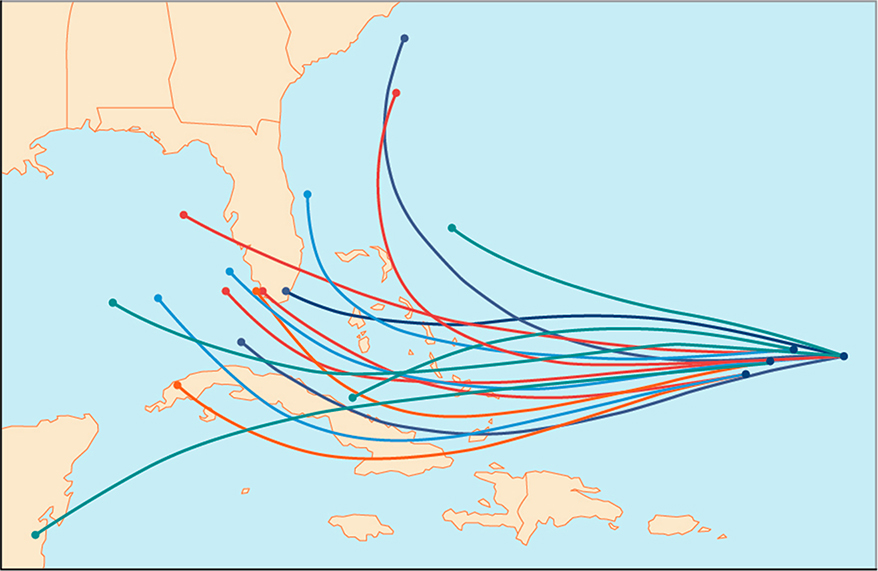
Residents of the Southeastern United States are all too familiar with charts, known as spaghetti models, such as the one in Figure 1. They combine a collection of weather data to predict the most likely path of a hurricane. Each colored line represents one possible path. The group of squiggly lines can begin to resemble strands of spaghetti, hence the name. In this section, we will investigate methods for making these types of predictions.
合衆国南東部の住民は、図1のようなスパゲッティモデルとして知られる図をよく知りすぎている。これは気象の資料をまとめて、颶風のもっともありそうな道筋を予測する。色の付いた各線が、ありうる一つの道筋を表す。くねくねした線の群がスパゲッティの束のように見えてくるので、この名がある。この節では、この種の予測を立てる方法を調べる。
Constructing Probability Models確率のモデルを作る
Suppose we roll a six-sided number cube. Rolling a number cube is an example of an experiment, or an activity with an observable result. The numbers on the cube are possible results, or outcomes, of this experiment. The set of all possible outcomes of an experiment is called the sample space of the experiment. The sample space for this experiment is An event is any subset of a sample space.
6面の数の立方体を振るとしよう。数の立方体を振ることは、試行、すなわち観測できる結果を持つ行いの例である。この立方体の数はこの試行の結果である。試行のありうる結果すべての集合を、その試行の標本空間という。この試行の標本空間は である。事象とは、標本空間の部分集合すべてである。
The likelihood of an event is known as probability. The probability of an event is a number that always satisfies where 0 indicates an impossible event and 1 indicates a certain event. A probability model is a mathematical description of an experiment listing all possible outcomes and their associated probabilities. For instance, if there is a 1% chance of winning a raffle and a 99% chance of losing the raffle, a probability model would look much like Table 1.
事象の起こりやすさを確率という。事象 の確率は、つねに を満たす数である。0は起こりえない事象、1は必ず起こる事象を示す。確率のモデルとは、ありうる結果すべてとそれに結び付いた確率を並べた、試行の数学的な記述である。たとえば、富くじに当たる見込みが1%、外れる見込みが99%なら、確率のモデルは表1のようになる。
| Outcome結果 | Probability確率 |
|---|---|
| Winning the raffle富くじに当たる | 1% |
| Losing the raffle富くじに外れる | 99% |
The sum of the probabilities listed in a probability model must equal 1, or 100%.
確率のモデルに並べた確率の和は、1すなわち100%に等しくなければならない。
How To 手順
Given a probability event where each event is equally likely, construct a probability model.
各事象が同様に確からしい確率の事象が与えられたとき、確率のモデルを作る。
1. Identify every outcome.2. Determine the total number of possible outcomes.3. Compare each outcome to the total number of possible outcomes.
1. 結果をすべて見分ける。2. ありうる結果の総数を決める。3. 各結果を、ありうる結果の総数と比べる。
Example 1例1
Constructing a Probability Model確率のモデルを作る
Construct a probability model for rolling a single, fair die, with the event being the number shown on the die.
偏りの無いさいころを一個振ることについて、さいころに出る数を事象として確率のモデルを作れ。
Solution 解答
Begin by making a list of all possible outcomes for the experiment. The possible outcomes are the numbers that can be rolled: 1, 2, 3, 4, 5, and 6. There are six possible outcomes that make up the sample space.
まずこの試行でありうる結果をすべて並べることから始める。ありうる結果は、出うる数 1、2、3、4、5、6 である。標本空間をなす、ありうる結果は六つある。
Assign probabilities to each outcome in the sample space by determining a ratio of the outcome to the number of possible outcomes. There is one of each of the six numbers on the cube, and there is no reason to think that any particular face is more likely to show up than any other one, so the probability of rolling any number is
結果とありうる結果の数との比を決めて、標本空間の各結果に確率を割り当てる。この立方体には六つの数がそれぞれ一つずつあり、どの面が他より出やすいと考える理由も無いので、どの数が出る確率も である。
| Outcome結果 | Roll of 11が出る | Roll of 22が出る | Roll of 33が出る | Roll of 44が出る | Roll of 55が出る | Roll of 66が出る |
| Probability確率 |
Q&A 疑問と答え
Do probabilities always have to be expressed as fractions?
確率はつねに分数で表さねばならないか。
No. Probabilities can be expressed as fractions, decimals, or percents. Probability must always be a number between 0 and 1, inclusive of 0 and 1.
そうではない。確率は分数、小数、百分率で表せる。確率はつねに0と1のあいだ(0と1を含む)の数でなければならない。
Try It #1やってみよう1
Construct a probability model for tossing a fair coin.
偏りの無い硬貨を投げることについて確率のモデルを作れ。
Computing Probabilities of Equally Likely Outcomes同様に確からしい結果の確率を計算する
Let be a sample space for an experiment. When investigating probability, an event is any subset of When the outcomes of an experiment are all equally likely, we can find the probability of an event by dividing the number of outcomes in the event by the total number of outcomes in Suppose a number cube is rolled, and we are interested in finding the probability of the event “rolling a number less than or equal to 4.” There are 4 possible outcomes in the event and 6 possible outcomes in so the probability of the event is
をある試行の標本空間とする。確率を調べるとき、事象とは の部分集合すべてである。試行の結果がすべて同様に確からしいとき、事象の結果の数を の結果の総数で割れば、その事象の確率が求まる。数の立方体を振り、「4以下の数が出る」という事象の確率を求めたいとしよう。この事象にはありうる結果が4つあり、 にはありうる結果が6つあるので、この事象の確率は である。
Computing the Probability of an Event with Equally Likely Outcomes 同様に確からしい場合の確率
The probability of an event in an experiment with sample space with equally likely outcomes is given by
同様に確からしい結果を持つ標本空間 の試行での事象 の確率は、次で与えられる。
is a subset of so it is always true that
は の部分集合なので、つねに が成り立つ。
Example 2例2
Computing the Probability of an Event with Equally Likely Outcomes同様に確からしい結果を持つ事象の確率を計算する
A six-sided number cube is rolled. Find the probability of rolling an odd number.
6面の数の立方体を振る。奇数が出る確率を求めよ。
Solution 解答
The event “rolling an odd number” contains three outcomes. There are 6 equally likely outcomes in the sample space. Divide to find the probability of the event.
「奇数が出る」という事象には結果が三つある。標本空間には同様に確からしい結果が6つある。割ってこの事象の確率を求める。
Try It #2やってみよう2
A number cube is rolled. Find the probability of rolling a number greater than 2.
数の立方体を振る。2より大きい数が出る確率を求めよ。
Computing the Probability of the Union of Two Events二つの事象の和事象の確率を計算する
We are often interested in finding the probability that one of multiple events occurs. Suppose we are playing a card game, and we will win if the next card drawn is either a heart or a king. We would be interested in finding the probability of the next card being a heart or a king. The union of two events is the event that occurs if either or both events occur.
複数の事象のどれかが起こる確率を求めたいことがしばしばある。トランプの遊びをしていて、次に引く札がハートかキングなら勝ちだとしよう。次の札がハートかキングである確率を求めたくなる。二つの事象 の和事象とは、どちらか一方または両方が起こるときに起こる事象である。
Suppose the spinner in Figure 2 is spun. We want to find the probability of spinning orange or spinning a
図2の回転盤を回すとしよう。橙が出るか が出る確率を求めたい。
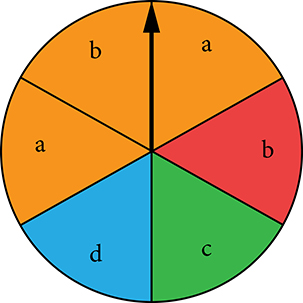
There are a total of 6 sections, and 3 of them are orange. So the probability of spinning orange is There are a total of 6 sections, and 2 of them have a So the probability of spinning a is If we added these two probabilities, we would be counting the sector that is both orange and a twice. To find the probability of spinning an orange or a we need to subtract the probability that the sector is both orange and has a
区画は全部で6つあり、そのうち3つが橙である。よって橙が出る確率は である。区画は全部で6つあり、そのうち2つに がある。よって が出る確率は である。この二つの確率を足すと、橙でありかつ でもある区画を二度数えてしまう。橙か が出る確率を求めるには、区画が橙でありかつ を持つ確率を引く必要がある。
The probability of spinning orange or a is
橙か が出る確率は である。
Probability of the Union of Two Events 2つの事象の和事象の確率
The probability of the union of two events and (written ) equals the sum of the probability of and the probability of minus the probability of and occurring together which is called the intersection of and and is written as ).
二つの事象 と の和事象の確率( と書く)は、 の確率と の確率の和から、 と が同時に起こる確率 を引いたものに等しい。後者を と の積事象といい、 と書く。
Example 3例3
Computing the Probability of the Union of Two Events二つの事象の和事象の確率を計算する
A card is drawn from a standard deck. Find the probability of drawing a heart or a 7.
標準の一組から札を一枚引く。ハートか7を引く確率を求めよ。
Solution 解答
A standard deck contains an equal number of hearts, diamonds, clubs, and spades. So the probability of drawing a heart is There are four 7s in a standard deck, and there are a total of 52 cards. So the probability of drawing a 7 is
標準の一組には、ハート、ダイヤ、クラブ、スペードが同数含まれる。よってハートを引く確率は である。標準の一組には7が四枚あり、札は全部で52枚である。よって7を引く確率は である。
The only card in the deck that is both a heart and a 7 is the 7 of hearts, so the probability of drawing both a heart and a 7 is Substitute into the formula.
一組の中でハートでありかつ7でもある札はハートの7だけなので、ハートでありかつ7でもある札を引く確率は である。公式に を代入する。
The probability of drawing a heart or a 7 is
ハートか7を引く確率は である。
Try It #3やってみよう3
A card is drawn from a standard deck. Find the probability of drawing a red card or an ace.
標準の一組から札を一枚引く。赤の札かエースを引く確率を求めよ。
Computing the Probability of Mutually Exclusive Events互いに排反な事象の確率を計算する
Suppose the spinner in Figure 2 is spun again, but this time we are interested in the probability of spinning an orange or a There are no sectors that are both orange and contain a so these two events have no outcomes in common. Events are said to be mutually exclusive events when they have no outcomes in common. Because there is no overlap, there is nothing to subtract, so the general formula is
図2の回転盤をもう一度回すとしよう。だが今度は、橙か が出る確率に関心がある。橙でありかつ を含む区画は無いので、この二つの事象に共通の結果は無い。共通の結果が無いとき、事象は互いに排反な事象であるという。重なりが無いので引くものが無く、一般の公式は次になる。
Notice that with mutually exclusive events, the intersection of and is the empty set. The probability of spinning an orange is and the probability of spinning a is We can find the probability of spinning an orange or a simply by adding the two probabilities.
互いに排反な事象では、 と の積事象が空集合であることに注意せよ。橙が出る確率は 、 が出る確率は である。二つの確率を足すだけで、橙か が出る確率が求まる。
The probability of spinning an orange or a is
橙か が出る確率は である。
Probability of the Union of Mutually Exclusive Events 排反な事象の和事象の確率
The probability of the union of two mutually exclusive events is given by
互いに排反な二つの事象 の和事象の確率は次で与えられる。
How To 手順
Given a set of events, compute the probability of the union of mutually exclusive events.
事象の組が与えられたとき、互いに排反な事象の和事象の確率を計算する。
1. Determine the total number of outcomes for the first event.2. Find the probability of the first event.3. Determine the total number of outcomes for the second event.4. Find the probability of the second event.5. Add the probabilities.
1. 一つ目の事象の結果の総数を決める。2. 一つ目の事象の確率を求める。3. 二つ目の事象の結果の総数を決める。4. 二つ目の事象の確率を求める。5. 確率どうしを足す。
Example 4例4
Computing the Probability of the Union of Mutually Exclusive Events互いに排反な事象の和事象の確率を計算する
A card is drawn from a standard deck. Find the probability of drawing a heart or a spade.
標準の一組から札を一枚引く。ハートかスペードを引く確率を求めよ。
Solution 解答
The events “drawing a heart” and “drawing a spade” are mutually exclusive because they cannot occur at the same time. The probability of drawing a heart is and the probability of drawing a spade is also so the probability of drawing a heart or a spade is
「ハートを引く」と「スペードを引く」は同時に起こりえないので、互いに排反な事象である。ハートを引く確率は 、スペードを引く確率も なので、ハートかスペードを引く確率は次である。
Try It #4やってみよう4
A card is drawn from a standard deck. Find the probability of drawing an ace or a king.
標準の一組から札を一枚引く。エースかキングを引く確率を求めよ。
Using the Complement Rule to Compute Probabilities余事象の規則を使って確率を計算する
We have discussed how to calculate the probability that an event will happen. Sometimes, we are interested in finding the probability that an event will not happen. The complement of an event denoted is the set of outcomes in the sample space that are not in For example, suppose we are interested in the probability that a horse will lose a race. If event is the horse winning the race, then the complement of event is the horse losing the race.
事象が起こる確率の計算のしかたを論じてきた。事象が起こらない確率を求めたいこともある。 と書く事象 の余事象とは、標本空間のうち に入らない結果の集合である。たとえば、ある馬が競走に負ける確率に関心があるとしよう。事象 がその馬が競走に勝つことなら、事象 の余事象はその馬が競走に負けることである。
To find the probability that the horse loses the race, we need to use the fact that the sum of all probabilities in a probability model must be 1.
その馬が負ける確率を求めるには、確率のモデルのすべての確率の和が1でなければならないという事実を使う必要がある。
The probability of the horse winning added to the probability of the horse losing must be equal to 1. Therefore, if the probability of the horse winning the race is the probability of the horse losing the race is simply
その馬が勝つ確率とその馬が負ける確率を足すと1に等しくなければならない。したがって、その馬が競走に勝つ確率が なら、その馬が競走に負ける確率は単に次である。
The Complement Rule 余事象の確率
The probability that the complement of an event will occur is given by
事象の余事象が起こる確率は次で与えられる。
Example 5例5
Using the Complement Rule to Calculate Probabilities余事象の規則を使って確率を計算する
Two six-sided number cubes are rolled.
6面の数の立方体を二個振る。
ⓐFind the probability that the sum of the numbers rolled is less than or equal to 3.ⓑFind the probability that the sum of the numbers rolled is greater than 3.
ⓐ出た数の和が3以下である確率を求めよ。ⓑ出た数の和が3より大きい確率を求めよ。
Solution 解答
The first step is to identify the sample space, which consists of all the possible outcomes. There are two number cubes, and each number cube has six possible outcomes. Using the Multiplication Principle, we find that there are or total possible outcomes. So, for example, 1-1 represents a 1 rolled on each number cube.
最初の一歩は、ありうる結果すべてからなる標本空間を見分けることである。数の立方体は二個あり、各立方体にはありうる結果が六つある。積の原理を使うと、ありうる結果は全部で すなわち 通りだと分かる。たとえば 1-1 は、各立方体に1が出たことを表す。
ⓐWe need to count the number of ways to roll a sum of 3 or less. These would include the following outcomes: 1-1, 1-2, and 2-1. So there are only three ways to roll a sum of 3 or less. The probability isⓑRather than listing all the possibilities, we can use the Complement Rule. Because we have already found the probability of the complement of this event, we can simply subtract that probability from 1 to find the probability that the sum of the numbers rolled is greater than 3.
ⓐ和が3以下になるしかたの数を数える必要がある。それは 1-1、1-2、2-1 である。よって和が3以下になるしかたは三通りしかない。確率は次である。ⓑ可能性をすべて並べる代わりに、余事象の規則が使える。この事象の余事象の確率はすでに求めたので、1からその確率を引くだけで、出た数の和が3より大きい確率が求まる。
Try It #5やってみよう5
Two number cubes are rolled. Use the Complement Rule to find the probability that the sum is less than 10.
数の立方体を二個振る。余事象の規則を使って、和が10より小さい確率を求めよ。
Computing Probability Using Counting Theory数え上げの理論を使って確率を計算する
Many interesting probability problems involve counting principles, permutations, and combinations. In these problems, we will use permutations and combinations to find the number of elements in events and sample spaces. These problems can be complicated, but they can be made easier by breaking them down into smaller counting problems.
興味深い確率の問題の多くは、数え上げの原理、順列、組合せにかかわる。この問題では、順列と組合せを使って事象と標本空間の要素の数を求める。この問題は込み入りうるが、小さな数え上げの問題に分ければ楽になる。
Assume, for example, that a store has 8 cellular phones and that 3 of those are defective. We might want to find the probability that a couple purchasing 2 phones receives 2 phones that are not defective. To solve this problem, we need to calculate all of the ways to select 2 phones that are not defective as well as all of the ways to select 2 phones. There are 5 phones that are not defective, so there are ways to select 2 phones that are not defective. There are 8 phones, so there are ways to select 2 phones. The probability of selecting 2 phones that are not defective is:
たとえば、ある店に携帯電話が8台あり、そのうち3台が不良品だとしよう。夫婦が2台買って、不良品でない2台を受け取る確率を求めたいかもしれない。この問題を解くには、不良品でない2台を選ぶしかたすべてと、2台を選ぶしかたすべてを計算する必要がある。不良品でない電話は5台なので、不良品でない2台を選ぶしかたは 通りある。電話は8台なので、2台を選ぶしかたは 通りある。不良品でない2台を選ぶ確率は次である。
Example 6例6
Computing Probability Using Counting Theory数え上げの理論を使って確率を計算する
A child randomly selects 5 toys from a bin containing 3 bunnies, 5 dogs, and 6 bears.
ある子どもが、兎3つ、犬5つ、熊6つの入った箱から、無作為に玩具を5つ選ぶ。
ⓐFind the probability that only bears are chosen.ⓑFind the probability that 2 bears and 3 dogs are chosen.ⓒFind the probability that at least 2 dogs are chosen.
ⓐ熊だけが選ばれる確率を求めよ。ⓑ熊2つと犬3つが選ばれる確率を求めよ。ⓒ犬が少なくとも2つ選ばれる確率を求めよ。
Solution 解答
ⓐWe need to count the number of ways to choose only bears and the total number of possible ways to select 5 toys. There are 6 bears, so there are ways to choose 5 bears. There are 14 toys, so there are ways to choose any 5 toys. ⓑWe need to count the number of ways to choose 2 bears and 3 dogs and the total number of possible ways to select 5 toys. There are 6 bears, so there are ways to choose 2 bears. There are 5 dogs, so there are ways to choose 3 dogs. Since we are choosing both bears and dogs at the same time, we will use the Multiplication Principle. There are ways to choose 2 bears and 3 dogs. We can use this result to find the probability. ⓒIt is often easiest to solve “at least” problems using the Complement Rule. We will begin by finding the probability that fewer than 2 dogs are chosen. If less than 2 dogs are chosen, then either no dogs could be chosen, or 1 dog could be chosen. When no dogs are chosen, all 5 toys come from the 9 toys that are not dogs. There are ways to choose toys from the 9 toys that are not dogs. Since there are 14 toys, there are ways to choose the 5 toys from all of the toys. If there is 1 dog chosen, then 4 toys must come from the 9 toys that are not dogs, and 1 must come from the 5 dogs. Since we are choosing both dogs and other toys at the same time, we will use the Multiplication Principle. There are ways to choose 1 dog and 1 other toy.Because these events would not occur together and are therefore mutually exclusive, we add the probabilities to find the probability that fewer than 2 dogs are chosen. We then subtract that probability from 1 to find the probability that at least 2 dogs are chosen.
ⓐ熊だけを選ぶしかたの数と、玩具を5つ選ぶありうるしかたの総数を数える必要がある。熊は6つなので、熊を5つ選ぶしかたは 通りある。玩具は14あるので、どれでも5つ選ぶしかたは 通りある。ⓑ熊2つと犬3つを選ぶしかたの数と、玩具を5つ選ぶありうるしかたの総数を数える必要がある。熊は6つなので、熊を2つ選ぶしかたは 通りある。犬は5つなので、犬を3つ選ぶしかたは 通りある。熊と犬を同時に選ぶので、積の原理を使う。熊2つと犬3つを選ぶしかたは 通りある。この結果を使えば確率が求まる。ⓒ「少なくとも」の問題は、余事象の規則を使うのがいちばん楽なことが多い。まず犬が2つ未満選ばれる確率を求める。犬が2つ未満選ばれるとは、犬が一つも選ばれないか、犬が1つ選ばれるかである。犬が一つも選ばれないとき、玩具5つはすべて、犬でない9つの玩具から来る。犬でない9つの玩具から玩具を選ぶしかたは 通りある。玩具は14あるので、すべての玩具から5つを選ぶしかたは 通りある。 犬が1つ選ばれるとき、玩具4つは犬でない9つから、1つは5つの犬から来なければならない。犬とほかの玩具を同時に選ぶので、積の原理を使う。犬1つとほかの玩具1つを選ぶしかたは 通りある。 この事象は同時に起こらず、したがって互いに排反なので、確率を足して犬が2つ未満選ばれる確率を求める。 そして1からその確率を引き、犬が少なくとも2つ選ばれる確率を求める。
Try It #6やってみよう6
A child randomly selects 3 gumballs from a container holding 4 purple gumballs, 8 yellow gumballs, and 2 green gumballs.
ある子どもが、紫のガムボール4つ、黄のガムボール8つ、緑のガムボール2つの入った容器から、無作為にガムボールを3つ選ぶ。
ⓐFind the probability that all 3 gumballs selected are purple.ⓑFind the probability that no yellow gumballs are selected.ⓒFind the probability that at least 1 yellow gumball is selected.
ⓐ選ばれた3つがすべて紫である確率を求めよ。ⓑ黄が一つも選ばれない確率を求めよ。ⓒ黄が少なくとも1つ選ばれる確率を求めよ。
Media 教材
Access these online resources for additional instruction and practice with probability.
確率についての説明と練習をさらに求めるなら、次のオンライン教材にあたるとよい。
• Introduction to Probability• Determining Probability
・確率入門・確率を決める
Verbal言葉で答える問題
2. What is a sample space?
2. 標本空間とは何か。
4. What is the difference between events and outcomes? Give an example of both using the sample space of tossing a coin 50 times.
4. 事象と結果の違いは何か。硬貨を50回投げる標本空間を使って、両方の例を挙げよ。
Numeric数の問題
For the following exercises, use the spinner shown in Figure 3 to find the probabilities indicated.
次の各問について、図3に示す回転盤を使い、示された確率を求めよ。
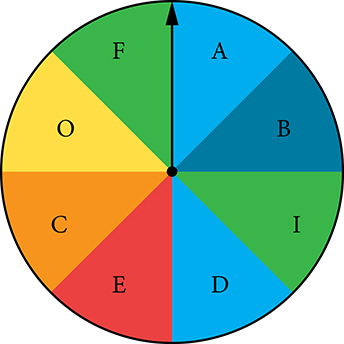
6. Landing on red
6. 赤で止まる
8. Not landing on blue
8. 青で止まらない
10. Landing on blue or a vowel
10. 青か母音で止まる
12. Landing on yellow or a consonant
12. 黄か子音で止まる
For the following exercises, two coins are tossed.
次の各問では、硬貨を二枚投げる。
14. What is the sample space?
14. 標本空間は何か。
16. Find the probability of tossing exactly one tail.
16. 裏がちょうど一つ出る確率を求めよ。
For the following exercises, four coins are tossed.
次の各問では、硬貨を四枚投げる。
18. What is the sample space?
18. 標本空間は何か。
20. Find the probability of tossing exactly three heads.
20. 表がちょうど三つ出る確率を求めよ。
22. Find the probability of tossing all tails.
22. すべて裏が出る確率を求めよ。
24. Find the probability of tossing exactly two heads or at least two tails.
24. 表がちょうど二つ、または裏が少なくとも二つ出る確率を求めよ。
For the following exercises, one card is drawn from a standard deck of cards. Find the probability of drawing the following:
次の各問では、標準の 枚の一組から札を一枚引く。次を引く確率を求めよ。
26. A club
26. クラブ
28. Six or seven
28. 6か7
30. An ace or a diamond
30. エースかダイヤ
32. A heart or a non-jack
32. ハートかジャックでない札
For the following exercises, two dice are rolled, and the results are summed.
次の各問では、さいころを二個振り、出た目を足す。
34. Find the probability of rolling a sum of
34. 和が になる確率を求めよ。
36. Find the probability of rolling an odd sum less than
36. 和が より小さい奇数になる確率を求めよ。
38. Find the probability of rolling a sum less than
38. 和が より小さくなる確率を求めよ。
40. Find the probability of rolling a sum between and inclusive.
40. 和が と のあいだ(両端を含む)になる確率を求めよ。
42. Find the probability of rolling any sum other than or
42. 和が でも でもない確率を求めよ。
For the following exercises, a coin is tossed, and a card is pulled from a standard deck. Find the probability of the following:
次の各問では、硬貨を一枚投げ、標準の一組から札を一枚引く。次の確率を求めよ。
44. A tail on the coin or red ace
44. 硬貨が裏か、赤のエース
46. No aces
46. エースが出ない
For the following exercises, use this scenario: a bag of M&Ms contains blue, brown, orange, yellow, red, and green M&Ms. Reaching into the bag, a person grabs 5 M&Ms.
次の各問では、次の筋書きを使え。ある袋のM&Mには、青 、茶 、橙 、黄 、赤 、緑 のM&Mが入っている。袋に手を入れ、ある人がM&Mを5個つかむ。
48. What is the probability of getting blue M&Ms?
48. 青のM&Mが 個になる確率はいくらか。
50. What is the probability of getting no brown M&Ms?
50. 茶のM&Mが一つも出ない確率はいくらか。
Extensions発展問題
Use the following scenario for the exercises that follow: In the game of Keno, a player starts by selecting numbers from the numbers to After the player makes his selections, winning numbers are randomly selected from numbers to A win occurs if the player has correctly selected or of the winning numbers. (Round all answers to the nearest hundredth of a percent.)
次の各問には次の筋書きを使え。キノという遊びでは、まず遊ぶ人が から までの数から 個の数を選ぶ。遊ぶ人が選び終えたあと、 から までの数から当たりの数が 個、無作為に選ばれる。遊ぶ人が 個の当たりの数のうち 個か 個を正しく選んでいれば当たりになる。(答えはすべて百分率で小数第二位まで求めよ。)
52. What is the percent chance that a player selects exactly 4 winning numbers?
52. 遊ぶ人が当たりの数をちょうど4個選ぶ見込みは何パーセントか。
54. What is the percent chance of winning?
54. 当たる見込みは何パーセントか。
Real-World Applications現実世界への応用
Use this data for the exercises that follow: In 2013, there were roughly 317 million citizens in the United States, and about 40 million were elderly (aged 65 and over).2
次の各問にはこの資料を使え。2013年、合衆国の国民はおよそ3億1700万人で、そのうちおよそ4000万人が高齢者(65歳以上)だった。2
56. If you meet a U.S. citizen, what is the percent chance that the person is elderly? (Round to the nearest tenth of a percent.)
56. 合衆国の国民に一人会うとき、その人が高齢者である見込みは何パーセントか。(百分率で小数第一位まで求めよ。)
58. If you meet five U.S. citizens, what is the percent chance that three are elderly? (Round to the nearest tenth of a percent.)
58. 合衆国の国民に五人会うとき、三人が高齢者である見込みは何パーセントか。(百分率で小数第一位まで求めよ。)
60. It is predicted that by 2030, one in five U.S. citizens will be elderly. How much greater will the chances of meeting an elderly person be at that time? What policy changes do you foresee if these statistics hold true?
60. 2030年までに、合衆国の国民の五人に一人が高齢者になると予測されている。そのとき高齢者に会う見込みはどれだけ大きくなるか。この統計が実際に当たるなら、どんな政策の変化が見込まれるか。
Key Terms重要語
Addition Principle if one event can occur in ways and a second event with no common outcomes can occur in ways, then the first or second event can occur in ways
和の原理 ある出来事が 通りに起こり、共通の結果を持たない第二の出来事が 通りに起こりうるなら、第一または第二の出来事は 通りに起こりうる
annuity an investment in which the purchaser makes a sequence of periodic, equal payments
年金 買い手が定期の等しい支払いを続ける投資
arithmetic sequence a sequence in which the difference between any two consecutive terms is a constant
等差数列 連続するどの二項の差も一定である数列
arithmetic series the sum of the terms in an arithmetic sequence
等差級数 等差数列の項の和
binomial coefficient the number of ways to choose r objects from n objects where order does not matter; equivalent to denoted
二項係数 n個の物から順序を気にせずr個を選ぶしかたの数。 と同値で、 と書く
binomial expansion the result of expanding by multiplying
二項展開 を掛け算で展開した結果
Binomial Theorem a formula that can be used to expand any binomial
二項定理 どの二項式の展開にも使える公式
combination a selection of objects in which order does not matter
組合せ 順序が効かない物の選び方
common difference the difference between any two consecutive terms in an arithmetic sequence
公差 等差数列で連続するどの二項の差
common ratio the ratio between any two consecutive terms in a geometric sequence
公比 等比数列で連続するどの二項の比
complement of an event the set of outcomes in the sample space that are not in the event
事象の余事象 標本空間のうち事象 に入らない結果の集合
diverge a series is said to diverge if the sum is not a real number
発散する 和が実数でないとき、級数は発散するという
event any subset of a sample space
事象 標本空間の部分集合すべて
experiment an activity with an observable result
試行 観測できる結果を持つ行い
explicit formula a formula that defines each term of a sequence in terms of its position in the sequence
一般項の公式 数列の各項をその位置で定める公式
finite sequence a function whose domain consists of a finite subset of the positive integers for some positive integer
有限数列 ある正の整数 について、定義域が正の整数 の有限の部分集合からなる関数
Fundamental Counting Principle if one event can occur in ways and a second event can occur in ways after the first event has occurred, then the two events can occur in ways; also known as the Multiplication Principle
数え上げの基本原理 ある出来事が 通りに起こり、その出来事が起こったあと第二の出来事が 通りに起こりうるなら、この二つの出来事は 通りに起こりうる。積の原理としても知られる
geometric sequence a sequence in which the ratio of a term to a previous term is a constant
等比数列 項と前の項の比が一定である数列
geometric series the sum of the terms in a geometric sequence
等比級数 等比数列の項の和
index of summation in summation notation, the variable used in the explicit formula for the terms of a series and written below the sigma with the lower limit of summation
和の指標 和の表記で、級数の項の一般項の公式に使い、和の下限とともにシグマの下に書く変数
infinite sequence a function whose domain is the set of positive integers
無限数列 定義域が正の整数の集合である関数
infinite series the sum of the terms in an infinite sequence
無限級数 無限数列の項の和
lower limit of summation the number used in the explicit formula to find the first term in a series
和の下限 級数の第一項を求めるのに一般項の公式に使う数
Multiplication Principle if one event can occur in ways and a second event can occur in ways after the first event has occurred, then the two events can occur in ways; also known as the Fundamental Counting Principle
積の原理 ある出来事が 通りに起こり、その出来事が起こったあと第二の出来事が 通りに起こりうるなら、この二つの出来事は 通りに起こりうる。数え上げの基本原理としても知られる
mutually exclusive events events that have no outcomes in common
互いに排反な事象 共通の結果を持たない事象
n factorial the product of all the positive integers from 1 to
nの階乗 1から までのすべての正の整数の積
nth partial sum the sum of the first terms of a sequence
第n部分和 数列の初めの 項の和
nth term of a sequence a formula for the general term of a sequence
数列の第n項 数列の一般項の公式
outcomes the possible results of an experiment
結果 試行のありうる結果
permutation a selection of objects in which order matters
順列 順序が効く物の選び方
probability a number from 0 to 1 indicating the likelihood of an event
確率 事象の起こりやすさを示す0から1までの数
probability model a mathematical description of an experiment listing all possible outcomes and their associated probabilities
確率のモデル ありうる結果すべてとそれに結び付いた確率を並べた、試行の数学的な記述
recursive formula a formula that defines each term of a sequence using previous term(s)
漸化式 前の項を使って数列の各項を定める公式
sample space the set of all possible outcomes of an experiment
標本空間 試行のありうる結果すべての集合
sequence a function whose domain is a subset of the positive integers
数列 定義域が正の整数の部分集合である関数
series the sum of the terms in a sequence
級数 数列の項の和
summation notation a notation for series using the Greek letter sigma; it includes an explicit formula and specifies the first and last terms in the series
和の表記 ギリシャ文字シグマを使う級数の表記。一般項の公式を含み、級数の最初と最後の項を指定する
term a number in a sequence
項 数列の中の数
union of two events the event that occurs if either or both events occur
二つの事象の和事象 どちらか一方または両方が起こるときに起こる事象
upper limit of summation the number used in the explicit formula to find the last term in a series
和の上限 級数の最後の項を求めるのに一般項の公式に使う数