第8章周期関数Periodic Functions
Investigating Sinusoidal Functions正弦曲線状の関数を調べる
As we can see, sine and cosine functions have a regular period and range. If we watch ocean waves or ripples on a pond, we will see that they resemble the sine or cosine functions. However, they are not necessarily identical. Some are taller or longer than others. A function that has the same general shape as a sine or cosine function is known as a sinusoidal function. The general forms of sinusoidal functions are
見てのとおり、正弦関数と余弦関数には決まった周期と値域がある。海の波や池のさざ波を見れば、それが正弦関数や余弦関数に似ているのが分かる。だが必ずしも同じではない。ほかより高いものも長いものもある。正弦関数や余弦関数と全体の形が同じ関数を、正弦曲線状の関数という。正弦曲線状の関数の一般形は次のとおりである。
Determining the Period of Sinusoidal Functions正弦曲線状の関数の周期を決める
Looking at the forms of sinusoidal functions, we can see that they are transformations of the sine and cosine functions. We can use what we know about transformations to determine the period.
正弦曲線状の関数の形を見ると、それが正弦関数と余弦関数の変形だと分かる。変形について知っていることを使えば、周期が決められる。
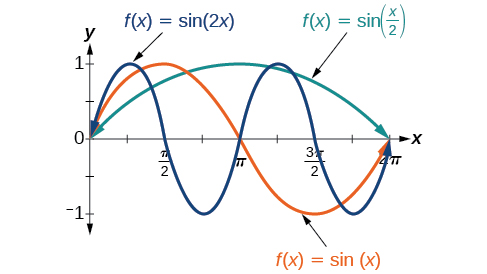
In the general formula, is related to the period by If then the period is less than and the function undergoes a horizontal compression, whereas if then the period is greater than and the function undergoes a horizontal stretch. For example, so the period is which we knew. If then so the period is and the graph is compressed. If then so the period is and the graph is stretched. Notice in Figure 8 how the period is indirectly related to
一般の公式で、 は周期と で結ばれている。 なら周期は より小さく、この関数は横に縮む。一方 なら周期は より大きく、この関数は横に伸びる。たとえば では なので周期は であり、これは分かっていた。 なら なので周期は で、グラフは縮む。 なら なので周期は で、グラフは伸びる。図8で、周期が と反比例の関係にあることに注目しよう。
Note重要事項
Period of Sinusoidal Functions正弦曲線状の関数の周期
If we let and in the general form equations of the sine and cosine functions, we obtain the forms
正弦関数と余弦関数の一般形の式で かつ とすると、次の形が得られる。
The period is
周期は である。
Example 1例1
Identifying the Period of a Sine or Cosine Function正弦関数や余弦関数の周期を見分ける
Determine the period of the function
関数 の周期を決めよ。
Solution 解答
Let’s begin by comparing the equation to the general form
まず、この式を一般形 と比べよう。
In the given equation, so the period will be
与えられた式では なので、周期は次のとおりである。
Try IT Feature #1確認問題 1
Determine the period of the function
関数 の周期を決めよ。
Determining Amplitude振幅を決める
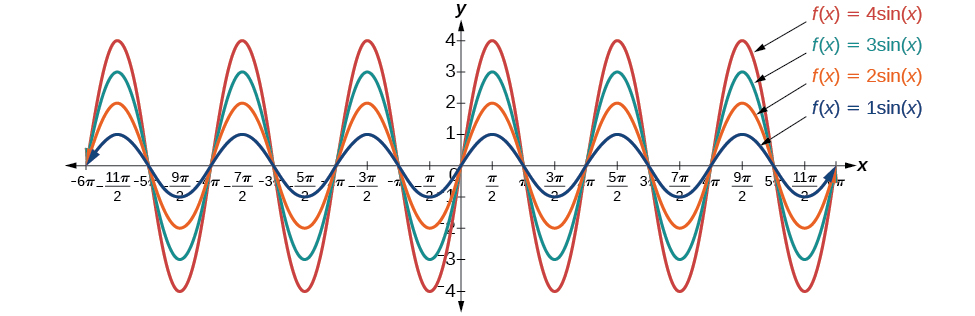
Returning to the general formula for a sinusoidal function, we have analyzed how the variable relates to the period. Now let’s turn to the variable so we can analyze how it is related to the amplitude, or greatest distance from rest. represents the vertical stretch factor, and its absolute value is the amplitude. The local maxima will be a distance above the horizontal midline of the graph, which is the line because in this case, the midline is the x-axis. The local minima will be the same distance below the midline. If the function is stretched. For example, the amplitude of is twice the amplitude of If the function is compressed. Figure 9 compares several sine functions with different amplitudes.
正弦曲線状の関数の一般の公式に戻ると、変数 が周期とどう関わるかを調べてきた。ここで変数 に目を向け、それが振幅、すなわち静止位置からの最大の距離とどう関わるかを調べよう。 は縦の伸びの倍率を表し、その絶対値 が振幅である。局所の最大値は、グラフの横の中央線、すなわち直線 より だけ上にくる。この場合 なので、中央線は x軸である。局所の最小値は、中央線より同じだけ下にくる。 なら、この関数は伸びる。たとえば の振幅は の振幅の2倍である。 なら、この関数は縮む。図9に、振幅の違ういくつかの正弦関数を比べて示す。
Note重要事項
Amplitude of Sinusoidal Functions正弦曲線状の関数の振幅
If we let and in the general form equations of the sine and cosine functions, we obtain the forms
正弦関数と余弦関数の一般形の式で かつ とすると、次の形が得られる。
The amplitude is which is the vertical height from the midline In addition, notice in the example that
振幅は で、これは中央線 からの縦の高さである。さらに、この例で次に注目しよう。
Example 2例2
Identifying the Amplitude of a Sine or Cosine Function正弦関数や余弦関数の振幅を見分ける
What is the amplitude of the sinusoidal function Is the function stretched or compressed vertically?
正弦曲線状の関数 の振幅はいくらか。この関数は縦に伸びているか、縮んでいるか。
Solution 解答
Let’s begin by comparing the function to the simplified form
まず、この関数を簡単にした形 と比べよう。
In the given function, so the amplitude is The function is stretched.
与えられた関数では なので、振幅は である。この関数は伸びている。
Analysis 考察
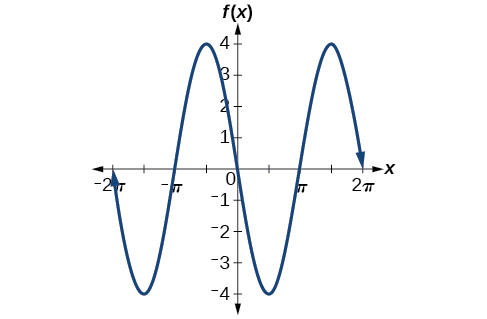
The negative value of results in a reflection across the x-axis of the sine function, as shown in Figure 10.
の値が負であることから、図10に示すとおり、正弦関数を x軸に関して折り返したものになる。
Try IT Feature #2確認問題 2
What is the amplitude of the sinusoidal function Is the function stretched or compressed vertically?
正弦曲線状の関数 の振幅はいくらか。この関数は縦に伸びているか、縮んでいるか。