第2章方程式と不等式Equations and Inequalities
2.6 Other Types of Equations2.6 その他の方程式
Learning Objectives 学習目標
In this section, you will:
この節を終えると、次のことができるようになる。
• Solve equations involving rational exponents.• Solve equations using factoring.• Solve radical equations.• Solve absolute value equations.• Solve other types of equations.
・有理数の指数を含む方程式を解く。・因数分解を使って方程式を解く。・無理方程式を解く。・絶対値の方程式を解く。・その他の方程式を解く。
We have solved linear equations, rational equations, and quadratic equations using several methods. However, there are many other types of equations, and we will investigate a few more types in this section. We will look at equations involving rational exponents, polynomial equations, radical equations, absolute value equations, equations in quadratic form, and some rational equations that can be transformed into quadratics. Solving any equation, however, employs the same basic algebraic rules. We will learn some new techniques as they apply to certain equations, but the algebra never changes.
これまで、一次方程式・分数方程式・二次方程式をいくつかの方法で解いてきた。しかし方程式の型はほかにも多くあり、この節ではさらにいくつかの型を調べる。有理数の指数を含む方程式、多項式の方程式、無理方程式、絶対値の方程式、二次の形をした方程式、そして二次に直せる分数方程式を見ていく。ただし、どんな方程式を解くにも、使う代数の基本の規則は同じである。特定の方程式に応じた新しい手つきをいくつか学ぶが、代数そのものは変わらない。
Solving Equations Involving Rational Exponents有理数の指数を含む方程式を解く
Rational exponents are exponents that are fractions, where the numerator is a power and the denominator is a root. For example, is another way of writing is another way of writing The ability to work with rational exponents is a useful skill, as it is highly applicable in calculus.
有理数の指数とは分数の指数のことで、分子が何乗するかを、分母が何乗根をとるかを表す。たとえば は の別の書き方であり、 は の別の書き方である。有理数の指数を扱えることは役に立つ技能で、微積分でも大いに使う。
We can solve equations in which a variable is raised to a rational exponent by raising both sides of the equation to the reciprocal of the exponent. The reason we raise the equation to the reciprocal of the exponent is because we want to eliminate the exponent on the variable term, and a number multiplied by its reciprocal equals 1. For example, and so on.
変数が有理数の指数に上げられている方程式は、両辺をその指数の逆数に上げれば解ける。指数の逆数に上げるのは、変数の項の指数を消したいからであり、ある数にその逆数を掛けると1になるからである。たとえば 、 などとなる。
Rational Exponents 有理数の指数
A rational exponent indicates a power in the numerator and a root in the denominator. There are multiple ways of writing an expression, a variable, or a number with a rational exponent:
有理数の指数は、分子が何乗するかを、分母が何乗根をとるかを表す。有理数の指数を持つ式・変数・数の書き方には、いくつかの形がある。
Example 1例1
Evaluating a Number Raised to a Rational Exponent有理数の指数に上げた数の値を求める
Evaluate
の値を求めよ。
Solution 解答
Whether we take the root first or the power first depends on the number. It is easy to find the cube root of 8, so rewrite as
先に根をとるか先に累乗するかは、数によって決まる。8の三乗根は求めやすいので、 を と書き直す。
Try It #1やってみよう1
Evaluate
の値を求めよ。
Example 2例2
Solve the Equation Including a Variable Raised to a Rational Exponent変数が有理数の指数に上げられた方程式を解く
Solve the equation in which a variable is raised to a rational exponent:
変数が有理数の指数に上げられた方程式 を解け。
Solution 解答
The way to remove the exponent on x is by raising both sides of the equation to a power that is the reciprocal of which is
x の指数を消すには、方程式の両辺を の逆数である 乗すればよい。
Try It #2やってみよう2
Solve the equation
方程式 を解け。
Example 3例3
Solving an Equation Involving Rational Exponents and Factoring有理数の指数と因数分解を含む方程式を解く
Solve
を解け。
Solution 解答
This equation involves rational exponents as well as factoring rational exponents. Let us take this one step at a time. First, put the variable terms on one side of the equal sign and set the equation equal to zero.
この方程式には有理数の指数が含まれ、しかも有理数の指数の因数分解も要る。一段ずつ進めよう。まず変数の項を等号の片側にまとめ、方程式を0とおく。
Now, it looks like we should factor the left side, but what do we factor out? We can always factor the term with the lowest exponent. Rewrite as Then, factor out from both terms on the left.
さて、左側を因数分解すべきだと分かるが、何をくくり出すのか。指数がいちばん低い項はいつでもくくり出せる。 を と書き直す。そのうえで左側の両方の項から をくくり出す。
Where did come from? Remember, when we multiply two numbers with the same base, we add the exponents. Therefore, if we multiply back in using the distributive property, we get the expression we had before the factoring, which is what should happen. We need an exponent such that when added to equals Thus, the exponent on x in the parentheses is
はどこから出てきたのか。底の同じ数どうしを掛けるときは指数を足したことを思い出そう。だから分配法則で を掛け戻せば、因数分解する前の式に戻る。そうならなければおかしい。 に足すと になる指数が要る。よって括弧の中の x の指数は である。
Let us continue. Now we have two factors and can use the zero factor theorem.
続けよう。因数が二つできたので、零因子の定理が使える。
The two solutions are and
二つの解は と である。
Try It #3やってみよう3
Solve:
を解け。
Solving Equations Using Factoring因数分解を使って方程式を解く
We have used factoring to solve quadratic equations, but it is a technique that we can use with many types of polynomial equations, which are equations that contain a string of terms including numerical coefficients and variables. When we are faced with an equation containing polynomials of degree higher than 2, we can often solve them by factoring.
二次方程式を解くのに因数分解を使ってきたが、これは多くの型の多項式の方程式に使える手つきである。多項式の方程式とは、数の係数と変数を含む項の並びからなる方程式のことである。次数が2より高い多項式を含む方程式に出会ったときも、因数分解で解けることが多い。
Polynomial Equations 多項式の方程式
A polynomial of degree n is an expression of the type
n 次の多項式とは、次の型の式である。
where n is a positive integer and are real numbers and
ここで n は正の整数、 は実数で、 とする。
Setting the polynomial equal to zero gives a polynomial equation. The total number of solutions (real and complex) to a polynomial equation is equal to the highest exponent n.
多項式を0とおくと多項式の方程式になる。多項式の方程式の解の総数(実数と複素数を合わせて)は、最も高い指数 n に等しい。
Example 4例4
Solving a Polynomial by Factoring多項式を因数分解して解く
Solve the polynomial by factoring:
因数分解によって多項式の方程式 を解け。
Solution 解答
First, set the equation equal to zero. Then factor out what is common to both terms, the GCF.
まず方程式を0とおく。それから両方の項に共通するもの、すなわち GCF をくくり出す。
Notice that we have the difference of squares in the factor which we will continue to factor and obtain two solutions. The first term, generates, technically, two solutions as the exponent is 2, but they are the same solution.
因数 が平方の差になっていることに注意せよ。これをさらに因数分解して解を二つ得る。最初の項 は、指数が2なので厳密には解を二つ生むが、それらは同じ解である。
The solutions are and
解は 、、 である。
Analysis 考察
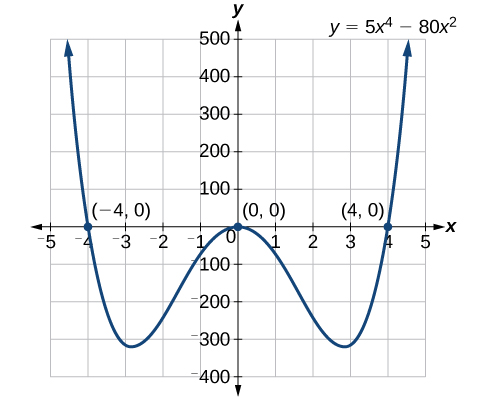
We can see the solutions on the graph in Figure 1. The x-coordinates of the points where the graph crosses the x-axis are the solutions—the x-intercepts. Notice on the graph that at the solution the graph touches the x-axis and bounces back. It does not cross the x-axis. This is typical of double solutions.
図1のグラフで解が見てとれる。グラフが x軸と交わる点の x座標が解、すなわち x切片である。グラフでは、解 のところでグラフが x軸に触れて跳ね返っていることに注意せよ。x軸を横切ってはいない。これは重解に特有の様子である。
Try It #4やってみよう4
Solve by factoring:
因数分解によって を解け。
Example 5例5
Solve a Polynomial by Grouping多項式を組み分けで解く
Solve a polynomial by grouping:
組み分けによって多項式の方程式 を解け。
Solution 解答
This polynomial consists of 4 terms, which we can solve by grouping. Grouping procedures require factoring the first two terms and then factoring the last two terms. If the factors in the parentheses are identical, we can continue the process and solve, unless more factoring is suggested.
この多項式は項が四つあるので、組み分けで解ける。組み分けの手順では、はじめの二項を因数分解し、次に後ろの二項を因数分解する。括弧の中の因数が同一なら、そのまま進めて解ける。ただし、さらに因数分解できそうならそちらを先にする。
The grouping process ends here, as we can factor using the difference of squares formula.
は平方の差の公式で因数分解できるので、組み分けの手順はここで終わる。
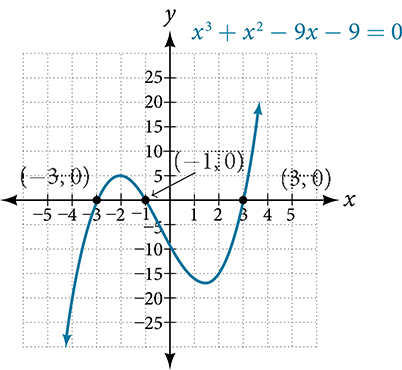
The solutions are and Note that the highest exponent is 3 and we obtained 3 solutions. We can see the solutions, the x-intercepts, on the graph in Figure 2.
解は 、、 である。最も高い指数が3で、解が三つ得られたことに注意せよ。図2のグラフで、解すなわち x切片が見てとれる。
Analysis 考察
We looked at solving quadratic equations by factoring when the leading coefficient is 1. When the leading coefficient is not 1, we solved by grouping. Grouping requires four terms, which we obtained by splitting the linear term of quadratic equations. We can also use grouping for some polynomials of degree higher than 2, as we saw here, since there were already four terms.
最高次係数が1のときの、因数分解による二次方程式の解き方を見た。最高次係数が1でないときは組み分けで解いた。組み分けには項が四つ必要で、二次方程式では一次の項を分けてそれを作った。ここで見たように、次数が2より高い多項式でも、はじめから項が四つあれば組み分けが使える。
Solving Radical Equations無理方程式を解く
Radical equations are equations that contain variables in the radicand (the expression under a radical symbol), such as
無理方程式とは、根号の中身(根号の記号の下の式)に変数を含む方程式のことである。たとえば次のようなものである。
Radical equations may have one or more radical terms, and are solved by eliminating each radical, one at a time. We have to be careful when solving radical equations, as it is not unusual to find extraneous solutions, roots that are not, in fact, solutions to the equation. These solutions are not due to a mistake in the solving method, but result from the process of raising both sides of an equation to a power. However, checking each answer in the original equation will confirm the true solutions.
無理方程式には根号の項が一つ以上あり、根号を一つずつ消していくことで解く。無理方程式を解くときは気をつけなければならない。外来解、すなわち実際にはその方程式の解でない根が出てくることが珍しくないからである。これは解き方を間違えたせいではなく、方程式の両辺を累乗するという手続きから生じる。ただし、それぞれの答えをもとの方程式に戻して確かめれば、本当の解が分かる。
Radical Equations 無理方程式
An equation containing terms with a variable in the radicand is called a radical equation.
根号の中身に変数を含む項がある方程式を、無理方程式という。
How To 手順
Given a radical equation, solve it.
無理方程式が与えられたとき、それを解く。
1. Isolate the radical expression on one side of the equal sign. Put all remaining terms on the other side.2. If the radical is a square root, then square both sides of the equation. If it is a cube root, then raise both sides of the equation to the third power. In other words, for an nth root radical, raise both sides to the nth power. Doing so eliminates the radical symbol.3. Solve the remaining equation.4. If a radical term still remains, repeat steps 1–2.5. Confirm solutions by substituting them into the original equation.
1. 等号の片側に根号の式だけを残す。残りの項はすべてもう一方の側へ移す。2. 根号が平方根なら方程式の両辺を二乗する。三乗根なら両辺を三乗する。つまり n乗根の根号なら両辺を n乗する。こうすれば根号の記号が消える。3. 残った方程式を解く。4. まだ根号の項が残っていれば、手順1〜2を繰り返す。5. 解をもとの方程式に代入して確かめる。
Example 6例6
Solving an Equation with One Radical根号が一つの方程式を解く
Solve
を解け。
Solution 解答
The radical is already isolated on the left side of the equal side, so proceed to square both sides.
根号はすでに等号の左側だけに残っているので、そのまま両辺を二乗する。
We see that the remaining equation is a quadratic. Set it equal to zero and solve.
残った方程式は二次である。0とおいて解く。
The proposed solutions are and Let us check each solution back in the original equation. First, check
出てきた解は と である。それぞれをもとの方程式に戻して確かめよう。まず を確かめる。
This is an extraneous solution. While no mistake was made solving the equation, we found a solution that does not satisfy the original equation.
これは外来解である。方程式を解く過程に間違いは無かったが、もとの方程式を満たさない解が出てきた。
Check
を確かめる。
The solution is
解は である。
Try It #5やってみよう5
Solve the radical equation:
無理方程式 を解け。
Example 7例7
Solving a Radical Equation Containing Two Radicals根号が二つある無理方程式を解く
Solve
を解け。
Solution 解答
As this equation contains two radicals, we isolate one radical, eliminate it, and then isolate the second radical.
この方程式には根号が二つあるので、まず一方の根号だけを残して消し、それから二つ目の根号だけを残す。
Use the perfect square formula to expand the right side:
完全平方の公式を使って右側を展開する。
Now that both radicals have been eliminated, set the quadratic equal to zero and solve.
これで両方の根号が消えたので、二次方程式を0とおいて解く。
The proposed solutions are and Check each solution in the original equation.
出てきた解は と である。それぞれをもとの方程式で確かめる。
One solution is
解の一つは である。
Check
を確かめる。
The only solution is We see that is an extraneous solution.
唯一の解は である。 は外来解だと分かる。
Try It #6やってみよう6
Solve the equation with two radicals:
根号が二つある方程式 を解け。
Solving an Absolute Value Equation絶対値の方程式を解く
Next, we will learn how to solve an absolute value equation. To solve an equation such as we notice that the absolute value will be equal to 8 if the quantity inside the absolute value bars is or This leads to two different equations we can solve independently.
次に、絶対値の方程式の解き方を学ぶ。 のような方程式を解くには、絶対値の縦線の中の量が または のとき絶対値が8になることに気づけばよい。ここから、別々に解ける二つの方程式が出てくる。
Knowing how to solve problems involving absolute value functions is useful. For example, we may need to identify numbers or points on a line that are at a specified distance from a given reference point.
絶対値関数を含む問題を解けることは役に立つ。たとえば、ある基準の点から決まった距離にある直線上の数や点を求めたいことがある。
Absolute Value Equations 絶対値を含む方程式
The absolute value of x is written as It has the following properties:
x の絶対値は と書く。次の性質を持つ。
For real numbers and an equation of the form with will have solutions when or If the equation has no solution.
実数 と について、 である の形の方程式は、 または のときに解を持つ。 なら、方程式 は解を持たない。
An absolute value equation in the form has the following properties:
の形の絶対値の方程式は、次の性質を持つ。
How To 手順
Given an absolute value equation, solve it.
絶対値の方程式が与えられたとき、それを解く。
1. Isolate the absolute value expression on one side of the equal sign.2. If write and solve two equations: and
1. 等号の片側に絶対値の式だけを残す。2. なら、二つの方程式 と を書いて解く。
Example 8例8
Solving Absolute Value Equations絶対値の方程式を解く
Solve the following absolute value equations:
次の絶対値の方程式を解け。
Solution 解答
ⓐ Write two equations and solve each: The two solutions are and ⓑ There is no solution as an absolute value cannot be negative.ⓒ Isolate the absolute value expression and then write two equations. There are two solutions: and ⓓ(d) The equation is set equal to zero, so we have to write only one equation. There is one solution:
ⓐ 二つの方程式を書いてそれぞれ解く。二つの解は と である。ⓑ 絶対値は負になれないので、解は無い。ⓒ 絶対値の式だけを残し、そのうえで二つの方程式を書く。 解は二つ、 と である。ⓓ(d) 方程式が0とおかれているので、書く方程式は一つでよい。 解は一つ、 である。
Try It #7やってみよう7
Solve the absolute value equation:
絶対値の方程式 を解け。
Solving Other Types of Equationsその他の方程式を解く
There are many other types of equations in addition to the ones we have discussed so far. We will see more of them throughout the text. Here, we will discuss equations that are in quadratic form, and rational equations that result in a quadratic.
これまで扱ってきたもの以外にも、方程式の型は多くある。本書の各所でさらに出てくる。ここでは、二次の形をした方程式と、二次になる分数方程式を扱う。
Solving Equations in Quadratic Form二次の形をした方程式を解く
Equations in quadratic form are equations with three terms. The first term has a power other than 2. The middle term has an exponent that is one-half the exponent of the leading term. The third term is a constant. We can solve equations in this form as if they were quadratic. A few examples of these equations include and In each one, doubling the exponent of the middle term equals the exponent on the leading term. We can solve these equations by substituting a variable for the middle term.
二次の形をした方程式とは、項が三つある方程式である。最初の項の乗数は2以外である。真ん中の項の指数は、最高次の項の指数の半分である。三つ目の項は定数である。この形の方程式は、二次であるかのように解ける。例としては や などがある。どれも、真ん中の項の指数を2倍すると最高次の項の指数に等しくなる。真ん中の項を別の変数で置き換えれば、これらの方程式を解ける。
Quadratic Form 二次式の形
If the exponent on the middle term is one-half of the exponent on the leading term, we have an equation in quadratic form, which we can solve as if it were a quadratic. We substitute a variable for the middle term to solve equations in quadratic form.
真ん中の項の指数が最高次の項の指数の半分なら、その方程式は二次の形をしており、二次であるかのように解ける。二次の形をした方程式を解くには、真ん中の項を別の変数で置き換える。
How To 手順
Given an equation quadratic in form, solve it.
二次の形をした方程式が与えられたとき、それを解く。
1. Identify the exponent on the leading term and determine whether it is double the exponent on the middle term.2. If it is, substitute a variable, such as u, for the variable portion of the middle term.3. Rewrite the equation so that it takes on the standard form of a quadratic.4. Solve using one of the usual methods for solving a quadratic.5. Replace the substitution variable with the original term.6. Solve the remaining equation.
1. 最高次の項の指数を見て、それが真ん中の項の指数の2倍かどうかを確かめる。2. そうなら、真ん中の項の変数の部分を u などの変数で置き換える。3. 方程式を、二次の標準形になるように書き直す。4. 二次方程式のいつもの解き方のどれかで解く。5. 置き換えた変数を、もとの項に戻す。6. 残った方程式を解く。
Example 9例9
Solving a Fourth-degree Equation in Quadratic Form二次の形をした四次方程式を解く
Solve this fourth-degree equation:
四次方程式 を解け。
Solution 解答
This equation fits the main criteria, that the power on the leading term is double the power on the middle term. Next, we will make a substitution for the variable term in the middle. Let Rewrite the equation in u.
この方程式は、最高次の項の乗数が真ん中の項の乗数の2倍という主な条件を満たしている。次に、真ん中の変数の項を置き換える。 とおき、方程式を u で書き直す。
Now solve the quadratic.
ここで二次方程式を解く。
Solve each factor and replace the original term for u.
各因数を解き、u をもとの項に戻す。
The solutions are and
解は と である。
Try It #8やってみよう8
Solve using substitution:
置き換えを使って を解け。
Example 10例10
Solving an Equation in Quadratic Form Containing a Binomial二項式を含む、二次の形をした方程式を解く
Solve the equation in quadratic form:
二次の形をした方程式 を解け。
Solution 解答
This equation contains a binomial in place of the single variable. The tendency is to expand what is presented. However, recognizing that it fits the criteria for being in quadratic form makes all the difference in the solving process. First, make a substitution, letting Then rewrite the equation in u.
この方程式では、一つの変数の代わりに二項式が入っている。つい展開したくなるところである。しかし、これが二次の形の条件を満たしていると見抜けるかどうかで、解き方はまるで違ってくる。まず とおいて置き換える。そのうえで方程式を u で書き直す。
Solve using the zero-factor property and then replace u with the original expression.
零因子の性質を使って解き、そのうえで u をもとの式に戻す。
The second factor results in
二つ目の因数からは次が得られる。
We have two solutions: and
解は二つ、 と である。
Try It #9やってみよう9
Solve:
を解け。
Solving Rational Equations Resulting in a Quadratic二次になる分数方程式を解く
Earlier, we solved rational equations. Sometimes, solving a rational equation results in a quadratic. When this happens, we continue the solution by simplifying the quadratic equation by one of the methods we have seen. It may turn out that there is no solution.
先に分数方程式を解いた。分数方程式を解くと二次になることがある。そうなったら、これまで見た方法のどれかで二次方程式を整理して解き進める。解が無いと分かることもある。
Example 11例11
Solving a Rational Equation Leading to a Quadratic二次になる分数方程式を解く
Solve the following rational equation:
次の分数方程式を解け。
Solution 解答
We want all denominators in factored form to find the LCD. Two of the denominators cannot be factored further. However, Then, the LCD is Next, we multiply the whole equation by the LCD.
LCD を求めるため、分母をすべて因数分解した形にしたい。二つの分母はこれ以上因数分解できない。しかし である。よって LCD は である。次に、方程式全体に LCD を掛ける。
In this case, either solution produces a zero in the denominator in the original equation. Thus, there is no solution.
この場合、どちらの解でも、もとの方程式の分母が0になってしまう。よって解は無い。
Try It #10やってみよう10
Solve
を解け。
Media 教材
Access these online resources for additional instruction and practice with different types of equations.
いろいろな型の方程式についての説明と練習をさらに求めるなら、次のオンライン教材にあたるとよい。
• Rational Equation with no Solution• Solving equations with rational exponents using reciprocal powers• Solving radical equations part 1 of 2• Solving radical equations part 2 of 2
・解の無い分数方程式・逆数の累乗を使って、有理数の指数を含む方程式を解く・無理方程式を解く 1/2・無理方程式を解く 2/2
Verbal言葉で答える問題
2. Explain why possible solutions must be checked in radical equations.
2. 無理方程式では、解の候補を必ず確かめなければならない理由を説明せよ。
4. Explain why has no solutions.
4. に解が無い理由を説明せよ。
Algebraic代数の問題
For the following exercises, solve the rational exponent equation. Use factoring where necessary.
次の各問について、有理数の指数の方程式を解け。必要なら因数分解を使え。
For the following exercises, solve the following polynomial equations by grouping and factoring.
次の各問について、組み分けと因数分解によって多項式の方程式を解け。
For the following exercises, solve the radical equation. Be sure to check all solutions to eliminate extraneous solutions.
次の各問について、無理方程式を解け。外来解を除くため、すべての解を必ず確かめよ。
For the following exercises, solve the equation involving absolute value.
次の各問について、絶対値を含む方程式を解け。
For the following exercises, solve the equation by identifying the quadratic form. Use a substitute variable and find all real solutions by factoring.
次の各問について、二次の形を見抜いて方程式を解け。置き換えの変数を使い、因数分解によって実数解をすべて求めよ。
Extensions発展問題
For the following exercises, solve for the unknown variable.
次の各問について、分からない変数について解け。
Real-World Applications応用問題
For the following exercises, use the model for the period of a pendulum, such that where the length of the pendulum is L and the acceleration due to gravity is
次の各問では、振り子の周期の式 、すなわち を使う。ここで振り子の長さは L、重力加速度は である。
46. If the acceleration due to gravity is 9.8 m/s2 and the period equals 1 s, find the length to the nearest cm (100 cm = 1 m).
46. 重力加速度が 9.8 m/s2、周期が1秒のとき、長さを1cm 単位で求めよ(100cm = 1m)。
For the following exercises, use a model for body surface area, BSA, such that where w = weight in kg and h = height in cm.
次の各問では、体表面積 BSA の式 を使う。ここで w は体重(kg)、h は身長(cm)である。
48. Find the height of a 72-kg female to the nearest cm whose
48. である体重72kg の女性の身長を、1cm 単位で求めよ。