第15章光Light原書 p.473–494
15.1 The Electromagnetic Spectrum15.1 電磁スペクトル
SECTION LEARNING OBJECTIVES By the end of this section, you will be able to do the following:
この節の学習目標 この節を終えると、次のことができるようになる。
• Define the electromagnetic spectrum, and describe it in terms of frequencies and wavelengths• Describe and explain the differences and similarities of each section of the electromagnetic spectrum and the applications of radiation from those sections
・電磁スペクトルを定義し、振動数と波長の言葉でそれを述べる・電磁スペクトルの各部分の違いと似ている点、およびそれらの部分の放射の応用を述べ、説明する
Section Key Termsこの節の重要語
electric fieldelectromagnetic radiation (EMR)magnetic fieldMaxwell’s equations
電場電磁放射(EMR)磁場マクスウェルの方程式
The Electromagnetic Spectrum電磁スペクトル
474We generally take light for granted, but it is a truly amazing and mysterious form of energy. Think about it: Light travels to Earth across millions of kilometers of empty space. When it reaches us, it interacts with matter in various ways to generate almost all the energy needed to support life, provide heat, and cause weather patterns. Light is a form of electromagnetic radiation (EMR). The term light usually refers to visible light, but this is not the only form of EMR. As we will see, visible light occupies a narrow band in a broad range of types of electromagnetic radiation.
光は身近でありながら、驚くべき性質を持つ。太陽の光は広大な真空を通って地球へ届き、物質とさまざまな形で相互作用する。そのエネルギーは生命を支え、地表を温め、天候の変化を引き起こす。光は電磁放射(EMR)の一種である。ふつう「光」と呼んでいるのは人の目で見える可視光だが、電磁放射はそれだけではない。これから学ぶように、可視光は広い電磁波の波長範囲の、ごく一部を占めている。
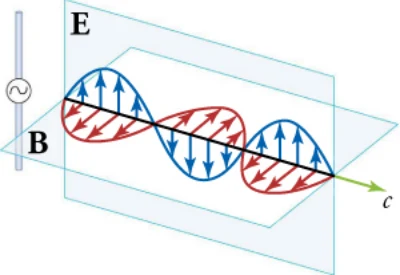
Electromagnetic radiation is generated by a moving electric charge, that is, by an electric current. As you will see when you study electricity, an electric current generates both an electric field, E, and a magnetic field, B. These fields are perpendicular to each other. When the moving charge oscillates, as in an alternating current, an EM wave is propagated. Figure 15.2 shows how an electromagnetic wave moves away from the source—indicated by the ~ symbol.
電磁放射は、動く電荷、すなわち電流によって生じる。電気を学ぶときに分かるように、電流は電場Eと磁場Bの両方を生む。この二つの場は互いに垂直である。交流のように動く電荷が振動すると、電磁波が伝わっていく。図15.2は、電磁波が源——記号~で示されている——から離れていく様子を示す。
Electromagnetic Waves and the Electromagnetic Spectrum This video, link below, is closely related to the following figure. If you have questions about EM wave properties, the EM spectrum, how waves propagate, or definitions of any of the related terms, the answers can be found in this video (http://www.openstax.org/l/28EMWaves).
電磁波と電磁スペクトル 下のリンクの動画は、次の図と密接に関わっている。電磁波の性質、電磁スペクトル、波の伝わり方、関連する語の定義について疑問があれば、この動画(http://www.openstax.org/l/28EMWaves)に答えがある。
Electromagnetic waves and the electromagnetic spectrum | Physics | Khan Academy (https://www.openstax.org/l/ 28EMWaves)
電磁波と電磁スペクトル|物理|カーンアカデミー(https://www.openstax.org/l/28EMWaves)
GRASP CHECK In an electromagnetic wave, how are the magnetic field, the electric field, and the direction of propagation oriented to each other?
理解の確認 電磁波では、磁場、電場、伝わる向きは互いにどんな向きになっているか。
a. All three are parallel to each other and are along the x-axis.b. All three are mutually perpendicular to each other.
a. 三つとも互いに平行で、x軸に沿っている。b. 三つとも互いに垂直である。
c. The electric field and magnetic fields are parallel to each other and perpendicular to the direction of propagation.d. The magnetic field and direction of propagation are parallel to each other along the y-axis and perpendicular to the electric field.
c. 電場と磁場は互いに平行で、伝わる向きに垂直である。d. 磁場と伝わる向きは互いに平行でy軸に沿い、電場に垂直である。
VIRTUAL PHYSICSシミュレーションRadio Waves and Electromagnetic Fields電波と電磁場
This simulation (https://openstax.org/l/28Radiowaves) demonstrates wave propagation. The EM wave is propagated from the broadcast tower on the left, just as in Figure 15.2. You can make the wave yourself or allow the animation to send it. When the wave reaches the antenna on the right, it causes an oscillating current. This is how radio and television signals are transmitted and received.
このシミュレーション(https://openstax.org/l/28Radiowaves)は波の伝わり方を示す。図15.2とちょうど同じように、電磁波が左の放送塔から伝わっていく。自分で波を作ることもできるし、アニメーションに送らせることもできる。波が右のアンテナに届くと、振動する電流を起こす。これがラジオやテレビの信号が送られ、受け取られるしかたである。
GRASP CHECK Where do radio waves fall on the electromagnetic spectrum?
理解の確認 電波は電磁スペクトルのどこに位置するか。
a. Radio waves have the same wavelengths as visible light.b. Radio waves fall on the high-frequency side of visible light.
a. 電波は可視光と同じ波長を持つ。b. 電波は可視光より振動数の高い側にある。
c. Radio waves fall on the short-wavelength side of visible light.d. Radio waves fall on the low-frequency side of visible light.
c. 電波は可視光より波長の短い側にある。d. 電波は可視光より振動数の低い側にある。
From your study of sound waves, recall these features that apply to all types of waves:
音波の学習から、あらゆる種類の波に当てはまる次の特徴を思い出そう。
• Wavelength—The distance between two wave crests or two wave troughs, expressed in various metric measures of distance• Frequency—The number of wave crests that pass a point per second, expressed in hertz (Hz or s–1)• Amplitude: The height of the crest above the null point
・波長——二つの波の山どうし、あるいは二つの波の谷どうしの距離。距離のさまざまなメートル法の単位で表される・振動数——1秒間にある点を通り過ぎる波の山の数。ヘルツ(Hzまたはs-1)で表される・振幅——中立の点から山までの高さ
As mentioned, electromagnetic radiation takes several forms. These forms are characterized by a range of frequencies. Because frequency is inversely proportional to wavelength, any form of EMR can also be represented by its range of wavelengths. Figure 15.3 shows the frequency and wavelength ranges of various types of EMR. With how many of these types are you familiar?
述べたとおり、電磁放射はいくつもの形をとる。これらの形は振動数の範囲で特徴づけられる。振動数は波長に反比例するので、どんな形の電磁放射も波長の範囲で表せる。図15.3にいろいろな種類の電磁放射の振動数と波長の範囲を示す。このうちいくつをあなたは知っているだろうか。
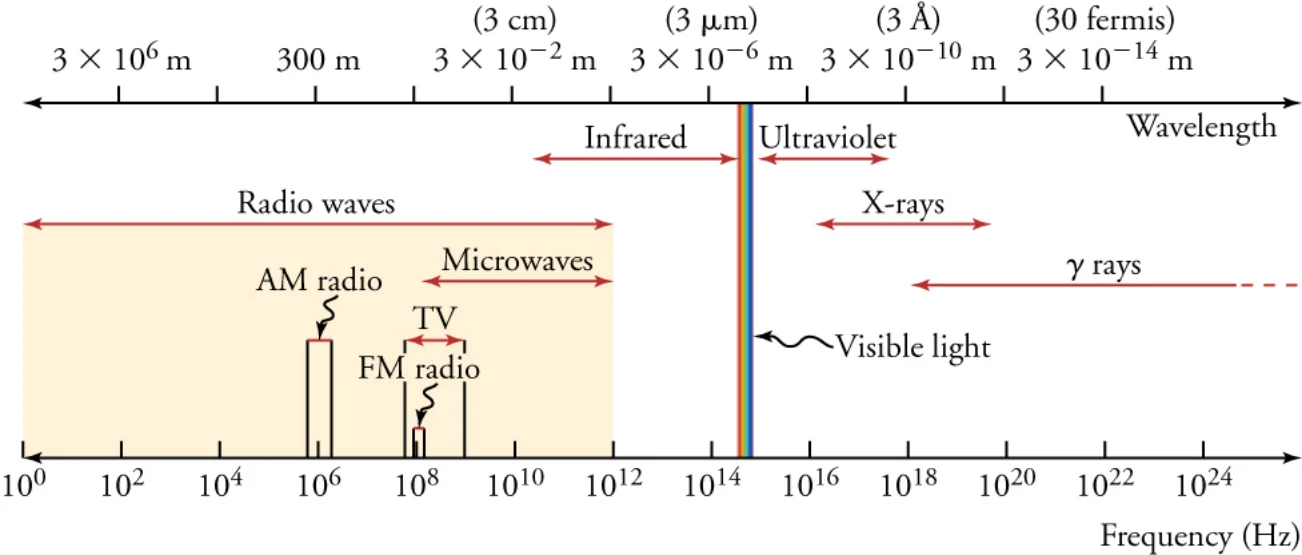
Take a few minutes to study the positions of the various types of radiation on the EM spectrum, above. The narrow band that is visible light extends from lower-frequency red light to higher-frequency violet light. Frequencies just below the visible are called infrared (below red) and those just above are ultraviolet (beyond violet). Radio waves, which overlap with the frequencies used for media broadcasts of TV and radio signals, occupy frequencies even lower than infrared (IR). The microwave radiation that you see on the diagram is the same radiation that is used in a microwave oven. What we feel as radiant heat is also a form of low-frequency EMR. The high-frequency radiation to the right of ultraviolet (UV) includes X-rays and gamma (γ) rays.
上の電磁スペクトルで、いろいろな種類の放射がどこにあるかを、少し時間をとって調べてみよう。可視光である狭い帯は、振動数の低い赤い光から振動数の高い紫の光まで広がっている。可視光のすぐ下の振動数は赤外線(赤の下)と呼ばれ、すぐ上は紫外線(紫の向こう)と呼ばれる。テレビやラジオの放送に使われる振動数と重なる電波は、赤外線(IR)よりさらに低い振動数を占めている。図にあるマイクロ波は、電子レンジで使われるのと同じ放射である。私たちが放射熱として感じるものも、低い振動数の電磁放射の一形態である。紫外線(UV)の右側の高い振動数の放射には、X線とガンマ(γ)線が含まれる。
Maxwell’s Equations The Scottish physicist James Clerk Maxwell (1831–1879) is regarded widely to have been the greatest theoretical physicist of the nineteenth century. Although he died young, Maxwell not only formulated a complete electromagnetic theory, represented by Maxwell’s equations, he also developed the kinetic theory of gases, and made significant contributions to the understanding of color vision and the nature of Saturn’s rings.
マクスウェルの方程式 スコットランドの物理学者ジェームズ・クラーク・マクスウェル(1831–1879)は、19世紀最大の理論物理学者だったと広くみなされている。若くして没したが、マクスウェルは、マクスウェルの方程式で表される完全な電磁気の理論を作り上げただけでなく、気体分子運動論も築き、色覚の理解や土星の環の性質にも大きな貢献をした。
Maxwell brought together all the work that had been done by brilliant physicists, such as Ørsted, Coulomb, Ampere, Gauss, and Faraday, and added his own insights to develop the overarching theory of electromagnetism. Maxwell’s equations are paraphrased here in words because their mathematical content is beyond the level of this text.However, the equations illustrate how apparently simple mathematical statements can elegantly unite and express a multitude of concepts—why mathematics is the language of science.
マクスウェルは、エルステッド、クーロン、アンペール、ガウス、ファラデーといった優れた物理学者たちがなしてきた仕事をすべてまとめ上げ、自らの洞察を加えて、電磁気学という包括的な理論を築いた。マクスウェルの方程式は、その数学の中身がこの本の水準を超えるので、ここでは言葉で言い換えてある。とはいえ、これらの方程式は、見かけ上単純な数式が、いかに数多くの概念を優雅に結び合わせ、表しうるかを示している——数学が科学の言葉である理由である。
Maxwell’s Equations
マクスウェルの方程式
1. Electric field lines originate on positive charges and terminate on negative charges. The electric field is defined as the force per unit charge on a test charge, and the strength of the force is related to the electric constant, ε0.2. Magnetic field lines are continuous, having no beginning or end. No magnetic monopoles are known to exist. The strength of the magnetic force is related to the magnetic constant, μ0.3. A changing magnetic field induces an electromotive force (emf) and, hence, an electric field. The direction of the emf opposes the change, changing direction of the magnetic field.4. Magnetic fields are generated by moving charges or by changing electric fields.
1. 電気力線は正の電荷から出て負の電荷で終わる。電場は試験電荷にはたらく単位電荷あたりの力と定義され、その力の強さは電気定数ε0に関係する。2. 磁力線は連続していて、始まりも終わりもない。磁気単極子は存在が知られていない。磁気の力の強さは磁気定数μ0に関係する。3. 変化する磁場は起電力(emf)を、したがって電場を誘導する。起電力の向きは変化に逆らい、磁場の向きの変化を打ち消す。4. 磁場は動く電荷、あるいは変化する電場によって生じる。
Maxwell’s complete theory shows that electric and magnetic forces are not separate, but different manifestations of the same thing—the electromagnetic force. This classical unification of forces is one motivation for current attempts to unify the four basic forces in nature—the gravitational, electromagnetic, strong nuclear, and weak nuclear forces. The weak nuclear and electromagnetic forces have been unified, and further unification with the strong nuclear force is expected; but, the unification of the gravitational force with the other three has proven to be a real head-scratcher.
マクスウェルの完全な理論は、電気の力と磁気の力が別物ではなく、同じもの——電磁気の力——の違った現れであることを示す。この古典的な力の統一は、自然界の四つの基本の力——重力、電磁気力、強い核力、弱い核力——を統一しようとする現在の試みの動機の一つである。弱い核力と電磁気力は統一され、強い核力とのさらなる統一も期待されている。しかし重力と他の三つとの統一は、本当に頭を悩ませるものであることが分かっている。
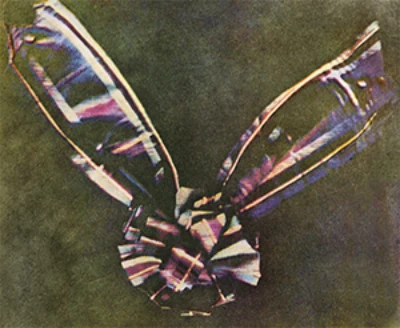
One final accomplishment of Maxwell was his development in 1855 of a process that could produce color photographic images. In 1861, he and photographer Thomas Sutton worked together on this process. The color image was achieved by projecting red, blue, and green light through black-and-white photographs of a tartan ribbon, each photo itself exposed in different-colored light. The final image was projected onto a screen (see Figure 15.4).
マクスウェルの最後の業績の一つが、1855年に、色つきの写真像を作れる方法を編み出したことである。1861年、彼は写真家トマス・サットンとともにこの方法に取り組んだ。色つきの像は、タータンのリボンを撮った白黒写真——それぞれ違う色の光で露光したもの——に赤・青・緑の光を投影して得られた。最後の像はスクリーンに映し出された(図15.4を見よ)。
Describe electromagnetic force as explained by Maxwell’s equations.
マクスウェルの方程式が説明する電磁気の力について述べよ。
a. According to Maxwell’s equations, electromagnetic force gives rise to electric force and magnetic force.b. According to Maxwell’s equations, electric force and magnetic force are different manifestations of electromagnetic force.c. According to Maxwell’s equations, electric force is the cause of electromagnetic force.d. According to Maxwell’s equations, magnetic force is the cause of electromagnetic force.
a. マクスウェルの方程式によれば、電磁気の力が電気の力と磁気の力を生む。b. マクスウェルの方程式によれば、電気の力と磁気の力は電磁気の力の違った現れである。c. マクスウェルの方程式によれば、電気の力が電磁気の力の原因である。d. マクスウェルの方程式によれば、磁気の力が電磁気の力の原因である。
Characteristics of Electromagnetic Radiation電磁放射の特徴
477All the EM waves mentioned above are basically the same form of radiation. They can all travel across empty space, and they all travel at the speed of light in a vacuum. The basic difference between types of radiation is their differing frequencies. Each frequency has an associated wavelength. As frequency increases across the spectrum, wavelength decreases. Energy also increases with frequency. Because of this, higher frequencies penetrate matter more readily. Some of the properties and uses of the various EM spectrum bands are listed in Table 15.1.
上に挙げた電磁波はすべて、基本的には同じ形の放射である。どれも何もない空間を進めるし、どれも真空中では光の速さで進む。種類による基本的な違いは振動数の違いである。それぞれの振動数には波長が結びついている。スペクトルを横切って振動数が上がるにつれ、波長は短くなる。エネルギーも振動数とともに増える。このため、振動数の高いものほど物質をより深く通り抜ける。電磁スペクトルの各帯の性質と用途のいくつかを表15.1に挙げる。
The narrow band of visible light is a combination of the colors of the rainbow. Figure 15.5 shows the section of the EM spectrum that includes visible light. The frequencies corresponding to these wavelengths are at the red end to at the violet end. This is a very narrow range, considering that the EM spectrum spans about 20 orders of magnitude.
可視光の狭い帯は虹の色の組み合わせである。図15.5に、可視光を含む電磁スペクトルの部分を示す。これらの波長に対応する振動数は、赤の端で、紫の端でである。電磁スペクトルがおよそ20桁にわたることを考えれば、これはとても狭い範囲である。
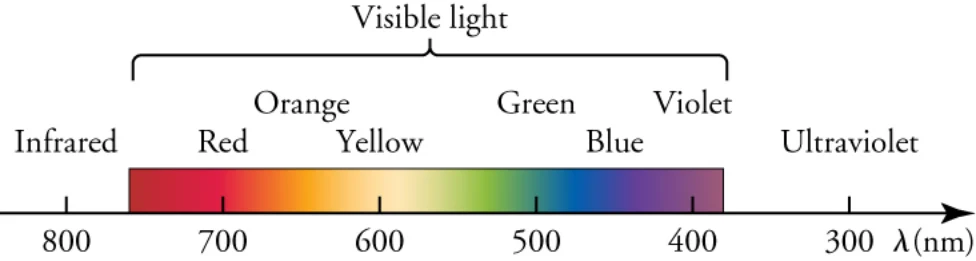
TIPS FOR SUCCESS Wavelengths of visible light are often given in nanometers, nm. One nm equals m. For example, yellow light has a wavelength of about 600 nm, or m.
学習のポイント 可視光の波長はしばしばナノメートル(nm)で示される。1 nmは mに等しい。たとえば黄色の光は波長がおよそ600 nm、すなわち mである。
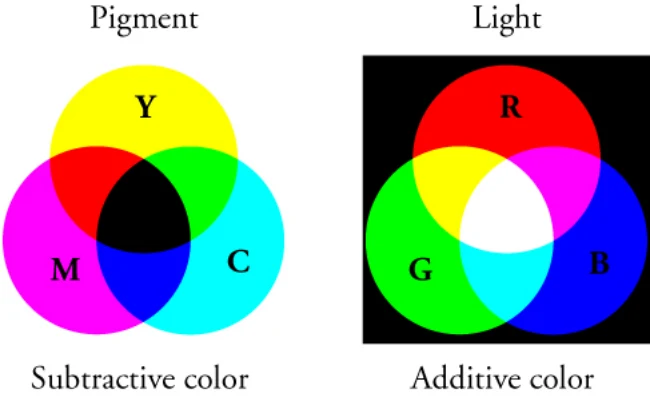
As a child, you probably learned the color wheel, shown on the left in Figure 15.6. It helps if you know what color results when you mix different colors of paint together. Mixing two of the primary pigment colors—magenta, yellow, or cyan—together results in a secondary color. For example, mixing cyan and yellow makes green. This is called subtractive color mixing. Mixing different colors of light together is quite different. The diagram on the right shows additive color mixing. In this case, the primary colors are red, green, and blue, and the secondary colors are cyan,
子どものころ、図15.6の左に示す色相環を習ったことがあるだろう。違う色の絵の具を混ぜたときに何色になるかを知っていると役に立つ。原色の顔料——マゼンタ、黄、シアン——のうち二つを混ぜると二次色になる。たとえばシアンと黄を混ぜると緑になる。これを減法混色という。違う色の光を混ぜるのはこれとはまるで違う。右の図は加法混色を示す。この場合、原色は赤・緑・青で、二次色はシアン・
magenta, and yellow. Mixing pigments and mixing light are different because materials absorb light by a different set of rules than does the perception of light by the eye. Notice that, when all colors are subtracted, the result is no color, or black. When all colors are added, the result is white light. We see the reverse of this when white sunlight is separated into the visible spectrum by a prism or by raindrops when a rainbow appears in the sky.
マゼンタ・黄である。顔料を混ぜるのと光を混ぜるのが違うのは、物質が光を吸収する規則と、目が光を感じ取る規則が違うからである。すべての色を引くと色なし、すなわち黒になることに注意しよう。すべての色を足すと白色光になる。プリズムで、あるいは空に虹が現れるときの雨粒で、白い日光が可視スペクトルに分けられるとき、私たちはこの逆を見ている。
VIRTUAL PHYSICSシミュレーションColor Vision色覚
Access multimedia content (http://openstax.org/books/physics/pages/15-1-the-electromagnetic-spectrum) This video demonstrates additive color and color filters. Try all the settings except Photons.
マルチメディア教材はこちら(http://openstax.org/books/physics/pages/15-1-the-electromagnetic-spectrum) この動画は加法混色と色フィルターを示す。「光子」以外のすべての設定を試してみよう。
PhET Explorations: Color Vision. Make a whole rainbow by mixing red, green, and blue light. Change the wavelength of a monochromatic beam or filter white light. View the light as a solid beam, or see the individual photons.Access multimedia content (http://openstax.org/books/physics/pages/15-1-the-electromagnetic-spectrum) Ordinary white light is a combination of all colors of visible light. How would a blue absorption filter placed in front of a white light source affect the light you observe?
PhET探究:色覚。赤・緑・青の光を混ぜて虹をまるごと作ろう。単色の光線の波長を変えたり、白色光をフィルターにかけたりしよう。光を一本の光束として見ることも、個々の光子を見ることもできる。マルチメディア教材はこちら(http://openstax.org/books/physics/pages/15-1-the-electromagnetic-spectrum) ふつうの白色光は可視光のすべての色の組み合わせである。白色光源の前に青の吸収フィルターを置いたら、見える光はどうなるか。
a. A blue filter absorbs blue light, causing the observed light to be a combination of the other colors.b. A blue filter absorbs the opposite color of light—orange, causing the observed light to be blue.
a. 青のフィルターは青い光を吸収するので、見える光は他の色の組み合わせになる。b. 青のフィルターは反対の色であるオレンジの光を吸収するので、見える光は青になる。
c. A blue filter permits only blue light to pass though, absorbing the other colors and leaving blue light for the observer.d. A blue filter permits only the opposite color light—orange—to pass through, leaving orange light for the observer.
c. 青のフィルターは青い光だけを通し、他の色を吸収するので、観測者には青い光が残る。d. 青のフィルターは反対の色であるオレンジの光だけを通すので、観測者にはオレンジの光が残る。
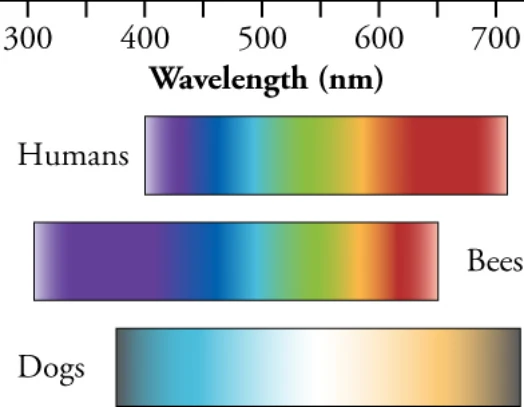
Animal Color Perception The physics of color perception has interesting links to zoology. Other animals have very different views of the world than humans, especially with respect to which colors can be seen. Color is detected by cells in the eye called cones. Humans have three cones that are sensitive to three different ranges of electromagnetic wavelengths. They are called red, blue, and green cones, although these colors do not correspond exactly to the centers of the three ranges. The ranges of wavelengths that each cone detects are red, 500 to 700 nm; green, 450 to 630 nm; and blue, 400 to 500 nm.
動物の色の感じ方 色の感じ方の物理は、動物学と興味深いつながりを持つ。他の動物は、とくにどの色が見えるかという点で、人間とはずいぶん違った世界を見ている。色は、目の中の錐体と呼ばれる細胞が感じ取る。人間には、電磁波の三つの違う波長の範囲に敏感な三種類の錐体がある。これらは赤・青・緑の錐体と呼ばれるが、これらの色は三つの範囲の中心とぴったり対応しているわけではない。それぞれの錐体が感じ取る波長の範囲は、赤が500から700 nm、緑が450から630 nm、青が400から500 nmである。
Most primates also have three kinds of cones and see the world much as we do. Most mammals other than primates only have two cones and have a less colorful view of things. Dogs, for example see blue and yellow, but are color blind to red and green. You might think that simpler species, such as fish and insects, would have less sophisticated vision, but this is not the case. Many birds, reptiles, amphibians, and insects have four or five different cones in their eyes. These species don’t have a wider range of perceived colors, but they see more hues, or combinations of colors.
たいていの霊長類も三種類の錐体を持ち、私たちとよく似た世界を見ている。霊長類以外のたいていの哺乳類は錐体を二つしか持たず、色の乏しい見え方をする。たとえばイヌは青と黄が見えるが、赤と緑には色盲である。魚や昆虫のようなより単純な種は視覚も単純だろうと思うかもしれないが、そうではない。多くの鳥、爬虫類、両生類、昆虫は、目の中に四つか五つの違う錐体を持つ。これらの種は感じ取れる色の範囲が広いわけではないが、より多くの色合い、すなわち色の組み合わせを見分けている。
Also, some animals, such as bees or rattlesnakes, see a range of colors that is as broad as ours, but shifted into the ultraviolet or infrared.
また、ハチやガラガラヘビのように、私たちと同じくらい広い範囲の色を見るが、その範囲が紫外や赤外のほうへずれている動物もいる。
These differences in color perception are generally adaptations that help the animals survive. Colorful tropical birds and fish display some colors that are too subtle for us to see. These colors are believed to play a role in the species mating rituals. Figure 15.7 shows the colors visible and the color range of vision in humans, bees, and dogs.
こうした色の感じ方の違いは、たいてい動物が生き延びるのを助ける適応である。色彩豊かな熱帯の鳥や魚は、私たちには微妙すぎて見えない色をいくつか見せている。これらの色は、その種の求愛の儀式で役割を果たしていると考えられている。図15.7に、人・ハチ・イヌで見える色と色覚の範囲を示す。
GRASP CHECK The belief that bulls are enraged by seeing the color red is a misconception. What did you read in this Links to Physics that shows why this belief is incorrect?
理解の確認 雄牛が赤い色を見て怒り狂うという信念は誤解である。この「物理へのつながり」で読んだことのうち、この信念が正しくないことを示すのはどれか。
a. Bulls are color-blind to every color in the spectrum of colors.b. Bulls are color-blind to the blue colors in the spectrum of colors.
a. 雄牛は色のスペクトルのすべての色に色盲である。b. 雄牛は色のスペクトルの青い色に色盲である。
c. Bulls are color-blind to the red colors in the spectrum of colors.d. Bulls are color-blind to the green colors in the spectrum of colors.
c. 雄牛は色のスペクトルの赤い色に色盲である。d. 雄牛は色のスペクトルの緑の色に色盲である。
Humans have found uses for every part of the electromagnetic spectrum. We will take a look at the uses of each range of frequencies, beginning with visible light. Most of our uses of visible light are obvious; without it our interaction with our surroundings would be much different. We might forget that nearly all of our food depends on the photosynthesis process in plants, and that the energy for this process comes from the visible part of the spectrum. Without photosynthesis, we would also have almost no oxygen in the atmosphere.
人間は電磁スペクトルのあらゆる部分に使い道を見つけてきた。可視光から始めて、それぞれの振動数の範囲の用途を見ていこう。可視光の用途のほとんどは明らかである。それがなければ、私たちと周囲との関わりはまるで違ったものになるだろう。私たちの食べ物のほとんどすべてが植物の光合成の過程に依存しており、その過程のエネルギーがスペクトルの可視の部分から来ていることは、忘れられがちである。光合成がなければ、大気中に酸素もほとんどないだろう。
The low-frequency, infrared region of the spectrum has many applications in media broadcasting. Television, radio, cell phone, and remote-control devices all broadcast and/or receive signals with these wavelengths. AM and FM radio signals are both low-frequency radiation. They are in different regions of the spectrum, but that is not their basic difference. AM and FM are abbreviations for amplitude modulation and frequency modulation. Information in AM signals has the form of changes in amplitude of the radio waves; information in FM signals has the form of changes in wave frequency.
スペクトルの低い振動数の赤外の領域には、放送での応用が多い。テレビ、ラジオ、携帯電話、リモコンは、いずれもこれらの波長で信号を送り、また受け取る。AMとFMのラジオの信号は、どちらも低い振動数の放射である。スペクトルの違う領域にあるが、それが両者の基本的な違いではない。AMとFMは振幅変調と周波数変調の略である。AMの信号では情報は電波の振幅の変化という形をとり、FMの信号では情報は波の振動数の変化という形をとる。
Another application of long-wavelength radiation is found in microwave ovens. These appliances cook or warm food by irradiating it with EM radiation in the microwave frequency range. Most kitchen microwaves use a frequency of
波長の長い放射のもう一つの応用が電子レンジである。この器具は、マイクロ波の振動数の範囲の電磁放射を食品にあてて、加熱したり温めたりする。台所のたいていの電子レンジは
Hz. These waves have the right amount of energy to cause polar molecules, such as water, to rotate faster. Polar molecules are those that have a partial charge separation. The rotational energy of these molecules is given up to surrounding matter as heat. The first microwave ovens were called Radaranges because they were based on radar technology developed during World War II.
Hzの振動数を使う。この波は、水のような極性分子をより速く回転させるのにちょうどよい量のエネルギーを持つ。極性分子とは、電荷の偏りが部分的にある分子である。これらの分子の回転のエネルギーが熱として周りの物質へ渡される。最初の電子レンジは、第二次世界大戦中に開発されたレーダーの技術にもとづいていたので、レーダーレンジと呼ばれた。
Radar uses radiation with wavelengths similar to those of microwaves to detect the location and speed of distant objects, such as airplanes, weather formations, and motor vehicles. Radar information is obtained by receiving and analyzing the echoes of microwaves reflected by an object. The speed of the object can be measured using the Doppler shift of the returning waves. This is the same effect you learned about when you studied sound waves. Like sound waves, EM waves are shifted to higher frequencies by an object moving toward an observer, and to lower frequencies by an object moving away from the observer. Astronomers use this same Doppler effect to measure the speed at which distant galaxies are moving away from us. In this case, the shift in frequency is called the red shift,
レーダーは、マイクロ波に近い波長の放射を使って、航空機・気象の形成・自動車といった遠くの物の位置と速さを検出する。レーダーの情報は、物に反射されたマイクロ波のこだまを受け取って解析することで得られる。物の速さは、返ってきた波のドップラーずれを使って測れる。これは音波を学んだときに知ったのと同じ効果である。音波と同じく、電磁波も、観測者へ向かって動く物によって高い振動数へずれ、遠ざかる物によって低い振動数へずれる。天文学者は、遠くの銀河が私たちから遠ざかる速さを測るのに、この同じドップラー効果を使う。この場合、振動数のずれは赤方偏移と呼ばれる。
because visible frequencies are shifted toward the lower-frequency, red end of the spectrum.
可視の振動数がスペクトルの振動数の低い赤い端のほうへずれるからである。
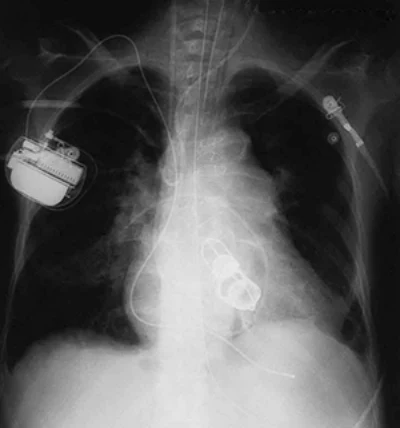
Exposure to any radiation with frequencies greater than those of visible light carries some health hazards. All types of radiation in this range are known to cause cell damage. The danger is related to the high energy and penetrating ability of these EM waves. The likelihood of being harmed by any of this radiation depends largely on the amount of exposure. Most people try to reduce exposure to UV radiation from sunlight by using sunscreen and protective clothing. Physicians still use X-rays to diagnose medical problems, but the intensity of the radiation used is extremely low. Figure 15.8 shows an X-ray image of a patient’s chest cavity.
可視光より振動数の高いどんな放射にさらされることにも、いくらかの健康上の危険がともなう。この範囲のどの型の放射も細胞に損傷を与えることが知られている。この危険は、これらの電磁波の高いエネルギーと、物を通り抜ける力に関係する。この放射で害を受ける見込みは、主にさらされる量による。たいていの人は、日焼け止めや衣服で日光の紫外線にさらされるのを減らそうとしている。医師は今も医学的な問題を診断するのにX線を使うが、使う放射の強さはきわめて低い。図15.8に患者の胸腔のX線写真を示す。
One medical-imaging technique that involves no danger of exposure is magnetic resonance imaging (MRI). MRI is an important imaging and research tool in medicine, producing highly detailed two- and three-dimensional images. Radio waves are broadcast, absorbed, and reemitted in a resonance process that is sensitive to the density of nuclei, usually hydrogen nuclei—protons.
さらされる危険がまったくない医用画像の技術の一つが、磁気共鳴画像法(MRI)である。MRIは医学で重要な画像化と研究の道具であり、きわめて詳しい二次元・三次元の像を作る。電波が放たれ、吸収され、また放出される共鳴の過程が使われ、それは原子核——ふつうは水素の原子核、すなわち陽子——の密度に敏感である。
Check Your Understanding理解の確認
1Identify the fields produced by a moving charged particle.a. Both an electric field and a magnetic field will be produced.b. Neither a magnetic field nor an electric field will be produced.c. A magnetic field, but no electric field will be produced.d. Only the electric field, but no magnetic field will be produced.
1動く荷電粒子が生む場を挙げよ。a. 電場と磁場の両方が生じる。b. 磁場も電場も生じない。c. 磁場は生じるが電場は生じない。d. 電場だけが生じ、磁場は生じない。
2X-rays carry more energy than visible light. Compare the frequencies and wavelengths of these two types of EM radiation.
2X線は可視光より大きなエネルギーを運ぶ。この二つの型の電磁放射の振動数と波長を比べよ。
a. Visible light has higher frequencies and shorter wavelengths than X-rays.b. Visible light has lower frequencies and shorter wavelengths than X-rays.c. Visible light has higher frequencies and longer wavelengths than X-rays.d. Visible light has lower frequencies and longer wavelengths than X-rays.
a. 可視光はX線より振動数が高く波長が短い。b. 可視光はX線より振動数が低く波長が短い。c. 可視光はX線より振動数が高く波長が長い。d. 可視光はX線より振動数が低く波長が長い。
3How does wavelength change as frequency increases across the EM spectrum?a. The wavelength increases.b. The wavelength first increases and then decreases.
3電磁スペクトルを横切って振動数が上がるにつれ、波長はどう変わるか。a. 波長は長くなる。b. 波長はまず長くなり、それから短くなる。
c. The wavelength first decreases and then increases.d. The wavelength decreases.
c. 波長はまず短くなり、それから長くなる。d. 波長は短くなる。
4Why are X-rays used in imaging of broken bones, rather than radio waves?a. X-rays have higher penetrating energy than radio waves.b. X-rays have lower penetrating energy than radio waves.
4折れた骨を写すのに、電波ではなくX線が使われるのはなぜか。a. X線は電波より物を通り抜けるエネルギーが大きいから。b. X線は電波より物を通り抜けるエネルギーが小さいから。
c. X-rays have a lower frequency range than radio waves.d. X-rays have longer wavelengths than radio waves.
c. X線は電波より振動数の範囲が低いから。d. X線は電波より波長が長いから。
5Identify the fields that make up an electromagnetic wave.a. both an electric field and a magnetic fieldb. neither a magnetic field nor an electric field
5電磁波を作っている場を挙げよ。a. 電場と磁場の両方b. 磁場も電場も含まない
c. only a magnetic field, but no electric fieldd. only an electric field, but no magnetic field
c. 磁場だけで電場は含まないd. 電場だけで磁場は含まない