第15章光Light原書 p.473–494
15.2 The Behavior of Electromagnetic Radiation15.2 電磁放射のふるまい
SECTION LEARNING OBJECTIVES By the end of this section, you will be able to do the following:
この節の学習目標 この節を終えると、次のことができるようになる。
• Describe the behavior of electromagnetic radiation• Solve quantitative problems involving the behavior of electromagnetic radiation
・電磁放射のふるまいを述べる・電磁放射のふるまいに関する量的な問題を解く
Section Key Termsこの節の重要語
illuminanceinterferencelumensluminous fluxluxpolarized light
照度干渉ルーメン光束ルクス偏光
Types of Electromagnetic Wave Behavior電磁波のふるまいの型
In a vacuum, all electromagnetic radiation travels at the same incredible speed of 3.00 × 10⁸ m/s, which is equal to 671 million miles per hour. This is one of the fundamental physical constants. It is referred to as the speed of light and is given the symbol c. The space between celestial bodies is a near vacuum, so the light we see from the Sun, stars, and other planets has traveled here at the speed of light. Keep in mind that all EM radiation travels at this speed. All the different wavelengths of radiation that leave the Sun make the trip to Earth in the same amount of time. That trip takes 8.3 minutes. Light from the nearest star, besides the Sun, takes 4.2 years to reach Earth, and light from the nearest galaxy—a dwarf galaxy that orbits the Milky Way—travels 25,000 years on its way to Earth. You can see why we call very long distances astronomical.
真空中では、あらゆる電磁放射が3.00 × 10⁸ m/sという同じとてつもない速さで進む。これは時速6億7100万マイルに等しい。これは基本的な物理定数の一つである。光の速さと呼ばれ、記号cが与えられている。天体どうしの間の空間はほぼ真空なので、太陽・恒星・他の惑星から私たちが見る光は、光の速さでここまで進んできたことになる。あらゆる電磁放射がこの速さで進むことを覚えておこう。太陽を出るあらゆる波長の放射が、同じ時間で地球への旅を終える。その旅は8.3分かかる。太陽以外で最も近い恒星からの光は地球に届くのに4.2年かかり、最も近い銀河——天の川を回る矮小銀河——からの光は、地球へ来る途中で25,000年を旅する。とても長い距離を天文学的と呼ぶ理由が分かるだろう。
When light travels through a physical medium, its speed is always less than the speed of light. For example, light travels in water at three-fourths the value of c. In air, light has a speed that is just slightly slower than in empty space: 99.97 percent of c. Diamond slows light down to just 41 percent of c. When light changes speeds at a boundary between media, it also changes direction. The greater the difference in speeds, the more the path of light bends. In other chapters, we look at this bending, called refraction, in greater detail. We introduce refraction here to help explain a phenomenon called thin-film interference.
光が物質の媒質の中を進むとき、その速さはつねに光の速さより小さい。たとえば光は水の中をcの4分の3の値で進む。空気中では、光の速さは何もない空間よりごくわずかに遅く、cの99.97パーセントである。ダイヤモンドは光をcのわずか41パーセントまで遅くする。光が媒質どうしの境目で速さを変えるとき、向きも変える。速さの差が大きいほど、光の進路はより大きく曲がる。他の章で、屈折と呼ばれるこの曲がりをより詳しく見る。ここで屈折を導くのは、薄膜干渉と呼ばれる現象を説明する助けにするためである。
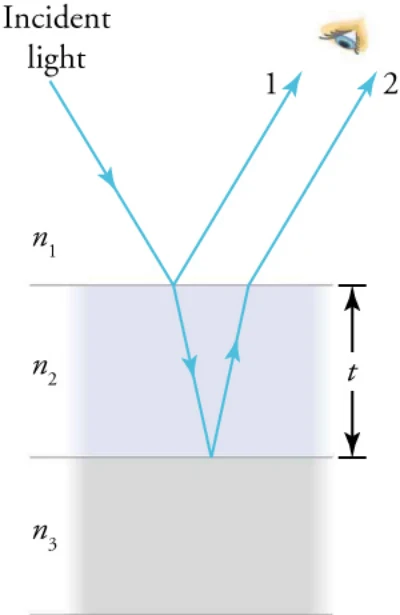
Have you ever wondered about the rainbow colors you often see on soap bubbles, oil slicks, and compact discs? This occurs when light is both refracted by and reflected from a very thin film. The diagram shows the path of light through such a thin film. The symbols n1, n2, and n3 indicate that light travels at different speeds in each of the three materials. Learn more about this topic in the chapter on diffraction and interference.
シャボン玉、油膜、コンパクトディスクによく見える虹の色を不思議に思ったことはないだろうか。これは、光がとても薄い膜で屈折し、また反射されるときに起こる。図はそのような薄膜を通る光の道筋を示す。記号n1、n2、n3は、三つの物質それぞれで光が違う速さで進むことを表す。この話題については回折と干渉の章でさらに学ぶ。
Figure 15.9 shows the result of thin film interference on the surface of soap bubbles. Because ray 2 travels a greater distance, the two rays become out of phase. That is, the crests of the two emerging waves are no longer moving together. This causes interference, which reinforces the intensity of the wavelengths of light that create the bands of color. The color bands are separated because each color has a different wavelength. Also, the thickness of the film is not uniform, and different thicknesses cause colors of different wavelengths to interfere in different places. Note that the film must be very, very thin—somewhere in the vicinity of the wavelengths of visible light.
図15.9はシャボン玉の表面での薄膜干渉の結果を示す。光線2のほうが長い距離を進むので、二つの光線は位相がずれる。すなわち、出てきた二つの波の山はもう一緒には動いていない。これが干渉を起こし、色の帯を作る波長の光の強さを強める。それぞれの色は波長が違うので、色の帯は分かれる。また、膜の厚さは一様ではなく、厚さが違えば違う波長の色が違う場所で干渉する。膜がとてもとても薄く——可視光の波長のあたりで——なければならないことに注意しよう。
You have probably experienced how polarized sunglasses reduce glare from the surface of water or snow. The effect is caused by the wave nature of light. Looking back at Figure 15.2, we see that the electric field moves in only one direction perpendicular to the direction of propagation. Light from most sources vibrates in all directions perpendicular to propagation. Light with an electric field that vibrates in only one direction is called polarized. A diagram of polarized light would look like Figure 15.2.
偏光サングラスが水面や雪面からのぎらつきを減らすのを経験したことがあるだろう。この効果は光の波としての性質による。図15.2に戻ると、電場が伝わる向きに垂直な一つの向きにだけ動いているのが分かる。たいていの光源からの光は、伝わる向きに垂直なあらゆる向きに振動している。電場が一つの向きにだけ振動する光を偏光という。偏光の図は図15.2のようになる。
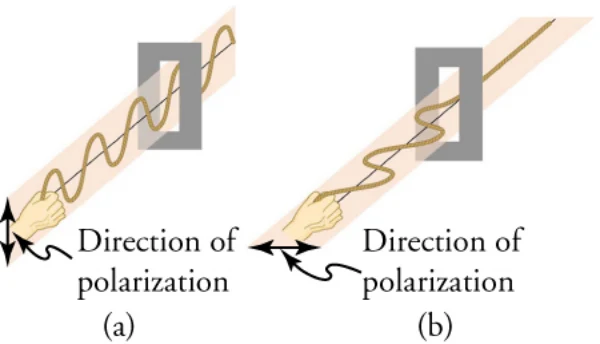
Polarized glasses are an example of a polarizing filter. These glasses absorb most of the horizontal light waves and transmit the vertical waves. This cuts down glare, which is caused by horizontal waves. Figure 15.10 shows how waves traveling along a rope can be used as a model of how a polarizing filter works. The oscillations in one rope are in a vertical plane and are said to be vertically polarized. Those in the other rope are in a horizontal plane and are horizontally polarized. If a vertical slit is placed on the first rope, the waves pass through. However, a vertical slit blocks the horizontally polarized waves. For EM waves, the direction of the electric field oscillation is analogous to the disturbances on the ropes.
偏光眼鏡は偏光フィルターの例である。この眼鏡は水平な光の波の大半を吸収し、鉛直な波を通す。これが、水平な波によって生じるぎらつきを減らす。図15.10は、ロープを伝わる波を使って偏光フィルターの働きをどう模せるかを示す。一方のロープの振動は鉛直な面内にあり、鉛直に偏っているという。もう一方のロープの振動は水平な面内にあり、水平に偏っている。一つ目のロープに鉛直なすきまを置けば、波は通り抜ける。しかし鉛直なすきまは水平に偏った波を遮る。電磁波では、電場の振動の向きがロープの乱れにあたる。
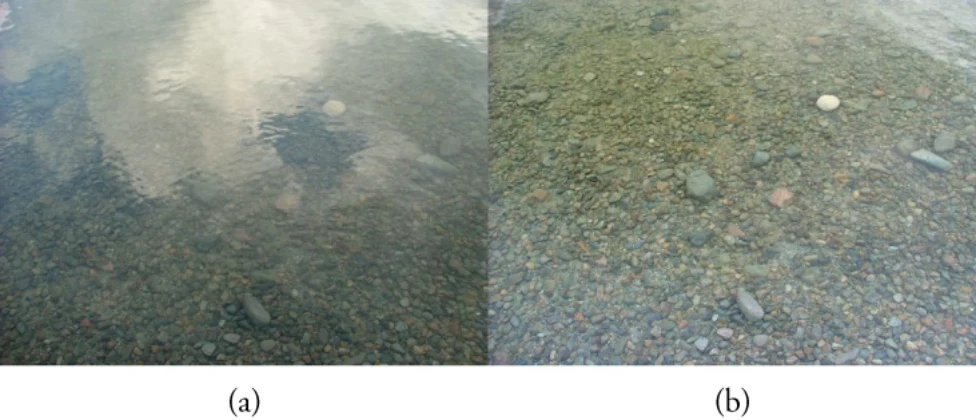
Light can also be polarized by reflection. Most of the light reflected from water, glass, or any highly reflective surface is polarized horizontally. Figure 15.11 shows the effect of a polarizing lens on light reflected from the surface of water.
光は反射によっても偏らせられる。水・ガラス・その他よく反射する面から反射された光の大半は、水平に偏っている。図15.11に、水面から反射された光に偏光レンズが及ぼす効果を示す。
Polarization of Light, Linear and Circular This video explains the polarization of light in great detail. Before viewing the video, look back at the drawing of an electromagnetic wave from the previous section. Try to visualize the two-dimensional drawing in three dimensions.
光の偏り、直線と円 この動画は光の偏りをかなり詳しく説明する。動画を見る前に、前の節の電磁波の図を見返しておこう。二次元の図を三次元で思い描いてみよう。
Polarization of light, linear and circular | Light waves | Physics | Khan Academy (https://www.openstax.org/l/ 28Polarization)
光の偏り、直線と円|光の波|物理|カーンアカデミー(https://www.openstax.org/l/28Polarization)
GRASP CHECK How do polarized glasses reduce glare reflected from the ocean?
理解の確認 偏光眼鏡は、海から反射したぎらつきをどうやって減らすか。
a. They block horizontally polarized and vertically polarized light.b. They are transparent to horizontally polarized and vertically polarized light.
a. 水平に偏った光も鉛直に偏った光も遮る。b. 水平に偏った光にも鉛直に偏った光にも透明である。
c. They block horizontally polarized rays and are transparent to vertically polarized rays.d. They are transparent to horizontally polarized light and block vertically polarized light.
c. 水平に偏った光線を遮り、鉛直に偏った光線には透明である。d. 水平に偏った光には透明で、鉛直に偏った光を遮る。
SNAP LAB身近な実験Polarized Glasses偏光眼鏡
EYE SAFETY—Looking at the Sun directly can cause permanent eye damage. Avoid looking directly at the Sun.
目の安全——太陽を直接見ると目に永久の損傷を与えうる。太陽を直接見ないこと。
• two pairs of polarized sunglasses OR• two lenses from one pair of polarized sunglasses
・偏光サングラス2本、または・偏光サングラス1本からのレンズ2枚
Procedure手順
1. Look through both or either polarized lens and record your observations.2. Hold the lenses, one in front of the other. Hold one lens stationary while you slowly rotate the other lens. Record your observations, including the relative angles of the lenses when you make each observation.3. Find a reflective surface on which the Sun is shining. It could be water, glass, a mirror, or any other similar smooth surface. The results will be more dramatic if the sunlight strikes the surface at a sharp angle.4. Observe the appearance of the surface with your naked eye and through one of the polarized lenses.5. Observe any changes as you slowly rotate the lens, and note the angles at which you see changes.
1. 両方あるいはどちらかの偏光レンズを通して見て、観察したことを記録する。2. レンズを一枚ずつ前後に重ねて持つ。一方を止めたまま、もう一方をゆっくり回す。観察したことを、そのときの二枚のレンズの相対的な角度とともに記録する。3. 日が当たっている反射する面を見つける。水・ガラス・鏡など、なめらかな面ならよい。日光が面に浅い角度であたっていれば結果はより劇的になる。4. その面の見え方を、裸眼と偏光レンズ越しの両方で観察する。5. レンズをゆっくり回しながら変化を観察し、変化が見える角度を記録する。
GRASP CHECK If you buy sunglasses in a store, how can you be sure that they are polarized?
理解の確認 店でサングラスを買うとき、それが偏光だとどうやって確かめられるか。
a. When one pair of sunglasses is placed in front of another and rotated in the plane of the body, the light passing through the sunglasses will be blocked at two positions due to refraction of light.b. When one pair of sunglasses is placed in front of another and rotated in the plane of the body, the light passing through the sunglasses will be blocked at two positions due to reflection of light.c. When one pair of sunglasses is placed in front of another and rotated in the plane of the body, the light passing through the sunglasses will be blocked at two positions due to the polarization of light.d. When one pair of sunglasses is placed in front of another and rotated in the plane of the body, the light passing through the sunglasses will be blocked at two positions due to the bending of light waves.
a. サングラス一本をもう一本の前に置いて、体の面内で回すと、光の屈折によって、サングラスを通る光が二つの位置で遮られる。b. サングラス一本をもう一本の前に置いて、体の面内で回すと、光の反射によって、サングラスを通る光が二つの位置で遮られる。c. サングラス一本をもう一本の前に置いて、体の面内で回すと、光の偏りによって、サングラスを通る光が二つの位置で遮られる。d. サングラス一本をもう一本の前に置いて、体の面内で回すと、光の波の曲がりによって、サングラスを通る光が二つの位置で遮られる。
Quantitative Treatment of Electromagnetic Waves電磁波の量的な扱い
We can use the speed of light, c, to carry out several simple but interesting calculations. If we know the distance to a celestial object, we can calculate how long it takes its light to reach us. Of course, we can also make the reverse calculation if we know the time it takes for the light to travel to us. For an object at a very great distance from Earth, it takes many years for its light to reach us. This means that we are looking at the object as it existed in the distant past. The object may, in fact, no longer exist. Very large distances in the universe are measured in light years. One light year is the distance that light travels in one year, which is kilometers or miles (…and 1012 is a trillion!).
光の速さcを使って、単純だが興味深い計算をいくつか行える。天体までの距離が分かれば、その光が私たちに届くのにどれだけかかるかを計算できる。もちろん、光が私たちのところまで進むのにかかる時間が分かれば、逆の計算もできる。地球からとても遠い天体では、その光が届くのに何年もかかる。これは、私たちがその天体を、遠い過去に存在していた姿で見ているということである。実のところ、その天体はもう存在していないかもしれない。宇宙のとても長い距離は光年で測られる。1光年とは光が1年間に進む距離であり、キロメートル、すなわちマイルである(……そして1012は1兆である!)。
A useful equation involving c is
cを含む役に立つ式が
where f is frequency in Hz, and is wavelength in meters.
である。ここでfはHzで表した振動数、はメートルで表した波長である。
Frequency and Wavelength Calculation For example, you can calculate the frequency of yellow light with a wavelength of m. Strategy
振動数と波長の計算 たとえば、波長 mの黄色い光の振動数を計算できる。 方針
Rearrange the equation to solve for frequency.
式を変形して振動数について解く。
Solution解答
Substitute the values for the speed of light and wavelength into the equation.
光の速さと波長の値を式に代入する。
Discussion考察
Manipulating exponents of 10 in a fraction can be tricky. Be sure you keep track of the + and – exponents correctly. Checking back to the diagram of the electromagnetic spectrum in the previous section shows that 1014 is a reasonable order of magnitude for the frequency of yellow light.
分数の中で10の指数を扱うのは間違えやすい。プラスとマイナスの指数を正しく追うようにしよう。前の節の電磁スペクトルの図に戻れば、1014が黄色い光の振動数の桁として妥当であることが分かる。
The frequency of a wave is proportional to the energy the wave carries. The actual proportionality constant will be discussed in a later chapter. Since frequency is inversely proportional to wavelength, we also know that wavelength is inversely proportional to energy. Keep these relationships in mind as general rules.
波の振動数は、その波が運ぶエネルギーに比例する。実際の比例定数はあとの章で論じる。振動数は波長に反比例するので、波長もエネルギーに反比例することが分かる。これらの関係を一般の規則として覚えておこう。
The rate at which light is radiated from a source is called luminous flux, P, and it is measured in lumens (lm). Energy-saving light bulbs, which provide more luminous flux for a given use of electricity, are now available. One of these bulbs is called a compact fluorescent lamp; another is an LED (light-emitting diode) bulb. If you wanted to replace an old incandescent bulb with an energy saving bulb, you would want the new bulb to have the same brightness as the old one. To compare bulbs accurately, you would need to compare the lumens each one puts out. Comparing wattage—that is, the electric power used—would be misleading. Both wattage and lumens are stated on the packaging.
光源から光が放たれる割合を光束Pといい、ルーメン(lm)で測られる。同じ電力でより多くの光束を出す省エネ電球が、いまでは手に入る。その一つが電球形蛍光灯、もう一つがLED(発光ダイオード)電球である。古い白熱電球を省エネ電球に替えたいなら、新しい電球が古いものと同じ明るさであってほしいだろう。電球を正確に比べるには、それぞれが出すルーメンを比べる必要がある。ワット数——すなわち使う電力——を比べるのは誤りのもとである。ワット数もルーメンも包装に書かれている。
The luminous flux of a bulb might be 2,000 lm. That accounts for all the light radiated in all directions. However, what we really need to know is how much light falls on an object, such as a book, at a specific distance. The number of lumens per square meter is called illuminance, and is given in units of lux (lx). Picture a light bulb in the middle of a sphere with a 1-m radius. The total surface of the sphere equals 4πr2 m2. The illuminance then is given by
ある電球の光束は2,000 lmかもしれない。これはあらゆる向きへ放たれる光をすべて数えたものである。しかし本当に知りたいのは、決まった距離にある本などの物にどれだけの光が当たるかである。平方メートルあたりのルーメンの数を照度といい、ルクス(lx)という単位で示される。半径1 mの球の中心に電球があると思い描こう。球の全表面積は4πr2 m2である。照度は次で与えられる。
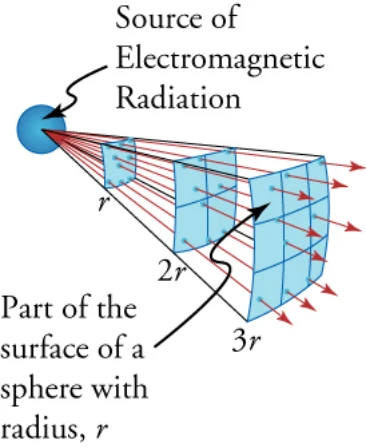
What happens if the radius of the sphere is increased 2 m? The illuminance is now only one-fourth as great, because the r2 term in the denominator is 4 instead of 1. Figure 15.12 shows how illuminance decreases with the inverse square of the distance.
球の半径が2 mに増えたらどうなるか。分母のr2の項が1でなく4になるので、照度はいまや4分の1にしかならない。図15.12は、照度が距離の2乗に反比例して減ることを示す。
Calculating Illuminance A woman puts a new bulb in a floor lamp beside an easy chair. If the luminous flux of the bulb is rated at 2,000 lm, what is the illuminance on a book held 2.00 m from the bulb?Strategy
照度を計算する ある女性が、安楽椅子のそばのフロアランプに新しい電球を入れる。電球の光束が2,000 lmと定格されているとき、電球から2.00 mのところで持った本の上の照度はいくらか。方針
Choose the equation and list the knowns.
式を選び、分かっているものを挙げる。
P = 2,000 lm
P = 2,000 lm
π = 3.14
π = 3.14
r = 2.00 m
r = 2.00 m
Solution解答
Substitute the known values into the equation.
分かっている値を式に代入する。
Discussion考察
Try some other distances to illustrate how greatly light fades with distance from its source. For example, at 3 m the illuminance is only 17.7 lux. Parents often scold children for reading in light that is too dim. Instead of shouting, “You’ll ruin your eyes!” it might be better to explain the inverse square law of illuminance to the child.
他の距離でも試して、光が源からの距離とともにどれほど大きく弱まるかを確かめてみよう。たとえば3 mでは照度はわずか17.7ルクスである。親はよく、暗すぎる明かりで本を読む子どもを叱る。「目を悪くするよ!」と怒鳴るかわりに、照度の逆二乗の法則を子どもに説明したほうがよいかもしれない。
Practice Problems練習問題
6Red light has a wavelength of 7.0 × 10⁻⁷ m and a frequency of 4.3 × 10¹⁴ Hz. Use these values to calculate the speed of light in a vacuum.
6赤い光は波長が7.0 × 10⁻⁷ m、振動数が4.3 × 10¹⁴ Hzである。これらの値を使って真空中の光の速さを計算せよ。
a. 3 × 10²⁰ m/sb. 3 × 10¹⁵ m/sc. 3 × 10¹⁴ m/sd. 3 × 10⁸ m/s
a. 3 × 10²⁰ m/sb. 3 × 10¹⁵ m/sc. 3 × 10¹⁴ m/sd. 3 × 10⁸ m/s
7A light bulb has a luminous flux of 942 lumens. What is the illuminance on a surface from the bulb when it is lit?
7ある電球の光束は942ルーメンである。点灯しているとき、電球からのところにある面の照度はいくらか。
Check Your Understanding理解の確認
8Give an example of a place where light travels at the speed of 3.00 × 10⁸ m/s.a. outer spaceb. water
8光が3.00 × 10⁸ m/sの速さで進む場所の例を挙げよ。a. 宇宙空間b. 水
c. Earth’s atmosphered. quartz glass
c. 地球の大気d. 石英ガラス
9Explain in terms of distances and the speed of light why it is currently very unlikely that humans will visit planets that circle stars other than our Sun.
9太陽以外の恒星をまわる惑星を人間が訪れることが、いまのところきわめてありそうにないのはなぜかを、距離と光の速さの言葉で説明せよ。
a. The spacecrafts used for travel are very heavy and thus very slow.b. Spacecrafts do not have a constant source of energy to run them.
a. 旅に使う宇宙船はとても重く、したがってとても遅いから。b. 宇宙船には、それを動かし続けるエネルギー源がないから。
c. If a spacecraft could attain a maximum speed equal to that of light, it would still be too slow to cover astronomical distances.d. Spacecrafts can attain a maximum speed equal to that of light, but it is difficult to locate planets around stars.
c. 宇宙船が光と同じ速さを最大で出せたとしても、天文学的な距離を渡るにはなお遅すぎるから。d. 宇宙船は光と同じ速さを最大で出せるが、恒星のまわりの惑星を見つけるのが難しいから。