第13章波とその性質Waves and Their Properties原書 p.405–430
13.2 Wave Properties: Speed, Amplitude, Frequency, and Period13.2 波の性質:速さ、振幅、振動数、周期
SECTION LEARNING OBJECTIVES By the end of this section, you will be able to do the following:
この節の学習目標 この節を終えると、次のことができるようになる。
• Define amplitude, frequency, period, wavelength, and velocity of a wave• Relate wave frequency, period, wavelength, and velocity• Solve problems involving wave properties
・波の振幅・振動数・周期・波長・速度を定義する・波の振動数・周期・波長・速度を結びつける・波の性質に関する問題を解く
Section Key Termsこの節の重要語
wavelengthwave velocity
波長波の速度
Wave Variables波の変数
In the chapter on motion in two dimensions, we defined the following variables to describe harmonic motion:
二次元の運動の章で、調和運動を述べるために次の変数を定義した。
• Amplitude—maximum displacement from the equilibrium position of an object oscillating around such equilibrium position• Frequency—number of events per unit of time• Period—time it takes to complete one oscillation
・振幅——ある釣り合いの位置のまわりで振動する物体の、その位置からの最大の変位・振動数——単位時間あたりの出来事の数・周期——一回の振動を終えるのにかかる時間
For waves, these variables have the same basic meaning. However, it is helpful to word the definitions in a more specific way that applies directly to waves:
波についても、これらの変数の基本的な意味は同じである。ただし、波に直接当てはまるように、もう少し具体的な言い方で定義しておくと役に立つ。
• Amplitude—distance between the resting position and the maximum displacement of the wave• Frequency—number of waves passing by a specific point per second• Period—time it takes for one wave cycle to complete
・振幅——静止の位置と波の最大の変位との距離・振動数——ある決まった点を1秒間に通り過ぎる波の数・周期——波の一周期が終わるのにかかる時間
In addition to amplitude, frequency, and period, their wavelength and wave velocity also characterize waves. The wavelength is the distance between adjacent identical parts of a wave, parallel to the direction of propagation. The wave velocity is the speed at which the disturbance moves.
振幅・振動数・周期に加えて、波長と波の速度も波を特徴づける。波長は、伝わる向きに平行にとった、波の隣り合う同じ部分どうしの距離である。波の速度は、乱れが動く速さである。
TIPS FOR SUCCESS Wave velocity is sometimes also called the propagation velocity or propagation speed because the disturbance propagates from one location to another.
学習のポイント 乱れがある場所から別の場所へ伝わっていくので、波の速度は伝播速度あるいは伝播の速さとも呼ばれる。
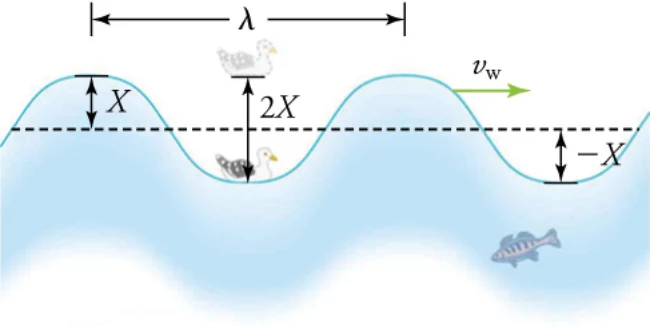
Consider the periodic water wave in Figure 13.7. Its wavelength is the distance from crest to crest or from trough to trough. The wavelength can also be thought of as the distance a wave has traveled after one complete cycle—or one period. The time for one complete up-and-down motion is the simple water wave’s period T. In the figure, the wave itself moves to the right with a wave velocity vw. Its amplitude X is the distance between the resting position and the maximum displacement—either the crest or the trough—of the wave. It is important to note that this movement of the wave is actually the disturbance moving to the right, not the water itself; otherwise, the bird would move to the right. Instead, the seagull bobs up and down in place as waves pass underneath, traveling a total distance of 2X in one cycle. However, as mentioned in the text feature on surfing, actual ocean waves are more complex than this simplified example.
図13.7の周期的な水の波を考えよう。その波長は、山から山まで、あるいは谷から谷までの距離である。波長は、一周期——すなわち一つの周期——のあと波が進んだ距離と考えることもできる。上下の運動が一回終わるのにかかる時間が、この単純な水の波の周期Tである。図では、波そのものが波の速度vwで右へ動いている。振幅Xは、静止の位置と、波の最大の変位——山または谷——との距離である。この波の動きは、実際には乱れが右へ動いているのであって、水そのものが動いているのではないことに注意することが大切である。そうでなければ鳥も右へ動くはずである。実際にはカモメは、波が下を通り過ぎるあいだその場で上下に揺れ、一周期で合わせて2Xの距離を進む。ただし、サーフィンの読み物で述べたとおり、実際の海の波はこの単純化した例より複雑である。
Amplitude, Period, Frequency, and Wavelength of Periodic Waves This video is a continuation of the video “Introduction to Waves” from the "Types of Waves" section. It discusses the properties of a periodic wave: amplitude, period, frequency, wavelength, and wave velocity.
周期波の振幅、周期、振動数、波長 この動画は「波の種類」の節の動画「波の導入」の続きである。周期波の性質——振幅、周期、振動数、波長、波の速度——を論じる。
Access multimedia content (http://openstax.org/books/physics/pages/13-2-wave-properties-speed-amplitude-frequency-and-period)
マルチメディア教材はこちら(http://openstax.org/books/physics/pages/13-2-wave-properties-speed-amplitude-frequency-and-period)
TIPS FOR SUCCESS The crest of a wave is sometimes also called the peak.
学習のポイント 波の山はピークとも呼ばれる。
Watch Physics: Amplitude, Period, Frequency and Wavelength of Periodic Waves. This video introduces several concepts of sound; amplitude, period, frequency, and wavelength of periodic waves.Access multimedia content (http://openstax.org/books/physics/pages/13-2-wave-properties-speed-amplitude-frequency-and-period) If you are on a boat in the trough of a wave on the ocean, and the wave amplitude is , what is the wave height from your position?
物理を見る:周期波の振幅、周期、振動数、波長。この動画は音についていくつかの概念、すなわち周期波の振幅・周期・振動数・波長を導く。マルチメディア教材はこちら(http://openstax.org/books/physics/pages/13-2-wave-properties-speed-amplitude-frequency-and-period) 海の波の谷にいる船の上にいて、波の振幅がのとき、あなたの位置から見た波の高さはいくらか。
The Relationship between Wave Frequency, Period, Wavelength, and Velocity波の振動数・周期・波長・速度の関係
Since wave frequency is the number of waves per second, and the period is essentially the number of seconds per wave, the relationship between frequency and period is
波の振動数とは1秒あたりの波の数であり、周期とは実質的に波1個あたりの秒数なので、振動数と周期の関係は
or
あるいは
just as in the case of harmonic motion of an object. We can see from this relationship that a higher frequency means a shorter period. Recall that the unit for frequency is hertz (Hz), and that 1 Hz is one cycle—or one wave—per second.
となる。物体の調和運動の場合とまったく同じである。この関係から、振動数が高いほど周期が短いことが分かる。振動数の単位はヘルツ(Hz)であり、1 Hzは1秒あたり1周期——すなわち波1個——であったことを思い出そう。
The speed of propagation vw is the distance the wave travels in a given time, which is one wavelength in a time of one period. In equation form, it is written as
伝播の速さvwとは、決まった時間に波が進む距離であり、一周期の時間に一波長進む。式で書けば
or
あるいは
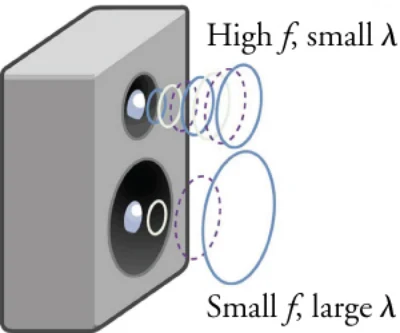
From this relationship, we see that in a medium where vw is constant, the higher the frequency, the smaller the wavelength. See Figure 13.8.
となる。この関係から、vwが一定の媒質では、振動数が高いほど波長が短いことが分かる。図13.8を見よ。
These fundamental relationships hold true for all types of waves. As an example, for water waves, vw is the speed of a surface wave; for sound, vw is the speed of sound; and for visible light, vw is the speed of light. The amplitude X is completely independent of the speed of propagation vw and depends only on the amount of energy in the wave.
これらの基本の関係は、あらゆる種類の波について成り立つ。たとえば水の波ではvwは表面波の速さ、音ではvwは音速、可視光ではvwは光速である。振幅Xは伝播の速さvwとまったく無関係で、波の中のエネルギーの量だけによって決まる。
SNAP LAB身近な実験Waves in a Bowlボウルの中の波
In this lab, you will take measurements to determine how the amplitude and the period of waves are affected by the transfer of energy from a cork dropped into the water. The cork initially has some potential energy when it is held above the water—the greater the height, the higher the potential energy. When it is dropped, such potential energy is converted to kinetic energy as the cork falls. When the cork hits the water, that energy travels through the water in waves.
この実験では、水に落としたコルクからのエネルギーの移動によって、波の振幅と周期がどう変わるかを調べるために測定を行う。コルクは水の上に持ち上げられているとき、いくらかの位置エネルギーを持つ。高さが大きいほど位置エネルギーは大きい。落とされると、コルクが落ちるにつれてその位置エネルギーは運動エネルギーへ変わる。コルクが水にあたると、そのエネルギーは波となって水の中を進む。
• Large bowl or basin• Water• Cork (or ping pong ball)• Stopwatch• Measuring tape
・大きなボウルまたはたらい・水・コルク(またはピンポン球)・ストップウォッチ・巻き尺
Instructions
手引き
Procedure手順
1. Fill a large bowl or basin with water and wait for the water to settle so there are no ripples.2. Gently drop a cork into the middle of the bowl.3. Estimate the wavelength and the period of oscillation of the water wave that propagates away from the cork. You can estimate the period by counting the number of ripples from the center to the edge of the bowl while your partner times it. This information, combined with the bowl measurement, will give you the wavelength when the correct formula is used.4. Remove the cork from the bowl and wait for the water to settle again.5. Gently drop the cork at a height that is different from the first drop.6. Repeat Steps 3 to 5 to collect a second and third set of data, dropping the cork from different heights and recording the resulting wavelengths and periods.7. Interpret your results.
1. 大きなボウルかたらいに水を満たし、波紋がなくなるまで水が落ち着くのを待つ。2. ボウルの真ん中にそっとコルクを落とす。3. コルクから離れていく水の波の波長と振動の周期を見積もる。相棒に時間を計ってもらいながら、中心からボウルの縁までの波紋の数を数えれば、周期を見積もれる。この情報をボウルの寸法と合わせ、正しい式を使えば波長が求まる。4. ボウルからコルクを取り出し、また水が落ち着くのを待つ。5. 一回目とは違う高さからそっとコルクを落とす。6. 手順3から5を繰り返し、違う高さからコルクを落として、得られた波長と周期を記録し、二組目・三組目のデータを集める。7. 結果を解釈する。
A cork is dropped into a pool of water creating waves. Does the wavelength depend upon the height above the water from which the cork is dropped?
コルクを水たまりに落として波を作る。波長は、コルクを落とす水面からの高さによるか。
a. No, only the amplitude is affected.b. Yes, the wavelength is affected.
a. いいえ。影響を受けるのは振幅だけである。b. はい。波長は影響を受ける。
Navy)
海軍)
Geologists rely heavily on physics to study earthquakes since earthquakes involve several types of wave disturbances, including disturbance of Earth’s surface and pressure disturbances under the surface. Surface earthquake waves are similar to surface waves on water. The waves under Earth’s surface have both longitudinal and transverse components. The longitudinal waves in an earthquake are called pressure waves (P-waves) and the transverse waves are called shear waves (S-waves). These two types of waves propagate at different speeds, and the speed at which they travel depends on the rigidity of the medium through which they are traveling. During earthquakes, the speed of P-waves in granite is significantly higher than the speed of S-waves. Both components of earthquakes travel more slowly in less rigid materials, such as sediments. P-waves have speeds of 4 to 7 km/s, and S-waves have speeds of 2 to 5 km/s, but both are faster in more rigid materials. The P-wave gets progressively farther ahead of the S-wave as they travel through Earth’s crust. For that reason, the time difference between the P- and S-waves is used to determine the distance to their source, the epicenter of the earthquake.
地質学者は地震を研究するのに物理に大きく頼っている。地震には、地表の乱れや地下の圧力の乱れを含む、いくつもの種類の波の乱れが関わるからである。地表の地震の波は、水面の表面波に似ている。地表の下の波には縦成分と横成分の両方がある。地震の縦波は圧力波(P波)、横波はせん断波(S波)と呼ばれる。この二種類の波は違う速さで伝わり、その速さは伝わっていく媒質の硬さによる。地震のとき、花崗岩の中のP波の速さはS波の速さよりかなり大きい。地震の波はどちらの成分も、堆積物のようなあまり硬くない材料の中ではより遅く進む。P波の速さは4から7 km/s、S波の速さは2から5 km/sだが、どちらも硬い材料の中ではより速い。地殻を進むにつれ、P波はS波より次第に先行していく。そのため、P波とS波の時間差が、波の源、すなわち地震の震央までの距離を求めるのに使われる。
We know from seismic waves produced by earthquakes that parts of the interior of Earth are liquid. Shear or transverse waves cannot travel through a liquid and are not transmitted through Earth’s core. In contrast, compression or longitudinal waves can pass through a liquid and they do go through the core.
地震が生む地震波から、地球の内部の一部が液体であることが分かっている。せん断波すなわち横波は液体を伝わることができず、地球の核を通り抜けない。これに対し、圧縮波すなわち縦波は液体を通り抜けることができ、実際に核を通っている。
All waves carry energy, and the energy of earthquake waves is easy to observe based on the amount of damage left behind after the ground has stopped moving. Earthquakes can shake whole cities to the ground, performing the work of thousands of wrecking balls. The amount of energy in a wave is related to its amplitude. Large-amplitude earthquakes produce large ground displacements and greater damage. As earthquake waves spread out, their amplitude decreases, so there is less damage the farther they get from the source.
あらゆる波がエネルギーを運ぶ。地震の波のエネルギーは、地面が動きやんだあとに残された被害の大きさから容易に見て取れる。地震は街をまるごと地面まで揺り崩し、何千もの鉄球の解体作業に等しい仕事をなしうる。波の中のエネルギーの量はその振幅に関係する。振幅の大きい地震は大きな地面の変位と大きな被害を生む。地震の波は広がるにつれて振幅が減るので、源から遠いほど被害は小さい。
GRASP CHECK What is the relationship between the propagation speed, frequency, and wavelength of the S-waves in an earthquake?
理解の確認 地震のS波の伝播の速さ、振動数、波長の関係はどうなっているか。
VIRTUAL PHYSICSシミュレーションWave on a String弦の上の波
Access multimedia content (http://openstax.org/books/physics/pages/13-2-wave-properties-speed-amplitude-frequency-and-period) In this animation, watch how a string vibrates in slow motion by choosing the Slow Motion setting. Select the No End and Manual options, and wiggle the end of the string to make waves yourself. Then switch to the Oscillate setting to generate waves automatically. Adjust the frequency and the amplitude of the oscillations to see what happens. Then experiment with adjusting the damping and the tension.
マルチメディア教材はこちら(http://openstax.org/books/physics/pages/13-2-wave-properties-speed-amplitude-frequency-and-period) このアニメーションでは、スローモーションの設定を選んで、弦がどう振動するかをゆっくり見る。「端なし」と「手動」を選び、弦の端を揺すって自分で波を作ってみよう。それから「振動」の設定に切り替えて、自動で波を出す。振動の振動数と振幅を変えて、何が起こるか見よう。それから減衰と張力を変えて試してみよう。
GRASP CHECK Which of the settings—amplitude, frequency, damping, or tension—changes the amplitude of the wave as it propagates? What does it do to the amplitude?
理解の確認 振幅・振動数・減衰・張力のうち、波が伝わっていくときにその振幅を変えるのはどれか。それは振幅をどうするか。
a. Frequency; it decreases the amplitude of the wave as it propagates.b. Frequency; it increases the amplitude of the wave as it propagates.c. Damping; it decreases the amplitude of the wave as it propagates.d. Damping; it increases the amplitude of the wave as it propagates.
a. 振動数。波が伝わっていくときに振幅を減らす。b. 振動数。波が伝わっていくときに振幅を増やす。c. 減衰。波が伝わっていくときに振幅を減らす。d. 減衰。波が伝わっていくときに振幅を増やす。
Solving Wave Problems波の問題を解く
Calculate the Velocity of Wave Propagation: Gull in the Ocean Calculate the wave velocity of the ocean wave in the previous figure if the distance between wave crests is 10.0 m and the time for a seagull to bob up and down is 5.00 s.Strategy
波の伝播速度を計算する:海のカモメ 前の図の海の波について、波の山どうしの距離が10.0 m、カモメが上下に一往復する時間が5.00 sのとき、波の速度を計算せよ。方針
The values for the wavelength and the period are given and we are asked to find Therefore, we can use to find the wave velocity.
波長 と周期の値が与えられ、求めるよう言われているのはである。したがってを使って波の速度を求められる。
Solution解答
Discussion考察
This slow speed seems reasonable for an ocean wave. Note that in the figure, the wave moves to the right at this speed, which is different from the varying speed at which the seagull bobs up and down.
この遅い速さは海の波として妥当に思える。図では波がこの速さで右へ動いており、これはカモメが上下に揺れるときの変化する速さとは別物であることに注意しよう。
Calculate the Period and the Wave Velocity of a Toy Spring The woman in Figure 13.3 creates two waves every second by shaking the toy spring up and down. (a)What is the period of each wave? (b) If each wave travels 0.9 meters after one complete wave cycle, what is the velocity of wave propagation?Strategy FOR (A)
おもちゃのばねの周期と波の速度を計算する 図13.3の女性は、おもちゃのばねを上下に揺すって毎秒2個の波を作る。(a)それぞれの波の周期はいくらか。(b)一周期のあとそれぞれの波が0.9メートル進むとすると、波の伝播の速度はいくらか。(a)の方針
To find the period, we solve for , given the value of the frequency
周期を求めるには、振動数の値が与えられているのでについて解く。
Solution for (a)(a)の解答
Strategy FOR (B)(b)の方針
Since one definition of wavelength is the distance a wave has traveled after one complete cycle—or one period—the values for the wavelength as well as the frequency are given. Therefore, we can use to find the wave velocity.
波長の一つの定義が、一周期——すなわち一つの周期——のあと波が進んだ距離であるから、波長の値も振動数の値も与えられていることになる。したがってを使って波の速度を求められる。
Solution for (b)(b)の解答
Discussion考察
We could have also used the equation to solve for the wave velocity since we already know the value of the period from our calculation in part (a), and we would come up with the same answer.
式を使って波の速度を求めることもできた。(a)の計算からすでに周期の値が分かっているので、同じ答えになる。
Practice Problems練習問題
7The frequency of a wave is 10 Hz. What is its period?a. The period of the wave is 100 s.b. The period of the wave is 10 s.
7ある波の振動数が10 Hzである。その周期はいくらか。a. この波の周期は100 sである。b. この波の周期は10 sである。
c. The period of the wave is 0.01 s.d. The period of the wave is 0.1 s.
c. この波の周期は0.01 sである。d. この波の周期は0.1 sである。
8What is the velocity of a wave whose wavelength is 2 m and whose frequency is 5 Hz?a. 20 m/sb. 2.5 m/s
8波長が2 m、振動数が5 Hzの波の速度はいくらか。a. 20 m/sb. 2.5 m/s
c. 0.4 m/sd. 10 m/s
c. 0.4 m/sd. 10 m/s
Check Your Understanding理解の確認
9What is the amplitude of a wave?a. A quarter of the total height of the waveb. Half of the total height of the wave
9波の振幅とは何か。a. 波の全体の高さの4分の1b. 波の全体の高さの半分
c. Two times the total height of the waved. Four times the total height of the wave
c. 波の全体の高さの2倍d. 波の全体の高さの4倍
10What is meant by the wavelength of a wave?a. The wavelength is the distance between adjacent identical parts of a wave, parallel to the direction of propagation.b. The wavelength is the distance between adjacent identical parts of a wave, perpendicular to the direction of propagation.c. The wavelength is the distance between a crest and the adjacent trough of a wave, parallel to the direction of propagation.d. The wavelength is the distance between a crest and the adjacent trough of a wave, perpendicular to the direction of propagation.
10波の波長とはどういう意味か。a. 波長とは、伝わる向きに平行にとった、波の隣り合う同じ部分どうしの距離である。b. 波長とは、伝わる向きに垂直にとった、波の隣り合う同じ部分どうしの距離である。c. 波長とは、伝わる向きに平行にとった、波の山と隣の谷との距離である。d. 波長とは、伝わる向きに垂直にとった、波の山と隣の谷との距離である。
11How can you mathematically express wave frequency in terms of wave period? a.
11波の振動数を波の周期を使って数式でどう表せるか。 a.
12When is the wavelength directly proportional to the period of a wave?a. When the velocity of the wave is halvedb. When the velocity of the wave is constant
12波長が波の周期に正比例するのはどんなときか。a. 波の速度が半分になるときb. 波の速度が一定のとき
c. When the velocity of the wave is doubledd. When the velocity of the wave is tripled
c. 波の速度が2倍になるときd. 波の速度が3倍になるとき