第13章波とその性質Waves and Their Properties原書 p.405–430
13.3 Wave Interaction: Superposition and Interference13.3 波の相互作用:重ね合わせと干渉
SECTION LEARNING OBJECTIVES By the end of this section, you will be able to do the following:
この節の学習目標 この節を終えると、次のことができるようになる。
• Describe superposition of waves• Describe interference of waves and distinguish between constructive and destructive interference of waves• Describe the characteristics of standing waves• Distinguish reflection from refraction of waves
・波の重ね合わせを述べる・波の干渉を述べ、強め合う干渉と弱め合う干渉を区別する・定常波の特徴を述べる・波の反射と屈折を区別する
Section Key Termsこの節の重要語
antinodeconstructive interferencedestructive interferenceinversionnodesreflectionrefractionstanding wavesuperposition
腹強め合う干渉弱め合う干渉反転節反射屈折定常波重ね合わせ
Superposition of Waves波の重ね合わせ
Most waves do not look very simple. They look more like the waves in Figure 13.10, rather than the simple water wave considered in the previous sections, which has a perfect sinusoidal shape.
たいていの波はあまり単純な形には見えない。前の節で考えた、完全な正弦の形をした単純な水の波というより、図13.10の波のように見える。
Most waves appear complex because they result from two or more simple waves that combine as they come together at the same place at the same time—a phenomenon called superposition.
たいていの波が複雑に見えるのは、それが二つ以上の単純な波が同じ場所に同じ時刻に来て合わさった結果だからである。この現象を重ね合わせという。
Waves superimpose by adding their disturbances; each disturbance corresponds to a force, and all the forces add. If the disturbances are along the same line, then the resulting wave is a simple addition of the disturbances of the individual waves, that is, their amplitudes add.
波は、その乱れを足し合わせることで重なる。それぞれの乱れは力に対応し、すべての力が足し合わされる。乱れが同じ直線に沿っているなら、できあがる波は個々の波の乱れの単純な足し算、すなわち振幅の足し算になる。
Wave Interference波の干渉
The two special cases of superposition that produce the simplest results are pure constructive interference and pure destructive interference.
重ね合わせのうち、最も単純な結果を生む二つの特別な場合が、純粋に強め合う干渉と純粋に弱め合う干渉である。
Pure constructive interference occurs when two identical waves arrive at the same point exactly in phase. When waves are exactly in phase, the crests of the two waves are precisely aligned, as are the troughs. Refer to Figure 13.11. Because the disturbances add, the pure constructive interference of two waves with the same amplitude produces a wave that has twice the amplitude of the two individual waves, but has the same wavelength.
純粋に強め合う干渉は、まったく同じ二つの波がぴったり同位相で同じ点に届いたときに起こる。波がぴったり同位相であるとき、二つの波の山どうし、谷どうしがぴったり揃う。図13.11を見よ。乱れが足し合わされるので、同じ振幅の二つの波が純粋に強め合う干渉をすると、波長は同じで、個々の波の2倍の振幅を持つ波ができる。
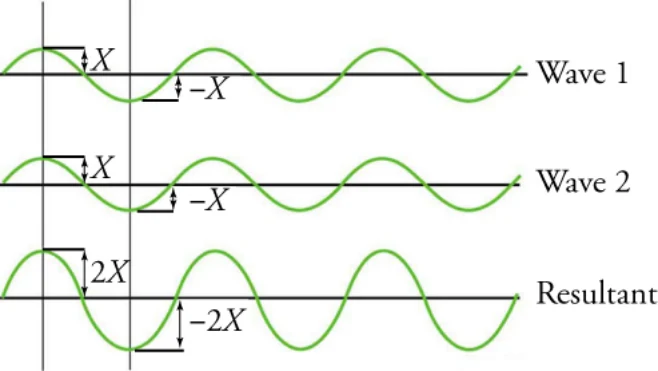
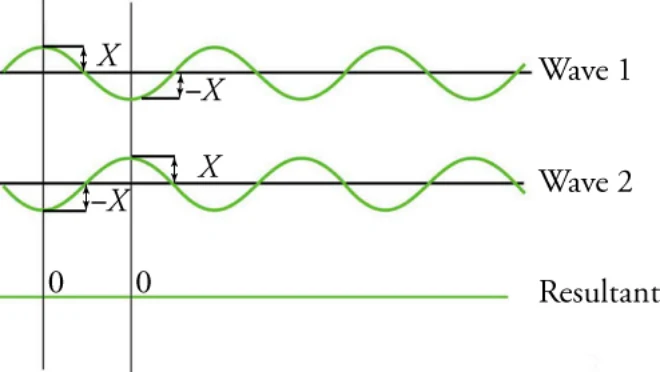
Figure 13.12 shows two identical waves that arrive exactly out of phase—that is, precisely aligned crest to trough—producing pure destructive interference. Because the disturbances are in opposite directions for this superposition, the resulting amplitude is zero for pure destructive interference; that is, the waves completely cancel out each other.
図13.12は、まったく同じ二つの波がぴったり逆位相で——すなわち山と谷がぴったり揃って——届き、純粋に弱め合う干渉を生む様子を示す。この重ね合わせでは乱れが互いに逆向きなので、純粋に弱め合う干渉ではできあがる振幅は0になる。すなわち、二つの波は完全に打ち消し合う。
While pure constructive interference and pure destructive interference can occur, they are not very common because they require precisely aligned identical waves. The superposition of most waves that we see in nature produces a combination of constructive and destructive interferences.
純粋に強め合う干渉も純粋に弱め合う干渉も起こりうるが、ぴったり揃ったまったく同じ波を必要とするので、あまりありふれてはいない。自然界で目にするたいていの波の重ね合わせは、強め合う干渉と弱め合う干渉の組み合わせを生む。
Waves that are not results of pure constructive or destructive interference can vary from place to place and time to time. The sound from a stereo, for example, can be loud in one spot and soft in another. The varying loudness means that the sound waves add partially constructively and partially destructively at different locations. A stereo has at least two speakers that create sound waves, and waves can reflect from walls. All these waves superimpose.
純粋に強め合う干渉でも弱め合う干渉でもない波は、場所ごと、時刻ごとに変わりうる。たとえばステレオからの音は、ある場所では大きく、別の場所では小さくなりうる。大きさが変わるということは、音波が場所によって部分的に強め合い、部分的に弱め合っているという意味である。ステレオには音波を作るスピーカーが少なくとも二つあり、波は壁からはね返りもする。これらの波がすべて重なり合う。
An example of sounds that vary over time from constructive to destructive is found in the combined whine of jet engines heard by a stationary passenger. The volume of the combined sound can fluctuate up and down as the sound from the two engines varies in time from constructive to destructive.
時間とともに強め合いから弱め合いへ変わる音の例が、止まっている乗客に聞こえるジェットエンジンの合わさったうなりである。二つのエンジンからの音が時間とともに強め合いから弱め合いへ変わるにつれ、合わさった音の大きさは上下に揺れうる。
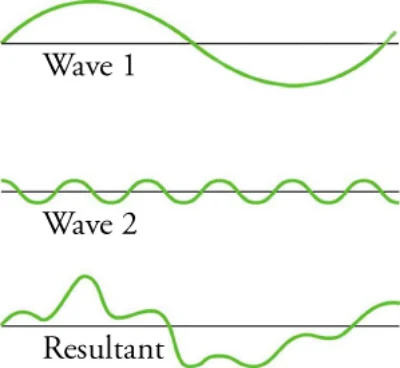
The two previous examples considered waves that are similar—both stereo speakers generate sound waves with the same amplitude and wavelength, as do the jet engines. But what happens when two waves that are not similar, that is, having different amplitudes and wavelengths, are superimposed? An example of the superposition of two dissimilar waves is shown in Figure 13.13. Here again, the disturbances add and subtract, but they produce an even more complicated-looking wave. The resultant wave from the combined disturbances of two dissimilar waves looks much different than the idealized sinusoidal shape of a periodic wave.
これまでの二つの例では、似た波を考えていた。ステレオの二つのスピーカーは同じ振幅と波長の音波を出すし、ジェットエンジンも同様である。しかし、似ていない二つの波、すなわち振幅も波長も違う波が重ね合わされたら、何が起こるのか。似ていない二つの波の重ね合わせの例を図13.13に示す。ここでもまた乱れは足し合わされ、また引き合うが、できあがるのはいっそう複雑に見える波である。似ていない二つの波の乱れが合わさってできる波は、周期波の理想化された正弦の形とはずいぶん違って見える。
VIRTUAL PHYSICSシミュレーションWave Interference波の干渉
In this simulation (https://openstax.org/l/28interference), make waves with a dripping faucet, an audio speaker, or a laser by switching between the water, sound, and light tabs. Contrast and compare how the different types of waves behave. Try rotating the view from top to side to make observations. Then experiment with adding a second source or a pair of slits to create an interference pattern.
このシミュレーション(https://openstax.org/l/28interference)では、水・音・光のタブを切り替えて、しずくの垂れる蛇口、音のスピーカー、レーザーで波を作る。いろいろな種類の波のふるまいを対比し、比べてみよう。視点を上からと横からで切り替えて観察してみよう。それから、源をもう一つ足したり、二つのすきまを置いたりして、干渉の模様を作ってみよう。
PhET Explorations: Wave Interference. Make waves with a dripping faucet, audio speaker, or laser! Add a second source or a pair of slits to create an interference pattern.
PhET探究:波の干渉。しずくの垂れる蛇口、音のスピーカー、レーザーで波を作ろう。源をもう一つ、あるいは二つのすきまを足して干渉の模様を作ろう。
Access multimedia content (http://openstax.org/books/physics/pages/13-3-wave-interaction-superposition-and-interference) In the water tab, compare the waves generated by one drip versus two drips. What happens to the amplitude of the waves when there are two drips? Is this constructive or destructive interference? Why would this be the case?
マルチメディア教材はこちら(http://openstax.org/books/physics/pages/13-3-wave-interaction-superposition-and-interference)水のタブで、しずく一つで作られる波と、しずく二つで作られる波を比べよう。しずくが二つのとき、波の振幅はどうなるか。これは強め合う干渉か、弱め合う干渉か。それはなぜか。
a. The amplitude of the water waves remains same because of the destructive interference as the drips of water hit the surface at the same time.b. The amplitude of the water waves is canceled because of the destructive interference as the drips of water hit the surface at the same time.c. The amplitude of water waves remains same because of the constructive interference as the drips of water hit the surface at the same time.d. The amplitude of water waves doubles because of the constructive interference as the drips of water hit the surface at the same time.
a. 水のしずくが同時に水面にあたると弱め合う干渉が起こるので、水の波の振幅は変わらない。b. 水のしずくが同時に水面にあたると弱め合う干渉が起こるので、水の波の振幅は打ち消される。c. 水のしずくが同時に水面にあたると強め合う干渉が起こるので、水の波の振幅は変わらない。d. 水のしずくが同時に水面にあたると強め合う干渉が起こるので、水の波の振幅は2倍になる。
Standing Waves定常波
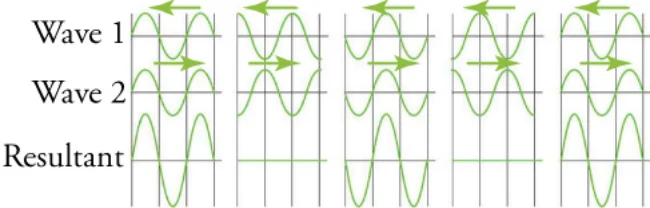
Sometimes waves do not seem to move and they appear to just stand in place, vibrating. Such waves are called standing waves and are formed by the superposition of two or more waves moving in opposite directions. The waves move through each other with their disturbances adding as they go by. If the two waves have the same amplitude and wavelength, then they alternate between constructive and destructive interference. Standing waves created by the superposition of two identical waves moving in opposite directions are illustrated in Figure 13.14.
波が動いていないように見え、ただその場に立って振動しているように見えることがある。そうした波は定常波と呼ばれ、互いに逆向きに進む二つ以上の波の重ね合わせでできる。波は互いを通り抜けていき、すれ違いながらその乱れが足し合わされる。二つの波の振幅と波長が同じなら、強め合う干渉と弱め合う干渉が交互に現れる。互いに逆向きに進むまったく同じ二つの波の重ね合わせでできる定常波を図13.14に示す。
As an example, standing waves can be seen on the surface of a glass of milk in a refrigerator. The vibrations from the refrigerator motor create waves on the milk that oscillate up and down but do not seem to move across the surface. The two waves that produce standing waves may be due to the reflections from the side of the glass.
例として、冷蔵庫の中の牛乳のコップの表面に定常波を見ることができる。冷蔵庫のモーターの振動が牛乳に波を作り、その波は上下に振動するが、表面を横切って動いてはいないように見える。定常波を生む二つの波は、コップの側面からの反射によるのだろう。
Earthquakes can create standing waves and cause constructive and destructive interferences. As the earthquake waves travel along the surface of Earth and reflect off denser rocks, constructive interference occurs at certain points. As a result, areas closer to the epicenter are not damaged while areas farther from the epicenter are damaged.
地震も定常波を作り、強め合う干渉と弱め合う干渉を起こしうる。地震の波が地表を伝わり、より密な岩からはね返るにつれ、ある地点で強め合う干渉が起こる。その結果、震央に近い地域が被害を受けず、震央から遠い地域が被害を受けるということが起こる。
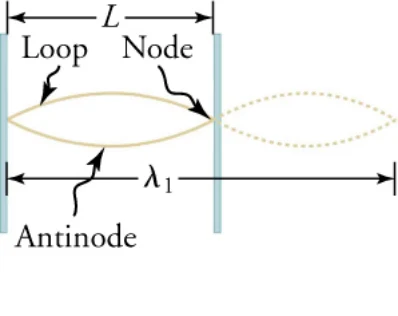
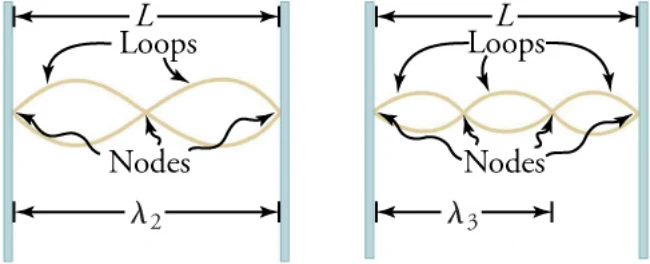
Standing waves are also found on the strings of musical instruments and are due to reflections of waves from the ends of the string. Figure 13.15 and Figure 13.16 show three standing waves that can be created on a string that is fixed at both ends. When the wave reaches the fixed end, it has nowhere else to go but back where it came from, causing the reflection. The nodes are the points where the string does not move; more generally, the nodes are the points where the wave disturbance is zero in a standing wave. The fixed ends of strings must be nodes, too, because the string cannot move there.
定常波は楽器の弦にも見られ、これは弦の端からの波の反射による。図13.15と図13.16は、両端を固定した弦に作れる三つの定常波を示す。波が固定端に達すると、来たほうへ戻るしか行き場がなく、それが反射を起こす。節とは弦が動かない点である。より一般には、節とは定常波で波の乱れが0になる点である。弦の固定端もそこでは弦が動けないので、必ず節になる。
The antinode is the location of maximum amplitude in standing waves. The standing waves on a string have a frequency that is related to the propagation speed of the disturbance on the string. The wavelength is determined by the distance between the points where the string is fixed in place.
腹とは、定常波で振幅が最大になる場所である。弦の上の定常波は、弦の上の乱れの伝播の速さに関係する振動数を持つ。波長は、弦が固定されている点どうしの距離によって決まる。
Reflection and Refraction of Waves波の反射と屈折
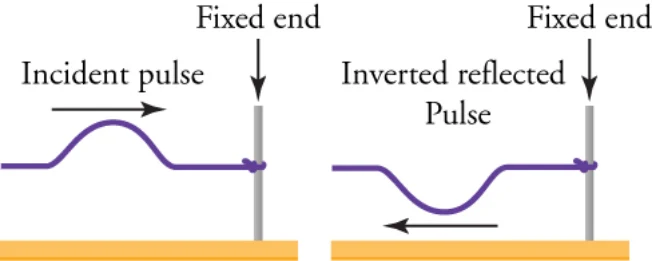
As we saw in the case of standing waves on the strings of a musical instrument, reflection is the change in direction of a wave when it bounces off a barrier, such as a fixed end. When the wave hits the fixed end, it changes direction, returning to its source. As it is reflected, the wave experiences an inversion, which means that it flips vertically. If a wave hits the fixed end with a crest, it will return as a trough, and vice versa (Henderson 2015). Refer to Figure 13.17.
楽器の弦の上の定常波の場合に見たように、反射とは、波が固定端のような壁にあたってはね返るときに向きを変えることである。波が固定端にあたると向きを変え、源へ戻っていく。反射されるとき、波は反転を経験する。すなわち上下がひっくり返る。波が山として固定端にあたれば谷として戻ってくるし、その逆も成り立つ(Henderson 2015)。図13.17を見よ。
TIPS FOR SUCCESS If the end is not fixed, it is said to be a free end, and no inversion occurs. When the end is loosely attached, it reflects without inversion, and when the end is not attached to anything, it does not reflect at all. You may have noticed this while changing the settings from Fixed End to Loose End to No End in the Waves on a String PhET simulation.
学習のポイント 端が固定されていなければ自由端と呼ばれ、反転は起こらない。端がゆるく取り付けられていれば反転せずに反射し、端が何にも取り付けられていなければまったく反射しない。「弦の上の波」のPhETシミュレーションで、設定を固定端から自由端、端なしへ変えたときに気づいたかもしれない。
Rather than encountering a fixed end or barrier, waves sometimes pass from one medium into another, for instance, from air into water. Different types of media have different properties, such as density or depth, that affect how a wave travels through them. At the boundary between media, waves experience refraction—they change their path of propagation. As the wave bends, it also changes its speed and wavelength upon entering the new medium. Refer to Figure 13.18.
固定端や壁にぶつかるのではなく、波が空気から水へというように、ある媒質から別の媒質へ入っていくこともある。媒質の種類が違えば、密度や深さといった性質も違い、それが波の伝わり方に影響する。媒質どうしの境目で、波は屈折を経験する——伝わる進路を変えるのである。波は曲がるとき、新しい媒質に入ることで速さと波長も変える。図13.18を見よ。
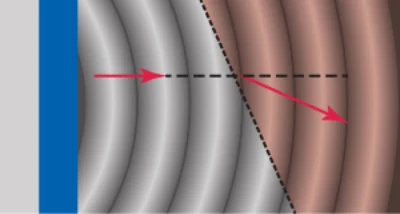
For example, water waves traveling from the deep end to the shallow end of a swimming pool experience refraction. They bend in a path closer to perpendicular to the surface of the water, propagate slower, and decrease in wavelength as they enter shallower water.
たとえばプールの深いほうから浅いほうへ進む水の波は屈折を経験する。より浅い水に入るにつれ、水面に垂直に近い進路へ曲がり、伝わる速さが遅くなり、波長が短くなる。
Check Your Understanding理解の確認
13What is the superposition of waves?a. When a single wave splits into two different waves at a pointb. When two waves combine at the same place at the same time
13波の重ね合わせとは何か。a. 一つの波がある点で二つの別の波に分かれることb. 二つの波が同じ場所に同じ時刻に合わさること
14How do waves superimpose on one another?a. By adding their frequenciesb. By adding their wavelengths
14波はどうやって互いに重なり合うか。a. 振動数を足し合わせてb. 波長を足し合わせて
c. By adding their disturbancesd. By adding their speeds
c. 乱れを足し合わせてd. 速さを足し合わせて
15What is interference of waves?a. Interference is a superposition of two waves to form a resultant wave with higher or lower frequency.b. Interference is a superposition of two waves to form a wave of larger or smaller amplitude.
15波の干渉とは何か。a. 干渉とは、二つの波が重なり合って、より高いか低い振動数の波ができることである。b. 干渉とは、二つの波が重なり合って、より大きいか小さい振幅の波ができることである。
c. Interference is a superposition of two waves to form a resultant wave with higher or lower velocity.d. Interference is a superposition of two waves to form a resultant wave with longer or shorter wavelength.
c. 干渉とは、二つの波が重なり合って、より速いか遅い速度の波ができることである。d. 干渉とは、二つの波が重なり合って、より長いか短い波長の波ができることである。
16Is the following statement true or false? The two types of interference are constructive and destructive interferences.
16次の文は正しいか誤りか。干渉には強め合う干渉と弱め合う干渉の二種類がある。
a. Trueb. False
a. 正b. 誤
17What are standing waves?a. Waves that appear to remain in one place and do not seem to moveb. Waves that seem to move along a trajectory
17定常波とは何か。a. 一つの場所にとどまり、動いていないように見える波b. ある軌道に沿って動いていくように見える波
18How are standing waves formed?a. Standing waves are formed by the superposition of two or more waves moving in opposite directions.b. Standing waves are formed by the superposition of two or more waves moving in the same direction.c. Standing waves are formed by the superposition of two or more waves moving in perpendicular directions.d. Standing waves are formed by the superposition of two or more waves moving in arbitrary directions.
18定常波はどうやってできるか。a. 定常波は、互いに逆向きに進む二つ以上の波の重ね合わせでできる。b. 定常波は、同じ向きに進む二つ以上の波の重ね合わせでできる。c. 定常波は、互いに垂直な向きに進む二つ以上の波の重ね合わせでできる。d. 定常波は、勝手な向きに進む二つ以上の波の重ね合わせでできる。
19What is the reflection of a wave?a. The reflection of a wave is the change in amplitude of a wave when it bounces off a barrier.b. The reflection of a wave is the change in frequency of a wave when it bounces off a barrier.c. The reflection of a wave is the change in velocity of a wave when it bounces off a barrier.d. The reflection of a wave is the change in direction of a wave when it bounces off a barrier.
19波の反射とは何か。a. 波の反射とは、波が壁にあたってはね返るときの振幅の変化である。b. 波の反射とは、波が壁にあたってはね返るときの振動数の変化である。c. 波の反射とは、波が壁にあたってはね返るときの速度の変化である。d. 波の反射とは、波が壁にあたってはね返るときの向きの変化である。
20What is inversion of a wave?
20波の反転とは何か。
a. Inversion occurs when a wave reflects off a fixed end and the wave amplitude changes sign.b. Inversion occurs when a wave reflects off a loose end and the wave amplitude changes sign.
a. 反転は、波が固定端で反射し、波の振幅の符号が変わるときに起こる。b. 反転は、波が自由端で反射し、波の振幅の符号が変わるときに起こる。
c. Inversion occurs when a wave reflects off a fixed end without the wave amplitude changing sign.d. Inversion occurs when a wave reflects off a loose end without the wave amplitude changing sign.
c. 反転は、波が固定端で反射し、波の振幅の符号が変わらないときに起こる。d. 反転は、波が自由端で反射し、波の振幅の符号が変わらないときに起こる。