第13章波とその性質Waves and Their Properties原書 p.405–430
13.1 Types of Waves13.1 波の種類
SECTION LEARNING OBJECTIVES By the end of this section, you will be able to do the following:
この節の学習目標 この節を終えると、次のことができるようになる。
• Define mechanical waves and medium, and relate the two• Distinguish a pulse wave from a periodic wave• Distinguish a longitudinal wave from a transverse wave and give examples of such waves
・力学的な波と媒質を定義し、両者を結びつける・パルス波と周期波を区別する・縦波と横波を区別し、それぞれの例を挙げる
Section Key Termsこの節の重要語
longitudinal wavemechanical wavemediumwaveperiodic wavepulse wavetransverse wave
縦波力学的な波媒質波周期波パルス波横波
Mechanical Waves力学的な波
What do we mean when we say something is a wave? A wave is a disturbance that travels or propagates from the place where it was created. Waves transfer energy from one place to another, but they do not necessarily transfer any mass. Light, sound, and waves in the ocean are common examples of waves. Sound and water waves are mechanical waves; meaning, they require a medium to travel through. The medium may be a solid, a liquid, or a gas, and the speed of the wave depends on the material properties of the medium through which it is traveling. However, light is not a mechanical wave; it can travel through a vacuum such as the empty parts of outer space.
波とは、ある場所で生じた振動や乱れが、周囲へ伝わっていく現象である。波はエネルギーを運ぶが、それに伴って物質そのものが同じ距離を移動する必要はない。光、音、海の波は身近な例である。音や水面の波は力学的な波であり、伝わるために媒質を必要とする。媒質には固体・液体・気体があり、波の速さはその物質の性質によって決まる。一方、光は力学的な波ではなく、宇宙空間のような真空も伝わる。
A familiar wave that you can easily imagine is the water wave. For water waves, the disturbance is in the surface of the water, an example of which is the disturbance created by a rock thrown into a pond or by a swimmer splashing the water surface repeatedly. For sound waves, the disturbance is caused by a change in air pressure, an example of which is when the oscillating cone inside a speaker creates a disturbance. For earthquakes, there are several types of disturbances, which include the disturbance of Earth’s surface itself and the pressure disturbances under the surface. Even radio waves are most easily understood using an analogy with water waves. Because water waves are common and visible, visualizing water waves may help you in studying other types of waves, especially those that are not visible.
すぐに思い浮かべられるおなじみの波が水の波である。水の波では、乱れは水面にある。池に投げ込まれた石や、水面を繰り返し叩く泳ぎ手が作る乱れがその例である。音波では、乱れは空気の圧力の変化によって生じる。スピーカーの中で振動するコーンが乱れを作るのがその例である。地震では、地表そのものの乱れと地下の圧力の乱れを含む、いくつもの種類の乱れがある。電波でさえ、水の波との類比で考えるのが最も分かりやすい。水の波はありふれていて目に見えるので、水の波を思い描くことは、他の種類の波、とくに目に見えない波を学ぶ助けになるだろう。
Water waves have characteristics common to all waves, such as amplitude, period, frequency, and energy, which we will discuss in the next section.
水の波は、振幅・周期・振動数・エネルギーといった、あらゆる波に共通の特徴を持つ。これらは次の節で論じる。
Pulse Waves and Periodic Wavesパルス波と周期波
If you drop a pebble into the water, only a few waves may be generated before the disturbance dies down, whereas in a wave pool, the waves are continuous. A pulse wave is a sudden disturbance in which only one wave or a few waves are generated, such as in the example of the pebble. Thunder and explosions also create pulse waves. A periodic wave repeats the same oscillation for several cycles, such as in the case of the wave pool, and is associated with simple harmonic motion. Each particle in the medium experiences simple harmonic motion in periodic waves by moving back and forth periodically through the same positions.
小石を水に落とすと、乱れが収まるまでにできる波はいくつかだけかもしれないが、波のプールでは波が続く。パルス波とは、小石の例のように、一つか、せいぜい数個の波しかできない突然の乱れである。雷や爆発もパルス波を作る。周期波は、波のプールの場合のように、同じ振動を何周期も繰り返すもので、単振動に結びついている。周期波では、媒質の中のそれぞれの粒子が、同じ位置を周期的に行き来しながら単振動をする。
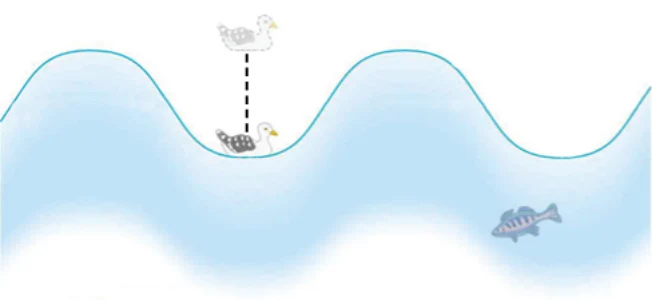
Consider the simplified water wave in Figure 13.2. This wave is an up-and-down disturbance of the water surface, characterized by a sine wave pattern. The uppermost position is called the crest and the lowest is the trough. It causes a seagull to move up and down in simple harmonic motion as the wave crests and troughs pass under the bird.
図13.2では、水面の波を単純化して、正弦波として表している。水面が上下に変位し、最も高い部分を山、最も低い部分を谷という。山と谷がカモメの下を通過するにつれて、カモメは上下に単振動する。
Longitudinal Waves and Transverse Waves縦波と横波
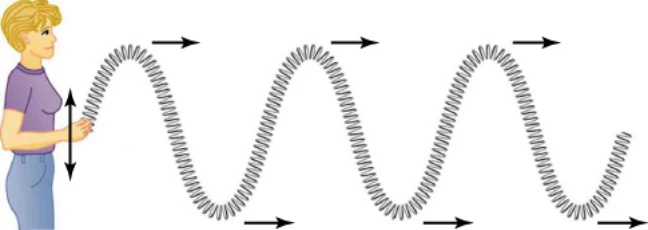
Mechanical waves are categorized by their type of motion and fall into any of two categories: transverse or longitudinal. Note that both transverse and longitudinal waves can be periodic. A transverse wave propagates so that the disturbance is perpendicular to the direction of propagation. An example of a transverse wave is shown in Figure 13.3, where a woman moves a toy spring up and down, generating waves that propagate away from herself in the horizontal direction while disturbing the toy spring in the vertical direction.
力学的な波は運動の型で分類され、横波か縦波かの二つのどちらかに入る。横波も縦波も周期的でありうることに注意しよう。横波は、乱れが伝わる向きに垂直になるように伝わる。横波の例を図13.3に示す。女性がおもちゃのばねを上下に動かし、ばねを鉛直方向に乱しながら、自分から水平方向に離れていく波を作っている。
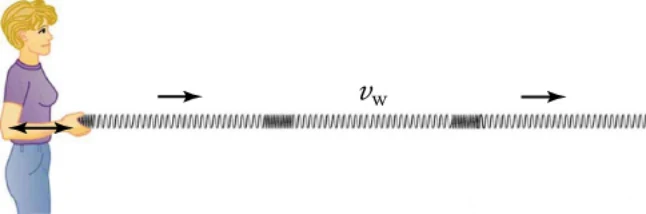
In contrast, in a longitudinal wave, the disturbance is parallel to the direction of propagation. Figure 13.4 shows an example of a longitudinal wave, where the woman now creates a disturbance in the horizontal direction—which is the same direction as the wave propagation—by stretching and then compressing the toy spring.
これに対し縦波では、乱れは伝わる向きに平行である。図13.4は縦波の例で、女性はおもちゃのばねを伸ばしたり縮めたりして、こんどは水平方向——波が伝わるのと同じ向き——に乱れを作っている。
TIPS FOR SUCCESS Longitudinal waves are sometimes called compression waves or compressional waves, and transverse waves are sometimes called shear waves.
学習のポイント 縦波は圧縮波と呼ばれることがあり、横波はせん断波と呼ばれることがある。
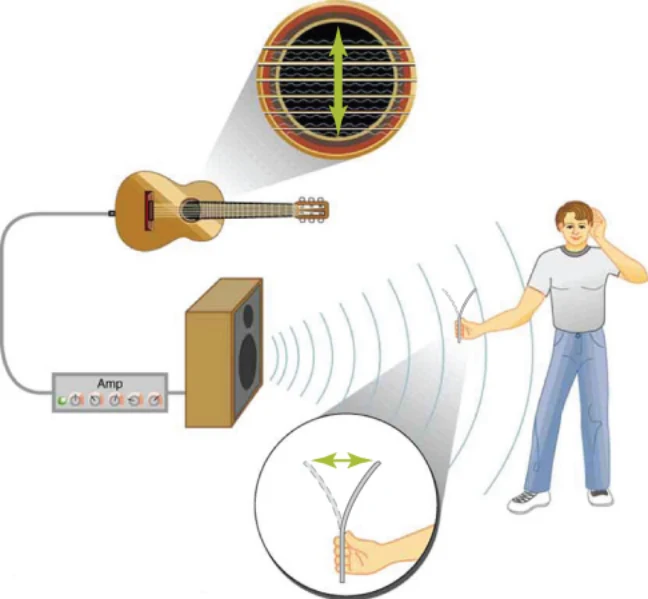
Waves may be transverse, longitudinal, or a combination of the two. The waves on the strings of musical instruments are transverse (as shown in Figure 13.5), and so are electromagnetic waves, such as visible light. Sound waves in air and water are longitudinal. Their disturbances are periodic variations in pressure that are transmitted in fluids.
波は横波でも縦波でも、その組み合わせでもありうる。楽器の弦の上の波は横波であり(図13.5に示すとおり)、可視光のような電磁波も横波である。空気や水の中の音波は縦波である。その乱れは、流体の中を伝わる圧力の周期的な変化である。
Sound in solids can be both longitudinal and transverse. Essentially, water waves are also a combination of transverse and longitudinal components, although the simplified water wave illustrated in Figure 13.2 does not show the longitudinal motion of the bird.
固体の中の音は縦波にも横波にもなりうる。実のところ水の波も横成分と縦成分の組み合わせだが、図13.2に描いた単純化した水の波では鳥の縦方向の運動は示されていない。
Earthquake waves under Earth’s surface have both longitudinal and transverse components as well. The longitudinal waves in an earthquake are called pressure or P-waves, and the transverse waves are called shear or S-waves. These components have important individual characteristics; for example, they propagate at different speeds. Earthquakes also have surface waves that are similar to surface waves on water.
地表の下の地震の波にも、縦成分と横成分の両方がある。地震の縦波は圧力波、すなわちP波と呼ばれ、横波はせん断波、すなわちS波と呼ばれる。これらの成分はそれぞれ重要な特徴を持つ。たとえば伝わる速さが違う。地震には、水面の表面波に似た表面波もある。
Introduction to Waves This video explains wave propagation in terms of momentum using an example of a wave moving along a rope. It also covers the differences between transverse and longitudinal waves, and between pulse and periodic waves.
波の導入 この動画は、ロープを伝わる波の例を使って、運動量の言葉で波の伝わり方を説明する。横波と縦波の違い、パルス波と周期波の違いも扱う。
Introduction to waves | Mechanical waves and sound | Physics | Khan Academy (https://openstax.org/l/ 02introtowaves)
波の導入|力学的な波と音|物理|カーンアカデミー(https://openstax.org/l/02introtowaves)
Watch Physics: Introduction to Waves. This video is an introduction to transverse and longitudinal waves.Access multimedia content (http://openstax.org/books/physics/pages/13-1-types-of-waves) In a longitudinal sound wave, after a compression wave moves through a region, the density of molecules briefly decreases. Why is this?
物理を見る:波の導入。この動画は横波と縦波を導く。マルチメディア教材はこちら(http://openstax.org/books/physics/pages/13-1-types-of-waves) 縦の音波では、圧縮の波がある領域を通り過ぎたあと、分子の密度が一時的に下がる。それはなぜか。
a. After a compression wave, some molecules move forward temporarily.b. After a compression wave, some molecules move backward temporarily.c. After a compression wave, some molecules move upward temporarily.d. After a compression wave, some molecules move downward temporarily.
a. 圧縮の波のあと、一部の分子が一時的に前へ動くから。b. 圧縮の波のあと、一部の分子が一時的に後ろへ動くから。c. 圧縮の波のあと、一部の分子が一時的に上へ動くから。d. 圧縮の波のあと、一部の分子が一時的に下へ動くから。
The Physics of Surfing Many people enjoy surfing in the ocean. For some surfers, the bigger the wave, the better. In one area off the coast of central California, waves can reach heights of up to 50 feet in certain times of the year (Figure 13.6).
サーフィンの物理 海でサーフィンを楽しむ人は多い。サーファーによっては、波が大きいほどよい。カリフォルニア中部の海岸沖のある地域では、年のある時期に波の高さが50フィートに達することがある(図13.6)。
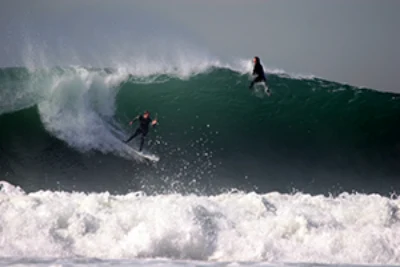
How do waves reach such extreme heights? Other than unusual causes, such as when earthquakes produce tsunami waves, most huge waves are caused simply by interactions between the wind and the surface of the water. The wind pushes up against the surface of the water and transfers energy to the water in the process. The stronger the wind, the more energy transferred. As waves start to form, a larger surface area becomes in contact with the wind, and even more energy is transferred from the wind to the water, thus creating higher waves. Intense storms create the fastest winds, kicking up massive waves that travel out from the origin of the storm. Longer-lasting storms and those storms that affect a larger area of the ocean create the biggest waves since they transfer more energy. The cycle of the tides from the Moon’s gravitational pull also plays a small role in creating waves.
波はどうやってそれほど極端な高さになるのか。地震が津波を生むといった特殊な原因を除けば、巨大な波の大半は、風と水面との相互作用だけで生じる。風が水面を押し、その過程で水にエネルギーを移す。風が強いほど移るエネルギーは多い。波ができ始めると、より広い表面が風と接するようになり、風から水へさらに多くのエネルギーが移り、こうしてより高い波ができる。激しい嵐は最も速い風を生み、嵐の起こった場所から進んでいく巨大な波を蹴り上げる。長く続く嵐や、海のより広い範囲に及ぶ嵐は、より多くのエネルギーを移すので、最も大きな波を作る。月の引力による潮の満ち引きの周期も、波を作るのに小さな役割を果たしている。
Actual ocean waves are more complicated than the idealized model of the simple transverse wave with a perfect sinusoidal shape. Ocean waves are examples of orbital progressive waves, where water particles at the surface follow a circular path from the crest to the trough of the passing wave, then cycle back again to their original position. This cycle repeats with each passing wave.
実際の海の波は、完全な正弦の形をした単純な横波という理想化したモデルより複雑である。海の波は軌道進行波の例である。表面の水の粒子は、通り過ぎる波の山から谷へ円を描いてたどり、それからまた元の位置へ戻ってくる。この周期は波が通り過ぎるたびに繰り返される。
As waves reach shore, the water depth decreases and the energy of the wave is compressed into a smaller volume. This creates higher waves—an effect known as shoaling.
波が岸に近づくと、水の深さが減り、波のエネルギーがより小さな体積へ押し込められる。これがより高い波を作る。浅水変形として知られる効果である。
Since the water particles along the surface move from the crest to the trough, surfers hitch a ride on the cascading water, gliding along the surface. If ocean waves work exactly like the idealized transverse waves, surfing would be much less exciting as it would simply involve standing on a board that bobs up and down in place, just like the seagull in the previous figure.
表面に沿った水の粒子は山から谷へ動くので、サーファーは崩れ落ちる水に乗って表面を滑っていく。もし海の波が理想化された横波そのものとして働くなら、サーフィンはずっとつまらないものになるだろう。前の図のカモメと同じように、その場で上下に揺れる板の上に立っているだけになるからである。
Additional information and illustrations about the scientific principles behind surfing can be found in the “Using Science to Surf Better!” (http://www.openstax.org/l/28Surf) video.
サーフィンの背後にある科学の原理についての説明と図は、「Using Science to Surf Better!」(http://www.openstax.org/l/28Surf)の動画にある。
If we lived in a parallel universe where ocean waves were longitudinal, what would a surfer’s motion look like?a. The surfer would move side-to-side/back-and-forth vertically with no horizontal motion.b. The surfer would forward and backward horizontally with no vertical motion.
海の波が縦波であるような並行世界に住んでいたとしたら、サーファーの動きはどう見えるだろうか。a. サーファーは水平方向には動かず、鉛直に左右・前後へ動く。b. サーファーは鉛直方向には動かず、水平に前後へ動く。
Check Your Understanding理解の確認
1What is a wave?a. A wave is a force that propagates from the place where it was created.b. A wave is a disturbance that propagates from the place where it was created.c. A wave is matter that provides volume to an object.d. A wave is matter that provides mass to an object.
1波とは何か。a. 波とは、それが作られた場所から伝わっていく力である。b. 波とは、それが作られた場所から伝わっていく乱れである。c. 波とは、物体に体積を与える物質である。d. 波とは、物体に質量を与える物質である。
2Do all waves require a medium to travel? Explain.a. No, electromagnetic waves do not require any medium to propagate.b. No, mechanical waves do not require any medium to propagate.
2どの波も伝わるのに媒質を必要とするか。説明せよ。a. いいえ。電磁波は伝わるのに媒質を必要としない。b. いいえ。力学的な波は伝わるのに媒質を必要としない。
c. Yes, both mechanical and electromagnetic waves require a medium to propagate.d. Yes, all transverse waves require a medium to travel.
c. はい。力学的な波も電磁波も伝わるのに媒質を必要とする。d. はい。すべての横波は伝わるのに媒質を必要とする。
3What is a pulse wave?a. A pulse wave is a sudden disturbance with only one wave generated.b. A pulse wave is a sudden disturbance with only one or a few waves generated.c. A pulse wave is a gradual disturbance with only one or a few waves generated.d. A pulse wave is a gradual disturbance with only one wave generated.
3パルス波とは何か。a. パルス波とは、波が一つだけできる突然の乱れである。b. パルス波とは、波が一つか数個だけできる突然の乱れである。c. パルス波とは、波が一つか数個だけできる、ゆるやかな乱れである。d. パルス波とは、波が一つだけできる、ゆるやかな乱れである。
4Is the following statement true or false? A pebble dropped in water is an example of a pulse wave.a. Falseb. True
4次の文は正しいか誤りか。水に落とした小石はパルス波の例である。a. 誤b. 正
5What are the categories of mechanical waves based on the type of motion?a. Both transverse and longitudinal wavesb. Only longitudinal waves
5運動の型にもとづく力学的な波の分類はどれか。a. 横波と縦波の両方b. 縦波だけ
c. Only transverse wavesd. Only surface waves
c. 横波だけd. 表面波だけ
6In which direction do the particles of the medium oscillate in a transverse wave?a. Perpendicular to the direction of propagation of the transverse waveb. Parallel to the direction of propagation of the transverse wave
6横波では、媒質の粒子はどの向きに振動するか。a. 横波が伝わる向きに垂直b. 横波が伝わる向きに平行