第12章熱力学Thermodynamics原書 p.369–404
12.4 Applications of Thermodynamics: Heat Engines, Heat Pumps, and Refrigerators12.4 熱力学の応用:熱機関、ヒートポンプ、冷蔵庫
SECTION LEARNING OBJECTIVES By the end of this section, you will be able to do the following:
この節の学習目標 この節を終えると、次のことができるようになる。
• Explain how heat engines, heat pumps, and refrigerators work in terms of the laws of thermodynamics• Describe thermal efficiency• Solve problems involving thermal efficiency
・熱機関、ヒートポンプ、冷蔵庫がどう働くかを熱力学の法則の言葉で説明する・熱効率を述べる・熱効率に関する問題を解く
Section Key Termsこの節の重要語
cyclical processheat engineheat pumpthermal efficiency
循環過程熱機関ヒートポンプ熱効率
Heat Engines, Heat Pumps, and Refrigerators熱機関、ヒートポンプ、冷蔵庫
In this section, we’ll explore how heat engines, heat pumps, and refrigerators operate in terms of the laws of thermodynamics.
この節では、熱機関・ヒートポンプ・冷蔵庫が熱力学の法則の言葉でどう働くかを探る。
One of the most important things we can do with heat is to use it to do work for us. A heat engine does exactly this—it makes use of the properties of thermodynamics to transform heat into work. Gasoline and diesel engines, jet engines, and steam turbines that generate electricity are all examples of heat engines.
熱でできる最も大切なことの一つが、それを使って私たちのために仕事をさせることである。熱機関はまさにこれをする——熱力学の性質を利用して熱を仕事へ変えるのである。ガソリンエンジンとディーゼルエンジン、ジェットエンジン、そして電気を起こす蒸気タービンは、いずれも熱機関の例である。
Figure 12.13 illustrates one of the ways in which heat transfers energy to do work. Fuel combustion releases chemical energy that heat transfers throughout the gas in a cylinder. This increases the gas temperature, which in turn increases the pressure of the gas and, therefore, the force it exerts on a movable piston. The gas does work on the outside world, as this force moves the piston through some distance. Thus, heat transfer of energy to the gas in the cylinder results in work being done.
図12.13は、熱がエネルギーを移して仕事をさせるやり方の一つを示している。燃料の燃焼が化学エネルギーを解き放ち、熱がそれをシリンダーの中の気体じゅうへ移す。これが気体の温度を上げ、それがまた気体の圧力を上げ、したがって動くピストンに及ぼす力を大きくする。この力がピストンをある距離だけ動かすことで、気体は外の世界に仕事をする。こうして、シリンダーの中の気体へ熱がエネルギーを移した結果、仕事がなされる。
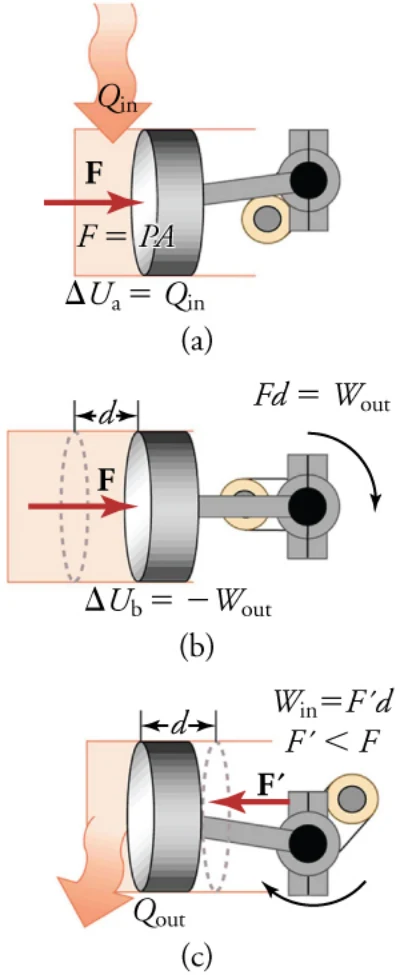
To repeat this process, the piston needs to be returned to its starting point. Heat now transfers energy from the gas to the surroundings, so that the gas’s pressure decreases, and a force is exerted by the surroundings to push the piston back through some distance.
この過程を繰り返すには、ピストンを出発点へ戻す必要がある。こんどは熱が気体から周囲へエネルギーを移し、気体の圧力が下がって、周囲が力を及ぼしてピストンをある距離だけ押し戻す。
A cyclical process brings a system, such as the gas in a cylinder, back to its original state at the end of every cycle. All heat engines use cyclical processes.
循環過程とは、シリンダーの中の気体のような系を、毎回の循環の終わりに元の状態へ戻す過程である。熱機関はすべて循環過程を使う。
Heat engines do work by using part of the energy transferred by heat from some source. As shown in Figure 12.14, heat transfers energy, , from the high-temperature object (or hot reservoir), whereas heat transfers unused energy, , into the low-temperature object (or cold reservoir), and the work done by the engine is W. In physics, a reservoir is defined as an infinitely large mass that can take in or put out an unlimited amount of heat, depending upon the needs of the system. The temperature of the hot reservoir is and the temperature of the cold reservoir is .
熱機関は、何らかの源から熱によって移されたエネルギーの一部を使って仕事をする。図12.14に示すとおり、熱は温度の高い物体(すなわち高温熱源)からエネルギーを移し、一方で熱は使われなかったエネルギーを温度の低い物体(すなわち低温熱源)へ移し、機関がした仕事がWである。物理では、熱源とは、系の必要に応じて限りない量の熱を受け取ったり出したりできる、無限に大きな質量として定義される。高温熱源の温度が、低温熱源の温度がである。
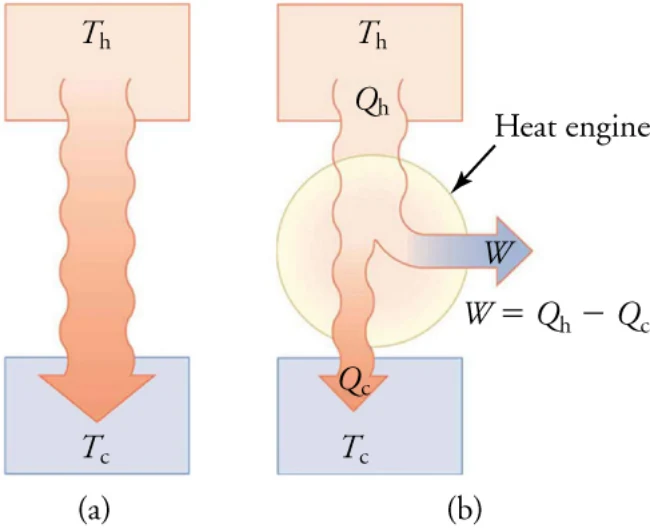
As noted, a cyclical process brings the system back to its original condition at the end of every cycle. Such a system’s internal energy, U, is the same at the beginning and end of every cycle—that is, . The first law of thermodynamics states that where Q is the net heat transfer during the cycle, and W is the net work done by the system. The net heat transfer is the energy transferred in by heat from the hot reservoir minus the amount that is transferred out to the cold reservoir ( ). Because there is no change in internal energy for a complete cycle ( ), we have
述べたとおり、循環過程は毎回の循環の終わりに系を元の状態へ戻す。そうした系の内部エネルギーUは、毎回の循環の初めと終わりで同じ——すなわちである。熱力学第一法則はと述べる。ここでQは循環のあいだの正味の熱の移動、Wは系がした正味の仕事である。正味の熱の移動は、熱によって高温熱源から入ったエネルギーから、低温熱源へ出ていったぶんを引いたもの()である。一循環全体では内部エネルギーの変化がない()ので、
so that
となり、したがって
Therefore, the net work done by the system equals the net heat into the system, or
したがって、循環過程では系がした正味の仕事は系へ入る正味の熱に等しく、
for a cyclical process.
となる。
Because the hot reservoir is heated externally, which is an energy-intensive process, it is important that the work be done as efficiently as possible. In fact, we want W to equal , and for there to be no heat to the environment (that is, ). Unfortunately, this is impossible. According to the second law of thermodynamics, heat engines cannot have perfect conversion of heat into work. Recall that entropy is a measure of the disorder of a system, which is also how much energy is unavailable to do work. The second law of thermodynamics requires that the total entropy of a system either increases or remains constant in any process. Therefore, there is a minimum amount of that cannot be used for work. The amount of heat rejected to the cold reservoir, depends upon the efficiency of the heat engine. The smaller the increase in entropy, , the smaller the value of , and the more heat energy is available to do work.
高温熱源は外から加熱され、それはエネルギーを多く食う過程なので、仕事はできる限り効率よくなされることが大切である。実のところ、Wがに等しく、環境への熱がない(すなわち)ことが望ましい。あいにく、これは不可能である。熱力学第二法則によれば、熱機関が熱を完全に仕事へ変えることはできない。エントロピーとは系の無秩序さを測るものであり、それはまた仕事に使えないエネルギーがどれだけあるかでもあったことを思い出そう。熱力学第二法則は、どんな過程でも系の全エントロピーが増えるか一定のままであることを求める。したがって、仕事に使えないの最小量が存在する。低温熱源へ捨てられる熱の量は、熱機関の効率による。エントロピーの増えが小さいほどの値は小さく、仕事に使える熱エネルギーは多くなる。
Heat pumps, air conditioners, and refrigerators utilize heat transfer of energy from low to high temperatures, which is the opposite of what heat engines do. Heat transfers energy from a cold reservoir and delivers energy into a hot one. This requires work input, W, which produces a transfer of energy by heat. Therefore, the total heat transfer to the hot reservoir is
ヒートポンプ、エアコン、冷蔵庫は、低い温度から高い温度への熱によるエネルギーの移動を利用する。これは熱機関がすることの逆である。熱は低温熱源からエネルギーを移し、高温熱源へエネルギーを届ける。これには仕事の入力Wが要り、それが熱によるエネルギーの移動を生む。したがって、高温熱源への熱の移動の合計は
The purpose of a heat pump is to transfer energy by heat to a warm environment, such as a home in the winter. The great advantage of using a heat pump to keep your home warm rather than just burning fuel in a fireplace or furnace is that a heat pump supplies . Heat comes from the outside air, even at a temperature below freezing, to the indoor space. You only pay for W, and you get an additional heat transfer of from the outside at no cost. In many cases, at least twice as much energy is transferred to the heated space as is used to run the heat pump. When you burn fuel to keep warm, you pay for all of it. The disadvantage to a heat pump is that the work input (required by the second law of thermodynamics) is sometimes more expensive than simply burning fuel, especially if the work is provided by electrical energy.
ヒートポンプの目的は、冬の家のような暖かい環境へ熱によってエネルギーを移すことである。暖炉や炉で燃料を燃やすだけでなくヒートポンプを使って家を暖める大きな利点は、ヒートポンプがを供給することである。熱は、氷点下の温度であっても、外の空気から屋内の空間へやってくる。支払うのはWのぶんだけで、外からぶんの熱の移動が余分に手に入る。ただで手に入る。多くの場合、ヒートポンプを動かすのに使うエネルギーの少なくとも2倍のエネルギーが、暖める空間へ移される。燃料を燃やして暖まるなら、そのすべてに代金を払うことになる。ヒートポンプの欠点は、(熱力学第二法則が求める)仕事の入力が、とくにその仕事が電気エネルギーで賄われる場合、単に燃料を燃やすより高くつくことがある点である。
The basic components of a heat pump are shown in Figure 12.15. A working fluid, such as a refrigerant, is used. In the outdoor coils (the evaporator), heat enters the working fluid from the cold outdoor air, turning it into a gas.
ヒートポンプの基本的な部品を図12.15に示す。冷媒のような作動流体が使われる。屋外のコイル(蒸発器)で、冷たい外気から作動流体へ熱が入り、流体は気体になる。
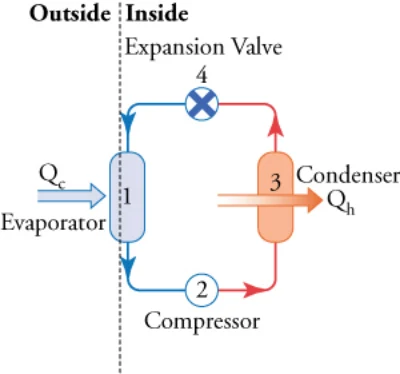
The electrically driven compressor (work input W) raises the temperature and pressure of the gas and forces it into the condenser coils that are inside the heated space. Because the temperature of the gas is higher than the temperature inside the room, heat transfers energy to the room, and the gas condenses into a liquid. The liquid then flows back through an expansion (pressure-reducing) valve. The liquid, having been cooled through expansion, returns to the outdoor evaporator coils to resume the cycle.
電気で動く圧縮機(仕事の入力W)が気体の温度と圧力を上げ、暖める空間の中にある凝縮器のコイルへ気体を押し込む。気体の温度は部屋の中の温度より高いので、熱が部屋へエネルギーを移し、気体は凝縮して液体になる。液体はそのあと膨張(減圧)弁を通って戻る。膨張によって冷やされた液体は、屋外の蒸発器のコイルへ戻り、循環を再開する。
The quality of a heat pump is judged by how much energy is transferred by heat into the warm space ( ) compared with how much input work (W) is required.
ヒートポンプの良し悪しは、必要な仕事の入力(W)にくらべて、熱によって暖かい空間へどれだけのエネルギー()が移されるかで判断される。
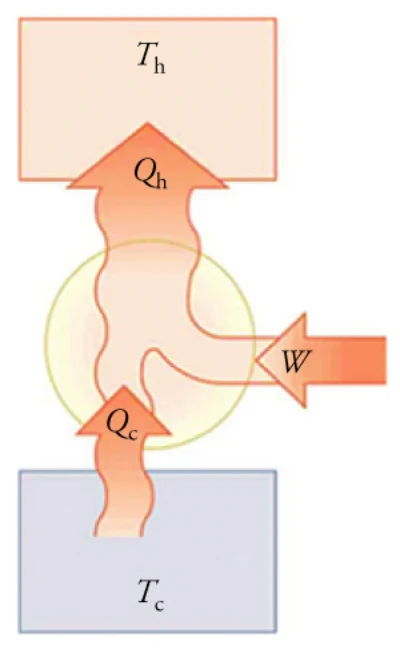
Air conditioners and refrigerators are designed to cool substances by transferring energy by heat out of a cool environment to a warmer one, where heat is given up. In the case of a refrigerator, heat is moved out of the inside of the fridge into the surrounding room. For an air conditioner, heat is transferred outdoors from inside a home. Heat pumps are also often used in a reverse setting to cool rooms in the summer.
エアコンと冷蔵庫は、涼しい環境から熱によってエネルギーを取り出し、より暖かいほうへ移して熱を渡すことで、物を冷やすように作られている。冷蔵庫の場合、熱は庫内から周りの部屋へ運び出される。エアコンでは、熱は家の中から屋外へ移される。ヒートポンプも、夏に部屋を冷やすために逆向きの設定でよく使われる。
As with heat pumps, work input is required for heat transfer of energy from cold to hot. The quality of air conditioners and refrigerators is judged by how much energy is removed by heat from a cold environment, compared with how much work, W, is required. So, what is considered the energy benefit in a heat pump, is considered waste heat in a refrigerator.
ヒートポンプと同じく、冷たいほうから熱いほうへ熱でエネルギーを移すには仕事の入力が要る。エアコンと冷蔵庫の良し悪しは、必要な仕事Wにくらべて、冷たい環境から熱によってどれだけのエネルギーが取り除かれるかで判断される。つまり、ヒートポンプでエネルギー上の利益とみなされるものが、冷蔵庫では廃熱とみなされる。
Thermal Efficiency熱効率
In the conversion of energy into work, we are always faced with the problem of getting less out than we put in. The problem is that, in all processes, there is some heat that transfers energy to the environment—and usually a very significant amount at that. A way to quantify how efficiently a machine runs is through a quantity called thermal efficiency.
エネルギーを仕事へ変えるとき、私たちはつねに、入れたぶんより取り出せるぶんが少ないという問題に直面する。問題は、どの過程でも環境へエネルギーを移す熱が必ずあり、しかもふつうそれがかなりの量になることである。機械がどれだけ効率よく動くかを数量で表すやり方が、熱効率と呼ばれる量である。
We define thermal efficiency, Eff, to be the ratio of useful energy output to the energy input (or, in other words, the ratio of what we get to what we spend). The efficiency of a heat engine is the output of net work, W, divided by heat-transferred energy, , into the engine; that is
熱効率Effを、有用なエネルギーの出力と、エネルギーの入力との比(言い換えれば、得たものと費やしたものとの比)と定める。熱機関の効率は、正味の仕事の出力Wを、熱によって機関へ移されたエネルギーで割ったものである。すなわち
An efficiency of 1, or 100 percent, would be possible only if there were no heat to the environment ( ).
効率が1、すなわち100パーセントになりうるのは、環境への熱がない()場合だけである。
TIPS FOR SUCCESS All values of heat ( and ) are positive; there is no such thing as negative heat. The direction of heat is indicated by a plus or minus sign. For example, is out of the system, so it is preceded by a minus sign in the equation for net heat.
学習のポイント 熱の値(と)はすべて正である。負の熱などというものはない。熱の向きはプラスかマイナスの符号で示される。たとえばは系から出るぶんなので、正味の熱の式ではマイナス符号が前に付く。
Solving Thermal Efficiency Problems熱効率の問題を解く
Daily Work Done by a Coal-Fired Power Station and Its Efficiency A coal-fired power station is a huge heat engine. It uses heat to transfer energy from burning coal to do work to turn turbines, which are used then to generate electricity. In a single day, a large coal power station transfers by heat from burning coal and transfers by heat into the environment. (a) What is the work done by the power station? (b) What is the efficiency of the power station?Strategy
石炭火力発電所が1日にする仕事とその効率 石炭火力発電所は巨大な熱機関である。燃える石炭からのエネルギーを熱で移し、タービンを回す仕事をさせ、それで電気を起こす。1日で、大きな石炭火力発電所は燃える石炭から熱によってを移し、熱によってを環境へ移す。(a)この発電所がした仕事はいくらか。(b)この発電所の効率はいくらか。方針
We can use to find the work output, W, assuming a cyclical process is used in the power station. In this process, water is boiled under pressure to form high-temperature steam, which is used to run steam turbine-generators and then condensed back to water to start the cycle again.
発電所で循環過程が使われているとして、を使って仕事の出力Wを求められる。この過程では、水が圧力のもとで沸かされて高温の蒸気になり、それが蒸気タービン発電機を動かし、そのあと凝縮して水へ戻り、また循環を始める。
Solution解答
Work output is given by
仕事の出力は次で与えられる。
Substituting the given values,
与えられた値を代入すると、
Strategy方針
391The efficiency can be calculated with , because is given, and work, W, was calculated in the first part of this example.
効率はで計算できる。が与えられており、仕事Wはこの例題の前半で計算したからである。
Solution解答
Efficiency is given by
効率は次で与えられる。
The work, W, is found to be , and is given ( ), so the efficiency is
仕事Wはと求まり、は(と)与えられているので、効率は
Discussion考察
The efficiency found is close to the usual value of 42 percent for coal-burning power stations. It means that fully 59.2 percent of the energy is transferred by heat to the environment, which usually results in warming lakes, rivers, or the ocean near the power station and is implicated in a warming planet generally. While the laws of thermodynamics limit the efficiency of such plants—including plants fired by nuclear fuel, oil, and natural gas—the energy transferred by heat to the environment could be, and sometimes is, used for heating homes or for industrial processes.
求まった効率は、石炭火力発電所のふつうの値である42パーセントに近い。これは、エネルギーの実に59.2パーセントが熱によって環境へ移されることを意味する。それはたいてい発電所の近くの湖・川・海を温める結果になり、惑星全体の温暖化にも関わっている。熱力学の法則がこうした発電所——核燃料・石油・天然ガスを使うものも含め——の効率を制限してはいるが、熱によって環境へ移されるエネルギーは、家庭の暖房や工業の過程に使うこともでき、実際に使われている場合もある。
Practice Problems練習問題
17A heat engine is given by heat and releases by heat to the environment. What is the amount of work done by the system?
17熱機関が熱によってを与えられ、熱によってを環境へ放出する。この系がした仕事の量はいくらか。
18A heat engine takes in 6.0 kJ from heat and produces waste heat of 4.8 kJ. What is its efficiency?a. 25 percentb. 2.50 percent
18熱機関が熱から6.0 kJを取り入れ、4.8 kJの廃熱を出す。その効率はいくらか。a. 25パーセントb. 2.50パーセント
c. 2.00 percentd. 20 percent
c. 2.00パーセントd. 20パーセント
Check Your Understanding理解の確認
19What is a heat engine?a. A heat engine converts mechanical energy into thermal energy.b. A heat engine converts thermal energy into mechanical energy.c. A heat engine converts thermal energy into electrical energy.d. A heat engine converts electrical energy into thermal energy.
19熱機関とは何か。a. 熱機関は力学的エネルギーを熱エネルギーへ変える。b. 熱機関は熱エネルギーを力学的エネルギーへ変える。c. 熱機関は熱エネルギーを電気エネルギーへ変える。d. 熱機関は電気エネルギーを熱エネルギーへ変える。
20Give an example of a heat engine.a. A generatorb. A battery
20熱機関の例を挙げよ。a. 発電機b. 電池
c. A water pumpd. A car engine
c. 水のポンプd. 自動車のエンジン
21What is thermal efficiency?a. Thermal efficiency is the ratio of work input to the energy input.b. Thermal efficiency is the ratio of work output to the energy input.
21熱効率とは何か。a. 熱効率とは、仕事の入力とエネルギーの入力との比である。b. 熱効率とは、仕事の出力とエネルギーの入力との比である。
c. Thermal efficiency is the ratio of work input to the energy output.d. Thermal efficiency is the ratio of work output to the energy output.
c. 熱効率とは、仕事の入力とエネルギーの出力との比である。d. 熱効率とは、仕事の出力とエネルギーの出力との比である。
22What is the mathematical expression for thermal efficiency?
22熱効率を表す数式はどれか。