第12章熱力学Thermodynamics原書 p.369–404
Chapter Review章のまとめ
Concept Items概念の問題
12.1 Zeroth Law of Thermodynamics: Thermal Equilibrium 1When are two bodies in thermal equilibrium?a. When they are in thermal contact and are at different pressuresb. When they are not in thermal contact but are at the same pressurec. When they are not in thermal contact but are at different temperaturesd. When they are in thermal contact and are at the same temperature
12.1 熱力学第零法則:熱平衡 1二つの物体が熱平衡にあるのはどんなときか。a. 熱的に接していて、違う圧力にあるときb. 熱的に接していないが、同じ圧力にあるときc. 熱的に接していないが、違う温度にあるときd. 熱的に接していて、同じ温度にあるとき
2What is thermal contact?a. Two objects are said to be in thermal contact when they are in contact with each other in such a way that the transfer of energy by heat can occur between them.b. Two objects are said to be in thermal contact when they are in contact with each other in such a way that the transfer of energy by mass can occur between them.c. Two objects are said to be in thermal contact when they neither lose nor gain energy by heat. There is no transfer of energy between them.d. Two objects are said to be in thermal contact when they only gain energy by
2熱的な接触とは何か。a. 二つの物体の間で熱によるエネルギーの移動が起こりうるように接しているとき、両者は熱的に接しているという。b. 二つの物体の間で質量によるエネルギーの移動が起こりうるように接しているとき、両者は熱的に接しているという。c. 二つの物体が熱によってエネルギーを失いも得もしないとき、両者は熱的に接しているという。両者の間にエネルギーの移動はない。d. 二つの物体が熱によってエネルギーを得るだけのとき、
during a cycle; more waste heat leads to less work output.• Heat pumps draw energy by heat from cold outside air and use it to heat an interior room.• A refrigerator is a type of heat pump; it takes energy from the warm air from the inside compartment and transfers it to warmer exterior air.
熱によるエネルギーの移動によって決まる。廃熱が多いほど仕事の出力は少ない。・ヒートポンプは冷たい外気から熱によってエネルギーを引き出し、それを使って屋内の部屋を暖める。・冷蔵庫はヒートポンプの一種である。庫内の暖かい空気からエネルギーを取り出し、より暖かい外の空気へ移す。
12.3 Second Law of Thermodynamics: Entropy12.3 熱力学第二法則:エントロピー
12.4 Applications of Thermodynamics: Heat Engines, Heat Pumps, and Refrigerators12.4 熱力学の応用:熱機関、ヒートポンプ、冷蔵庫
thermal efficiency of a heat engine
熱機関の熱効率
work output for a cyclical process
循環過程での仕事の出力
heat. There is transfer of energy between them.
両者は熱的に接しているという。両者の間にエネルギーの移動がある。
3To which mathematical property is the zeroth law of thermodynamics similar?
3熱力学第零法則はどの数学の性質に似ているか。
a. Associative propertyb. Commutative propertyc. Distributive propertyd. Transitive property
a. 結合律b. 交換律c. 分配律d. 推移律
12.2 First law of Thermodynamics: Thermal Energy and Work 4Why does thermal expansion occur?a. An increase in temperature causes intermolecular distances to increase.b. An increase in temperature causes intermolecular distances to decrease.c. An increase in temperature causes an increase in the work done on the system.d. An increase in temperature causes an increase in the work done by the system.
12.2 熱力学第一法則:熱エネルギーと仕事 4熱膨張が起こるのはなぜか。a. 温度が上がると分子間の距離が広がるから。b. 温度が上がると分子間の距離が縮まるから。c. 温度が上がると系になされる仕事が増えるから。d. 温度が上がると系がする仕事が増えるから。
5How does pressure-volume work relate to heat and internal energy of a system?
5圧力-体積仕事は、系の熱と内部エネルギーとどう関係するか。
a. The energy added to a system by heat minus the change in the internal energy of that system is equal to the pressure-
a. 熱によって系に加えられたエネルギーから、その系の内部エネルギーの変化を引いたものが、系がした
volume work done by the system.b. The sum of the energy released by a system by heat and the change in the internal energy of that system is equal to the pressure-volume work done by the system.c. The product of the energy added to a system by heat and the change in the internal energy of that system is equal to the pressure-volume work done by the system.d. If the energy added to a system by heat is divided by the change in the internal energy of that system, the quotient is equal to the pressure-volume work done by the system.
圧力-体積仕事に等しい。b. 熱によって系から放出されたエネルギーと、その系の内部エネルギーの変化との和が、系がした圧力-体積仕事に等しい。c. 熱によって系に加えられたエネルギーと、その系の内部エネルギーの変化との積が、系がした圧力-体積仕事に等しい。d. 熱によって系に加えられたエネルギーを、その系の内部エネルギーの変化で割った商が、系がした圧力-体積仕事に等しい。
6On what does internal energy depend?a. The path of energy changes in the systemb. The state of the system
6内部エネルギーは何によって決まるか。a. 系におけるエネルギー変化の経路b. 系の状態
c. The size of the systemd. The shape of the system
c. 系の大きさd. 系の形
7The first law of thermodynamics helps us understand the relationships among which three quantities?
7熱力学第一法則は、どの三つの量の関係を理解する助けになるか。
a. Heat, work, and internal energyb. Heat, work, and external energyc. Heat, work, and enthalpyd. Heat, work, and entropy
a. 熱、仕事、内部エネルギーb. 熱、仕事、外部エネルギーc. 熱、仕事、エンタルピーd. 熱、仕事、エントロピー
12.3 Second Law of Thermodynamics: Entropy 8Air freshener is sprayed from a bottle. The molecules spread throughout the room and cannot make their way back into the bottle. Why is this the case?
12.3 熱力学第二法則:エントロピー 8芳香剤がボトルから噴かれる。分子は部屋じゅうに広がり、ボトルへ戻ることはできない。それはなぜか。
a. The entropy of the molecules increases.b. The entropy of the molecules decreases.
a. 分子のエントロピーが増えるから。b. 分子のエントロピーが減るから。
c. The heat content (enthalpy, or total energy available for heat) of the molecules increases.d. The heat content (enthalpy, or total energy available for heat) of the molecules decreases.
c. 分子の熱の含み(エンタルピー、すなわち熱に使える全エネルギー)が増えるから。d. 分子の熱の含み(エンタルピー、すなわち熱に使える全エネルギー)が減るから。
9Give an example of entropy as experienced in
9日常で経験するエントロピーの例を
Critical Thinking Items批判的に考える問題
12.1 Zeroth Law of Thermodynamics: Thermal Equilibrium 13What are the necessary conditions for energy transfer by heat to occur between two bodies
12.1 熱力学第零法則:熱平衡 13伝導の過程によって二つの物体の間で熱によるエネルギーの移動が起こるために
everyday life.
挙げよ。
a. rotation of Earthb. formation of a solar eclipsec. filling a car tire with aird. motion of a pendulum bob
a. 地球の自転b. 日食が起こることc. 車のタイヤに空気を入れることd. 振り子のおもりの運動
12.4 Applications of Thermodynamics: Heat Engines, Heat Pumps, and Refrigerators 10. What is the quality by which air conditioners are judged?12.4 熱力学の応用:熱機関、ヒートポンプ、冷蔵庫 10. エアコンはどんな性質で判断されるか。
a. The amount of energy generated by heat from a hot environment, compared with the required work inputb. The amount of energy transferred by heat from a cold environment, compared with the required work inputc. The amount of energy transferred by heat from a hot environment, compared with the required work outputd. The amount of energy transferred by heat from a cold environment, compared with the required work output
a. 必要な仕事の入力にくらべて、熱い環境から熱によって生み出されるエネルギーの量b. 必要な仕事の入力にくらべて、冷たい環境から熱によって移されるエネルギーの量c. 必要な仕事の出力にくらべて、熱い環境から熱によって移されるエネルギーの量d. 必要な仕事の出力にくらべて、冷たい環境から熱によって移されるエネルギーの量
11Why is the efficiency of a heat engine never 100 percent?
11熱機関の効率が決して100パーセントにならないのはなぜか。
a. Some energy is always gained by heat from the environment.b. Some energy is always lost by heat to the environment.c. Work output is always greater than energy input.d. Work output is infinite for any energy input.
a. 環境から熱によっていくらかのエネルギーをつねに得るから。b. 環境へ熱によっていくらかのエネルギーをつねに失うから。c. 仕事の出力がつねにエネルギーの入力より大きいから。d. どんなエネルギーの入力に対しても仕事の出力が無限になるから。
12What is a cyclic process?a. A process in which the system returns to its original state at the end of the cycleb. A process in which the system does not return to its original state at the end of the cyclec. A process in which the system follows the same path for every cycled. A process in which the system follows a different path for every cycle
12循環過程とは何か。a. 循環の終わりに系が元の状態へ戻る過程b. 循環の終わりに系が元の状態へ戻らない過程c. 毎回の循環で系が同じ経路をたどる過程d. 毎回の循環で系が違う経路をたどる過程
through the process of conduction?
必要な条件は何か。
a. They should be at the same temperature, and they should be in thermal contact.b. They should be at the same temperature,
a. 同じ温度にあり、熱的に接していること。b. 同じ温度にあり、
and they should not be in thermal contact.c. They should be at different temperatures, and they should be in thermal contact.d. They should be at different temperatures, and they should not be in thermal contact.
熱的に接していないこと。c. 違う温度にあり、熱的に接していること。d. 違う温度にあり、熱的に接していないこと。
14Oil is heated in a pan on a hot plate. The pan is in thermal equilibrium with the hot plate and also with the oil. The temperature of the hot plate is 150 °C . What is the temperature of the oil?a. 160 °Cb. 150 °C
14電熱器の上のフライパンで油を熱する。フライパンは電熱器とも油とも熱平衡にある。電熱器の温度は150 ℃である。油の温度はいくらか。a. 160 ℃b. 150 ℃
c. 140 °Cd. 130 °C
c. 140 ℃d. 130 ℃
12.2 First law of Thermodynamics: Thermal Energy and Work 15When an inflated balloon experiences a decrease in size, the air pressure inside the balloon remains nearly constant. If there is no transfer of energy by heat to or from the balloon, what physical change takes place in the balloon?a. The average kinetic energy of the gas particles decreases, so the balloon becomes colder.b. The average kinetic energy of the gas particles increases, so the balloon becomes hotter.c. The average potential energy of the gas particles decreases, so the balloon becomes colder.d. The average potential energy of the gas particles increases, so the balloon becomes hotter.
12.2 熱力学第一法則:熱エネルギーと仕事 15膨らんだ風船が小さくなるとき、風船の中の空気の圧力はほぼ一定のままである。熱によるエネルギーの出入りが風船にないとすると、風船にはどんな物理的変化が起こるか。a. 気体の粒子の平均の運動エネルギーが減り、風船は冷たくなる。b. 気体の粒子の平均の運動エネルギーが増え、風船は熱くなる。c. 気体の粒子の平均の位置エネルギーが減り、風船は冷たくなる。d. 気体の粒子の平均の位置エネルギーが増え、風船は熱くなる。
16What are two reasonable outcomes of adding heat energy to an inflated balloon?
16膨らんだ風船に熱エネルギーを加えたときに起こりうる、もっともらしい結果を二つ挙げよ。
a. Increased pressure and constant volume.b. Constant pressure and increased volume.
a. 圧力が増え、体積は一定。b. 圧力は一定で、体積が増える。
c. Constant pressure and constant volume.d. Increased pressure and increased volume.
c. 圧力も体積も一定。d. 圧力も体積も増える。
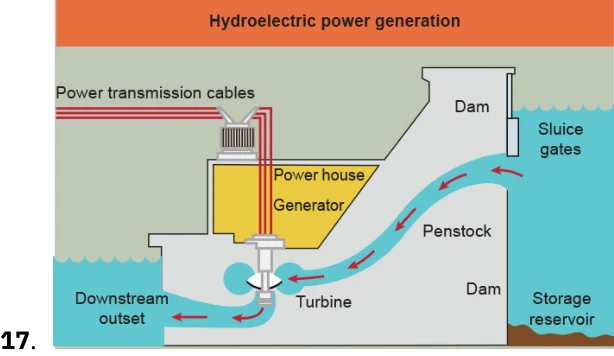
(credit: modification of work by Environment
(credit: カナダ環境省の作品を改変)
Canada) A hydroelectric dam produces electricity by moving water from a reservoir fed by a river above through a turbine below. Consider the system to include the dam and the reservoir. If the turbine jams and stops producing electricity, what effect will this have on the internal energy of the system?
水力発電のダムは、川から水を引いた上の貯水池から下のタービンへ水を落として電気を起こす。ダムと貯水池を含めたものを系と考える。タービンが詰まって電気を起こさなくなったら、系の内部エネルギーにどんな影響があるか。
a. The internal energy would be converted to work.b. The internal energy would remain constant because work is no longer being done.c. The excess internal energy would radiate as heat.d. The internal energy will increase as the reservoir fills up.
a. 内部エネルギーは仕事へ変わる。b. もう仕事がなされないので、内部エネルギーは一定のままである。c. 余分な内部エネルギーは熱として放射される。d. 貯水池が満たされるにつれて内部エネルギーは増える。
18Air is pumped into a car tire, causing its temperature to increase. In another tire, the temperature increase is due to exposure to the sun. Is it possible to tell what caused the temperature increase in each tire? Explain your answer.
18車のタイヤに空気を入れて、その温度が上がった。別のタイヤでは、温度の上昇は日射によるものである。それぞれのタイヤで何が温度上昇を起こしたのかを見分けることはできるか。答えを説明せよ。
a. No, because it is a chemical change, and the cause of that change does not matter; the final state of both systems are the same.b. Although the final state of each system is identical, the source is different in each case.c. No, because the changes in energy for both systems are the same, and the cause of that change does not matter; the state of each system is identical.d. Yes, the changes in the energy for both systems are the same, but the causes of that change are different, so the states of each system are not identical.
a. いいえ。それは化学変化であり、その変化の原因は問題にならないから。どちらの系の最終状態も同じである。b. どちらの系の最終状態も同じだが、その源はそれぞれ違う。c. いいえ。どちらの系でもエネルギーの変化は同じであり、その変化の原因は問題にならないから。どちらの系の状態も同じである。d. はい。どちらの系でもエネルギーの変化は同じだが、その変化の原因は違うので、それぞれの系の状態は同じではない。
19How does the transfer of energy from the sun help plants?
19太陽からのエネルギーの移動は植物をどう助けるか。
a. Plants absorb solar energy from the sun and utilize it during the fertilization process.b. Plants absorb solar energy from the sun and utilize it during the process of photosynthesis to turn it into plant matter.c. Plants absorb solar energy from the sun and utilize it to increase the temperature inside them.d. Plants absorb solar energy from the sun and utilize it during the shedding of their leaves and fruits.
a. 植物は太陽から太陽エネルギーを吸収し、受精の過程でそれを利用する。b. 植物は太陽から太陽エネルギーを吸収し、光合成の過程でそれを利用して植物の体へ変える。c. 植物は太陽から太陽エネルギーを吸収し、体内の温度を上げるのに利用する。d. 植物は太陽から太陽エネルギーを吸収し、葉や実を落とすときにそれを利用する。
12.3 Second Law of Thermodynamics: Entropy 20If an engine were constructed to perform such that there would be no losses due to friction, what would be its efficiency?
12.3 熱力学第二法則:エントロピー 20摩擦による損失がまったくないように作られた機関があるとしたら、その効率はいくらになるか。
a. It would be 0 percent.b. It would be less than 100 percent.
a. 0パーセントになる。b. 100パーセントより小さくなる。
c. It would be 100 percent.d. It would be greater than 100 percent.
c. 100パーセントになる。d. 100パーセントより大きくなる。
21Entropy never decreases in a spontaneous process. Give an example to support this statement.
21自発的な過程でエントロピーが減ることは決してない。この言明を裏づける例を挙げよ。
a. The transfer of energy by heat from colder bodies to hotter bodies is a spontaneous process in which the entropy of the system of bodies increases.b. The melting of an ice cube placed in a room causes an increase in the entropy of the room.c. The dissolution of salt in water is a spontaneous process in which the entropy of the system increases.d. A plant uses energy from the sun and converts it into sugar molecules by the process of photosynthesis.
a. 冷たい物体から熱い物体への熱によるエネルギーの移動は、物体の系のエントロピーが増える自発的な過程である。b. 部屋に置かれた氷が融けると、部屋のエントロピーが増える。c. 塩が水に溶けることは、系のエントロピーが増える自発的な過程である。d. 植物は太陽からのエネルギーを使い、光合成の過程でそれを糖の分子へ変える。
12.4 Applications of Thermodynamics: Heat Engines, Heat Pumps, and Refrigerators 22What is the advantage of a heat pump as opposed to burning fuel (as in a fireplace) for keeping warm?
12.4 熱力学の応用:熱機関、ヒートポンプ、冷蔵庫 22暖をとるのに、(暖炉のように)燃料を燃やすのにくらべて、ヒートポンプにはどんな利点があるか。
a. A heat pump supplies energy by heat from the cold, outside air.
a. ヒートポンプは冷たい外気から熱によってエネルギーを供給する。
Problems問題
12.2 First law of Thermodynamics: Thermal Energy and Work 25Some amount of energy is transferred by heat into a system. The net work done by the system is , while the increase in its internal energy is . What is the amount of net heat?a. b.
12.2 熱力学第一法則:熱エネルギーと仕事 25ある量のエネルギーが熱によって系へ移される。系がした正味の仕事は、内部エネルギーの増加はである。正味の熱の量はいくらか。a. b.
26Eighty joules are added by heat to a system, while it does of work. Later, are added by heat to the system, and it does of work. What is the change in the system’s internal energy?
2680ジュールが熱によって系に加えられ、その間に系はの仕事をする。そのあとが熱によって系に加えられ、系はの仕事をする。系の内部エネルギーの変化はいくらか。
b. A heat pump supplies energy generated by the work done.c. A heat pump supplies energy by heat from the cold, outside air and also from the energy generated by the work done.d. A heat pump supplies energy not by heat from the cold, outside air, nor from the energy generated by the work done, but from more accessible sources.
b. ヒートポンプはなされた仕事から生まれるエネルギーを供給する。c. ヒートポンプは冷たい外気から熱によってエネルギーを供給し、加えてなされた仕事から生まれるエネルギーも供給する。d. ヒートポンプは、冷たい外気からの熱によってでも、なされた仕事から生まれるエネルギーによってでもなく、もっと手に入りやすい源からエネルギーを供給する。
23What is thermal efficiency of an engine? Can it ever be 100 percent? Why or why not?
23機関の熱効率とは何か。それが100パーセントになることはありうるか。それはなぜか。
a. Thermal efficiency is the ratio of the output (work) to the input (heat). It is always 100 percent.b. Thermal efficiency is the ratio of the output (heat) to the input (work). It is always 100 percent.c. Thermal efficiency is the ratio of the output (heat) to the input (work). It is never 100 percent.d. Thermal efficiency is the ratio of the output (work) to the input (heat). It is never 100 percent.
a. 熱効率とは出力(仕事)と入力(熱)との比である。それはつねに100パーセントである。b. 熱効率とは出力(熱)と入力(仕事)との比である。それはつねに100パーセントである。c. 熱効率とは出力(熱)と入力(仕事)との比である。それが100パーセントになることは決してない。d. 熱効率とは出力(仕事)と入力(熱)との比である。それが100パーセントになることは決してない。
24When would 100 percent thermal efficiency be possible?
24熱効率100パーセントが可能になるのはどんなときか。
a. When all energy is transferred by heat to the environmentb. When mass transferred to the environment is zeroc. When mass transferred to the environment is at a maximumd. When no energy is transferred by heat to the environment
a. すべてのエネルギーが熱によって環境へ移されるときb. 環境へ移る質量が0のときc. 環境へ移る質量が最大のときd. 熱によって環境へ移るエネルギーがないとき
12.4 Applications of Thermodynamics: Heat Engines, Heat Pumps, and Refrigerators 27A coal power station functions at 40.0 percent efficiency. What is the amount of work it does if it takes in 1.20×10¹² J by heat?a. 3×10¹⁰ Jb. 4.8×10¹¹ Jc. 3×10¹² Jd. 4.8×10¹³ J
12.4 熱力学の応用:熱機関、ヒートポンプ、冷蔵庫 27ある石炭火力発電所が40.0パーセントの効率で動いている。熱によって1.20×10¹² Jを取り入れるとき、この発電所がする仕事の量はいくらか。a. 3×10¹⁰ Jb. 4.8×10¹¹ Jc. 3×10¹² Jd. 4.8×10¹³ J
28A heat engine functions with 70.7 percent thermal efficiency and consumes 12.0 kJ from heat daily. If its efficiency were raised to 75.0 percent, how much energy from heat would be saved daily, while providing the same output?
28ある熱機関が熱効率70.7パーセントで働き、毎日熱から12.0 kJを消費している。効率を75.0パーセントに上げたら、同じ出力を出しながら、熱からのエネルギーを毎日どれだけ節約できるか。
Performance Task実践課題
12.4 Applications of Thermodynamics: Heat Engines, Heat Pumps, and Refrigerators 29You have been tasked to design and construct a thermometer that works on the principle of thermal expansion. There are four materials available for you to test, each of which will find use under different sets of conditions and temperature ranges: Materials
12.4 熱力学の応用:熱機関、ヒートポンプ、冷蔵庫 29熱膨張の原理で働く温度計を設計し、作れという課題が与えられた。試せる材料は四つあり、それぞれ違う条件と温度範囲で使い道がある。 材料
• Four sample materials with similar mass or volume: copper, steel, water, and alcohol (ethanol or isopropanol)• Oven or similar heating source• Instrument (e.g., meter ruler, Vernier calipers, or micrometer) for measuring changes in dimension• Balance for measuring mass
・質量または体積の近い四つの試料。銅、鋼、水、アルコール(エタノールまたはイソプロパノール)・オーブンなどの熱源・寸法の変化を測る器具(たとえば直尺、ノギス、マイクロメーター)・質量を測る天びん
Procedure手順
1. Design a safe experiment to analyze the thermal expansion properties of each material.2. Write down the materials needed for your experiment and the procedure you will follow. Make sure that you include every detail so that the experiment can be
1. それぞれの材料の熱膨張の性質を調べる安全な実験を設計する。2. 実験に必要な材料と、たどる手順を書き出す。他の人が同じ実験を