第12章熱力学Thermodynamics原書 p.369–404
12.3 Second Law of Thermodynamics: Entropy12.3 熱力学第二法則:エントロピー
SECTION LEARNING OBJECTIVES By the end of this section, you will be able to do the following:
この節の学習目標 この節を終えると、次のことができるようになる。
• Describe entropy• Describe the second law of thermodynamics• Solve problems involving the second law of thermodynamics
・エントロピーを述べる・熱力学第二法則を述べる・熱力学第二法則に関する問題を解く
Section Key Termsこの節の重要語
entropysecond law of thermodynamics
エントロピー熱力学第二法則
Entropyエントロピー
Recall from the chapter introduction that it is not even theoretically possible for engines to be 100 percent efficient. This phenomenon is explained by the second law of thermodynamics, which relies on a concept known as entropy.
章のはじめに、エンジンが100パーセントの効率を持つことは理論の上でさえ不可能だと述べたことを思い出そう。この事実は熱力学第二法則によって説明され、その法則はエントロピーと呼ばれる概念にもとづいている。
Entropy is a measure of the disorder of a system. Entropy also describes how much energy is not available to do work. The more disordered a system and higher the entropy, the less of a system's energy is available to do work.
エントロピーとは、系の無秩序さを測るものである。エントロピーはまた、仕事に使えないエネルギーがどれだけあるかを表す。系が無秩序でエントロピーが高いほど、系のエネルギーのうち仕事に使えるぶんは少ない。
Although all forms of energy can be used to do work, it is not possible to use the entire available energy for work. Consequently, not all energy transferred by heat can be converted into work, and some of it is lost in the form of waste heat—that is, heat that does not go toward doing work. The unavailability of energy is important in thermodynamics; in fact, the field originated from efforts to convert heat to work, as is done by engines.
あらゆる形のエネルギーが仕事に使えるとはいえ、使えるエネルギーのすべてを仕事に使うことはできない。したがって、熱によって移されたエネルギーのすべてを仕事に変えることはできず、その一部は廃熱——すなわち仕事に向かわない熱——の形で失われる。エネルギーが使えないことは熱力学で重要である。実際この分野は、エンジンがするように熱を仕事へ変えようとする試みから生まれた。
The equation for the change in entropy, , is
エントロピーの変化の式は
where Q is the heat that transfers energy during a process, and T is the absolute temperature at which the process takes place.
ここでQは過程のあいだにエネルギーを移す熱、Tはその過程が起こる絶対温度である。
Q is positive for energy transferred into the system by heat and negative for energy transferred out of the system by heat. In SI, entropy is expressed in units of joules per kelvin (J/K). If temperature changes during the process, then it is usually a good approximation (for small changes in temperature) to take T to be the average temperature in order to avoid trickier math (calculus).
Qは、熱によって系へ移るエネルギーについては正、熱によって系から出るエネルギーについては負である。SIでは、エントロピーはケルビンあたりのジュール(J/K)の単位で表される。過程のあいだに温度が変わる場合は、面倒な数学(微積分)を避けるために、(温度の変化が小さければ)Tを平均の温度とするのがふつうよい近似になる。
TIPS FOR SUCCESS Absolute temperature is the temperature measured in Kelvins. The Kelvin scale is an absolute temperature scale that is measured in terms of the number of degrees above absolute zero. All temperatures are therefore positive. Using temperatures from another, nonabsolute scale, such as Fahrenheit or Celsius, will give the wrong answer.
学習のポイント 絶対温度とは、ケルビンで測った温度である。ケルビン目盛りは絶対温度の目盛りで、絶対零度から何度上かで測られる。したがってすべての温度が正である。ファーレンハイトやセルシウスのような、絶対でない別の目盛りの温度を使うと、答えを間違える。
Second Law of Thermodynamics熱力学第二法則
Have you ever played the card game 52 pickup? If so, you have been on the receiving end of a practical joke and, in the process, learned a valuable lesson about the nature of the universe as described by the second law of thermodynamics. In the game of 52 pickup, the prankster tosses an entire deck of playing cards onto the floor, and you get to pick them up. In the process of picking up the cards, you may have noticed that the amount of work required to restore the cards to an orderly state in the deck is much greater than the amount of work required to toss the cards and create the disorder.
「52枚拾い」というカード遊びをしたことがあるだろうか。あるなら、あなたはいたずらを仕掛けられた側であり、その過程で、熱力学第二法則が述べる宇宙の性質について貴重な教訓を学んだことになる。52枚拾いでは、いたずら好きがトランプ一組をまるごと床にばらまき、あなたがそれを拾うのである。カードを拾いながら、カードを組の中の整った状態へ戻すのに要る仕事の量が、カードをばらまいて無秩序を作るのに要る仕事の量よりはるかに大きいことに気づいたかもしれない。
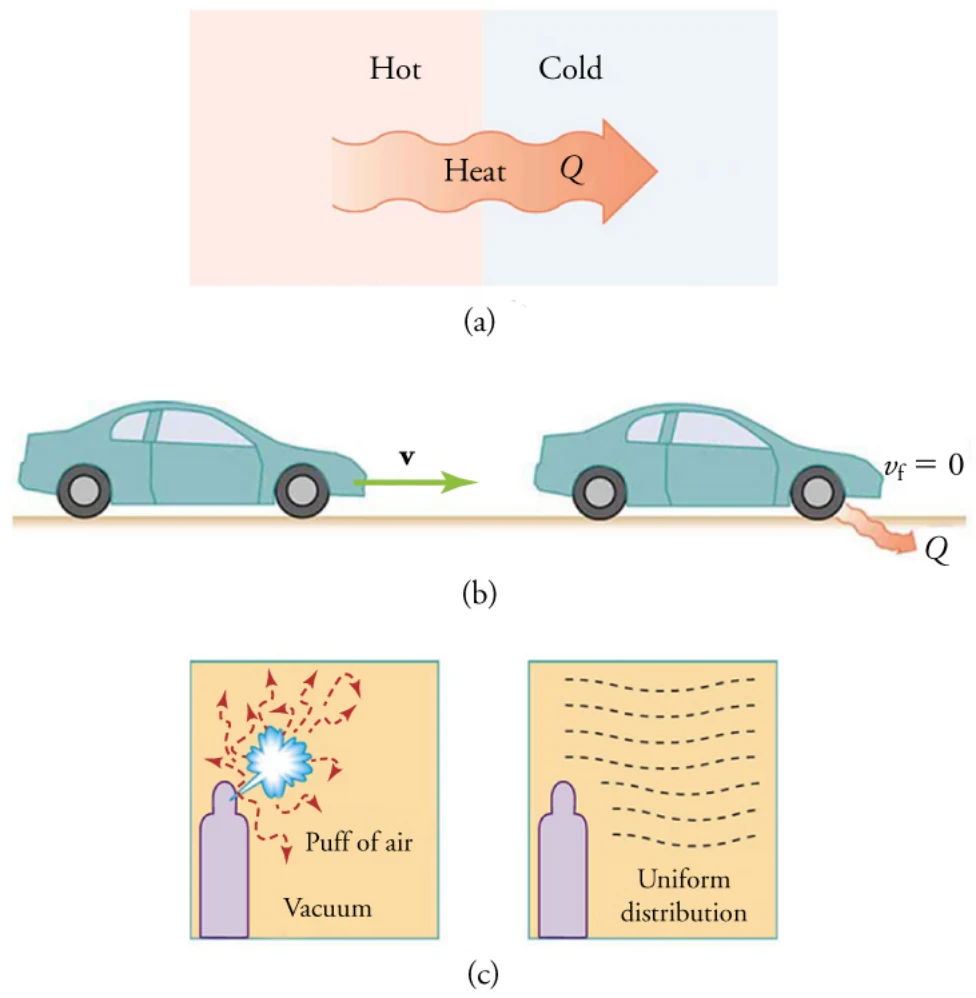
The second law of thermodynamics states that the total entropy of a system either increases or remains constant in any spontaneous process; it never decreases. An important implication of this law is that heat transfers energy spontaneously from higher- to lower-temperature objects, but never spontaneously in the reverse direction. This is because entropy increases for heat transfer of energy from hot to cold (Figure 12.9). Because the change in entropy is Q/T, there is a larger change in at lower temperatures (smaller T). The decrease in entropy of the hot (larger T) object is therefore less than the increase in entropy of the cold (smaller T) object, producing an overall increase in entropy for the system.
熱力学第二法則は、自発的な過程では系の全エントロピーは増えるか一定のままであり、決して減らない、と述べる。この法則の重要な含みは、熱は温度の高い物体から低い物体へは自発的にエネルギーを移すが、逆向きに自発的に移すことは決してない、ということである。これは、熱いほうから冷たいほうへエネルギーが移るときエントロピーが増えるからである(図12.9)。エントロピーの変化はQ/Tなので、低い温度(小さいT)のほうがの変化は大きくなる。したがって熱い(大きいT)物体のエントロピーの減りは、冷たい(小さいT)物体のエントロピーの増えより小さく、系全体としてはエントロピーが増える。

Another way of thinking about this is that it is impossible for any process to have, as its sole result, heat transferring energy from a cooler to a hotter object. Heat cannot transfer energy spontaneously from colder to hotter, because the entropy of the overall system would decrease.
これを別の言い方で考えると、冷たい物体から熱い物体へ熱がエネルギーを移すことだけを結果とするような過程は、ありえないということである。熱が冷たいほうから熱いほうへ自発的にエネルギーを移すことはできない。系全体のエントロピーが減ってしまうからである。
Suppose we mix equal masses of water that are originally at two different temperatures, say and . The result will be water at an intermediate temperature of . Three outcomes have resulted: entropy has increased, some energy has become unavailable to do work, and the system has become less orderly. Let us think about each of these results.
はじめとという違う温度にある同じ質量の水を混ぜるとしよう。結果はという中間の温度の水になる。三つの結果が生じた。エントロピーが増え、一部のエネルギーが仕事に使えなくなり、系は秩序が減った。この一つひとつを考えてみよう。
First, why has entropy increased? Mixing the two bodies of water has the same effect as the heat transfer of energy from the higher-temperature substance to the lower-temperature substance. The mixing decreases the entropy of the hotter water but increases the entropy of the colder water by a greater amount, producing an overall increase in entropy.
第一に、なぜエントロピーが増えたのか。二つの水を混ぜることは、温度の高い物質から低い物質へ熱がエネルギーを移すのと同じ効果を持つ。混ぜることで熱いほうの水のエントロピーは減るが、冷たいほうの水のエントロピーはそれより大きく増え、全体としてはエントロピーが増える。
Second, once the two masses of water are mixed, there is no more temperature difference left to drive energy transfer by heat and therefore to do work. The energy is still in the water, but it is now unavailable to do work.
第二に、いったん二つの水が混ざってしまえば、熱によるエネルギーの移動を駆動し、したがって仕事をさせるための温度差はもう残っていない。エネルギーはまだ水の中にあるが、いまや仕事には使えない。
Third, the mixture is less orderly, or to use another term, less structured. Rather than having two masses at different temperatures and with different distributions of molecular speeds, we now have a single mass with a broad distribution of molecular speeds, the average of which yields an intermediate temperature.
第三に、混ざったものは秩序が減っている。別の言い方をすれば、構造が減っている。違う温度にあり、分子の速さの分布も違う二つの塊があったのが、いまや分子の速さの分布が広い一つの塊になり、その平均が中間の温度を与えている。
These three results—entropy, unavailability of energy, and disorder—not only are related but are, in fact, essentially equivalent. Heat transfer of energy from hot to cold is related to the tendency in nature for systems to become disordered and for less energy to be available for use as work.
これら三つの結果——エントロピー、エネルギーが使えないこと、無秩序——は互いに関係しているだけでなく、実のところ本質的に同じことである。熱いほうから冷たいほうへ熱がエネルギーを移すことは、系が無秩序になり、仕事に使えるエネルギーが減るという自然の傾向に結びついている。
Based on this law, what cannot happen? A cold object in contact with a hot one never spontaneously transfers energy by heat to the hot object, getting colder while the hot object gets hotter. Nor does a hot, stationary automobile ever spontaneously cool off and start moving.
この法則にもとづくと、何が起こりえないか。熱い物体に接している冷たい物体が、自発的に熱によって熱い物体へエネルギーを移し、自分は冷たくなり相手はさらに熱くなる、ということは決して起こらない。熱くて止まっている自動車が、自発的に冷えて動き出すこともない。
Another example is the expansion of a puff of gas introduced into one corner of a vacuum chamber. The gas expands to fill the chamber, but it never regroups on its own in the corner. The random motion of the gas molecules could take them all back to the corner, but this is never observed to happen (Figure 12.10).
もう一つの例が、真空容器の隅に入れられた気体の塊の膨張である。気体は膨らんで容器を満たすが、ひとりでに隅へ集まり直すことは決してない。気体の分子の無秩序な運動が全部を隅へ戻すこともありえはするが、そんなことが起こるのは観測されたことがない(図12.10)。
We've explained that heat never transfers energy spontaneously from a colder to a hotter object. The key word here is spontaneously. If we do work on a system, it is possible to transfer energy by heat from a colder to hotter object. We'll learn more about this in the next section, covering refrigerators as one of the applications of the laws of thermodynamics.
熱が冷たいほうから熱いほうへ自発的にエネルギーを移すことは決してない、と説明してきた。ここで肝心なのは自発的にという語である。系に仕事をするなら、冷たいほうから熱いほうへ熱によってエネルギーを移すことはできる。これについては次の節で、熱力学の法則の応用の一つとして冷蔵庫を扱いながらさらに学ぶ。
Sometimes people misunderstand the second law of thermodynamics, thinking that based on this law, it is impossible for entropy to decrease at any particular location. But, it actually is possible for the entropy of one part of the universe to decrease, as long as the total change in entropy of the universe increases. In equation form, we can write this as
熱力学第二法則は、この法則にもとづけばどの特定の場所でもエントロピーが減ることは不可能だ、と誤解されることがある。しかし実際には、宇宙全体のエントロピーの変化が増えている限り、宇宙のある部分のエントロピーが減ることはありうる。式で書けば次のようになる。
Based on this equation, we see that can be negative as long as is positive and greater in magnitude.
この式から、は、が正で大きさがそれより大きい限り、負でありうると分かる。
How is it possible for the entropy of a system to decrease? Energy transfer is necessary. If you pick up marbles that are scattered about the room and put them into a cup, your work has decreased the entropy of that system. If you gather iron ore from the ground and convert it into steel and build a bridge, your work has decreased the entropy of that system. Energy coming from the sun can decrease the entropy of local systems on Earth—that is, is negative. But the overall entropy of the rest of the universe increases by a greater amount—that is, is positive and greater in magnitude. In the case of the iron ore, although you made the system of the bridge and steel more structured, you did so at the expense of the universe. Altogether, the entropy of the universe is increased by the disorder created by digging up the ore and converting it to steel. Therefore,
系のエントロピーが減ることはどうすれば可能なのか。エネルギーの移動が必要である。部屋じゅうに散らばったビー玉を拾ってコップに入れれば、あなたの仕事がその系のエントロピーを減らしたことになる。地面から鉄鉱石を集め、それを鋼に変えて橋を建てれば、あなたの仕事がその系のエントロピーを減らしたことになる。太陽から来るエネルギーは、地球の局所的な系のエントロピーを減らしうる——すなわちは負である。しかし宇宙の残りの部分の全体としてのエントロピーは、それより大きく増える——すなわちは正で、大きさがより大きい。鉄鉱石の場合、橋と鋼という系をより構造化したとはいえ、それは宇宙を犠牲にして行われた。全体として、鉱石を掘り出して鋼に変えることで生まれた無秩序によって、宇宙のエントロピーは増えている。したがって、
and the second law of thermodynamics is not violated.
であり、熱力学第二法則は破られていない。
Every time a plant stores some solar energy in the form of chemical potential energy, or an updraft of warm air lifts a soaring bird, Earth experiences local decreases in entropy as it uses part of the energy transfer from the sun into deep space to do work. There is a large total increase in entropy resulting from this massive energy transfer. A small part of this energy transfer by heat is stored in structured systems on Earth, resulting in much smaller, local decreases in entropy.
植物が太陽エネルギーの一部を化学的な位置エネルギーの形で蓄えるたびに、あるいは暖かい空気の上昇気流が舞う鳥を持ち上げるたびに、地球は、太陽から深宇宙へのエネルギーの移動の一部を仕事に使いながら、局所的なエントロピーの減少を経験している。この巨大なエネルギーの移動から生じる全体のエントロピーの増加は大きい。この熱によるエネルギーの移動のごく一部が地球上の構造を持つ系に蓄えられ、それよりずっと小さい局所的なエントロピーの減少を生んでいる。
Solving Problems Involving the Second Law of Thermodynamics熱力学第二法則に関する問題を解く
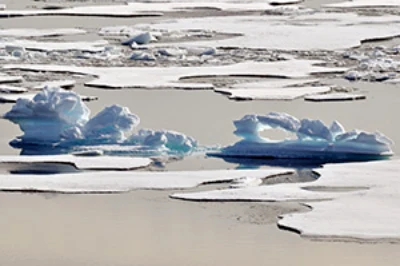
Entropy is related not only to the unavailability of energy to do work; it is also a measure of disorder. For example, in the case of a melting block of ice, a highly structured and orderly system of water molecules changes into a disorderly liquid, in which molecules have no fixed positions (Figure 12.11). There is a large increase in entropy for this process, as we'll see in the following worked example.
エントロピーは、エネルギーが仕事に使えないことに結びついているだけでなく、無秩序さを測るものでもある。たとえば氷の塊が融ける場合、高度に構造化され秩序立った水分子の系が、分子が決まった位置を持たない無秩序な液体へ変わる(図12.11)。この過程ではエントロピーが大きく増える。次の例題で見よう。
Entropy Associated with Disorder Find the increase in entropy of 1.00 kg of ice that is originally at and melts to form water at . Strategy
無秩序に結びついたエントロピー はじめにあった氷1.00 kgが融けての水になるときの、エントロピーの増加を求めよ。 方針
The change in entropy can be calculated from the definition of once we find the energy, Q, needed to melt the ice.
氷を融かすのに必要なエネルギーQが分かれば、の定義からエントロピーの変化を計算できる。
Solution解答
The change in entropy is defined as
エントロピーの変化は次のように定義される。
Here, Q is the heat necessary to melt 1.00 kg of ice and is given by
ここでQは1.00 kgの氷を融かすのに必要な熱で、次で与えられる。
where m is the mass and is the latent heat of fusion. for water, so
ここでmは質量、は融解の潜熱である。水についてはなので、
Because Q is the amount of energy heat adds to the ice, its value is positive, and T is the melting temperature of ice, So the change in entropy is
Qは熱が氷に加えるエネルギーの量なのでその値は正であり、Tは氷が融ける温度である。したがってエントロピーの変化は
Discussion考察
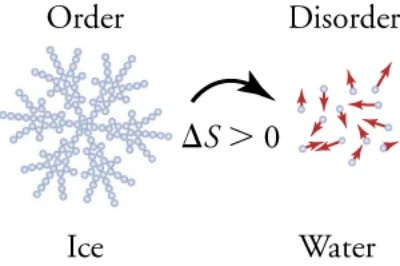
The change in entropy is positive, because heat transfers energy into the ice to cause the phase change. This is a significant increase in entropy, because it takes place at a relatively low temperature. It is accompanied by an increase in the disorder of the water molecules.
エントロピーの変化は正である。相変化を起こすために熱が氷へエネルギーを移すからである。これは比較的低い温度で起こるので、エントロピーの増加としてはかなり大きい。これには水分子の無秩序さの増加がともなう。
Practice Problems練習問題
11If are added by heat to water at , what is the change in entropy?a. b.
11が熱によっての水に加えられるとき、エントロピーの変化はいくらか。a. b.
12What is the increase in entropy when of ice at melt to form water at ? a. b.
12の氷が融けての水になるとき、エントロピーの増加はいくらか。 a. b.
Check Your Understanding理解の確認
13What is entropy?a. Entropy is a measure of the potential energy of a system.b. Entropy is a measure of the net work done by a system.
13エントロピーとは何か。a. エントロピーとは、系の位置エネルギーを測るものである。b. エントロピーとは、系がした正味の仕事を測るものである。
c. Entropy is a measure of the disorder of a system.d. Entropy is a measure of the heat transfer of energy into a system.
c. エントロピーとは、系の無秩序さを測るものである。d. エントロピーとは、熱によって系へ移るエネルギーを測るものである。
14Which forms of energy can be used to do work?a. Only work is able to do work.b. Only heat is able to do work.
14どの形のエネルギーが仕事に使えるか。a. 仕事だけが仕事をなしうる。b. 熱だけが仕事をなしうる。
c. Only internal energy is able to do work.d. Heat, work, and internal energy are all able to do work.
c. 内部エネルギーだけが仕事をなしうる。d. 熱・仕事・内部エネルギーのいずれもが仕事をなしうる。
15What is the statement for the second law of thermodynamics?a. All the spontaneous processes result in decreased total entropy of a system.b. All the spontaneous processes result in increased total entropy of a system.
15熱力学第二法則の言明はどれか。a. 自発的な過程はすべて、系の全エントロピーを減らす。b. 自発的な過程はすべて、系の全エントロピーを増やす。
c. All the spontaneous processes result in decreased or constant total entropy of a system.d. All the spontaneous processes result in increased or constant total entropy of a system.
c. 自発的な過程はすべて、系の全エントロピーを減らすか一定に保つ。d. 自発的な過程はすべて、系の全エントロピーを増やすか一定に保つ。
16For heat transferring energy from a high to a low temperature, what usually happens to the entropy of the whole system?
16熱が高い温度から低い温度へエネルギーを移すとき、系全体のエントロピーはふつうどうなるか。
a. It decreases.
a. 減る。
b. It must remain constant.
b. 必ず一定のままである。
c. The entropy of the system cannot be predicted without specific values for the temperatures.d. It increases.
c. 温度の具体的な値がなければ、系のエントロピーは予測できない。d. 増える。