第12章熱力学Thermodynamics原書 p.369–404
12.2 First law of Thermodynamics: Thermal Energy and Work12.2 熱力学第一法則:熱エネルギーと仕事
SECTION LEARNING OBJECTIVES By the end of this section, you will be able to do the following:
この節の学習目標 この節を終えると、次のことができるようになる。
• Describe how pressure, volume, and temperature relate to one another and to work, based on the ideal gas law• Describe pressure–volume work• Describe the first law of thermodynamics verbally and mathematically• Solve problems involving the first law of thermodynamics
・理想気体の法則にもとづいて、圧力・体積・温度が互いに、また仕事とどう関係するかを述べる・圧力-体積仕事を述べる・熱力学第一法則を言葉と数式で述べる・熱力学第一法則に関する問題を解く
Section Key Termsこの節の重要語
Boltzmann constantfirst law of thermodynamicsideal gas lawinternal energypressure
ボルツマン定数熱力学第一法則理想気体の法則内部エネルギー圧力
Pressure, Volume, Temperature, and the Ideal Gas Law圧力、体積、温度、そして理想気体の法則
Before covering the first law of thermodynamics, it is first important to understand the relationship between pressure, volume, and temperature. Pressure, P, is defined as
熱力学第一法則を扱う前に、まず圧力・体積・温度の関係を理解しておくことが大切である。圧力Pは次のように定義される。
where F is a force applied to an area, A, that is perpendicular to the force.
ここでFは、力に垂直な面積Aに加えられた力である。
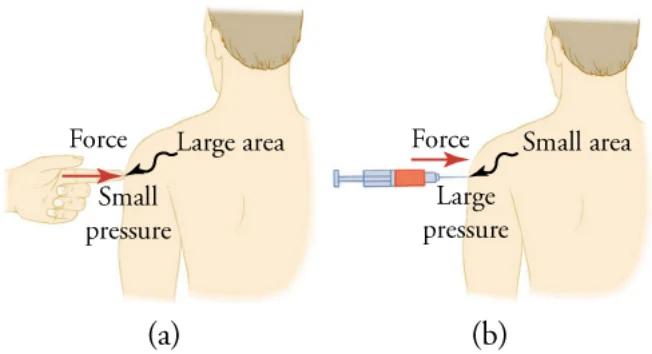
Depending on the area over which it is exerted, a given force can have a significantly different effect, as shown in Figure 12.3.
図12.3に示すように、同じ力でも、及ぼされる面積によってその効き方は大きく変わりうる。
The SI unit for pressure is the pascal, where
圧力のSI単位はパスカルで、
Pressure is defined for all states of matter but is particularly important when discussing fluids (such as air). You have probably heard the word pressure being used in relation to blood (high or low blood pressure) and in relation to the weather (high- and low-pressure weather systems). These are only two of many examples of pressures in fluids.
圧力は物質のあらゆる状態に対して定義されるが、(空気のような)流体を論じるときにとくに重要になる。血圧(高血圧や低血圧)や天気(高気圧・低気圧)との関わりで、圧力という語を耳にしたことがあるだろう。これらは流体の圧力の数ある例のうちの二つにすぎない。
The relationship between the pressure, volume, and temperature for an ideal gas is given by the ideal gas law. A gas is considered ideal at low pressure and fairly high temperature, and forces between its component particles can be ignored. The ideal gas law states that
理想気体の圧力・体積・温度の関係は、理想気体の法則で与えられる。気体は、低い圧力とかなり高い温度のもとで理想的とみなされ、構成粒子の間の力は無視できる。理想気体の法則は次のように述べる。
where P is the pressure of a gas, V is the volume it occupies, N is the number of particles (atoms or molecules) in the gas, and T is its absolute temperature. The constant k is called the Boltzmann constant and has the value
ここでPは気体の圧力、Vはそれが占める体積、Nは気体の中の粒子(原子または分子)の数、Tはその絶対温度である。定数kはボルツマン定数と呼ばれ、次の値を持つ。
For the purposes of this chapter, we will not go into calculations using the ideal gas law. Instead, it is important for us to notice from the equation that the following are true for a given mass of gas:
この章では、理想気体の法則を使った計算には立ち入らない。かわりに、決まった質量の気体について次のことが成り立つと、この式から読み取ることが大切である。
• When volume is constant, pressure is directly proportional to temperature.• When temperature is constant, pressure is inversely proportional to volume.• When pressure is constant, volume is directly proportional to temperature.
・体積が一定のとき、圧力は温度に正比例する。・温度が一定のとき、圧力は体積に反比例する。・圧力が一定のとき、体積は温度に正比例する。
This last point describes thermal expansion—the change in size or volume of a given mass with temperature. What is the underlying cause of thermal expansion? An increase in temperature means that there’s an increase in the kinetic energy of the individual atoms. Gases are especially affected by thermal expansion, although liquids expand to a lesser extent with similar increases in temperature, and even solids have minor expansions at higher temperatures. This is why railroad tracks and bridges have expansion joints that allow them to freely expand and contract with temperature changes.
この最後の点が熱膨張——決まった質量の大きさや体積が温度によって変わること——を表している。熱膨張の根本の原因は何か。温度が上がるとは、個々の原子の運動エネルギーが増えることを意味する。熱膨張の影響をとくに受けるのは気体だが、同じくらい温度が上がれば液体もそれより小さいながら膨張し、固体でさえ高い温度ではわずかに膨張する。線路や橋に、温度変化に応じて自由に伸び縮みできる伸縮継手があるのはこのためである。
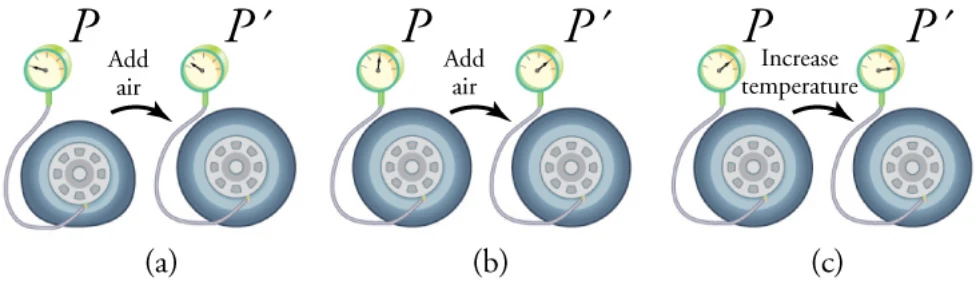
To get some idea of how pressure, temperature, and volume of a gas are related to one another, consider what happens when you pump air into a deflated tire. The tire’s volume first increases in direct proportion to the amount of air injected, without much increase in the tire pressure. Once the tire has expanded to nearly its full size, the walls limit volume expansion. If you continue to pump air into tire (which now has a nearly constant volume), the pressure increases with increasing temperature (see Figure 12.4).
気体の圧力・温度・体積が互いにどう関係しているかをつかむために、空気の抜けたタイヤに空気を入れるとどうなるかを考えよう。タイヤの体積は、まず入れた空気の量に正比例して増え、タイヤの圧力はさほど上がらない。タイヤがほぼ満杯の大きさまで膨らむと、壁が体積の膨張を制限する。(体積がほぼ一定になった)タイヤにさらに空気を入れ続けると、温度の上昇とともに圧力が上がる(図12.4を見よ)。
Pressure–Volume Work圧力-体積仕事
Pressure–volume work is the work that is done by the compression or expansion of a fluid. Whenever there is a change in volume and external pressure remains constant, pressure–volume work is taking place. During a compression, a decrease in volume increases the internal pressure of a system as work is done on the system. During an expansion (Figure 12.5), an increase in volume decreases the internal pressure of a system as the system does work.
圧力-体積仕事とは、流体の圧縮や膨張によってなされる仕事である。体積が変わり、外の圧力が一定に保たれるところではいつでも、圧力-体積仕事が起こっている。圧縮のあいだ、系に仕事がなされるにつれて、体積の減少が系の内部の圧力を上げる。膨張のあいだ(図12.5)、系が仕事をするにつれて、体積の増加が系の内部の圧力を下げる。
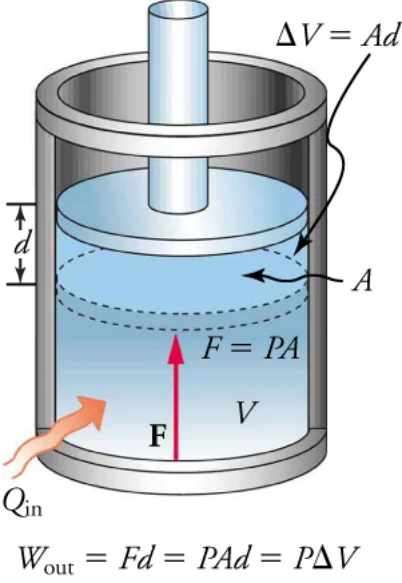
Recall that the formula for work is We can rearrange the definition of pressure, to get an expression for force in terms of pressure.
仕事の式がであったことを思い出そう。圧力の定義を変形すれば、圧力を使った力の表し方が得られる。
Substituting this expression for force into the definition of work, we get
この力の表し方を仕事の定義に代入すると、
Because area multiplied by displacement is the change in volume, , the mathematical expression for pressure–volume work is
面積に変位をかけたものは体積の変化だから、圧力-体積仕事の数式は
Just as we say that work is force acting over a distance, for fluids, we can say that work is the pressure acting through the change in volume. For pressure–volume work, pressure is analogous to force, and volume is analogous to distance in the traditional definition of work.
仕事とは距離にわたってはたらく力であると言うのと同じように、流体については、仕事とは体積の変化を通してはたらく圧力であると言える。圧力-体積仕事では、圧力が伝統的な仕事の定義における力にあたり、体積が距離にあたる。
Work from Expansion This video describes work from expansion (or pressure–volume work). Sal combines the equations and to get .
膨張による仕事 この動画は膨張による仕事(すなわち圧力-体積仕事)を説明する。サルは式とを組み合わせてを得る。
Access multimedia content (http://openstax.org/books/physics/pages/12-2-first-law-of-thermodynamics-thermal-energy-and-work)
マルチメディア教材はこちら(http://openstax.org/books/physics/pages/12-2-first-law-of-thermodynamics-thermal-energy-and-work)
GRASP CHECK If the volume of a system increases while pressure remains constant, is the value of work done by the system W positive or negative? Will this increase or decrease the internal energy of the system?
理解の確認 圧力が一定のまま系の体積が増えるとき、系がする仕事Wの値は正か負か。これは系の内部エネルギーを増やすか、減らすか。
a. Positive; internal energy will decreaseb. Positive; internal energy will increase
a. 正。内部エネルギーは減るb. 正。内部エネルギーは増える
c. Negative; internal energy will decreased. Negative; internal energy will increase
c. 負。内部エネルギーは減るd. 負。内部エネルギーは増える
The First Law of Thermodynamics熱力学第一法則
Heat (Q) and work (W) are the two ways to add or remove energy from a system. The processes are very different. Heat is driven by temperature differences, while work involves a force exerted through a distance. Nevertheless,
熱(Q)と仕事(W)は、系にエネルギーを加えたり系からエネルギーを取り去ったりする二つのやり方である。この二つの過程はまったく違う。熱は温度差によって駆動され、仕事は距離にわたって及ぼされる力に関わる。それでも、
heat and work can produce identical results. For example, both can cause a temperature increase. Heat transfers energy into a system, such as when the sun warms the air in a bicycle tire and increases the air’s temperature.Similarly, work can be done on the system, as when the bicyclist pumps air into the tire. Once the temperature increase has occurred, it is impossible to tell whether it was caused by heat or work. Heat and work are both energy in transit—neither is stored as such in a system. However, both can change the internal energy, U, of a system.
熱と仕事は同じ結果を生みうる。たとえばどちらも温度を上げうる。熱は系へエネルギーを移す。太陽が自転車のタイヤの中の空気を温めて温度を上げるときのように。同じように、系に仕事をすることもできる。自転車に乗る人がタイヤに空気を入れるときのように。いったん温度が上がってしまえば、それが熱によるのか仕事によるのかを見分けることはできない。熱も仕事も、移動中のエネルギーであり、どちらもそのままの形で系に蓄えられはしない。しかしどちらも系の内部エネルギーUを変えうる。
Internal energy is the sum of the kinetic and potential energies of a system’s atoms and molecules. It can be divided into many subcategories, such as thermal and chemical energy, and depends only on the state of a system (that is, P, V, and T), not on how the energy enters or leaves the system.
内部エネルギーとは、系の原子と分子の運動エネルギーと位置エネルギーの和である。熱エネルギーや化学エネルギーなど多くの下位区分に分けられ、系の状態(すなわちP、V、T)だけによって決まり、エネルギーがどのように系へ入り、また出ていったかにはよらない。
In order to understand the relationship between heat, work, and internal energy, we use the first law of thermodynamics. The first law of thermodynamics applies the conservation of energy principle to systems where heat and work are the methods of transferring energy into and out of the systems. It can also be used to describe how energy transferred by heat is converted and transferred again by work.
熱・仕事・内部エネルギーの関係を理解するために、熱力学第一法則を使う。熱力学第一法則は、熱と仕事が系へ、また系からエネルギーを移すやり方である場合に、エネルギー保存の原理を系に適用したものである。また、熱によって移されたエネルギーがどう変換され、仕事によってふたたび移されるかを述べるのにも使える。
TIPS FOR SUCCESS Recall that the principle of conservation of energy states that energy cannot be created or destroyed, but it can be altered from one form to another.
学習のポイント エネルギー保存の原理は、エネルギーは生成も消滅もしないが、ある形から別の形へ変わりうると述べていたことを思い出そう。
The first law of thermodynamics states that the change in internal energy of a closed system equals the net heat transfer into the system minus the net work done by the system. In equation form, the first law of thermodynamics is
熱力学第一法則は、閉じた系の内部エネルギーの変化は、系へ移った正味の熱から系がした正味の仕事を引いたものに等しい、と述べる。式で書けば、熱力学第一法則は
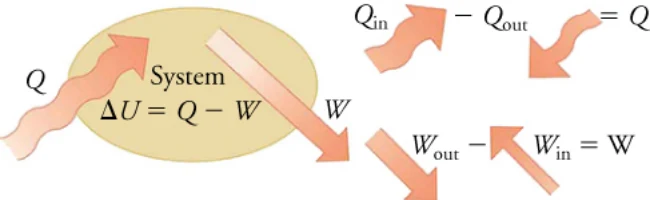
Here, is the change in internal energy, U, of the system. As shown in Figure 12.6, Q is the net heat transferred into the system—that is, Q is the sum of all heat transfers into and out of the system. W is the net work done by the system—that is, W is the sum of all work done on or by the system. By convention, if Q is positive, then there is a net heat transfer into the system; if W is positive, then there is net work done by the system. So positive Q adds energy to the system by heat, and positive W takes energy from the system by work. Note that if heat transfers more energy into the system than that which is done by work, the difference is stored as internal energy.
ここでは系の内部エネルギーUの変化である。図12.6に示すとおり、Qは系へ移った正味の熱、すなわち系へ入り系から出るすべての熱の移動の和である。Wは系がした正味の仕事、すなわち系になされ、また系がしたすべての仕事の和である。約束として、Qが正なら系へ正味の熱の移動があり、Wが正なら系が正味の仕事をしている。したがって、正のQは熱によって系にエネルギーを加え、正のWは仕事によって系からエネルギーを取り去る。熱が仕事によって取り去られるより多くのエネルギーを系へ移す場合、その差は内部エネルギーとして蓄えられることに注意しよう。
It follows also that negative Q indicates that energy is transferred away from the system by heat and so decreases the system’s internal energy, whereas negative W is work done on the system, which increases the internal energy.
したがってまた、負のQは熱によって系からエネルギーが移り去り系の内部エネルギーが減ることを表し、負のWは系になされた仕事であって内部エネルギーを増やすことになる。
First Law of Thermodynamics/Internal Energy This video explains the first law of thermodynamics, conservation of energy, and internal energy. It goes over an example of energy transforming between kinetic energy, potential energy, and heat transfer due to air resistance.
熱力学第一法則/内部エネルギー この動画は熱力学第一法則、エネルギー保存、内部エネルギーを説明する。運動エネルギー、位置エネルギー、そして空気抵抗による熱の移動の間でエネルギーが移り変わる例を扱っている。
Access multimedia content (http://openstax.org/books/physics/pages/12-2-first-law-of-thermodynamics-thermal-energy-and-work) Watch Physics: First Law of Thermodynamics / Internal Energy. This video introduces and explains the first law of thermodynamics and the concept of internal energy.
マルチメディア教材はこちら(http://openstax.org/books/physics/pages/12-2-first-law-of-thermodynamics-thermal-energy-and-work) 物理を見る:熱力学第一法則/内部エネルギー。この動画は熱力学第一法則と内部エネルギーの考えを導き、説明する。
Access multimedia content (http://openstax.org/books/physics/pages/12-2-first-law-of-thermodynamics-thermal-energy-and-work) Consider the example of tossing a ball when there’s air resistance. As air resistance increases, what would you expect to happen to the final velocity and final kinetic energy of the ball? Why?
マルチメディア教材はこちら(http://openstax.org/books/physics/pages/12-2-first-law-of-thermodynamics-thermal-energy-and-work)空気抵抗があるところでボールを投げ上げる例を考えよう。空気抵抗が大きくなると、ボールの最後の速さと最後の運動エネルギーはどうなると予想されるか。それはなぜか。
a. Both will decrease. Energy is transferred to the air by heat due to air resistance.b. Both will increase. Energy is transferred from the air to the ball due to air resistance.
a. どちらも減る。空気抵抗によって熱として空気へエネルギーが移るから。b. どちらも増える。空気抵抗によって空気からボールへエネルギーが移るから。
c. Final velocity will increase, but final kinetic energy will decrease. Energy is transferred by heat to the air from the ball through air resistance.d. Final velocity will decrease, but final kinetic energy will increase. Energy is transferred by heat from the air to the ball through air resistance.
c. 最後の速さは増えるが、最後の運動エネルギーは減る。空気抵抗によってボールから空気へ熱としてエネルギーが移るから。d. 最後の速さは減るが、最後の運動エネルギーは増える。空気抵抗によって空気からボールへ熱としてエネルギーが移るから。
More on Internal Energy This video goes into further detail, explaining internal energy and how to use the equation Note that Sal uses the equation , where W is the work done on the system, whereas we use W to represent work done by the system.
内部エネルギーをさらに この動画はさらに詳しく、内部エネルギーと、式の使い方を説明する。サルはという式を使い、そこでのWは系になされた仕事であるのに対し、こちらではWは系がした仕事を表していることに注意しよう。
Biology: Biological Thermodynamics We often think about thermodynamics as being useful for inventing or testing machinery, such as engines or steam turbines. However, thermodynamics also applies to living systems, such as our own bodies. This forms the basis of the biological thermodynamics (Figure 12.7).
生物学:生物熱力学 熱力学は、エンジンや蒸気タービンのような機械を発明したり試験したりするのに役立つものだと考えがちである。しかし熱力学は、私たち自身の体のような生きた系にも当てはまる。これが生物熱力学の土台をなす(図12.7)。
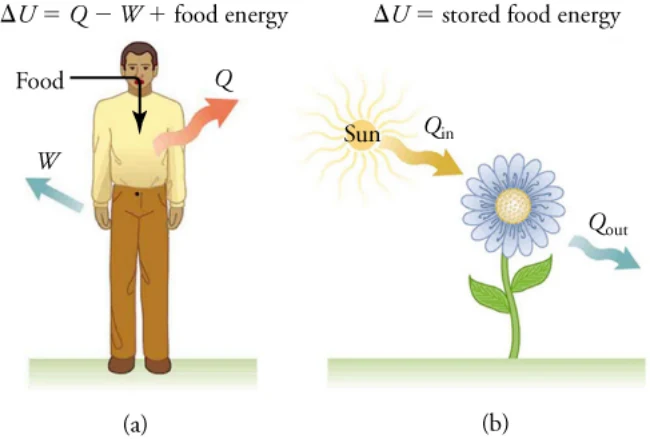
Life itself depends on the biological transfer of energy. Through photosynthesis, plants absorb solar energy from the sun and use this energy to convert carbon dioxide and water into glucose and oxygen. Photosynthesis takes in one form of energy—light—and converts it into another form—chemical potential energy (glucose and other carbohydrates).
生命そのものが、生物学的なエネルギーの移動に依存している。光合成によって、植物は太陽から太陽エネルギーを吸収し、このエネルギーを使って二酸化炭素と水をブドウ糖と酸素へ変える。光合成は一つの形のエネルギー——光——を取り入れ、それを別の形——化学的な位置エネルギー(ブドウ糖その他の炭水化物)——へ変える。
Human metabolism is the conversion of food into energy given off by heat, work done by the body’s cells, and stored fat. Metabolism is an interesting example of the first law of thermodynamics in action. Eating increases the internal energy of the body by adding chemical potential energy; this is an unromantic view of a good burrito.
人間の代謝とは、食物を、熱として放たれるエネルギー、体の細胞がする仕事、そして蓄えられる脂肪へ変えることである。代謝は、熱力学第一法則が働いている興味深い例である。食べることは化学的な位置エネルギーを加えて体の内部エネルギーを増やす。これはうまいブリトーについてのまるでロマンのない見方である。
The body metabolizes all the food we consume. Basically, metabolism is an oxidation process in which the chemical potential energy of food is released. This implies that food input is in the form of work. Exercise helps you lose weight, because it provides energy transfer from your body by both heat and work and raises your metabolic rate even when you are at rest.
体は、口にした食物をすべて代謝する。基本的に代謝とは、食物の化学的な位置エネルギーが解き放たれる酸化の過程である。これは、食物の入力が仕事の形をとっていることを意味する。運動が体重を減らすのに役立つのは、熱と仕事の両方によって体からエネルギーを移し、また休んでいるときでさえ代謝の速さを上げるからである。
Biological thermodynamics also involves the study of transductions between cells and living organisms.Transduction is a process where genetic material—DNA—is transferred from one cell to another. This often occurs during a viral infection (e.g., influenza) and is how the virus spreads, namely, by transferring its genetic material to an increasing number of previously healthy cells. Once enough cells become infected, you begin to feel the effects of the virus (flu symptoms—muscle weakness, coughing, and congestion).
生物熱力学は、細胞や生物の間の形質導入の研究にも関わる。形質導入とは、遺伝物質——DNA——がある細胞から別の細胞へ移る過程である。これはウイルス感染(たとえばインフルエンザ)のときによく起こり、ウイルスはこうして広がる。すなわち、それまで健康だった細胞へ次々と自分の遺伝物質を移していくのである。十分な数の細胞が感染すると、ウイルスの影響(筋肉の脱力、咳、鼻づまりといったインフルエンザの症状)を感じ始める。
Energy is transferred along with the genetic material and so obeys the first law of thermodynamics. Energy is transferred—not created or destroyed—in the process. When work is done on a cell or heat transfers energy to a cell, the cell’s internal energy increases. When a cell does work or loses heat, its internal energy decreases. If the amount of work done by a cell is the same as the amount of energy transferred in by heat, or the amount of work performed on a cell matches the amount of energy transferred out by heat, there will be no net change in internal energy.
エネルギーは遺伝物質とともに移るので、熱力学第一法則に従う。この過程でエネルギーは移るのであって、生成も消滅もしない。細胞に仕事がなされたり、熱が細胞へエネルギーを移したりすると、細胞の内部エネルギーは増える。細胞が仕事をしたり熱を失ったりすると、その内部エネルギーは減る。細胞がする仕事の量が、熱によって入ってくるエネルギーの量と同じであるか、細胞になされる仕事の量が、熱によって出ていくエネルギーの量と釣り合っていれば、内部エネルギーに正味の変化はない。
GRASP CHECK Based on what you know about heat transfer and the first law of thermodynamics, do you need to eat more or less to maintain a constant weight in colder weather? Explain why.
理解の確認 熱の移動と熱力学第一法則について知っていることをもとに考えると、寒い天候で体重を一定に保つには、もっと食べる必要があるか、それとも少なく食べる必要があるか。理由を説明せよ。
a. more; as more energy is lost by the body in colder weather, the need to eat increases so as to maintain a constant weightb. more; eating more food means accumulating more fat, which will insulate the body from colder weather and will reduce the energy lossc. less; as less energy is lost by the body in colder weather, the need to eat decreases so as to maintain a constant weightd. less; eating less food means accumulating less fat, so less energy will be required to burn the fat, and, as a result, weight will remain constant
a. もっと食べる。寒い天候では体からより多くのエネルギーが失われるので、体重を一定に保つには食べる必要が増すb. もっと食べる。より多く食べれば脂肪がより多く蓄えられ、それが寒い天候から体を断熱してエネルギーの損失を減らすc. 少なく食べる。寒い天候では体から失われるエネルギーが少ないので、体重を一定に保つには食べる必要が減るd. 少なく食べる。食べる量が少なければ蓄えられる脂肪も少なく、脂肪を燃やすのに要るエネルギーも少なくなるので、結果として体重は一定に保たれる
Calculating Change in Internal Energy Suppose 40.00 J of energy is transferred by heat to a system, while the system does 10.00 J of work. Later, heat transfers 25.00 J out of the system, while 4.00 J is done by work on the system. What is the net change in the system’s internal energy?Strategy
内部エネルギーの変化を計算する 40.00 Jのエネルギーが熱によって系へ移り、その間に系が10.00 Jの仕事をしたとする。そのあと、熱が系から25.00 Jを移し出し、その間に4.00 Jの仕事が系になされた。系の内部エネルギーの正味の変化はいくらか。方針
You must first calculate the net heat and net work. Then, using the first law of thermodynamics, find the change in internal energy.
まず正味の熱と正味の仕事を計算しなければならない。それから熱力学第一法則を使って内部エネルギーの変化を求める。
Solution解答
The net heat is the transfer into the system by heat minus the transfer out of the system by heat, or
正味の熱は、熱によって系へ入ったぶんから、熱によって系から出たぶんを引いたもの、すなわち
The total work is the work done by the system minus the work done on the system, or
仕事の合計は、系がした仕事から系になされた仕事を引いたもの、すなわち
The change in internal energy is given by the first law of thermodynamics.
内部エネルギーの変化は熱力学第一法則で与えられる。
Discussion考察
A different way to solve this problem is to find the change in internal energy for each of the two steps separately and then add the two changes to get the total change in internal energy. This approach would look as follows:
この問題を解く別のやり方は、二つの段階それぞれについて内部エネルギーの変化を求め、その二つを足して全体の変化を得ることである。この筋道は次のようになる。
For 40.00 J of heat in and 10.00 J of work out, the change in internal energy is
熱の入り40.00 Jと仕事の出10.00 Jについて、内部エネルギーの変化は
For 25.00 J of heat out and 4.00 J of work in, the change in internal energy is
熱の出25.00 Jと仕事の入り4.00 Jについて、内部エネルギーの変化は
The total change is
全体の変化は
No matter whether you look at the overall process or break it into steps, the change in internal energy is the same.
過程全体を見ようと、段階に分けようと、内部エネルギーの変化は同じである。
Calculating Change in Internal Energy: The Same Change in U is Produced by Two Different Processes What is the change in the internal energy of a system when a total of 150.00 J is transferred by heat from the system and 159.00 J is done by work on the system?Strategy
内部エネルギーの変化を計算する:同じUの変化が二つの違う過程で生じる 熱によって系から合計150.00 Jが移り出し、159.00 Jの仕事が系になされたとき、系の内部エネルギーの変化はいくらか。方針
The net heat and work are already given, so simply use these values in the equation
正味の熱と仕事はすでに与えられているので、これらの値をそのまま次の式に使えばよい。
Solution解答
Here, the net heat and total work are given directly as so that
ここでは正味の熱と仕事の合計がとして直接与えられているので、
Discussion考察
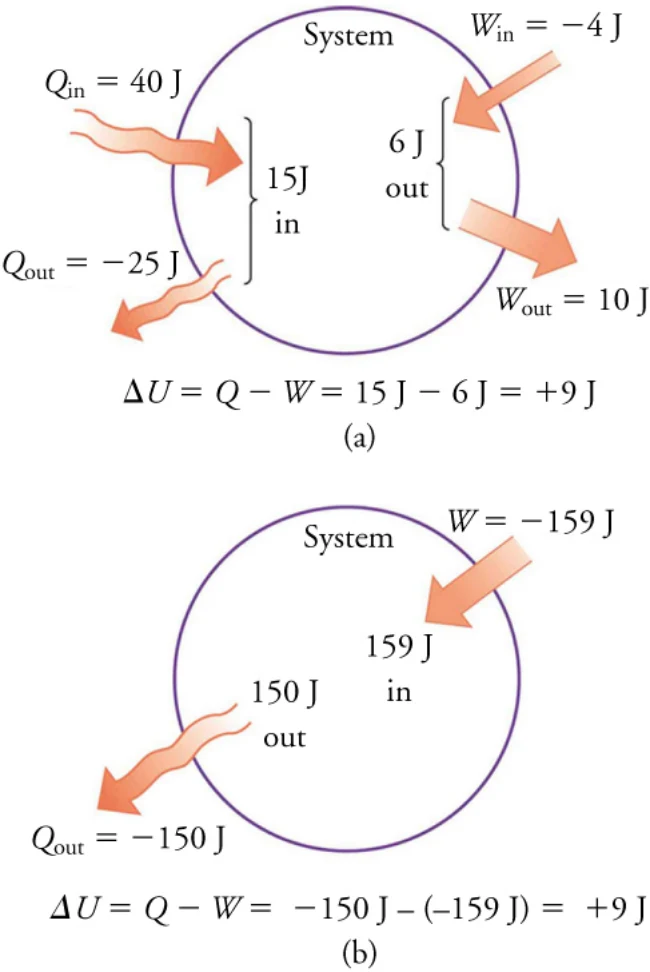
A very different process in this second worked example produces the same 9.00 J change in internal energy as in the first worked example. Note that the change in the system in both parts is related to and not to the individual Q’s or W’s involved. The system ends up in the same state in both problems. Note that, as usual, in Figure 12.8 above, is work done by the system, and is work done on the system.
この二つ目の例題では、まったく違う過程が、一つ目の例題と同じ9.00 Jの内部エネルギーの変化を生んでいる。どちらの場合も系の変化はに結びついており、関わっている個々のQやWによるのではないことに注意しよう。二つの問題で、系は同じ状態に行き着く。いつもどおり、上の図12.8では系がした仕事、は系になされた仕事であることに注意しよう。
Practice Problems練習問題
3How much work is done by a gas under 20 Pa of pressure increasing in volume by 3.0 m3?a. –0.15 Jb. 6.7 J
320 Paの圧力のもとにある気体の体積が3.0 m3増えるとき、気体がする仕事はいくらか。a. −0.15 Jb. 6.7 J
c. –23 Jd. 60 J
c. −23 Jd. 60 J
4What is the net heat out of the system when is transferred by heat into the system and is transferred out of it?
4が熱によって系へ移り、が系から移り出るとき、系から出る正味の熱はいくらか。
Check Your Understanding理解の確認
5What is pressure?a. Pressure is force divided by length.b. Pressure is force divided by area.
5圧力とは何か。a. 圧力とは力を長さで割ったものである。b. 圧力とは力を面積で割ったものである。
c. Pressure is force divided by volume.d. Pressure is force divided by mass.
c. 圧力とは力を体積で割ったものである。d. 圧力とは力を質量で割ったものである。
6What is the SI unit for pressure? a. pascal, or N/m3
6圧力のSI単位は何か。 a. パスカル、すなわちN/m3
b. coulomb
b. クーロン
c. newtond. pascal, or N/m2
c. ニュートンd. パスカル、すなわちN/m2
7What is pressure-volume work?a. It is the work that is done by the compression or expansion of a fluid.b. It is the work that is done by a force on an object to produce a certain displacement.c. It is the work that is done by the surface molecules of a fluid.d. It is the work that is done by the high-energy molecules of a fluid.
7圧力-体積仕事とは何か。a. 流体の圧縮や膨張によってなされる仕事である。b. ある変位を生むために物体に力がする仕事である。c. 流体の表面の分子がする仕事である。d. 流体の高いエネルギーを持つ分子がする仕事である。
8When is pressure-volume work said to be done ON a system?a. When there is an increase in both volume and internal pressure.b. When there is a decrease in both volume and internal pressure.
8圧力-体積仕事が系に対してなされたと言えるのはどんなときか。a. 体積と内部の圧力の両方が増えるとき。b. 体積と内部の圧力の両方が減るとき。
c. When there is a decrease in volume and an increase in internal pressure.d. When there is an increase in volume and a decrease in internal pressure.
c. 体積が減り、内部の圧力が増えるとき。d. 体積が増え、内部の圧力が減るとき。
9What are the ways to add energy to or remove energy from a system?a. Transferring energy by heat is the only way to add energy to or remove energy from a system.b. Doing compression work is the only way to add energy to or remove energy from a system.
9系にエネルギーを加えたり、系からエネルギーを取り去ったりするやり方はどれか。a. 熱によってエネルギーを移すことだけが、系にエネルギーを加え、また取り去るやり方である。b. 圧縮の仕事をすることだけが、系にエネルギーを加え、また取り去るやり方である。
c. Doing expansion work is the only way to add energy to or remove energy from a system.d. Transferring energy by heat or by doing work are the ways to add energy to or remove energy from a system.
c. 膨張の仕事をすることだけが、系にエネルギーを加え、また取り去るやり方である。d. 熱によってエネルギーを移すことと仕事をすることが、系にエネルギーを加え、また取り去るやり方である。
10What is internal energy?a. It is the sum of the kinetic energies of a system’s atoms and molecules.b. It is the sum of the potential energies of a system’s atoms and molecules.
10内部エネルギーとは何か。a. 系の原子と分子の運動エネルギーの和である。b. 系の原子と分子の位置エネルギーの和である。
c. It is the sum of the kinetic and potential energies of a system’s atoms and molecules.d. It is the difference between the magnitudes of the kinetic and potential energies of a system’s atoms and molecules.
c. 系の原子と分子の運動エネルギーと位置エネルギーの和である。d. 系の原子と分子の運動エネルギーと位置エネルギーの大きさの差である。