Zipline is an autonomous fixed-wing aircraft drone used to carry blood and medicine from a distribution center to wherever it is needed. It can launch within minutes and travel in any weather.
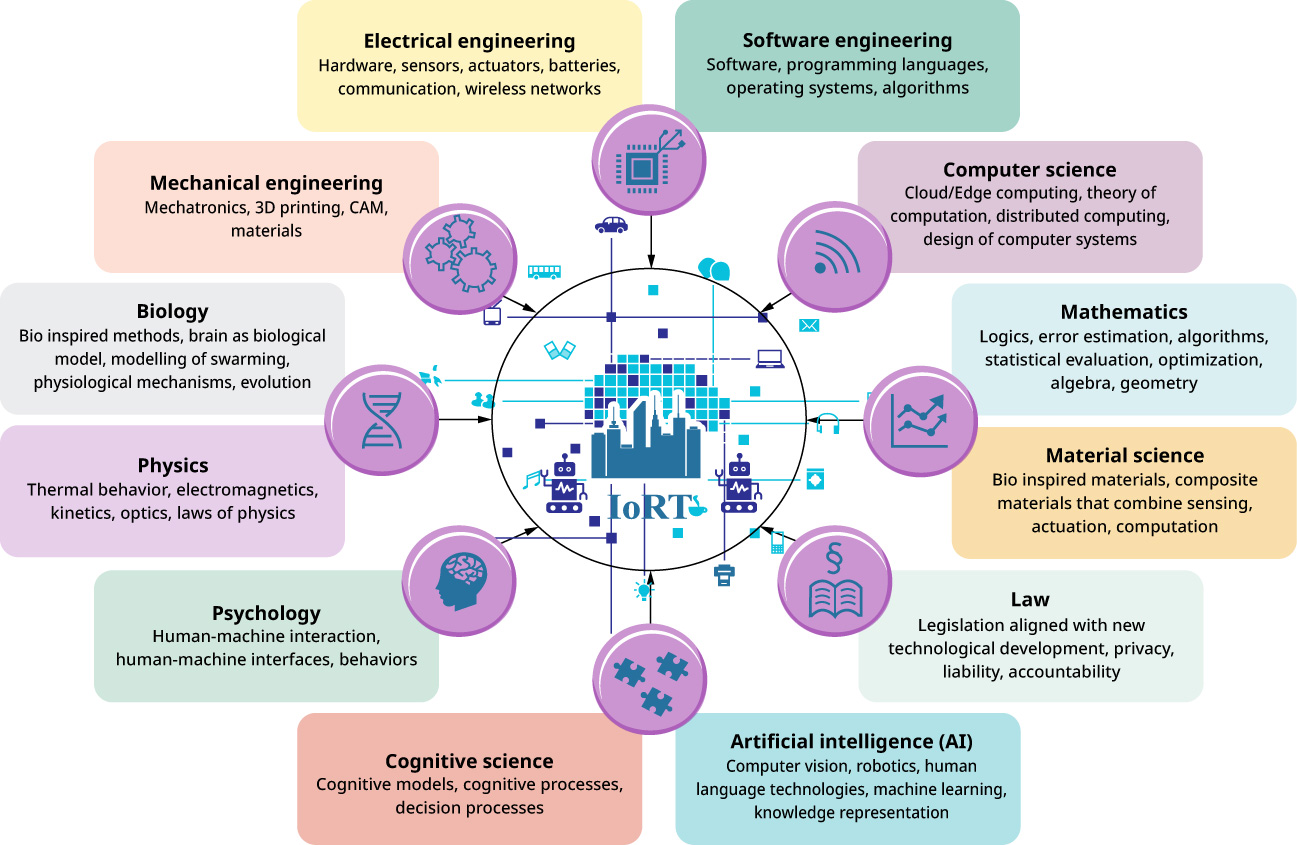
As these examples show, mobile robots have many applications. Figure 13.20 provides an overview of the fields and industries that find mobile robots useful.
Computer vision advances have facilitated the positioning and navigation of mobile robots. Computer vision is achieved using optics and sensors, which involve image acquisition, image representation, and image processing.
Open Source Computer Vision Library(OpenCV)は、コンピュータービジョン用の共通基盤を提供し、商用製品で機械の知覚を利用しやすくするために作られた、機械学習ソフトウェアライブラリー(https://openstax.org/r/76MachineLearn)である。
Artificial Cognitive Systems
人工認知システム
Robots need artificial cognitive systems that simulate human thought processes to supplement human cognition. Artificial cognitive systems are developed using algorithms in artificial intelligence and technologies such as machine learning, deep learning, speech recognition, and object recognition.
Various supercomputers are being developed based on neuromorphic computing and quantum technology. The supercomputers will eventually be available on the big clouds to help optimize the performance and throughput of supersociety applications. IBM already provides quantum compute access plans for its cloud, and Intel is building neuromorphic computing hardware that can be leveraged on cloud supercomputers.
The computing approach that combines the use of AI and cognitive science is called cognitive computing. The study of how to build a computer that can mimic basic human brain functions is called neuroinformatics. This requires robots’ ability to handle ambiguity as well as uncertainty. Robots that are equipped with these capabilities can mimic humans’ ability to memorize information, learn, reason, react, and show emotions.
Study of how linguistics and language are learned and acquired, and how to understand novel sentences
言語学と言語をどのように学習・習得するか、未知の文をどう理解するかを研究する
Language and speech processing, machine translation
言語・音声処理、機械翻訳
Perception and action
知覚と行動
Study of the ability to take in information via the senses such as vision and hearing; haptic, olfactory, and gustatory stimuli fall into this domain
視覚や聴覚などの感覚から情報を取り込む能力を研究する。触覚・嗅覚・味覚の刺激もこの領域に含まれる
Image recognition and understanding, behavioral science, brain imaging, psychology, and anthropology
画像認識・理解、行動科学、脳画像、心理学、人類学
Neuroinformatics
神経情報学
The intersection of neuroscience and information science
神経科学と情報科学が交わる分野
Neurocomputers, artificial neural nets, deep learning, aging, disease control
ニューロコンピューター、人工ニューラルネットワーク、深層学習、加齢、疾病の制御
Knowledge engineering
知識工学
The study of big data analysis, knowledge discovery, and the transformation and creativity process
ビッグデータ分析、知識発見、変換と創造の過程を研究する
Datamining, data analytics, knowledge discovery, and system construction
データマイニング、データ分析、知識発見、システム構築
Table 13.3Cognitive Science and Technology Support
表13.3 認知科学と支援技術
Desired features of cognitive computing systems include the following:
認知コンピューティングシステムに求められる特徴には、次のものがある。
• adaptive learning, which is learning as information changes and as goals and requirements evolve, resolving ambiguity and tolerating unpredictability
• interaction with users, allowing users—which may include other processors, devices, and cloud services, as well as people—to define their needs as a cognitive system trainer
• ability to be iterative and stateful, which means the system may remember previous interactions and may redefine a problem by asking questions or finding additional source input if a problem statement is ambiguous or incomplete
• contextual in information discovery, which means the system may understand and extract meaning, syntax, time, location, appropriate domain, regulations, user profiles, process, tasks, and goals, and respond to sensory inputs with visual and gestural effects
The real-world applications of cognitive systems include speech understanding, sentiment analysis, facial recognition, election insights, autonomous driving, and deep learning applications. Deep learning, in particular, requires specific hardware, including graphic processors, digital signal processors, field programmable logic devices, systems on a chip, custom microchips, and application-specific integrated circuits. Some of the providers of deep learning hardware include the Google Neural Machine Translation System (GNMT), Google Cloud’s Tensor Processing Unit (TPU), TensorFlow, Cambricon’s Neural Processing Unit (NPU), Intel’s Movidius Neural Compute Stick (NCS), the Intel Movidius Neural Compute SDK, and Intel’s Movidius Vision Processing Unit (VPU).
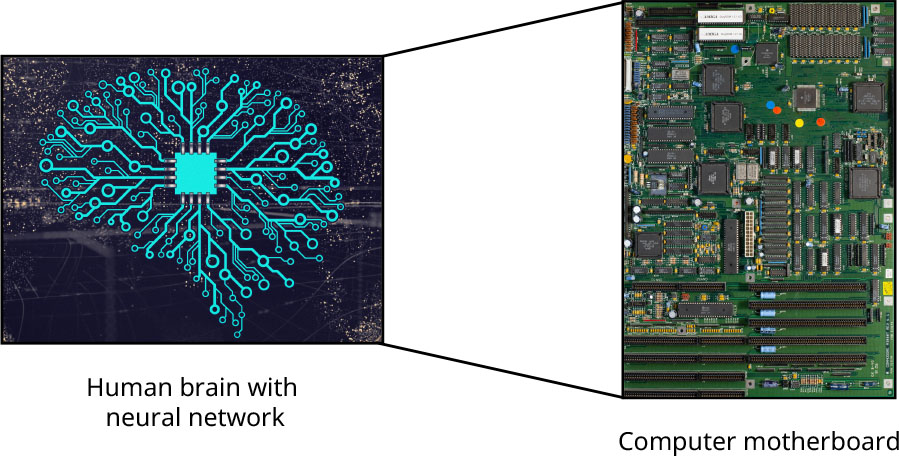
Cognitive science is interdisciplinary in nature. It covers the areas of psychology, artificial intelligence, neuroscience, and linguistics. It spans many levels of analysis, from low-level machine learning and decision mechanisms to high-level neural circuitry to build brain-modeled computers. It applies software libraries on clouds or supercomputers for machine learning and neuroinformatics studies. It uses representation and algorithms to relate the inputs and outputs of artificial neural computers. It also designs hardware neural chips to implement brain-like computers referred to as neuromorphic computers, as illustrated in Figure 13.21.
attribution: Copyright Rice University, OpenStax, under CC BY 4.0 license; credit left image: modification of “Artificial Neural Network with Chip” by mikemacmarketing/Wikimedia Commons, CC BY 2.0; credit right image: modification of “Amiga 3000T motherboard without annotations” by Podstawko/Wikimedia Commons, CC0 · CC BY 4.0 / CC BY 2.0 / CC0 · Source出典
Figure 13.21 As a field, cognitive science has made many advances, including the design of hardware neural chips, such as those pictured here, which are used to implement brain-like computers known as neuromorphic computers. (attribution: Copyright Rice University, OpenStax, under CC BY 4.0 license; credit left image: modification of “Artificial Neural Network with Chip” by mikemacmarketing/Wikimedia Commons, CC BY 2.0; credit right image: modification of “Amiga 3000T motherboard without annotations” by Podstawko/Wikimedia Commons, CC0)
図13.21 認知科学は多くの進歩を遂げた。図のようなハードウェアの神経チップの設計も含まれ、ニューロモーフィックコンピューターと呼ばれる脳に似た計算機の実装に用いる。(帰属表示:著作権 Rice University、OpenStax、CC BY 4.0。左の画像:mikemacmarketing/Wikimedia Commons「Artificial Neural Network with Chip」を改変、CC BY 2.0。右の画像:Podstawko/Wikimedia Commons「Amiga 3000T motherboard without annotations」を改変、CC0)
In 1990, Carver Mead, the Gordon and Betty Moore Professor Emeritus of Engineering and Applied Science for the California Institute of Technology, introduced the term neuromorphic computing, which relies on a hardware architecture that models how the human brain uses neurons. This provides the potential for faster, more complex computations while remaining power efficient. This field of computing emerged to compete with traditional computer architectures. Machine learning became popular, and as it advanced, neuromorphic computing became the best platform for machine learning algorithms. Comprised of a network of neurons and synapses, neuromorphic computing relies on hardware architecture modeled after the human brain. A neuron is a function that operates on an input. A synapse, which processes neuron output and passes a state to another neuron, can be trained to know how to convert neuron output to states. A memristor is a component that remembers the charge of an electric current. Memristors are great for neuromorphic computing as they provide neuroplasticity. Neurons pulse electric signals as input. Output is based on the path taken through the network, and it is a highly connected and parallel architecture that uses side-by-side memory and processing while consuming a low amount of power. Various neuromorphic computing models have been developed on this type of hardware, including the Neuroscience-Inspired Dynamic Architecture (NIDA), Dynamic Adaptive Neural Network Arrays (DANNAs), and Memristive Dynamic Adaptive Neural Network Arrays (mrDANNAs). Intel Labs developed the Loihi 2 neuromorphic chip that is used for research along with an open-source framework known as Lava. Intel’s goal is to facilitate the adoption of neuromorphic computing. Intel Labs’ second-generation neuromorphic research chip, codenamed Loihi 2, and Lava, an open-source software framework, will drive innovation and adoption of neuromorphic computing solutions.
Quantum computing has applications in experimental physics. It provides a theory that is more fundamental than Newtonian mechanics and electromagnetism and can explain phenomena that these theories cannot tackle.
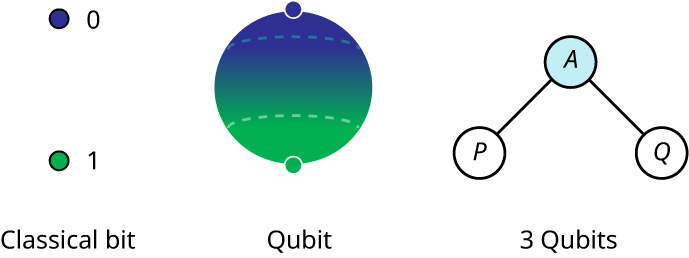
A quantum computer is a machine that performs calculations based on the laws and principles of quantum mechanics, in which the smallest particles of light and matter can be in different places at the same time. Information is stored in a physical medium and manipulated by physical processes. Designs of “classical” computers are implicitly based in the classical framework for physics and can only deal with bits, not qubits. This classical framework has been replaced by the more powerful framework of quantum mechanics. In a quantum computer, one qubit (a quantum bit) could be both 0 and 1 at the same time. So, as Figure 13.22 shows, with three qubits of data, a quantum computer could store all eight combinations of 0 and 1 simultaneously. That means a three-qubit quantum computer could potentially process information more efficiently than a classical three-bit digital computer, depending on the algorithm.
attribution: Copyright Rice University, OpenStax, under CC BY 4.0 license · CC BY 4.0 · Source出典
Figure 13.22 In a quantum computer, one qubit, or quantum bit, could be both 0 and 1 at the same time, enabling a quantum computer to store all eight combinations of 0 and 1 simultaneously. (attribution: Copyright Rice University, OpenStax, under CC BY 4.0 license)
図13.22 量子コンピューターでは、1量子ビットが同時に0と1であり得る。そのため、0と1の8通りの組み合わせを同時に保存できる。(帰属表示:著作権 Rice University、OpenStax、CC BY 4.0)
Typical personal computers today calculate 64 bits of data at a time. A quantum computer with 64 qubits would be 264 faster, or about 18 billion times faster. A bit of data is represented by a single atom that is in one of two states, denoted by |0> and |1>. A single bit of this form is known as a qubit. A physical implementation of a qubit could use the two energy levels of an atom. An excited state represents |1>, and a ground state represents |0>. A single qubit can be forced into a superposition of the two states denoted by the addition of the state vectors:
A qubit in superposition is in both of the states |1> and |0 at the same time.
重ね合わせ状態の量子ビットは、|1>と|0の両方の状態に同時にある。
In general, an n qubit register can represent the numbers 0 through 2n–1 simultaneously. Entanglement is the ability of quantum systems to exhibit correlations between states within a superposition. Imagine two qubits, each in the state |0> + |1> (a superposition of the 0 and 1). We can entangle the two qubits such that the measurement of one qubit is always correlated to the measurement of the other qubit.
However, if we attempt to retrieve the values represented within a superposition, the superposition randomly collapses to represent just one of the original values. This means that a wave function changed and instead of the superposition state continuing, the superposition has collapsed into a single state that has a defined value representing only one of the original values.
In the classical computing model, a probabilistic Turing machine (PTM) is an abstract model of the modern (classical) computer. The strong Church-Turing thesis states that a PTM can efficiently simulate any realistic model of computing, meaning that if a problem is difficult for a PTM, it must also be difficult for any other reasonable computing model. For example, factoring is believed to be hard to perform on a Turing machine (or any equivalent model). We do not know whether there is some novel architecture on which factoring is easy. Because we lack certainty, we assume that certain computational problems, such as factoring, possess inherent complexity regardless of the effort put into finding an efficient algorithm.
In the early 1980s, Richard Feynman noted that it appeared unlikely for a PTM to efficiently simulate quantum mechanical systems. Because quantum computers operate as quantum mechanical systems, the model of quantum computing appears to challenge the strong Church-Turing thesis.
Possible applications of quantum computing include efficient simulations of quantum systems, phase estimation, improved time-frequency and other measurement standards such as GPS, factoring and discrete logarithms, hidden subgroup problems, and amplitude amplification. Possible implementations of quantum systems include optical photon computers, nuclear magnetic resonance (NMR), ion traps, and solid-state quantum. The optical photon computer operates through the interaction between an atom and a photon inside a resonator, while another approach employs optical devices such as a beam splitter and mirror. NMR represents qubits using the spin of atomic nuclei, with chemical bonds between these spins manipulated by a magnetic field to simulate gates. The spins are initialized by magnetization, and measurement is achieved by detecting induced voltages. Currently, it is believed that NMR will not scale beyond about twenty qubits. However, in 2006, researchers reached a 12-coherence state, showing that scalability up to 12 qubits is feasible using liquid-state nuclear magnetic resonance quantum information processors. Ion traps form qubits using two electron orbits of an ion (charged atom) confined in a vacuum by an electromagnetic field. Additionally, there are two widely recognized solid-state implementations of qubits:
1. A qubit formed through a superconducting circuit using a Josephson junction, which establishes a weak link between two superconductors. A Josephson junction consists of two superconductors separated by a very thin insulating barrier.
2. A qubit formed using a semiconductor quantum dot, a nanostructure ranging from ten to several hundred nanometers in size, designed to confine a single electron.
Many papers have explored various aspects of quantum computing, including detailed language specifications. For more information about any of the following examples, perform some further research.