第13章ハイブリッドマルチクラウドのデジタルソリューション開発
LINK TO LEARNING学びを広げるリンク
Microsoft offers mixed reality guidance and allows users to try the technology for free to learn how it can improve workplace processes. According to Microsoft, mixed reality technology can help solve problems while improving productivity and maximizing efficiency. For example, companies such as PCL Construction have successfully utilized Microsoft Mixed Reality, including HoloLens and Dynamics 365 Guides, to enhance project management and on-site operations.
MicrosoftはMRの指針を提供し、職場の工程をどう改善できるかを学ぶため、技術を無料で試せるようにしている。同社によれば、MRは生産性を高め効率を最大にしながら、問題解決に役立つ。例えばPCL Constructionなどは、HoloLensやDynamics 365 Guidesを含むMicrosoft Mixed Realityを使い、プロジェクト管理と現場での運用を改善している。
PCL visualized 3-D blueprints directly on-site and provided interactive training through mixed reality, resulting in improved project accuracy, a 30% reduction in completion times, and a 25% decrease in costs. The technology also enhanced safety protocols, ensuring compliance and minimizing on-site accidents. You can read more about PCL’s experience with mixed reality technology (https://openstax.org/r/ 76PCLexperience) and explore other examples.
英語のヒント
PCLは3Dの設計図を現場で直接可視化し、MRを使う対話型の研修を実施した。その結果、プロジェクトの精度が上がり、完了までの時間は30%、費用は25%減った。安全上の手順も改善され、遵守を確保し、現場での事故を最小にした。PCLによるMR技術の利用経験(https://openstax.org/r/76PCLexperience)を詳しく読み、ほかの例も調べてみよう。
Evolving Considerations for Standards and Guidelines進化する標準と指針の検討
The use of immersive applications in the metaverse has made it necessary to update the standards and guidelines used to develop applications. Traditional usability guidelines were designed for web and mobile applications that forced users to access applications with computers. Immersive applications force designers to understand how human beings sense things, reason, and plan actions, as well as what motivates people to use available solutions. Designing for these applications requires paying attention to usability, accessibility, and inclusion.
英語のヒント
メタバースで没入型アプリケーションが使われるようになり、開発の標準や指針を更新する必要が生じている。従来の使いやすさの指針は、コンピューターを介して利用させるWeb・モバイルアプリケーション向けに作られた。没入型アプリケーションでは、人が何をどのように感じ、考え、行動を計画するのか、また何が利用への動機になるのかを、設計者が理解する必要がある。設計に当たっては、ユーザビリティー、アクセシビリティー、包摂性に注意を払わなければならない。
The process of designing products to be effective, efficient, and satisfying is called usability; per the World Wide Web Consortium (W3C) standards, it also calls for accessibility and inclusion. It subsumes solution qualities (e.g., effectiveness, efficiency) that are appealing to humans and motivate the use of such solutions. The concept of accessibility addresses discriminatory aspects related to equivalent user experience for people with disabilities. It pertains to solution qualities that make these solutions usable by people with disabilities. For example, web pages that display pictures should have “alt-text” HTML tags associated with the pictures that can be used to read what the pictures contain so that people who are blind can navigate to pages and understand what is displayed within pictures they cannot see. In general, people with disabilities should be able to perceive, understand, navigate, interact, and leverage websites and related tools in much the same way as all people do. The concept of inclusion ensures that diverse communities can make use of solutions regardless of their location, culture, and other differentiating traits, habits, or interests.
英語のヒント
効果的、効率的で、満足できる製品を設計する過程を、ユーザビリティーという。World Wide Web Consortium(W3C)の標準では、アクセシビリティーと包摂性も求める。人にとって魅力があり利用の動機となる、効果や効率などのソリューションの品質を含む。アクセシビリティーは、障害のある人にも同等の利用体験を提供することに関わる差別的な側面を扱う。障害のある人が利用可能になるような品質に関する概念である。例えば画像を載せるWebページでは、画像に関連づけた「alt-text」のHTMLタグを用意し、その内容を読み上げられるようにする。目の見えない人もページを移動し、見えない画像の中身を理解できる。一般に、障害のある人も他の人と同じように、Webサイトや関連ツールを知覚し、理解し、移動し、やり取りし、活用できるべきである。包摂性は、場所、文化、そのほかの特徴、習慣、関心の違いにかかわらず、多様なコミュニティーがソリューションを利用できるようにする概念である。
LINK TO LEARNING学びを広げるリンク
Read these current usability guidelines (https://openstax.org/r/76UsablityGuide) to learn how to create websites that are accessible to everyone, accessibility, usability, and inclusion are important concepts.
現在のユーザビリティーの指針(https://openstax.org/r/76UsablityGuide)を読み、誰もが利用できるWebサイトの作り方を学ぼう。アクセシビリティー、ユーザビリティー、包摂性は重要な概念である。
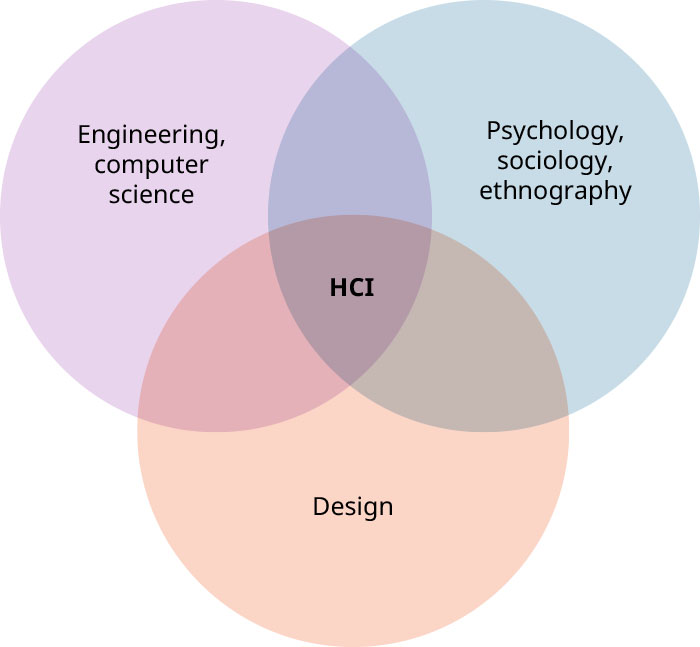
An important aspect of designing applications is human-computer interaction (HCI), the science that studies interactions between people and computers and evaluates whether computers can successfully interact with humans. As illustrated in Figure 13.16, “HCI is concerned with understanding the influence technology has on how people think, value, feel, and relate and using this understanding to inform technology design.”1
英語のヒント
attribution: Copyright Rice University, OpenStax, under CC BY 4.0 license · CC BY 4.0 · Source出典
Figure 13.16 Human-computer interaction (HCI) studies the interaction of humans with technology to understand how technology influences human behavior. (attribution: Copyright Rice University, OpenStax, under CC BY 4.0 license)
図13.16 HCIは、人と技術との相互作用を研究し、技術が人の行動にどう影響するかを理解する。(帰属表示:著作権 Rice University、OpenStax、CC BY 4.0)
The focus of HCI is to ensure that solutions are usable by humans. Usable solutions should be easy to use as well as effective, safe, efficient, and fun for the user. HCI also focuses on the creation of methods that may be used to measure and otherwise evaluate usability, as well as on the definition of usability guidelines and standards. Applying HCI as part of the design of computing systems requires considering human physical and mental capabilities (e.g., attention, memory) as well as the needs of humans (e.g., functional, emotional, social) as constraints at the same level as machine physical constraints such as processor speed and networking capabilities.
英語のヒント
HCIの重点は、人がソリューションを使えるようにすることである。利用可能なソリューションは、使いやすく、利用者にとって効果的、安全、効率的で、楽しいものであるべきだ。HCIは、使いやすさを測定・評価する方法の作成や、指針と標準の定義にも取り組む。計算システムの設計にHCIを適用するには、人の身体的・精神的な能力(注意、記憶など)と必要(機能、感情、社会に関わるものなど)を、プロセッサーの速度やネットワーク能力といった機械の物理的制約と同じ水準の制約として考慮する必要がある。
1 P. C. Wright and J. C. McCarthy, “Empathy and experience in HCI,” Conference: Proceedings of the 2008 Conference on Human Factors in Computing Systems, CHI 2008, 2008, Florence, Italy, April 5-10, 2008. http://dx.doi.org/10.1145/1357054.1357156
1 P. C. Wright、J. C. McCarthy「Empathy and experience in HCI」。2008年コンピューティングシステムにおけるヒューマンファクター会議(CHI 2008)論文集、イタリア・フィレンツェ、2008年4月5〜10日。http://dx.doi.org/10.1145/1357054.1357156
A usable system must understand the various roles of humans. This includes the following:
使いやすいシステムには、人間のさまざまな役割を理解することが必要だ。次のような役割が含まれる。
• Humans as sensory processors. Usability results when the system fits within human sensory limits for vision, hearing, touch, smell, and taste.
・感覚情報を処理するものとしての人間。システムが、視覚、聴覚、触覚、嗅覚、味覚に関する人の感覚の限界に収まると、使いやすさが生まれる。
• Humans as interpreters/predictors. Usability results when the system fits with human knowledge. This includes the ability to process information via perception and cognitive processes such as selective attention, learning, problem-solving, and language processing.
英語のヒント
・解釈し、予測するものとしての人間。システムが人の知識に合っていると、使いやすさが生まれる。知覚と、選択的注意、学習、問題解決、言語処理などの認知過程を通じて情報を処理する能力が含まれる。
• Humans as actors in environments. Usability results when the system fits within task and social contexts, such as gender and ethnic backgrounds.
・環境の中で行動するものとしての人間。システムが、仕事の状況や、性別・民族的背景などの社会的な文脈に合うと、使いやすさが生まれる。