第13章ハイブリッドマルチクラウドのデジタルソリューション開発
Robotics and Advanced Roboticsロボット工学と高度なロボット工学
Robotics and advanced robotics are joint disciplines that include computer science and mechanical and electrical engineering. The field of robotics focuses on the design, development, functioning, and application of robots, as well as the computer systems needed to control the robots, provide sensory feedback, and process information. Swarm robotics emphasizes a large number of robots and promotes scalability. A cyborg is a biological human with parts replaced with machinery, while machines with biological parts added are considered to be an artificial human. Google’s Cloud Robotics Core is an open-source platform that facilitates the management of robot fleets as well as the creation and operation of robotics-packaged solutions that automate business tasks. Other big cloud platforms also provide support for robotics and advanced robotics.
英語のヒント
ロボット工学と高度なロボット工学は、コンピューターサイエンス、機械工学、電気工学が交わる分野である。ロボットの設計、開発、動作、応用に加え、その制御、感覚的なフィードバック、情報処理に必要な計算機システムを扱う。群ロボット工学は、多数のロボットと拡張性に重点を置く。身体の一部を機械で置き換えた生物学的な人間はサイボーグであり、生体部品を付け加えた機械は人工人間とみなされる。GoogleのCloud Robotics Coreは、ロボット群の管理と、業務を自動化するロボット用パッケージの作成・運用を容易にするオープンソース基盤である。ほかの大手クラウドも、ロボット工学と高度なロボット工学を支援する。
Software Robots
ソフトウェアロボット
Software robots, or bots (e.g., web crawlers, chatbots), are computer programs that operate autonomously to complete a virtual task. They are not physical robots; instead, they exist only within a computer.
英語のヒント
ソフトウェアロボット、すなわちボット(Webクローラー、チャットボットなど)は、仮想的なタスクを完了するために自律的に動くプログラムである。物理的なロボットではなく、コンピューター内だけに存在する。
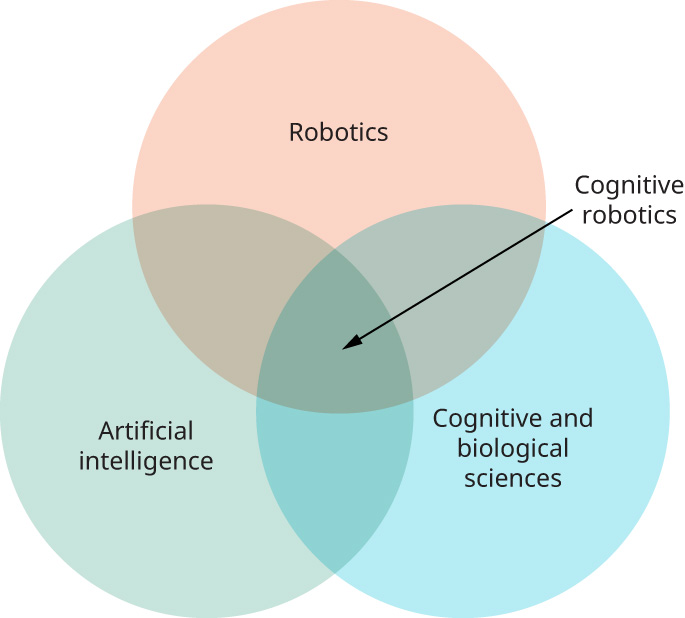
Another field of robotics, cognitive robotics, is a field that creates robots that can think, perceive, learn, remember, reason, and interact. It focuses on creating robots that mimic human perception, reasoning, and planning abilities. One subspecialty, biomimetic robotics, focuses on the design of robots that leverage principles common in nature, such as what can be learned from the evolution and development of intelligence in animals and humans. Recent progress and directions in AI, machine learning, and cognitive science drive the focus of the next generation of robotic systems. Figure 13.18 shows how these areas overlap.
英語のヒント
ロボット工学の別の分野である認知ロボット工学は、考える、知覚する、学ぶ、記憶する、推論する、やり取りするといったことができるロボットを作る。人の知覚、推論、計画の能力を模倣するロボットの作成に重点を置く。その一分野の生物模倣ロボット工学は、自然界に共通する原理を使う設計を扱う。動物や人間の知能の進化・発達から学べることなどがその例である。AI、機械学習、認知科学の最近の進展と方向性が、次世代ロボットシステムの重点を決める。図13.18は、これらの領域の重なりを示す。
attribution: Copyright Rice University, OpenStax, under CC BY 4.0 license · CC BY 4.0 · Source出典
Figure 13.18 Cognitive robotics draws from the fields of cognitive and biological sciences and artificial intelligence, as well as robotics. (attribution: Copyright Rice University, OpenStax, under CC BY 4.0 license)
図13.18 認知ロボット工学は、ロボット工学に加え、認知科学、生物科学、人工知能を基にしている。(帰属表示:著作権 Rice University、OpenStax、CC BY 4.0)
The intent of cognitive robotics is to replace humans in dangerous environments or manufacturing processes or resemble humans in cognition, enabling robots to do jobs that are hazardous to people. Cognitive robotics aims to improve robots’ perception capabilities as they navigate and manipulate objects in a given environment and interact with people. It also makes it possible for robots to perform tasks by predicting the actions of people around them as well as their own. Cognitive robots can also perceive how people see the world, predict what they need, and anticipate their actions. This explains how these robots can execute daily tasks while interacting safely with people. They are capable of direct interactions, such as assisting customers, as well as indirect interactions, such as sweeping the floor while customers are shopping in a store.
英語のヒント
認知ロボット工学は、危険な環境や製造工程で人に代わったり、人と似た認知を実現したりして、人にとって危険な仕事をロボットが行えるようにすることを目指す。特定の環境を移動し、物体を操作し、人とやり取りする際の知覚能力を改善する。周囲の人々の行動と自分自身の行動を予測して、タスクを実行することも可能になる。人が世界をどう見ているかを捉え、何を必要としているかを予測し、行動を先読みすることもできる。このため、人と安全にやり取りしながら日常の仕事をこなせる。顧客を手伝うような直接的なやり取りだけでなく、買い物中の顧客のそばで床を掃くような、間接的なやり取りも可能である。
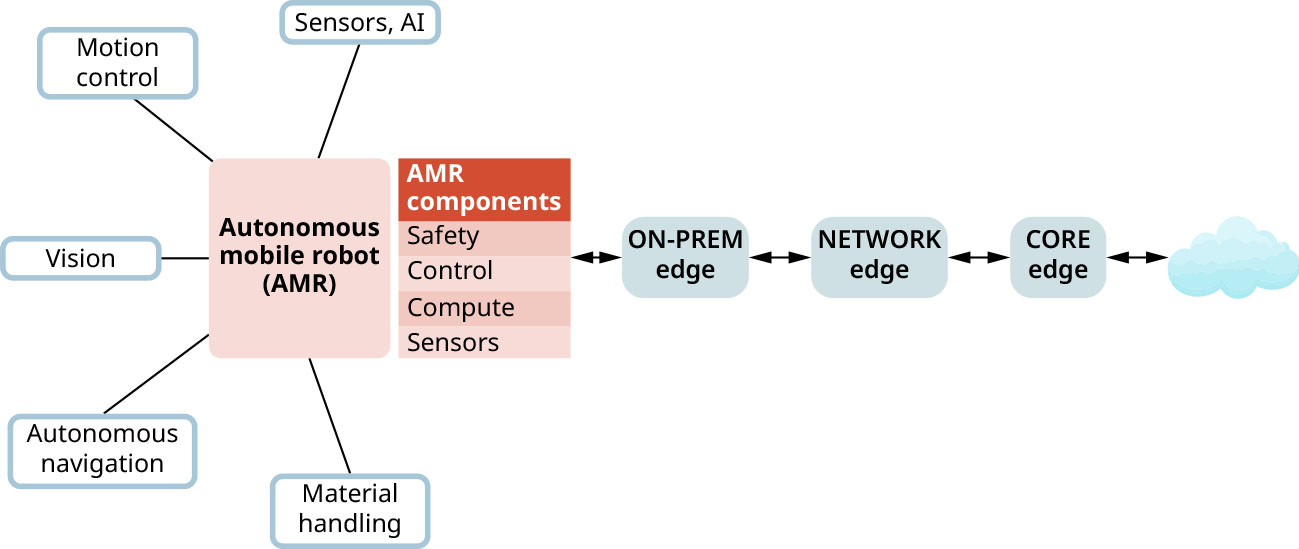
Intelligent mobile robots that can move independently were introduced during the Second World War. Following the implementation of artificial intelligence (AI) in robotics, they became autonomous or more intelligent. Figure 13.19 provides a list of components and architecture of modern intelligent robots.
独立して動ける知的な移動ロボットは、第二次世界大戦中に登場した。ロボット工学にAIが実装されると、自律的に、あるいはさらに知的に動くようになった。図13.19は、現代の知的ロボットの構成要素とアーキテクチャーを示す。
attribution: Copyright Rice University, OpenStax, under CC BY 4.0 license · CC BY 4.0 · Source出典
Figure 13.19 Modern, intelligent robots rely on various components and architecture to function as intended. (attribution: Copyright Rice University, OpenStax, under CC BY 4.0 license)
図13.19 現代の知的ロボットは、意図したとおりに機能するため、さまざまな構成要素とアーキテクチャーを利用する。(帰属表示:著作権 Rice University、OpenStax、CC BY 4.0)
Robot Operating System
Robot Operating System
The Robot Operating System (ROS) is a meta-operating system specially designed for robots. It is open-source and supports a variety of services to control robotics hardware, provide hardware abstractions, and perform common tasks. It can also help manage software packages and pass messages from one process to another. ROS also includes various libraries and tools to facilitate the selection, development, and operation of software modules across various computers.
英語のヒント
Robot Operating System(ROS)は、ロボット向けに特別に設計されたメタOSである。オープンソースで、ハードウェアの制御、ハードウェアの抽象化、共通タスクの実行に使う各種サービスに対応する。ソフトウェアパッケージの管理や、プロセス間でのメッセージの受け渡しも助ける。複数のコンピューターでソフトウェアモジュールを選択・開発・運用しやすくする、各種ライブラリーとツールも含まれる。
Robot Manipulators and Mobile Robots Characteristics
ロボットマニピュレーターと移動ロボットの特徴
Robots include robot manipulators and mobile robots. A robot manipulator is a physical tool that operates at a fixed location to catch and move items. A mobile robot is one that can navigate from one position to another. Robot manipulators face the challenge of being able to pick and place objects with a sufficient degree of precision, while mobile robots must be able to estimate relative and absolute robot positions and navigate on a map.
英語のヒント
ロボットには、マニピュレーターと移動ロボットがある。マニピュレーターは固定された場所で物をつかみ、移動させる物理的な道具である。移動ロボットは、ある場所から別の場所へ進めるロボットだ。マニピュレーターには、物体を十分に正確につかんで置く課題がある。一方、移動ロボットは、自分の相対位置と絶対位置を推定し、地図上を移動できなければならない。
Mobile robots are used in applications such as medical treatment, mail delivery, infrastructure inspections, and passenger travel. For example, Nao is a humanoid robot that is specially designed to interact with humans. It is loaded with sensors that enable it to mimic emotions. It can recognize people’s faces as well as objects and can speak, walk, and dance. Nao was created by Aldebaran Robotics, which was acquired by SoftBank in 2015. Sixth-generation Nao robots are used in research as well as in the health-care and education industries.
英語のヒント
移動ロボットは、治療、郵便の配達、インフラ点検、乗客の移動などに使われる。例えばNaoは、人と交流するよう特別に設計された人型ロボットで、感情を模倣できるセンサーを搭載する。人の顔や物体を認識し、話し、歩き、踊ることができる。NaoはAldebaran Roboticsが開発し、同社は2015年にSoftBankに買収された。第6世代のNaoは、研究に加え、医療と教育の分野で使われている。
Atlas is one of the most agile robots in existence. It uses whole-body skills to move quickly and balance dynamically. While Atlas can lift and carry objects such as boxes and crates, the robot can also run, jump, and do backflips.
英語のヒント
Atlasは、現存する最も機敏なロボットの一つである。全身の技能を使い、素早く動き、動作に合わせてバランスを取る。箱や木箱を持ち上げて運べるだけでなく、走り、跳び、後方宙返りもできる。