第15章その他の反応の平衡
15.3 Coupled Equilibria15.3 連結した平衡
Learning Objectives学習目標
By the end of this section, you will be able to:
この節を学び終えると、次のことができるようになる。
- Describe examples of systems involving two (or more) coupled chemical equilibria二つ以上の連結した化学平衡が関与する系の例を説明する。
- Calculate reactant and product concentrations for coupled equilibrium systems連結した平衡の系について、反応物と生成物の濃度を計算する。
As discussed in preceding chapters on equilibrium, coupled equilibria involve two or more separate chemical reactions that share one or more reactants or products. This section of this chapter will address solubility equilibria coupled with acid-base and complex-formation reactions.
英語のヒント
平衡を扱った前の各章で説明したように、連結した平衡には、一つ以上の反応物または生成物を共有する、二つ以上の別々の化学反応が関与する。本章のこの節では、酸塩基反応や錯体形成反応と結び付いた溶解平衡を扱う。
An environmentally relevant example illustrating the coupling of solubility and acid-base equilibria is the impact of ocean acidification on the health of the ocean’s coral reefs. These reefs are built upon skeletons of sparingly soluble calcium carbonate excreted by colonies of corals (small marine invertebrates). The relevant dissolution equilibrium is
英語のヒント
溶解平衡と酸塩基平衡との結び付きを示す、環境に関係する例が、海洋のサンゴ礁の健全さに対する海洋酸性化の影響である。これらのサンゴ礁は、サンゴ(小さな海生無脊椎動物)の群体が排出する、難溶性の炭酸カルシウムの骨格を土台として作られる。関係する溶解平衡は、次のとおりである。
Rising concentrations of atmospheric carbon dioxide contribute to an increased acidity of ocean waters due to the dissolution, hydrolysis, and acid ionization of carbon dioxide:
大気中の二酸化炭素濃度の上昇は、二酸化炭素の溶解、加水分解、酸としての電離によって、海水の酸性が強まる一因となる。
Inspection of these equilibria shows the carbonate ion is involved in the calcium carbonate dissolution and the acid hydrolysis of bicarbonate ion. Combining the dissolution equation with the reverse of the acid hydrolysis equation yields
これらの平衡を調べると、炭酸イオンは、炭酸カルシウムの溶解と炭酸水素イオンの酸としての加水分解に関与していることが分かる。溶解の反応式と、酸としての加水分解の逆反応の式を組み合わせると、次のようになる。
The equilibrium constant for this net reaction is much greater than the Ksp for calcium carbonate, indicating its solubility is markedly increased in acidic solutions. As rising carbon dioxide levels in the atmosphere increase the acidity of ocean waters, the calcium carbonate skeletons of coral reefs become more prone to dissolution and subsequently less healthy (Figure 15.7).
英語のヒント
この正味の反応の平衡定数は、炭酸カルシウムのKspよりはるかに大きい。このことは、酸性溶液中でその溶解度が著しく増加することを示している。大気中の二酸化炭素濃度の上昇によって海水の酸性が強まると、サンゴ礁の炭酸カルシウム骨格はより溶けやすくなり、その後、健全さを失っていく(図15.7)。
Image omitted because its reuse rights could not be verified.権利の確認ができないため画像を割愛。
Figure 15.7図 15.7
Healthy coral reefs (a) support a dense and diverse array of sea life across the ocean food chain. But when coral are unable to adequately build and maintain their calcium carbonate skeletons because of excess ocean acidification, the unhealthy reef (b) is only capable of hosting a small fraction of the species as before, and the local food chain starts to collapse. (credit a: modification of work by NOAA Photo Library; credit b: modification of work by “prilfish”/Flickr)
英語のヒント
健全なサンゴ礁(a)は、海の食物連鎖の全体にわたって、密集した多様な海洋生物を支えている。しかし、過度の海洋酸性化によって、サンゴが炭酸カルシウムの骨格を十分に形成・維持できなくなると、不健全なサンゴ礁(b)は、それまでの種のごく一部しか養えなくなり、地域の食物連鎖が崩れ始める。(出典:aはNOAA Photo Libraryの作品を改変、bは「prilfish」/Flickrの作品を改変)
The dramatic increase in solubility with increasing acidity described above for calcium carbonate is typical of salts containing basic anions (e.g., carbonate, fluoride, hydroxide, sulfide). Another familiar example is the formation of dental cavities in tooth enamel. The major mineral component of enamel is calcium hydroxyapatite (Figure 15.8), a sparingly soluble ionic compound whose dissolution equilibrium is
英語のヒント
上で炭酸カルシウムについて説明した、酸性が強まるにつれて溶解度が大幅に増加する現象は、塩基性陰イオン(炭酸イオン、フッ化物イオン、水酸化物イオン、硫化物イオンなど)を含む塩に典型的である。もう一つの身近な例は、歯のエナメル質に虫歯ができることである。エナメル質の主要な鉱物成分はヒドロキシアパタイトカルシウム(図15.8)であり、その溶解平衡は次のとおりである。これは難溶性のイオン化合物である。
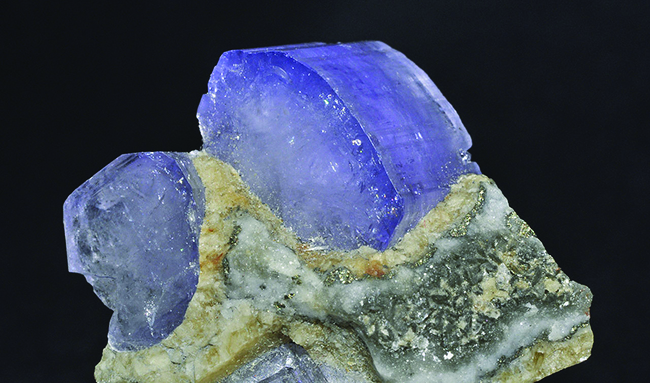
Figure 15.8図 15.8
Crystal of the mineral hydroxyapatite, Ca5(PO4)3OH, is shown here. The pure compound is white, but like many other minerals, this sample is colored because of the presence of impurities.
鉱物ヒドロキシアパタイトCa5(PO4)3OHの結晶である。純粋な化合物は白色だが、ほかの多くの鉱物と同じように、この試料は不純物が存在するために色づいている。
This compound dissolved to yield two different basic ions: triprotic phosphate ions
この化合物は溶けて、二種類の異なる塩基性イオンを生じる。一つは、三つのプロトンを受け取るリン酸イオンである。
and monoprotic hydroxide ions:
もう一つは、一つのプロトンを受け取る水酸化物イオンである。
Of the two basic productions, the hydroxide is, of course, by far the stronger base (it’s the strongest base that can exist in aqueous solution), and so it is the dominant factor providing the compound an acid-dependent solubility. Dental cavities form when the acid waste of bacteria growing on the surface of teeth hastens the dissolution of tooth enamel by reacting completely with the strong base hydroxide, shifting the hydroxyapatite solubility equilibrium to the right. Some toothpastes and mouth rinses contain added NaF or SnF2 that make enamel more acid resistant by replacing the strong base hydroxide with the weak base fluoride:
英語のヒント
この二つの塩基性生成物のうち、水酸化物イオンのほうがはるかに強い塩基である(水溶液中に存在しうる最も強い塩基である)。したがって、化合物の溶解度が酸に依存することの主要な要因となる。歯の表面で増殖する細菌が出す酸性の老廃物が、強塩基である水酸化物イオンと完全に反応し、ヒドロキシアパタイトの溶解平衡を右へ移動させて歯のエナメル質の溶解を速めると、虫歯ができる。一部の歯磨き剤や洗口液にはNaFやSnF2が添加されている。これらは、強塩基である水酸化物イオンを弱塩基であるフッ化物イオンに置き換えて、エナメル質を酸に対して強くする。
The weak base fluoride ion reacts only partially with the bacterial acid waste, resulting in a less extensive shift in the solubility equilibrium and an increased resistance to acid dissolution. See the Chemistry in Everyday Life feature on the role of fluoride in preventing tooth decay for more information.
弱塩基であるフッ化物イオンは、細菌が出す酸性の老廃物と部分的にしか反応しない。そのため、溶解平衡の移動はより小さくなり、酸による溶解への抵抗力が高まる。詳しくは、虫歯予防におけるフッ化物の役割を扱う「日常生活の化学」の特集を参照しよう。
The solubility of ionic compounds may also be increased when dissolution is coupled to the formation of a complex ion. For example, aluminum hydroxide dissolves in a solution of sodium hydroxide or another strong base because of the formation of the complex ion
溶解が錯イオンの形成と結び付くと、イオン化合物の溶解度が増加する場合もある。たとえば、水酸化アルミニウムは、錯イオンを形成するため、水酸化ナトリウムやその他の強塩基の溶液に溶ける。
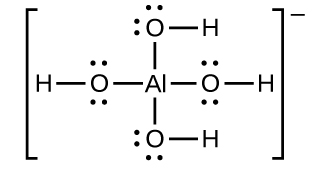
The equations for the dissolution of aluminum hydroxide, the formation of the complex ion, and the combined (net) equation are shown below. As indicated by the relatively large value of K for the net reaction, coupling complex formation with dissolution drastically increases the solubility of Al(OH)3.
水酸化アルミニウムの溶解、錯イオンの形成、およびそれらを組み合わせた正味の反応の式を、次に示す。正味の反応のKの値が比較的大きいことから分かるように、錯体形成と溶解を結び付けると、Al(OH)3の溶解度は劇的に増加する。
Example 15.15例題 15.15
Increased Solubility in Acidic Solutions酸性溶液中での溶解度の増加
Compute and compare the molar solublities for aluminum hydroxide, Al(OH)3, dissolved in (a) pure water and (b) a buffer containing 0.100 M acetic acid and 0.100 M sodium acetate.
水酸化アルミニウムAl(OH)3を(a)純水、(b)0.100 Mの酢酸と0.100 Mの酢酸ナトリウムを含む緩衝液に溶かした場合のモル溶解度を計算し、比較しなさい。
Solution解き方
(a) The molar solubility of aluminum hydroxide in water is computed considering the dissolution equilibrium only as demonstrated in several previous examples:
(a) 水中での水酸化アルミニウムのモル溶解度は、前のいくつかの例で示したように、溶解平衡だけを考慮して計算する。
(b) The concentration of hydroxide ion of the buffered solution is conveniently calculated by the Henderson-Hasselbalch equation:
(b) 緩衝溶液の水酸化物イオン濃度は、ヘンダーソン–ハッセルバルヒの式を使うと簡便に計算できる。
At this pH, the concentration of hydroxide ion is
このpHでは、水酸化物イオン濃度は次のようになる。
The solubility of Al(OH)3 in this buffer is then calculated from its solubility product expressions:
次に、この緩衝液中のAl(OH)3の溶解度を、その溶解度積の式から計算する。
Compared to pure water, the solubility of aluminum hydroxide in this mildly acidic buffer is approximately ten million times greater (though still relatively low).
この穏やかに酸性を示す緩衝液中での水酸化アルミニウムの溶解度は、純水中と比べて約1000万倍大きい(それでもなお比較的小さい)。
Check Your Learning理解度の確認
What is the solubility of aluminum hydroxide in a buffer comprised of 0.100 M formic acid and 0.100 M sodium formate?
0.100 Mのギ酸と0.100 Mのギ酸ナトリウムからなる緩衝液中での、水酸化アルミニウムの溶解度はいくらか。
Example 15.16例題 15.16
Multiple Equilibria複合平衡
Unexposed silver halides are removed from photographic film when they react with sodium thiosulfate (Na2S2O3, called hypo) to form the complex ion (Kf = 4.7 1013).
英語のヒント
未露光のハロゲン化銀は、チオ硫酸ナトリウム(Na2S2O3、ハイポと呼ばれる)と反応して錯イオンを形成することで、写真フィルムから除去される(Kf = 4.7 1013)。



What mass of Na2S2O3 is required to prepare 1.00 L of a solution that will dissolve 1.00 g of AgBr by the formation of
を形成させて1.00 gのAgBrを溶かせる溶液を1.00 L調製するには、どれだけの質量のNa2S2O3が必要か。
Solution解き方
Two equilibria are involved when silver bromide dissolves in an aqueous thiosulfate solution containing the ion:
臭化銀が、イオンを含むチオ硫酸塩水溶液に溶けるときには、二つの平衡が関与する。
dissolution:
溶解:
complexation:
錯体形成:
Combining these two equilibrium equations yields
これら二つの平衡反応式を組み合わせると、次のようになる。
The concentration of bromide resulting from dissolution of 1.00 g of AgBr in 1.00 L of solution is
1.00 Lの溶液に1.00 gのAgBrが溶けることで生じる臭化物イオンの濃度は、次のとおりである。
The stoichiometry of the dissolution equilibrium indicates the same concentration of aqueous silver ion will result, 0.00532 M, and the very large value of ensures that essentially all the dissolved silver ion will be complexed by thiosulfate ion:
溶解平衡の化学量論から、水溶液中の銀イオンも同じ0.00532 Mの濃度になることが分かる。さらに、の値が非常に大きいことから、溶けた銀イオンは実質的にすべて、チオ硫酸イオンによって錯体となる。
Rearranging the K expression for the combined equilibrium equations and solving for the concentration of thiosulfate ion yields
二つを組み合わせた平衡反応式のKの式を変形し、チオ硫酸イオン濃度について解くと、次のようになる。
Finally, the total mass of required to provide enough thiosulfate to yield the concentrations cited above can be calculated.
最後に、上記の濃度を生じるだけの十分な量のチオ硫酸イオンを供給するために必要な、の総質量を計算できる。
Mass of required to yield 0.00532 M
0.00532 Mのを生じるために必要なの質量。
Mass of required to yield 0.00110 M
0.00110 Mのを生じるために必要なの質量。
(15.1)
The mass of required to dissolve 1.00 g of AgBr in 1.00 L of water is thus 1.68 g + 0.17 g = 1.85 g
したがって、1.00 Lの水に1.00 gのAgBrを溶かすために必要なの質量は、1.68 g + 0.17 g = 1.85 gである。
Check Your Learning理解度の確認
AgCl(s), silver chloride, has a very low solubility: Ksp = 1.6 10–10. Adding ammonia significantly increases the solubility of AgCl because a complex ion is formed: Kf = 1.7 107. What mass of NH3 is required to prepare 1.00 L of solution that will dissolve 2.00 g of AgCl by formation of
塩化銀AgCl(s)の溶解度は非常に低い。、Ksp = 1.6 10–10である。アンモニアを加えると、錯イオンが形成されるため、AgClの溶解度が大幅に増加する。、Kf = 1.7 107である。の形成によって2.00 gのAgClを溶かせる溶液を1.00 L調製するには、どれだけの質量のNH3が必要か。