第15章その他の反応の平衡
Key Concepts and Summary重要概念とまとめ
A Lewis acid is a species that can accept an electron pair, whereas a Lewis base has an electron pair available for donation to a Lewis acid. Complex ions are examples of Lewis acid-base adducts and comprise central metal atoms or ions acting as Lewis acids bonded to molecules or ions called ligands that act as Lewis bases. The equilibrium constant for the reaction between a metal ion and ligands produces a complex ion called a formation constant; for the reverse reaction, it is called a dissociation constant.
ルイス酸は電子対を受け取ることのできる化学種であり、ルイス塩基はルイス酸に供与できる電子対を持つ。錯イオンはルイス酸塩基付加体の一例であり、ルイス酸として働く中心の金属原子またはイオンに、ルイス塩基として働く配位子と呼ばれる分子やイオンが結合したものである。金属イオンと配位子が反応して錯イオンを生じる反応の平衡定数を生成定数と呼び、逆反応については解離定数と呼ぶ。
Chemistry End of Chapter Exercises章末問題
Exercises 61–84練習問題 61–84
Exercise 61問題 61
Even though Ca(OH)2 is an inexpensive base, its limited solubility restricts its use. What is the pH of a saturated solution of Ca(OH)2?
Ca(OH)2は安価な塩基だが、溶解度が限られているため用途に制約がある。Ca(OH)2の飽和溶液のpHはいくらか。
Exercise 62問題 62
Under what circumstances, if any, does a sample of solid AgCl completely dissolve in pure water?
英語のヒント
固体AgClの試料が純水に完全に溶ける場合があるとすれば、それはどのような条件のときか。
Solution解き方
when the amount of solid is so small that a saturated solution is not produced
固体の量がきわめて少なく、飽和溶液ができない場合。
Exercise 63問題 63
Explain why the addition of NH3 or HNO3 to a saturated solution of Ag2CO3 in contact with solid Ag2CO3 increases the solubility of the solid.
固体Ag2CO3と接触しているAg2CO3の飽和溶液に、NH3またはHNO3を加えると、この固体の溶解度が増加する理由を説明しなさい。
Exercise 64問題 64
Calculate the cadmium ion concentration, [Cd2+], in a solution prepared by mixing 0.100 L of 0.0100 M Cd(NO3)2 with 0.150 L of 0.100 NH3(aq).
0.0100 MのCd(NO3)2 0.100 Lと、0.100のNH3(aq) 0.150 Lを混合して調製した溶液の、カドミウムイオン濃度[Cd2+]を計算しなさい。
Solution解き方
8.2 10–5 M
8.2 10–5 M
Exercise 65問題 65
Explain why addition of NH3 or HNO3 to a saturated solution of Cu(OH)2 in contact with solid Cu(OH)2 increases the solubility of the solid.
固体Cu(OH)2と接触しているCu(OH)2の飽和溶液に、NH3またはHNO3を加えると、この固体の溶解度が増加する理由を説明しなさい。
Exercise 66問題 66
Sometimes equilibria for complex ions are described in terms of dissociation constants, Kd. For the complex ion the dissociation reaction is:
錯イオンの平衡を、解離定数Kdを使って表す場合もある。錯イオンの解離反応は、次のとおりである。
and
および
Calculate the value of the formation constant, Kf, for
の生成定数Kfの値を計算しなさい。
Solution解き方
5 1023
5 1023
Exercise 67問題 67
Using the value of the formation constant for the complex ion calculate the dissociation constant.
錯イオンの生成定数の値を使って、解離定数を計算しなさい。
Exercise 68問題 68
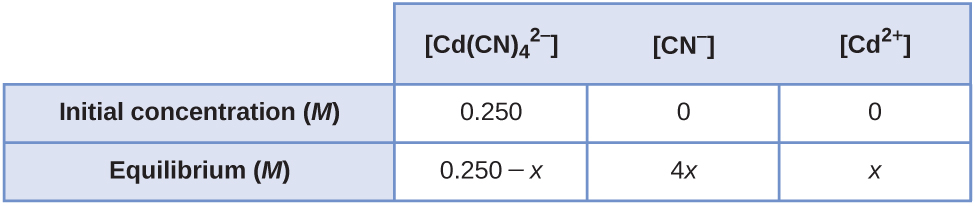
Using the dissociation constant, Kd = 3.3 10–19, calculate the equilibrium concentrations of Cd2+ and CN– in a 0.250-M solution of
解離定数Kd = 3.3 10–19を使って、0.250 Mの溶液中のCd2+とCN–の平衡濃度を計算しなさい。
Exercise 69問題 69
Using the dissociation constant, Kd = 3.4 10–15, calculate the equilibrium concentrations of Zn2+ and OH– in a 0.0465-M solution of
解離定数Kd = 3.4 10–15を使って、0.0465 Mの溶液中のZn2+とOH–の平衡濃度を計算しなさい。
Exercise 70問題 70
Using the dissociation constant, Kd = 2.2 10–34, calculate the equilibrium concentrations of Co3+ and NH3 in a 0.500-M solution of
解離定数Kd = 2.2 10–34を使って、0.500 Mの溶液中のCo3+とNH3の平衡濃度を計算しなさい。
Solution解き方
[Co3+] = 3.0 10–6 M; [NH3] = 1.8 10–5 M
[Co3+] = 3.0 10–6 M; [NH3] = 1.8 10–5 M
Exercise 71問題 71
Using the dissociation constant, Kd = 1 10–44, calculate the equilibrium concentrations of Fe3+ and CN– in a 0.333 M solution of
解離定数Kd = 1 10–44を使って、0.333 Mの溶液中のFe3+とCN–の平衡濃度を計算しなさい。
Exercise 72問題 72
Calculate the mass of potassium cyanide ion that must be added to 100 mL of solution to dissolve 2.0 10–2 mol of silver cyanide, AgCN.
2.0 10–2 molのシアン化銀AgCNを溶かすため、100 mLの溶液に加えなければならないシアン化カリウムイオンの質量を計算しなさい。
Solution解き方
1.3 g
1.3 g
Exercise 73問題 73
Calculate the minimum concentration of ammonia needed in 1.0 L of solution to dissolve 3.0 10–3 mol of silver bromide.
3.0 10–3 molの臭化銀を溶かすため、1.0 Lの溶液中に必要なアンモニアの最小濃度を計算しなさい。
Exercise 74問題 74
A roll of 35-mm black and white photographic film contains about 0.27 g of unexposed AgBr before developing. What mass of Na2S2O3·5H2O (sodium thiosulfate pentahydrate or hypo) in 1.0 L of fixer is required to dissolve the AgBr as (Kf = 4.7 1013)?
英語のヒント
35 mmの白黒写真フィルム1巻には、現像前に約0.27 gの未露光のAgBrが含まれる。このAgBrをとして溶かすには、定着液1.0 L中に、どれだけの質量のNa2S2O3·5H2O(チオ硫酸ナトリウム五水和物、またはハイポ)が必要か(Kf = 4.7 1013)。
Solution解き方
0.79 g
0.79 g
Exercise 75問題 75
We have seen an introductory definition of an acid: An acid is a compound that reacts with water and increases the amount of hydronium ion present. In the chapter on acids and bases, we saw two more definitions of acids: a compound that donates a proton (a hydrogen ion, H+) to another compound is called a Brønsted-Lowry acid, and a Lewis acid is any species that can accept a pair of electrons. Explain why the introductory definition is a macroscopic definition, while the Brønsted-Lowry definition and the Lewis definition are microscopic definitions.
酸の入門的な定義として、「酸とは、水と反応して、存在するヒドロニウムイオンの量を増加させる化合物である」というものを学んだ。酸と塩基の章では、さらに二つの酸の定義を学んだ。別の化合物にプロトン(水素イオンH+)を供与する化合物をブレンステッド–ローリー酸と呼び、電子対を受け取ることのできる化学種をルイス酸と呼ぶ。入門的な定義が巨視的な定義であるのに対し、ブレンステッド–ローリーの定義とルイスの定義が微視的な定義である理由を説明しなさい。
Exercise 76問題 76
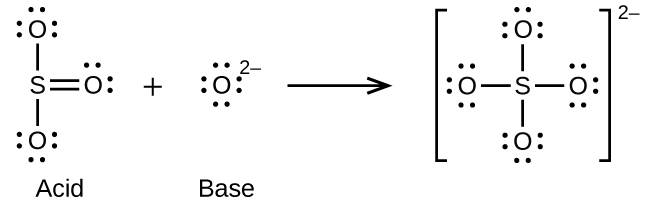
Write the Lewis structures of the reactants and product of each of the following equations, and identify the Lewis acid and the Lewis base in each:
次の各反応式の反応物と生成物のルイス構造を書き、それぞれのルイス酸とルイス塩基を特定しなさい。
(a)
(a)
(b)
(b)
(c)
(c)
(d) (use Al-Cl single bonds)
(d) (Al–Cl単結合を使う)
(e)
(e)
Solution解き方
(a)
(a)
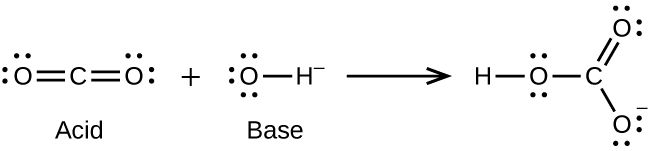
(b)
(b)
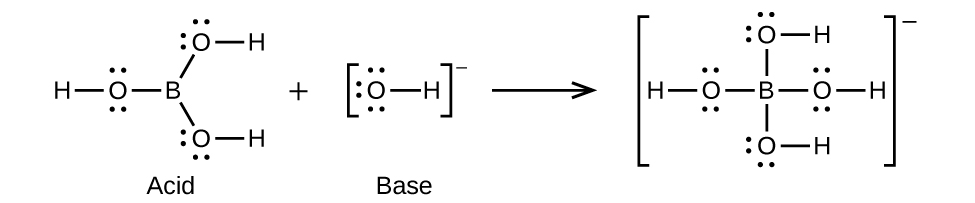
(c)
(c)

(d)
(d)
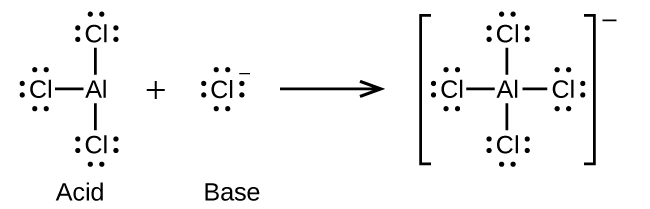
(e)
(e)
Exercise 77問題 77
Write the Lewis structures of the reactants and product of each of the following equations, and identify the Lewis acid and the Lewis base in each:
次の各反応式の反応物と生成物のルイス構造を書き、それぞれのルイス酸とルイス塩基を特定しなさい。
(a)
(a)
(b)
(b)
(c)
(c)
(d)
(d)
(e)
(e)
Exercise 78問題 78
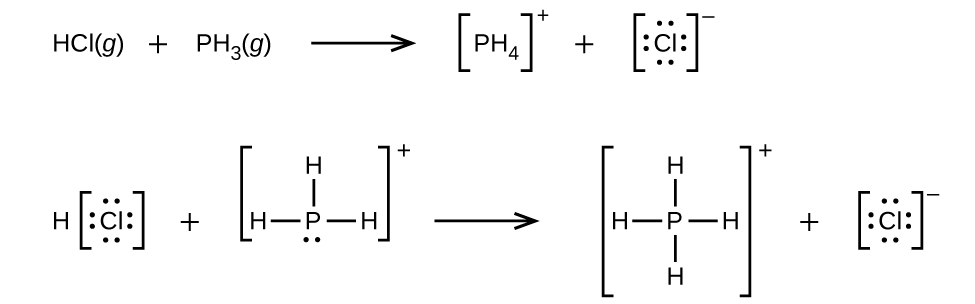
Using Lewis structures, write balanced equations for the following reactions:
ルイス構造を使って、次の反応について係数を合わせた反応式を書きなさい。
(a)
(a)
(b)
(b)
(c)
(c)
(d)
(d)





Exercise 79問題 79
Calculate in a solution prepared by adding 0.0200 mol of NaCl to 0.250 L of a 0.100-M HgCl2 solution.
0.100 MのHgCl2溶液0.250 Lに0.0200 molのNaClを加えて調製した溶液中のを計算しなさい。
Exercise 80問題 80
In a titration of cyanide ion, 28.72 mL of 0.0100 M AgNO3 is added before precipitation begins. [The reaction of Ag+ with CN– goes to completion, producing the complex.] Precipitation of solid AgCN takes place when excess Ag+ is added to the solution, above the amount needed to complete the formation of How many grams of NaCN were in the original sample?
英語のヒント
シアン化物イオンの滴定で、沈殿が始まるまでに0.0100 MのAgNO3を28.72 mL加えた。[Ag+とCN–の反応は完結し、錯体を生じる。]の形成を完結させるのに必要な量を超えて、過剰のAg+を溶液に加えると、固体AgCNが沈殿する。もとの試料にはNaCNが何グラム含まれていたか。
Solution解き方
0.0281 g
0.0281 g
Exercise 81問題 81
What are the concentrations of Ag+, CN–, and in a saturated solution of AgCN?
AgCNの飽和溶液中のAg+、CN–、の濃度はいくらか。
Exercise 82問題 82
In dilute aqueous solution HF acts as a weak acid. However, pure liquid HF (boiling point = 19.5 °C) is a strong acid. In liquid HF, HNO3 acts like a base and accepts protons. The acidity of liquid HF can be increased by adding one of several inorganic fluorides that are Lewis acids and accept F– ion (for example, BF3 or SbF5). Write balanced chemical equations for the reaction of pure HNO3 with pure HF and of pure HF with BF3.
希薄な水溶液中でHFは弱酸として働く。しかし、純粋な液体HF(沸点19.5 °C)は強酸である。液体HF中では、HNO3は塩基として働き、プロトンを受け取る。液体HFの酸性は、ルイス酸としてF–イオンを受け取る無機フッ化物(たとえばBF3やSbF5)のいずれかを加えると強くなる。純粋なHNO3と純粋なHFの反応、および純粋なHFとBF3の反応について、係数を合わせた化学反応式を書きなさい。
Solution解き方
Exercise 83問題 83
The simplest amino acid is glycine, H2NCH2CO2H. The common feature of amino acids is that they contain the functional groups: an amine group, –NH2, and a carboxylic acid group, –CO2H. An amino acid can function as either an acid or a base. For glycine, the acid strength of the carboxyl group is about the same as that of acetic acid, CH3CO2H, and the base strength of the amino group is slightly greater than that of ammonia, NH3.
英語のヒント
最も単純なアミノ酸はグリシンH2NCH2CO2Hである。アミノ酸に共通する特徴は、官能基として、アミン基–NH2とカルボン酸基–CO2Hを含むことである。アミノ酸は酸としても塩基としても働く。グリシンでは、カルボキシ基の酸の強さは酢酸CH3CO2Hとほぼ同じであり、アミノ基の塩基の強さはアンモニアNH3より少し大きい。
(a) Write the Lewis structures of the ions that form when glycine is dissolved in 1 M HCl and in 1 M KOH.
(a) グリシンを1 M HClと1 M KOHにそれぞれ溶かしたときに形成されるイオンのルイス構造を書きなさい。
(b) Write the Lewis structure of glycine when this amino acid is dissolved in water. (Hint: Consider the relative base strengths of the –NH2 and groups.)
(b) このアミノ酸を水に溶かしたときのグリシンのルイス構造を書きなさい。(ヒント:–NH2基と基の塩基の強さの大小を考える。)
Exercise 84問題 84
Boric acid, H3BO3, is not a Brønsted-Lowry acid but a Lewis acid. (Hint: See the equation in Exercise 76)
ホウ酸H3BO3は、ブレンステッド–ローリー酸ではなくルイス酸である。(ヒント:問題76の反応式を参照する。)
(a) Write an equation for its reaction with water.
(a) 水との反応の反応式を書きなさい。
(b) Predict the shape of the anion thus formed.
(b) このようにして形成される陰イオンの形を予測しなさい。
(c) What is the hybridization on the boron, and is it consistent with the shape you have predicted?
(c) ホウ素はどのような混成状態か。また、それは予測した形と一致するか。
Solution解き方
(a) (b) The electronic and molecular shapes are the same—both tetrahedral. (c) The tetrahedral structure is consistent with sp3 hybridization.
(a) (b) 電子配置の形と分子の形は同じで、どちらも正四面体形である。(c) 正四面体構造はsp3混成と一致する。
complex ion
錯イオン
ion consisting of a central atom surrounding molecules or ions called ligands via coordinate covalent bonds
中心原子と、その周囲の、配位共有結合でつながる配位子と呼ばれる分子またはイオンからなるイオン。
coordinate covalent bond
配位共有結合
(also, dative bond) covalent bond in which both electrons originated from the same atom
配位結合ともいう。二つの電子がともに同じ原子に由来する共有結合。
dissociation constant
解離定数
(Kd) equilibrium constant for the decomposition of a complex ion into its components
(Kd)錯イオンがその構成成分に分解する反応の平衡定数。
formation constant
生成定数
(Kf) (also, stability constant) equilibrium constant for the formation of a complex ion from its components
(Kf)安定度定数ともいう。構成成分から錯イオンが形成される反応の平衡定数。
Lewis acid
ルイス酸
any species that can accept a pair of electrons and form a coordinate covalent bond
電子対を受け取って配位共有結合を形成できる化学種。
Lewis acid-base adduct
ルイス酸塩基付加体
compound or ion that contains a coordinate covalent bond between a Lewis acid and a Lewis base
ルイス酸とルイス塩基との間の配位共有結合を含む化合物またはイオン。
Lewis acid-base chemistry
ルイス酸塩基の化学
reactions involving the formation of coordinate covalent bonds
配位共有結合の形成を伴う反応。
Lewis base
ルイス塩基
any species that can donate a pair of electrons and form a coordinate covalent bond
電子対を供与して配位共有結合を形成できる化学種。
ligand
配位子
molecule or ion acting as a Lewis base in complex ion formation; bonds to the central atom of the complex
錯イオンの形成においてルイス塩基として働く分子またはイオン。錯体の中心原子と結合する。