第15章その他の反応の平衡
Common Ion Effect共通イオン効果
Compared with pure water, the solubility of an ionic compound is less in aqueous solutions containing a common ion (one also produced by dissolution of the ionic compound). This is an example of a phenomenon known as the common ion effect, which is a consequence of the law of mass action that may be explained using Le ChÂtelier’s principle. Consider the dissolution of silver iodide:
英語のヒント
イオン化合物の溶解度は、純水中に比べ、共通イオン(そのイオン化合物の溶解によっても生じるイオン)を含む水溶液中のほうが小さい。これは、共通イオン効果として知られる現象の一例である。共通イオン効果は質量作用の法則の帰結であり、ルシャトリエの原理を用いて説明できる。ヨウ化銀の溶解を考えよう。
This solubility equilibrium may be shifted left by the addition of either silver(I) or iodide ions, resulting in the precipitation of AgI and lowered concentrations of dissolved Ag+ and I–. In solutions that already contain either of these ions, less AgI may be dissolved than in solutions without these ions.
英語のヒント
この溶解平衡は、銀(I)イオンまたはヨウ化物イオンを加えると左へ移動する場合があり、その結果、AgIが沈殿し、溶けているAg+とI–の濃度が低下する。どちらかのイオンをすでに含む溶液では、これらのイオンを含まない溶液より、溶けるAgIの量が少なくなる場合がある。
This effect may also be explained in terms of mass action as represented in the solubility product expression:
この効果は、溶解度積の式に表される質量作用の観点からも説明できる。
The mathematical product of silver(I) and iodide ion molarities is constant in an equilibrium mixture regardless of the source of the ions, and so an increase in one ion’s concentration must be balanced by a proportional decrease in the other.
英語のヒント
平衡混合物では、イオンの供給源にかかわらず、銀(I)イオンとヨウ化物イオンのモル濃度の積は一定である。したがって、一方のイオン濃度の増加は、他方のイオン濃度がそれに比例して減少することで釣り合わなければならない。
Example 15.12例題 15.12
Common Ion Effect on Solubility溶解度に対する共通イオン効果
What is the effect on the amount of solid Mg(OH)2 and the concentrations of Mg2+ and OH– when each of the following are added to a saturated solution of Mg(OH)2?
Mg(OH)2の飽和溶液に、次の物質をそれぞれ加えると、固体Mg(OH)2の量、およびMg2+とOH–の濃度に、どのような影響があるか。
(a) MgCl2
(a) MgCl2
(b) KOH
(b) KOH
(c) NaNO3
(c) NaNO3
(d) Mg(OH)2
(d) Mg(OH)2
Solution解き方
The solubility equilibrium is
溶解平衡は、次のとおりである。
(a) Adding a common ion, Mg2+, will increase the concentration of this ion and shift the solubility equilibrium to the left, decreasing the concentration of hydroxide ion and increasing the amount of undissolved magnesium hydroxide.
(a) 共通イオンMg2+を加えると、そのイオン濃度が増加し、溶解平衡が左へ移動する。その結果、水酸化物イオン濃度は低下し、溶け残った水酸化マグネシウムの量は増加する。
(b) Adding a common ion, OH–, will increase the concentration of this ion and shift the solubility equilibrium to the left, decreasing the concentration of magnesium ion and increasing the amount of undissolved magnesium hydroxide.
(b) 共通イオンOH–を加えると、そのイオン濃度が増加し、溶解平衡が左へ移動する。その結果、マグネシウムイオン濃度は低下し、溶け残った水酸化マグネシウムの量は増加する。
(c) The added compound does not contain a common ion, and no effect on the magnesium hydroxide solubility equilibrium is expected.
(c) 加える化合物は共通イオンを含まないので、水酸化マグネシウムの溶解平衡に影響しないと予想される。
(d) Adding more solid magnesium hydroxide will increase the amount of undissolved compound in the mixture. The solution is already saturated, though, so the concentrations of dissolved magnesium and hydroxide ions will remain the same.
英語のヒント
(d) 固体の水酸化マグネシウムをさらに加えると、混合物中の溶け残った化合物の量が増加する。しかし、溶液はすでに飽和しているので、溶けているマグネシウムイオンと水酸化物イオンの濃度は変わらない。
Thus, changing the amount of solid magnesium hydroxide in the mixture has no effect on the value of Q, and no shift is required to restore Q to the value of the equilibrium constant.
したがって、混合物中の固体水酸化マグネシウムの量を変えても、Qの値には影響しない。Qを平衡定数の値に戻すための平衡移動も必要ない。
Check Your Learning理解度の確認
What is the effect on the amount of solid NiCO3 and the concentrations of Ni2+ and when each of the following are added to a saturated solution of NiCO3
NiCO3の飽和溶液に、次の物質をそれぞれ加えると、固体NiCO3の量、およびNi2+との濃度に、どのような影響があるか。
(a) Ni(NO3)2
(a) Ni(NO3)2
(b) KClO4
(b) KClO4
(c) NiCO3
(c) NiCO3
(d) K2CO3
(d) K2CO3
Example 15.13例題 15.13
Common Ion Effect共通イオン効果
Calculate the molar solubility of cadmium sulfide (CdS) in a 0.010-M solution of cadmium bromide (CdBr2). The Ksp of CdS is 1.0 10–28.
0.010 Mの臭化カドミウム(CdBr2)溶液中での硫化カドミウム(CdS)のモル溶解度を計算しなさい。CdSのKspは1.0 10–28である。
Solution解き方
This calculation can be performed using the ICE approach:
この計算にはICE法を使うことができる。
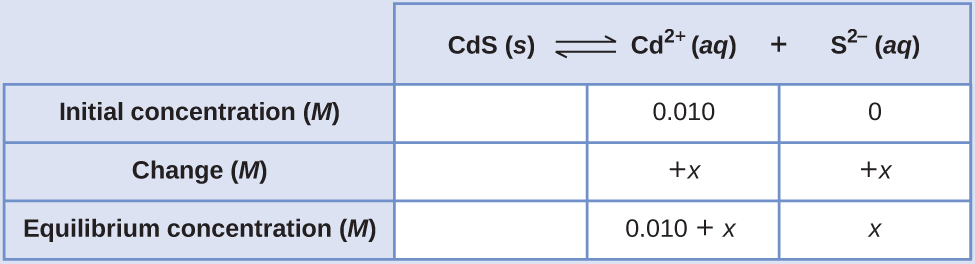

Because Ksp is very small, assume x << 0.010 and solve the simplified equation for x:
Kspは非常に小さいので、x << 0.010と仮定し、簡略化した方程式をxについて解く。
The molar solubility of CdS in this solution is 1.0 10–26 M.
この溶液中のCdSのモル溶解度は1.0 10–26 Mである。
Check Your Learning理解度の確認
Calculate the molar solubility of aluminum hydroxide, Al(OH)3, in a 0.015-M solution of aluminum nitrate, Al(NO3)3. The Ksp of Al(OH)3 is 2 10–32.
0.015 Mの硝酸アルミニウムAl(NO3)3溶液中での水酸化アルミニウムAl(OH)3のモル溶解度を計算しなさい。Al(OH)3のKspは2 10–32である。
Key Concepts and Summary重要概念とまとめ
The equilibrium constant for an equilibrium involving the precipitation or dissolution of a slightly soluble ionic solid is called the solubility product, Ksp, of the solid. For a heterogeneous equilibrium involving the slightly soluble solid MpXq and its ions Mm+ and Xn–:
難溶性のイオン性固体の沈殿または溶解を伴う平衡の平衡定数を、その固体の溶解度積Kspという。難溶性固体MpXqと、そのイオンMm+およびXn–が関与する不均一平衡については、次のようになる。
the solubility product expression is:
溶解度積の式は、次のとおりである。
The solubility product of a slightly soluble electrolyte can be calculated from its solubility; conversely, its solubility can be calculated from its Ksp, provided the only significant reaction that occurs when the solid dissolves is the formation of its ions.
難溶性電解質の溶解度積は、その溶解度から計算できる。逆に、固体が溶けるときの重要な反応がそのイオンの生成だけであるという条件のもとで、Kspから溶解度を計算できる。
A slightly soluble electrolyte begins to precipitate when the magnitude of the reaction quotient for the dissolution reaction exceeds the magnitude of the solubility product. Precipitation continues until the reaction quotient equals the solubility product.
難溶性電解質は、溶解反応の反応商の大きさが溶解度積の大きさを超えると、沈殿し始める。沈殿は、反応商が溶解度積に等しくなるまで続く。