第15章その他の反応の平衡
15.2 Lewis Acids and Bases15.2 ルイス酸とルイス塩基
Learning Objectives学習目標
By the end of this section, you will be able to:
この節を学び終えると、次のことができるようになる。
- Explain the Lewis model of acid-base chemistry酸塩基の化学について、ルイスのモデルを説明する。
- Write equations for the formation of adducts and complex ions付加体と錯イオンの形成を表す反応式を書く。
- Perform equilibrium calculations involving formation constants生成定数を使った平衡計算を行う。
In 1923, G. N. Lewis proposed a generalized definition of acid-base behavior in which acids and bases are identified by their ability to accept or to donate a pair of electrons and form a coordinate covalent bond.
英語のヒント
1923年、G. N. Lewisは、酸塩基の振る舞いについて一般化した定義を提案した。この定義では、電子対を受け取ったり供与したりして配位共有結合を形成する能力によって、酸と塩基を区別する。
A coordinate covalent bond (or dative bond) occurs when one of the atoms in the bond provides both bonding electrons. For example, a coordinate covalent bond occurs when a water molecule combines with a hydrogen ion to form a hydronium ion. A coordinate covalent bond also results when an ammonia molecule combines with a hydrogen ion to form an ammonium ion. Both of these equations are shown here.
英語のヒント
配位共有結合(配位結合)は、結合する原子の一方が結合電子を二つとも提供するときに生じる。たとえば、水分子が水素イオンと結合してヒドロニウムイオンを形成するときに、配位共有結合が生じる。アンモニア分子が水素イオンと結合してアンモニウムイオンを形成するときにも、配位共有結合が生じる。これら二つの反応式を次に示す。
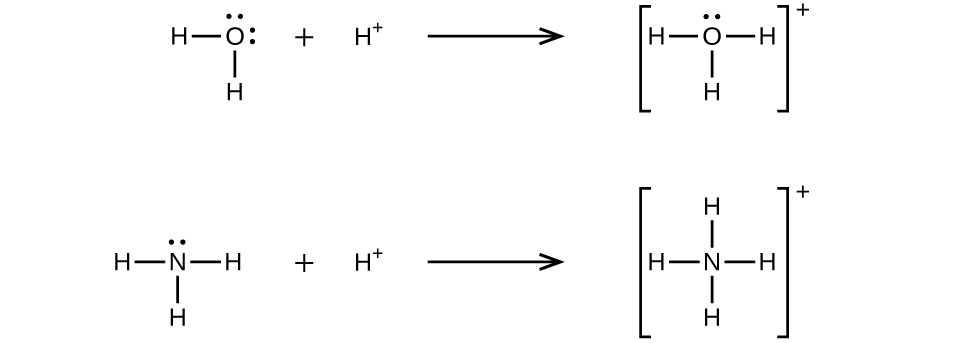
Reactions involving the formation of coordinate covalent bonds are classified as Lewis acid-base chemistry. The species donating the electron pair that compose the bond is a Lewis base, the species accepting the electron pair is a Lewis acid, and the product of the reaction is a Lewis acid-base adduct. As the two examples above illustrate, Brønsted-Lowry acid-base reactions represent a subcategory of Lewis acid reactions, specifically, those in which the acid species is H+. A few examples involving other Lewis acids and bases are described below.
英語のヒント
配位共有結合の形成を伴う反応は、ルイス酸塩基の化学に分類される。結合を作る電子対を供与する化学種がルイス塩基、電子対を受け取る化学種がルイス酸であり、反応生成物はルイス酸塩基付加体である。上の二つの例が示すように、ブレンステッド–ローリーの酸塩基反応は、ルイス酸の反応の一部、具体的には酸として働く化学種がH+である場合に相当する。以下に、その他のルイス酸やルイス塩基が関与する例をいくつか示す。
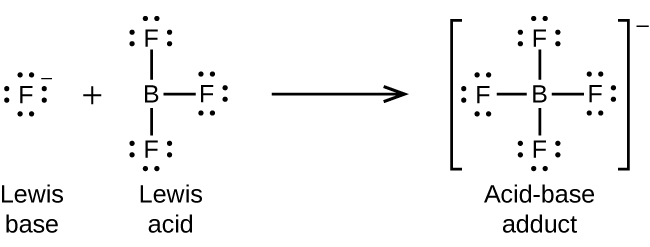
The boron atom in boron trifluoride, BF3, has only six electrons in its valence shell. Being short of the preferred octet, BF3 is a very good Lewis acid and reacts with many Lewis bases; a fluoride ion is the Lewis base in this reaction, donating one of its lone pairs:
英語のヒント
三フッ化ホウ素BF3のホウ素原子は、価電子殻に電子を六つしか持たない。望ましいオクテットに足りないため、BF3は非常によく働くルイス酸であり、多くのルイス塩基と反応する。次の反応では、フッ化物イオンが孤立電子対の一組を供与するルイス塩基である。
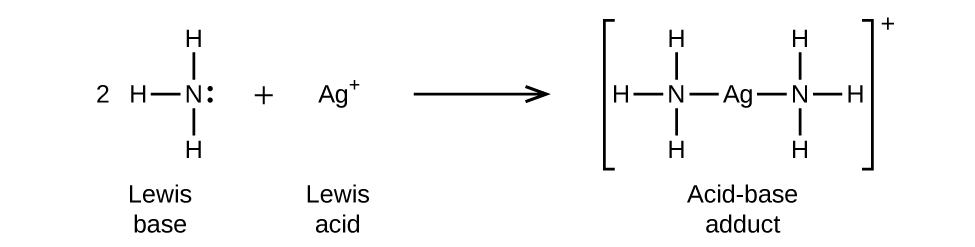
In the following reaction, each of two ammonia molecules, Lewis bases, donates a pair of electrons to a silver ion, the Lewis acid:
英語のヒント
次の反応では、ルイス塩基である二つのアンモニア分子が、それぞれ電子対を一組、ルイス酸である銀イオンに供与する。
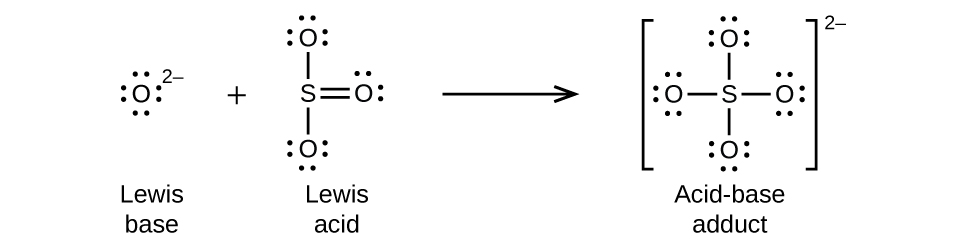
Nonmetal oxides act as Lewis acids and react with oxide ions, Lewis bases, to form oxyanions:
英語のヒント
非金属酸化物はルイス酸として働き、ルイス塩基である酸化物イオンと反応してオキソ陰イオンを形成する。
Many Lewis acid-base reactions are displacement reactions in which one Lewis base displaces another Lewis base from an acid-base adduct, or in which one Lewis acid displaces another Lewis acid:
英語のヒント
多くのルイス酸塩基反応は置換反応である。酸塩基付加体から、あるルイス塩基が別のルイス塩基を置き換えたり、あるルイス酸が別のルイス酸を置き換えたりする。
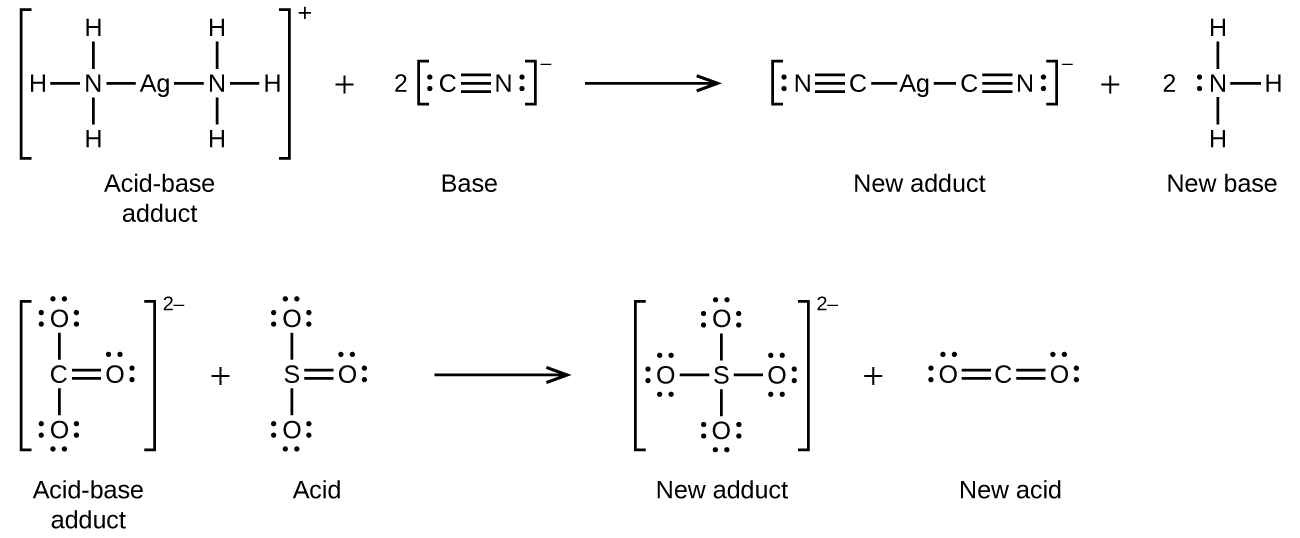
Another type of Lewis acid-base chemistry involves the formation of a complex ion (or a coordination complex) comprising a central atom, typically a transition metal cation, surrounded by ions or molecules called ligands. These ligands can be neutral molecules like H2O or NH3, or ions such as CN– or OH–. Often, the ligands act as Lewis bases, donating a pair of electrons to the central atom. These types of Lewis acid-base reactions are examples of a broad subdiscipline called coordination chemistry—the topic of another chapter in this text.
英語のヒント
ルイス酸塩基の化学のもう一つの種類には、錯イオン(または配位錯体)の形成がある。これは、一般には遷移金属の陽イオンである中心原子の周囲を、配位子と呼ばれるイオンや分子が取り囲んだものである。配位子には、H2OやNH3のような中性分子、CN–やOH–のようなイオンがある。多くの場合、配位子はルイス塩基として働き、電子対を一組、中心原子に供与する。この種のルイス酸塩基反応は、本書の別の章で扱う、配位化学という広範な分野の一例である。
The equilibrium constant for the reaction of a metal ion with one or more ligands to form a coordination complex is called a formation constant (Kf) (sometimes called a stability constant). For example, the complex ion
英語のヒント
金属イオンが一つ以上の配位子と反応して配位錯体を形成する反応の平衡定数を、生成定数(Kf)、または安定度定数と呼ぶ。たとえば、錯イオンは、

is produced by the reaction
次の反応によって生成する。
The formation constant for this reaction is
この反応の生成定数は、次のとおりである。
Alternatively, the reverse reaction (decomposition of the complex ion) can be considered, in which case the equilibrium constant is a dissociation constant (Kd). Per the relation between equilibrium constants for reciprocal reactions described, the dissociation constant is the mathematical inverse of the formation constant, Kd = Kf–1. A tabulation of formation constants is provided in Appendix K.
英語のヒント
別の考え方として、逆反応(錯イオンの分解)を考えることもでき、その場合の平衡定数は解離定数(Kd)である。すでに説明した、互いに逆向きの反応の平衡定数どうしの関係によると、解離定数は生成定数の逆数、すなわちKd = Kf–1である。生成定数の表を付録Kに示す。
As an example of dissolution by complex ion formation, let us consider what happens when we add aqueous ammonia to a mixture of silver chloride and water. Silver chloride dissolves slightly in water, giving a small concentration of Ag+ ([Ag+] = 1.3 10–5 M):
錯イオンの形成による溶解の例として、塩化銀と水の混合物にアンモニア水を加えると何が起こるかを考えよう。塩化銀は水にわずかに溶け、低濃度のAg+を生じる([Ag+] = 1.3 10–5 M)。
However, if NH3 is present in the water, the complex ion, can form according to the equation:
しかし、水中にNH3が存在すれば、次の式に従って錯イオンを形成できる。
with
このとき、
The large size of this formation constant indicates that most of the free silver ions produced by the dissolution of AgCl combine with NH 3 to form As a consequence, the concentration of silver ions, [Ag + ], is reduced, and the reaction quotient for the dissolution of silver chloride, [Ag + ][Cl – ], falls below the solubility product of AgCl:
英語のヒント
この生成定数の大きな値は、AgClの溶解によって生じる遊離の銀イオンの大半が、NH3と結合してを形成することを示している。その結果、銀イオン濃度[Ag+]は低下し、塩化銀の溶解の反応商[Ag+][Cl–]は、AgClの溶解度積より小さくなる。
More silver chloride then dissolves. If the concentration of ammonia is great enough, all of the silver chloride dissolves.
英語のヒント
すると、塩化銀がさらに溶ける。アンモニア濃度が十分に高ければ、塩化銀はすべて溶ける。
Example 15.14例題 15.14
Dissociation of a Complex Ion錯イオンの解離
Calculate the concentration of the silver ion in a solution that initially is 0.10 M with respect to
初めの濃度が0.10 Mの溶液中の銀イオン濃度を計算しなさい。
Solution解き方
Applying the standard ICE approach to this reaction yields the following:
この反応に通常のICE法を適用すると、次のようになる。
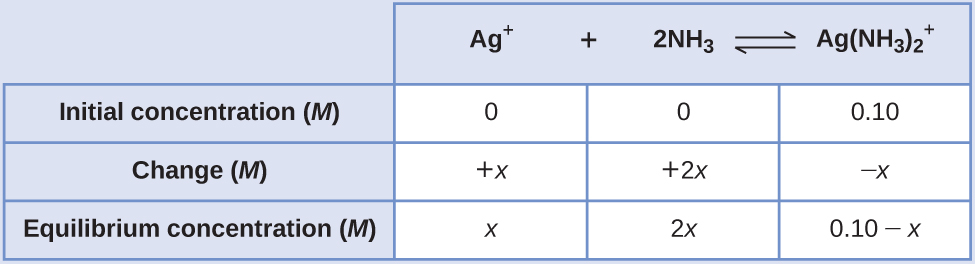


Substituting these equilibrium concentration terms into the Kf expression gives
これらの平衡濃度を表す項をKfの式に代入すると、次のようになる。
The very large equilibrium constant means the amount of the complex ion that will dissociate, x, will be very small. Assuming x << 0.1 permits simplifying the above equation:
平衡定数が非常に大きいことは、解離する錯イオンの量xが非常に小さいことを意味する。x << 0.1と仮定すると、上の式を次のように簡略化できる。
Because only 1.1% of the dissociates into Ag+ and NH3, the assumption that x is small is justified.
英語のヒント
のうちAg+とNH3に解離するのは1.1%にすぎないので、xは小さいという仮定は妥当である。
Using this value of x and the relations in the above ICE table allows calculation of all species’ equilibrium concentrations:
このxの値と上のICE表の関係を使えば、すべての化学種の平衡濃度を計算できる。
The concentration of free silver ion in the solution is 0.0011 M.
溶液中の遊離銀イオンの濃度は0.0011 Mである。
Check Your Learning理解度の確認
Calculate the silver ion concentration, [Ag+], of a solution prepared by dissolving 1.00 g of AgNO3 and 10.0 g of KCN in sufficient water to make 1.00 L of solution. (Hint: Because Kf is very large, the silver/cyanide complex ion (see Appendix K), assume the reaction goes to completion and then calculate the [Ag+] produced by dissociation of the complex.)
英語のヒント
1.00 gのAgNO3と10.0 gのKCNを、溶液が1.00 Lになるのに十分な量の水に溶かして調製した溶液について、銀イオン濃度[Ag+]を計算しなさい。(ヒント:銀とシアン化物の錯イオンのKfは非常に大きいので(付録K参照)、反応が完結すると仮定し、その後に錯体の解離によって生じる[Ag+]を計算する。)