第5章熱化学
5.3 Enthalpy5.3 エンタルピー
Learning Objectives学習目標
By the end of this section, you will be able to:
この節を終えると、次のことができるようになる。
- State the first law of thermodynamics熱力学第1法則を述べる。
- Define enthalpy and explain its classification as a state functionエンタルピーを定義し、状態関数に分類される理由を説明する。
- Write and balance thermochemical equations熱化学方程式を書き、係数を合わせる。
- Calculate enthalpy changes for various chemical reactionsさまざまな化学反応のエンタルピー変化を計算する。
- Explain Hess’s law and use it to compute reaction enthalpiesヘスの法則を説明し、反応エンタルピーの計算に使う。
Thermochemistry is a branch of chemical thermodynamics, the science that deals with the relationships between heat, work, and other forms of energy in the context of chemical and physical processes. As we concentrate on thermochemistry in this chapter, we need to consider some widely used concepts of thermodynamics.
英語のヒント
熱化学は、化学熱力学の一分野である。化学熱力学は、化学的・物理的過程における熱、仕事、その他の形のエネルギーの関係を扱う科学である。この章で熱化学を重点的に学ぶにあたり、熱力学で広く使われる概念をいくつか考える必要がある。
Substances act as reservoirs of energy, meaning that energy can be added to them or removed from them. Energy is stored in a substance when the kinetic energy of its atoms or molecules is raised. The greater kinetic energy may be in the form of increased translations (travel or straight-line motions), vibrations, or rotations of the atoms or molecules. When thermal energy is lost, the intensities of these motions decrease and the kinetic energy falls. The total of all possible kinds of energy present in a substance is called the internal energy (U), sometimes symbolized as E.
英語のヒント
物質はエネルギーの貯蔵庫として働く。つまり、物質へエネルギーを加えることも、物質から取り出すこともできる。原子や分子の運動エネルギーが増すと、物質にエネルギーが蓄えられる。この運動エネルギーの増加は、原子や分子の並進運動(移動・直線運動)、振動、回転が増すという形をとる。熱エネルギーが失われると、こうした運動の激しさが弱まり、運動エネルギーが減る。物質内に存在しうる、あらゆる種類のエネルギーの総和を内部エネルギー(U)という。Eで表すこともある。
As a system undergoes a change, its internal energy can change, and energy can be transferred from the system to the surroundings, or from the surroundings to the system. Energy is transferred into a system when it absorbs heat (q) from the surroundings or when the surroundings do work (w) on the system. For example, energy is transferred into room-temperature metal wire if it is immersed in hot water (the wire absorbs heat from the water), or if you rapidly bend the wire back and forth (the wire becomes warmer because of the work done on it). Both processes increase the internal energy of the wire, which is reflected in an increase in the wire’s temperature. Conversely, energy is transferred out of a system when heat is lost from the system, or when the system does work on the surroundings.
英語のヒント
系が変化すると、その内部エネルギーが変化することがあり、系から外界へ、または外界から系へエネルギーが移ることがある。系が外界から熱qを吸収したり、外界が系に仕事wをしたりすると、系にエネルギーが入る。たとえば、室温の金属線を熱い水に浸すと、水から熱を吸収してエネルギーが金属線に入る。また、金属線を素早く繰り返し曲げ伸ばしすると、金属線に仕事をするため温かくなる。どちらの過程も金属線の内部エネルギーを増やし、その結果が温度上昇に表れる。逆に、系から熱が失われたり、系が外界に仕事をしたりすると、エネルギーは系から出ていく。
The relationship between internal energy, heat, and work can be represented by the equation:
内部エネルギー、熱、仕事の関係は、次の式で表せる。
as shown in Figure 5.19. This is one version of the first law of thermodynamics, and it shows that the internal energy of a system changes through heat flow into or out of the system (positive q is heat flow in; negative q is heat flow out) or work done on or by the system. The work, w, is positive if it is done on the system and negative if it is done by the system.
図5.19にこの関係を示す。これは熱力学第一法則の表し方の1つである。系の内部エネルギーは、系への熱の出入り(qが正なら流入、負なら流出)や、系が受ける仕事・系がする仕事によって変化する。仕事wは、系が仕事をされる場合に正、系が仕事をする場合に負となる。
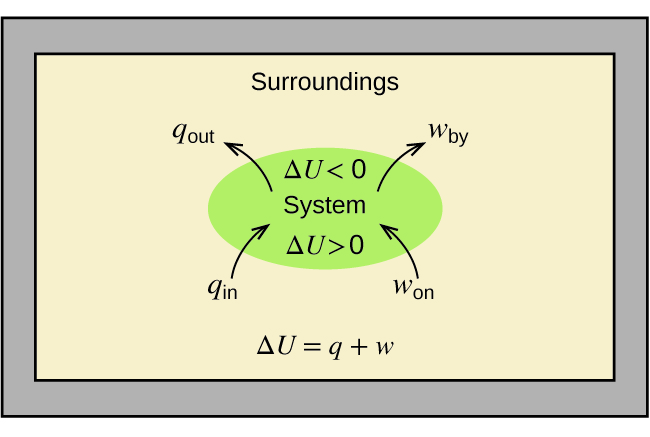

Figure 5.19図 5.19
The internal energy, U, of a system can be changed by heat flow and work. If heat flows into the system, qin, or work is done on the system, won, its internal energy increases, ΔU > 0. If heat flows out of the system, qout, or work is done by the system, wby, its internal energy decreases, ΔU < 0.
系の内部エネルギーUは、熱の流れと仕事によって変えられる。系へ熱が入るqin、または系が仕事をされるwon場合、内部エネルギーは増加し、ΔU > 0となる。系から熱が出るqout、または系が仕事をするwby場合、内部エネルギーは減少し、ΔU < 0となる。
A type of work called expansion work (or pressure-volume work) occurs when a system pushes back the surroundings against a restraining pressure, or when the surroundings compress the system. An example of this occurs during the operation of an internal combustion engine. The reaction of gasoline and oxygen is exothermic. Some of this energy is given off as heat, and some does work pushing the piston in the cylinder. The substances involved in the reaction are the system, and the engine and the rest of the universe are the surroundings. The system loses energy by both heating and doing work on the surroundings, and its internal energy decreases. (The engine is able to keep the car moving because this process is repeated many times per second while the engine is running.) We will consider how to determine the amount of work involved in a chemical or physical change in the chapter on thermodynamics.
英語のヒント
系が外からの圧力に逆らって外界を押しのける場合や、外界が系を圧縮する場合には、膨張仕事(圧力・体積仕事)と呼ぶ仕事が生じる。内燃機関の動作は、その一例である。ガソリンと酸素の反応は発熱反応であり、エネルギーの一部は熱として放出され、一部はシリンダー内のピストンを押す仕事をする。反応に関わる物質が系であり、エンジンとそれ以外の宇宙全体が外界である。系は外界を加熱し、外界に仕事をすることでエネルギーを失い、内部エネルギーが減少する。(エンジンの運転中にはこの過程が毎秒何度も繰り返されるため、車を動かし続けられる。)化学的・物理的変化に伴う仕事の量を求める方法は、熱力学の章で考える。
As discussed, the relationship between internal energy, heat, and work can be represented as ΔU = q + w. Internal energy is an example of a state function (or state variable), whereas heat and work are not state functions. The value of a state function depends only on the state that a system is in, and not on how that state is reached. If a quantity is not a state function, then its value does depend on how the state is reached. An example of a state function is altitude or elevation. If you stand on the summit of Mt. Kilimanjaro, you are at an altitude of 5895 m, and it does not matter whether you hiked there or parachuted there. The distance you traveled to the top of Kilimanjaro, however, is not a state function. You could climb to the summit by a direct route or by a more roundabout, circuitous path (Figure 5.20). The distances traveled would differ (distance is not a state function) but the elevation reached would be the same (altitude is a state function).
英語のヒント
すでに述べたように、内部エネルギー、熱、仕事の関係はΔU = q + wと表せる。内部エネルギーは状態関数(状態変数)の一例だが、熱と仕事は状態関数ではない。状態関数の値は、系が現在どの状態にあるかだけで決まり、そこへ至った道筋には依存しない。状態関数でない量の値は、どのようにその状態に至ったかに依存する。状態関数の例は、高度や標高である。キリマンジャロの山頂に立てば高度は5895 mであり、歩いて登ったのか、パラシュートで降りたのかは関係ない。しかし、山頂まで移動した距離は状態関数ではない。直線的な道順でも、遠回りの曲がりくねった道でも山頂に行ける(図5.20)。移動距離は道順によって変わるので状態関数ではないが、到達した標高は同じなので、高度は状態関数である。
Image omitted because its reuse rights could not be verified.権利の確認ができないため画像を割愛。
Figure 5.20図 5.20
Paths X and Y represent two different routes to the summit of Mt. Kilimanjaro. Both have the same change in elevation (altitude or elevation on a mountain is a state function; it does not depend on path), but they have very different distances traveled (distance walked is not a state function; it depends on the path). (credit: modification of work by Paul Shaffner)
経路XとYは、キリマンジャロの山頂への異なる2つの道順を示す。標高の変化は同じである。山の高度・標高は状態関数で、経路に依存しない。一方、移動距離は大きく異なる。歩いた距離は状態関数ではなく、経路に依存する。(出典:Paul Shaffnerの作品を改変)
Chemists ordinarily use a property known as enthalpy (H) to describe the thermodynamics of chemical and physical processes. Enthalpy is defined as the sum of a system’s internal energy (U) and the mathematical product of its pressure (P) and volume (V):
英語のヒント
化学では通常、化学的・物理的過程の熱力学を記述するために、エンタルピー(H)という量を使う。エンタルピーは、系の内部エネルギーUと、圧力Pと体積Vの積との和として定義される。
Enthalpy is also a state function. Enthalpy values for specific substances cannot be measured directly; only enthalpy changes for chemical or physical processes can be determined. For processes that take place at constant pressure (a common condition for many chemical and physical changes), the enthalpy change (ΔH) is:
エンタルピーも状態関数である。個々の物質のエンタルピーの値を直接測ることはできず、測定できるのは化学的・物理的過程に伴うエンタルピー変化だけである。一定の圧力のもとで起こる過程では、エンタルピー変化ΔHは次のようになる。多くの化学的・物理的変化は、この条件で起こる。
The mathematical product PΔV represents work (w), namely, expansion or pressure-volume work as noted. By their definitions, the arithmetic signs of ΔV and w will always be opposite:
英語のヒント
積PΔVは仕事w、すなわち先ほど述べた膨張仕事、または圧力・体積仕事を表す。それぞれの定義により、ΔVとwの符号は常に逆になる。
Substituting this equation and the definition of internal energy into the enthalpy-change equation yields:
この式と内部エネルギーの定義を、エンタルピー変化の式へ代入すると、
where qp is the heat of reaction under conditions of constant pressure.
ここでqpは、圧力一定の条件での反応熱である。
And so, if a chemical or physical process is carried out at constant pressure with the only work done caused by expansion or contraction, then the heat flow (qp) and enthalpy change (ΔH) for the process are equal.
英語のヒント
したがって、化学的・物理的過程が圧力一定で進み、仕事が膨張・収縮によるものだけであれば、その過程の熱の流れqpとエンタルピー変化ΔHは等しくなる。
The heat given off when you operate a Bunsen burner is equal to the enthalpy change of the methane combustion reaction that takes place, since it occurs at the essentially constant pressure of the atmosphere. On the other hand, the heat produced by a reaction measured in a bomb calorimeter (Figure 5.17) is not equal to ΔH because the closed, constant-volume metal container prevents the pressure from remaining constant (it may increase or decrease if the reaction yields increased or decreased amounts of gaseous species). Chemists usually perform experiments under normal atmospheric conditions, at constant external pressure with q = ΔH, which makes enthalpy the most convenient choice for determining heat changes for chemical reactions.
英語のヒント
ブンゼンバーナーを使うときに放出される熱は、そこで起こるメタンの燃焼反応のエンタルピー変化に等しい。反応が、ほぼ一定の大気圧のもとで起こるからである。一方、ボンベ熱量計(図5.17)で測る反応の発生熱はΔHに等しくない。密閉された一定体積の金属容器では、圧力を一定に保てないためである。反応によって気体の化学種の量が増減すると、圧力が上昇・低下することがある。化学の実験は、通常はふつうの大気条件、つまり外圧一定でq = ΔHとなる条件で行う。このため、化学反応に伴う熱変化を求めるには、エンタルピーが最も便利な量となる。
The following conventions apply when using ΔH:
ΔHを使うときは、次の約束に従う。
- A negative value of an enthalpy change, ΔH < 0, indicates an exothermic reaction; a positive value, ΔH > 0, indicates an endothermic reaction. If the direction of a chemical equation is reversed, the arithmetic sign of its ΔH is changed (a process that is endothermic in one direction is exothermic in the opposite direction).エンタルピー変化が負、ΔH < 0なら発熱反応、正、ΔH > 0なら吸熱反応である。化学反応式の向きを逆にすると、ΔHの符号も逆になる。一方向で吸熱となる過程は、逆方向では発熱となる。
- Chemists use a thermochemical equation to represent the changes in both matter and energy. In a thermochemical equation, the enthalpy change of a reaction is shown as a ΔH value following the equation for the reaction. This ΔH value indicates the amount of heat associated with the reaction involving the number of moles of reactants and products as shown in the chemical equation. For example, consider this equation:
英語のヒント
物質とエネルギーの両方の変化を表すために、熱化学方程式を使う。熱化学方程式では、化学反応式に続けてΔHの値を示す。この値は、反応式に示したモル数の反応物と生成物が関わる反応に伴う熱量を表す。たとえば、次の式を考えよう。This equation indicates that when 1 mole of hydrogen gas and mole of oxygen gas at some temperature and pressure change to 1 mole of liquid water at the same temperature and pressure, 286 kJ of heat are released to the surroundings. If the coefficients of the chemical equation are multiplied by some factor, the enthalpy change must be multiplied by that same factor (ΔH is an extensive property):英語のヒント
この式は、ある温度・圧力で、水素ガス1 molと酸素ガス molが、同じ温度・圧力の液体の水1 molへ変わると、286 kJの熱が外界へ放出されることを示す。反応式の係数をある数倍したら、エンタルピー変化も同じ数倍しなければならない。ΔHは示量性の量だからである。 - The enthalpy change of a reaction depends on the physical states of the reactants and products, so these must be shown. For example, when 1 mole of hydrogen gas and mole of oxygen gas change to 1 mole of liquid water at the same temperature and pressure, 286 kJ of heat are released. If gaseous water forms, only 242 kJ of heat are released.反応のエンタルピー変化は、反応物と生成物の物理的状態に依存するため、状態を明記する必要がある。たとえば、水素ガス1 molと酸素ガス molが、同じ温度・圧力で液体の水1 molに変わると、286 kJの熱が放出される。気体の水ができる場合には、放出熱は242 kJにとどまる。
Example 5.8例題 5.8
Writing Thermochemical Equations熱化学方程式を書く
When 0.0500 mol of HCl(aq) reacts with 0.0500 mol of NaOH(aq) to form 0.0500 mol of NaCl(aq), 2.9 kJ of heat are produced. Write a balanced thermochemical equation for the reaction of one mole of HCl.
HCl(aq) 0.0500 molとNaOH(aq) 0.0500 molが反応し、NaCl(aq) 0.0500 molができると、2.9 kJの熱が発生する。HCl 1 molが反応する場合の、係数を合わせた熱化学方程式を書きなさい。
Solution解答
For the reaction of 0.0500 mol acid (HCl), q = −2.9 kJ. The reactants are provided in stoichiometric amounts (same molar ratio as in the balanced equation), and so the amount of acid may be used to calculate a molar enthalpy change. Since ΔH is an extensive property, it is proportional to the amount of acid neutralized:
英語のヒント
酸HCl 0.0500 molの反応では、q = −2.9 kJである。反応物は化学量論的な量、すなわち係数を合わせた反応式と同じモル比で与えられているので、酸の量からモルあたりのエンタルピー変化を計算できる。ΔHは示量性の量であり、中和される酸の量に比例する。
The thermochemical equation is then
したがって、熱化学方程式は、
Check Your Learning理解を確かめよう
When 1.34 g Zn(s) reacts with 60.0 mL of 0.750 M HCl(aq), 3.14 kJ of heat are produced. Determine the enthalpy change per mole of zinc reacting for the reaction:
Zn(s) 1.34 gが0.750 M HCl(aq) 60.0 mLと反応すると、3.14 kJの熱が発生する。次の反応について、反応する亜鉛1 molあたりのエンタルピー変化を求めなさい。
Be sure to take both stoichiometry and limiting reactants into account when determining the ΔH for a chemical reaction.
英語のヒント
化学反応のΔHを求める際は、化学量論と限定反応物の両方を必ず考慮すること。
Example 5.9例題 5.9
Writing Thermochemical Equations熱化学方程式を書く
A gummy bear contains 2.67 g sucrose, C12H22O11. When it reacts with 7.19 g potassium chlorate, KClO3, 43.7 kJ of heat are produced. Write a thermochemical equation for the reaction of one mole of sucrose:
クマ形のグミにはスクロースC12H22O11が2.67 g含まれている。これを塩素酸カリウムKClO3 7.19 gと反応させると、43.7 kJの熱が発生する。スクロース1 molの反応について、熱化学方程式を書きなさい。
Solution解答
Unlike the previous example exercise, this one does not involve the reaction of stoichiometric amounts of reactants, and so the limiting reactant must be identified (it limits the yield of the reaction and the amount of thermal energy produced or consumed).
英語のヒント
前の例題とは異なり、この問題では反応物の量が化学量論的な比になっていない。そのため、限定反応物を特定する必要がある。限定反応物が、反応の収量と、発生・消費する熱エネルギーの量を制限する。
The provided amounts of the two reactants are
与えられた2つの反応物の物質量は、
The provided molar ratio of perchlorate-to-sucrose is then
したがって、与えられた過塩素酸塩とスクロースのモル比は、
The balanced equation indicates 8 mol KClO3 are required for reaction with 1 mol C12H22O11. Since the provided amount of KClO3 is less than the stoichiometric amount, it is the limiting reactant and may be used to compute the enthalpy change:
係数を合わせた反応式によると、C12H22O11 1 molと反応するには、KClO3が8 mol必要である。与えられたKClO3の量は化学量論的な量より少ないので、これが限定反応物であり、その量からエンタルピー変化を計算できる。
Because the equation, as written, represents the reaction of 8 mol KClO3, the enthalpy change is
書かれた反応式はKClO3 8 molの反応を表すので、エンタルピー変化は、
The enthalpy change for this reaction is −5960 kJ, and the thermochemical equation is:
この反応のエンタルピー変化は−5960 kJであり、熱化学方程式は次のようになる。
Check Your Learning理解を確かめよう
When 1.42 g of iron reacts with 1.80 g of chlorine, 3.22 g of FeCl2(s) and 8.60 kJ of heat is produced. What is the enthalpy change for the reaction when 1 mole of FeCl2(s) is produced?
鉄1.42 gと塩素1.80 gが反応すると、FeCl2(s) 3.22 gと8.60 kJの熱が生じる。FeCl2(s) 1 molが生成するときの、反応のエンタルピー変化はいくらか。
Enthalpy changes are typically tabulated for reactions in which both the reactants and products are at the same conditions. A standard state is a commonly accepted set of conditions used as a reference point for the determination of properties under other different conditions. For chemists, the IUPAC standard state refers to materials under a pressure of 1 bar and solutions at 1 M, and does not specify a temperature. Many thermochemical tables list values with a standard state of 1 atm. Because the ΔH of a reaction changes very little with such small changes in pressure (1 bar = 0.987 atm), ΔH values (except for the most precisely measured values) are essentially the same under both sets of standard conditions. We will include a superscripted “o” in the enthalpy change symbol to designate standard state. Since the usual (but not technically standard) temperature is 298.15 K, this temperature will be assumed unless some other temperature is specified. Thus, the symbol is used to indicate an enthalpy change for a process occurring under these conditions. (The symbol ΔH is used to indicate an enthalpy change for a reaction occurring under nonstandard conditions.)
英語のヒント
エンタルピー変化は通常、反応物と生成物が同じ条件にある反応について表にまとめる。標準状態とは、異なる条件での性質を求める基準として広く受け入れられている、一組の条件である。化学でいうIUPACの標準状態は、物質が1 barの圧力下にあり、溶液は1 Mである状態を指し、温度は指定しない。多くの熱化学の表は、標準状態を1 atmとして値を載せている。1 bar = 0.987 atmという小さな圧力差では、反応のΔHはごくわずかしか変化しないので、最も精密に測定された値を除けば、両条件でのΔHは実質的に同じである。ここではエンタルピー変化の記号に上付きの「o」を付け、標準状態を表す。一般に使う温度は298.15 Kなので、ほかに指定がない限りこの温度とする。厳密には、温度は標準状態に含まれない。したがって、記号は、これらの条件で起こる過程のエンタルピー変化を表す。標準以外の条件で起こる反応のエンタルピー変化には、ΔHという記号を使う。
The enthalpy changes for many types of chemical and physical processes are available in the reference literature, including those for combustion reactions, phase transitions, and formation reactions. As we discuss these quantities, it is important to pay attention to the extensive nature of enthalpy and enthalpy changes. Since the enthalpy change for a given reaction is proportional to the amounts of substances involved, it may be reported on that basis (i.e., as the ΔH for specific amounts of reactants). However, we often find it more useful to divide one extensive property (ΔH) by another (amount of substance), and report a per-amount intensive value of ΔH, often “normalized” to a per-mole basis. (Note that this is similar to determining the intensive property specific heat from the extensive property heat capacity, as seen previously.)
英語のヒント
燃焼反応、相転移、生成反応を含む、多くの化学的・物理的過程のエンタルピー変化は、参考資料に載っている。これらの量を考えるときは、エンタルピーとその変化が示量性であることに注意する必要がある。反応のエンタルピー変化は関わる物質の量に比例するので、一定量の反応物に対するΔHとして示してもよい。しかし、示量性の量であるΔHを別の示量性の量、すなわち物質量で割り、単位量あたりの示強性の値として示すほうが便利なことが多い。よく使われるのは、1 molあたりへ「規格化」した値である。これは、前に示したように、示量性の熱容量から示強性の比熱を求めることに似ている。