第5章熱化学
Standard Enthalpy of Formation標準生成エンタルピー
A standard enthalpy of formation is an enthalpy change for a reaction in which exactly 1 mole of a pure substance is formed from free elements in their most stable states under standard state conditions. These values are especially useful for computing or predicting enthalpy changes for chemical reactions that are impractical or dangerous to carry out, or for processes for which it is difficult to make measurements. If we have values for the appropriate standard enthalpies of formation, we can determine the enthalpy change for any reaction, which we will practice in the next section on Hess’s law.
英語のヒント
標準生成エンタルピーとは、標準状態の条件で、最も安定な状態の単体から純物質がちょうど1 mol生成する反応のエンタルピー変化である。この値は、実施が難しい・危険な化学反応や、測定が困難な過程のエンタルピー変化を計算・予測する際に特に役立つ。必要な標準生成エンタルピーがわかれば、どの反応のエンタルピー変化も求められる。次のヘスの法則の節で、その計算を練習する。
The standard enthalpy of formation of CO2(g) is −393.5 kJ/mol. This is the enthalpy change for the exothermic reaction:
CO2(g)の標準生成エンタルピーは−393.5 kJ/molである。これは、次の発熱反応のエンタルピー変化である。
starting with the reactants at a pressure of 1 atm and 25 °C (with the carbon present as graphite, the most stable form of carbon under these conditions) and ending with one mole of CO2, also at 1 atm and 25 °C. For nitrogen dioxide, NO2(g), is 33.2 kJ/mol. This is the enthalpy change for the reaction:
反応物は1 atm、25 °Cから出発する。炭素は、この条件で最も安定な形態である黒鉛として存在する。最後に、同じく1 atm、25 °CのCO2が1 molできる。二酸化窒素NO2(g)の場合、は33.2 kJ/molであり、次の反応のエンタルピー変化にあたる。
A reaction equation with mole of N2 and 1 mole of O2 is correct in this case because the standard enthalpy of formation always refers to 1 mole of product, NO2(g).
この場合、N2 molとO2 1 molを用いる反応式で正しい。標準生成エンタルピーは常に、生成物NO2(g) 1 molに対して定義されるからである。
You will find a table of standard enthalpies of formation of many common substances in Appendix G. These values indicate that formation reactions range from highly exothermic (such as −2984 kJ/mol for the formation of P4O10) to strongly endothermic (such as +226.7 kJ/mol for the formation of acetylene, C2H2). By definition, the standard enthalpy of formation of an element in its most stable form is equal to zero under standard conditions, which is 1 atm for gases and 1 M for solutions.
付録Gには、よく使う多くの物質の標準生成エンタルピーの表がある。生成反応には、P4O10の−2984 kJ/molのように大きく発熱するものから、アセチレンC2H2の+226.7 kJ/molのように強く吸熱するものまである。定義により、最も安定な形の単体の標準生成エンタルピーは、標準条件で0である。標準条件は、気体では1 atm、溶液では1 Mである。
Example 5.11例題 5.11
Evaluating an Enthalpy of Formation生成エンタルピーを求める
Ozone, O3(g), forms from oxygen, O2(g), by an endothermic process. Ultraviolet radiation is the source of the energy that drives this reaction in the upper atmosphere. Assuming that both the reactants and products of the reaction are in their standard states, determine the standard enthalpy of formation, of ozone from the following information:
オゾンO3(g)は、酸素O2(g)から吸熱過程によって生成する。上層大気では、この反応を起こすエネルギー源は紫外線である。反応物と生成物がいずれも標準状態にあると仮定し、次の情報からオゾンの標準生成エンタルピーを求めなさい。
Solution解答
is the enthalpy change for the formation of one mole of a substance in its standard state from the elements in their standard states. Thus, for O3(g) is the enthalpy change for the reaction:
は、標準状態の単体から標準状態の物質1 molが生成するときのエンタルピー変化である。したがって、O3(g)のは、次の反応のエンタルピー変化となる。
For the formation of 2 mol of O3(g), This ratio, can be used as a conversion factor to find the heat produced when 1 mole of O3(g) is formed, which is the enthalpy of formation for O3(g):
O3(g)が2 mol生成するとき、である。この比を換算係数として使うと、O3(g)が1 mol生成するときの熱量、すなわちO3(g)の生成エンタルピーが求まる。
Therefore,
したがって、
Check Your Learning理解を確かめよう
Hydrogen gas, H2, reacts explosively with gaseous chlorine, Cl2, to form hydrogen chloride, HCl(g). What is the enthalpy change for the reaction of 1 mole of H2(g) with 1 mole of Cl2(g) if both the reactants and products are at standard state conditions? The standard enthalpy of formation of HCl(g) is −92.3 kJ/mol.
水素ガスH2は塩素ガスCl2と爆発的に反応し、塩化水素HCl(g)を生成する。反応物と生成物がともに標準状態の条件にあるとき、H2(g) 1 molとCl2(g) 1 molの反応のエンタルピー変化はいくらか。HCl(g)の標準生成エンタルピーは−92.3 kJ/molである。
Example 5.12例題 5.12
Writing Reaction Equations for の反応式を書く
Write the heat of formation reaction equations for:
次の物質の生成熱に対応する反応式を書きなさい。
(a) C2H5OH(l)
(a) C2H5OH(l)
(b) Ca3(PO4)2(s)
(b) Ca3(PO4)2(s)
Solution解答
Remembering that reaction equations are for forming 1 mole of the compound from its constituent elements under standard conditions, we have:
の反応式は、標準条件で、構成元素の単体から化合物1 molを作る反応であることを思い出すと、次のようになる。
(a)
(a)
(b)
(b)
Note: The standard state of carbon is graphite, and phosphorus exists as P4.
注:炭素の標準状態は黒鉛であり、リンはP4として存在する。
Check Your Learning理解を確かめよう
Write the heat of formation reaction equations for:
次の物質の生成熱に対応する反応式を書きなさい。
(a) C2H5OC2H5(l)
(a) C2H5OC2H5(l)
(b) Na2CO3(s)
(b) Na2CO3(s)
Hess’s Lawヘスの法則
There are two ways to determine the amount of heat involved in a chemical change: measure it experimentally, or calculate it from other experimentally determined enthalpy changes. Some reactions are difficult, if not impossible, to investigate and make accurate measurements for experimentally. And even when a reaction is not hard to perform or measure, it is convenient to be able to determine the heat involved in a reaction without having to perform an experiment.
英語のヒント
化学変化に伴う熱量を求める方法は2つある。実験で測定する方法と、ほかの実験で求めたエンタルピー変化から計算する方法である。反応によっては、実験的に調べて正確に測ることが、不可能とまではいかなくても難しい。実施や測定が難しくない反応でも、実験をしなくても熱量を求められれば便利である。
This type of calculation usually involves the use of Hess’s law, which states: If a process can be written as the sum of several stepwise processes, the enthalpy change of the total process equals the sum of the enthalpy changes of the various steps. Hess’s law is valid because enthalpy is a state function: Enthalpy changes depend only on where a chemical process starts and ends, but not on the path it takes from start to finish. For example, we can think of the reaction of carbon with oxygen to form carbon dioxide as occurring either directly or by a two-step process. The direct process is written:
英語のヒント
この種の計算には通常、ヘスの法則を使う。ある過程をいくつかの段階的な過程の和として書けるなら、全過程のエンタルピー変化は、各段階のエンタルピー変化の和に等しい。ヘスの法則が成り立つのは、エンタルピーが状態関数だからである。エンタルピー変化は、化学的過程の始まりと終わりの状態だけで決まり、その間に通る経路には依存しない。たとえば、炭素と酸素が反応して二酸化炭素ができる過程は、直接起こるとも、2段階で起こるとも考えられる。直接の過程は次のように書ける。
In the two-step process, first carbon monoxide is formed:
2段階の過程では、まず一酸化炭素が生成する。
Then, carbon monoxide reacts further to form carbon dioxide:
次に、一酸化炭素がさらに反応して二酸化炭素を生成する。
The equation describing the overall reaction is the sum of these two chemical changes:
全体の反応を表す式は、これら2つの化学変化の和である。
Because the CO produced in Step 1 is consumed in Step 2, the net change is:
第1段階で生成したCOは第2段階で消費されるので、正味の変化は次のとおりである。
According to Hess’s law, the enthalpy change of the reaction will equal the sum of the enthalpy changes of the steps.
ヘスの法則によれば、反応のエンタルピー変化は、各段階のエンタルピー変化の和に等しくなる。
The result is shown in Figure 5.24. We see that ΔH of the overall reaction is the same whether it occurs in one step or two. This finding (overall ΔH for the reaction = sum of ΔH values for reaction “steps” in the overall reaction) is true in general for chemical and physical processes.
結果を図5.24に示す。1段階で起きても2段階で起きても、反応全体のΔHは同じである。この関係、すなわち「反応全体のΔH = 全反応を構成する各段階のΔHの和」は、化学的・物理的過程一般に成り立つ。
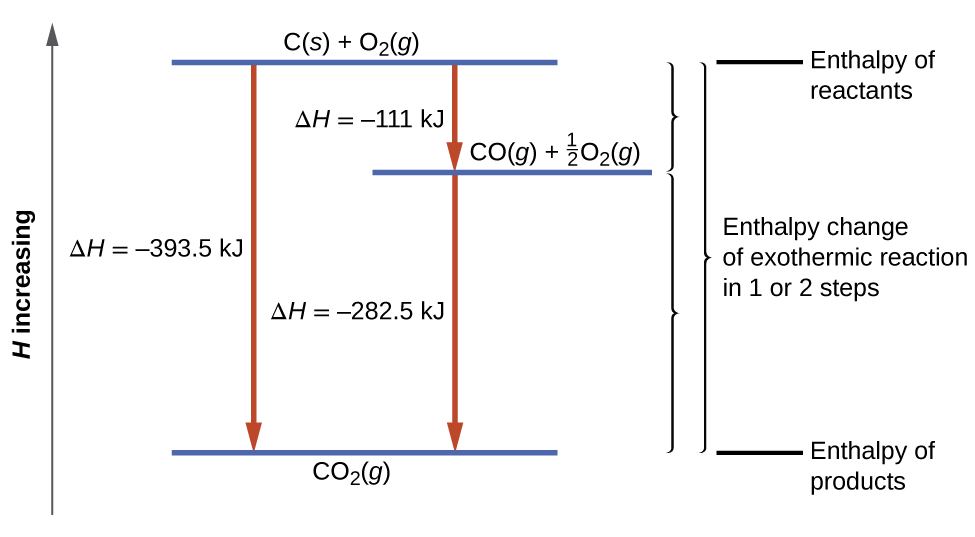

Figure 5.24図 5.24
The formation of CO2(g) from its elements can be thought of as occurring in two steps, which sum to the overall reaction, as described by Hess’s law. The horizontal blue lines represent enthalpies. For an exothermic process, the products are at lower enthalpy than are the reactants.
単体からCO2(g)が生成する反応は、2段階で起こると考えられる。その2段階を足すと全反応になることは、ヘスの法則が示すとおりである。青い水平線はエンタルピーを表す。発熱過程では、生成物のエンタルピーは反応物より低い。
Before we further practice using Hess’s law, let us recall two important features of ΔH.
ヘスの法則をさらに練習する前に、ΔHの重要な2つの特徴を思い出そう。
- ΔH is directly proportional to the quantities of reactants or products. For example, the enthalpy change for the reaction forming 1 mole of NO2(g) is +33.2 kJ:ΔHは反応物や生成物の量に正比例する。たとえば、NO2(g) 1 molができる反応のエンタルピー変化は+33.2 kJである。When 2 moles of NO2 (twice as much) are formed, the ΔH will be twice as large:NO2が2 mol、つまり2倍の量できる場合、ΔHも2倍になる。In general, if we multiply or divide an equation by a number, then the enthalpy change should also be multiplied or divided by the same number.一般に、反応式をある数で掛けたり割ったりした場合、エンタルピー変化も同じ数で掛けたり割ったりする必要がある。
- ΔH for a reaction in one direction is equal in magnitude and opposite in sign to ΔH for the reaction in the reverse direction. For example, given that:一方向の反応のΔHと逆方向の反応のΔHは、大きさが等しく、符号が逆である。たとえば、次の関係が与えられているとする。Then, for the “reverse” reaction, the enthalpy change is also “reversed”:このとき、逆反応では、エンタルピー変化も符号が逆になる。
Example 5.13例題 5.13
Stepwise Calculation of Using Hess’s Lawヘスの法則によるの段階的な計算
Determine the enthalpy of formation, of FeCl3(s) from the enthalpy changes of the following two-step process that occurs under standard state conditions:
標準状態の条件で起こる次の2段階の過程のエンタルピー変化から、FeCl3(s)の生成エンタルピーを求めなさい。
Solution解答
We are trying to find the standard enthalpy of formation of FeCl3(s), which is equal to ΔH° for the reaction:
求めたいのはFeCl3(s)の標準生成エンタルピーであり、これは次の反応のΔH°に等しい。
Looking at the reactions, we see that the reaction for which we want to find ΔH° is the sum of the two reactions with known ΔH values, so we must sum their ΔHs:
英語のヒント
反応式を見ると、ΔH°を求めたい反応は、ΔHが既知の2つの反応の和になっている。したがって、両者のΔHを足せばよい。
The enthalpy of formation, of FeCl3(s) is −399.5 kJ/mol.
FeCl3(s)の生成エンタルピーは−399.5 kJ/molである。
Check Your Learning理解を確かめよう
Calculate ΔH for the process:
次の過程のΔHを求めなさい。
from the following information:
次の情報を用いること。
Here is a less straightforward example that illustrates the thought process involved in solving many Hess’s law problems. It shows how we can find many standard enthalpies of formation (and other values of ΔH) if they are difficult to determine experimentally.
英語のヒント
次はもう少し複雑な例である。多くのヘスの法則の問題を解くときの考え方を示す。実験で求めにくい標準生成エンタルピーや、その他のΔHの値を求める方法がわかる。
Example 5.14例題 5.14
A More Challenging Problem Using Hess’s Lawヘスの法則を使う、より難しい問題
Chlorine monofluoride can react with fluorine to form chlorine trifluoride:
一フッ化塩素はフッ素と反応し、三フッ化塩素を生成する。
(i)
(i)
Use the reactions here to determine the ΔH° for reaction (i):
ここに示す反応を使い、反応(i)のΔH°を求めなさい。
(ii)
(ii)
(iii)
(iii)
(iv)
(iv)
Solution解答
Our goal is to manipulate and combine reactions (ii), (iii), and (iv) such that they add up to reaction (i). Going from left to right in (i), we first see that ClF(g) is needed as a reactant. This can be obtained by multiplying reaction (iii) by which means that the ΔH° change is also multiplied by
英語のヒント
目標は、反応(ii)、(iii)、(iv)を変形して組み合わせ、足すと反応(i)になるようにすることである。(i)を左から右へ見ると、まず反応物としてClF(g)が必要だとわかる。これは、反応(iii)を倍すると得られる。そのため、ΔH°も倍する。
Next, we see that F2 is also needed as a reactant. To get this, reverse and halve reaction (ii), which means that the ΔH° changes sign and is halved:
英語のヒント
次に、反応物としてF2も必要である。これを得るには、反応(ii)を逆向きにして半分にする。したがって、ΔH°の符号を逆にし、値を半分にする。
To get ClF3 as a product, reverse (iv), changing the sign of ΔH°:
ClF3を生成物にするため、(iv)を逆向きにし、ΔH°の符号を変える。
Now check to make sure that these reactions add up to the reaction we want:
これらの反応を足すと、求めたい反応になることを確かめよう。
Reactants and cancel out product O2; product cancels reactant and reactant is cancelled by products and OF2. This leaves only reactants ClF(g) and F2(g) and product ClF3(g), which are what we want. Since summing these three modified reactions yields the reaction of interest, summing the three modified ΔH° values will give the desired ΔH°:
英語のヒント
反応物のとは生成物のO2と相殺される。生成物のは反応物のと相殺され、反応物のは生成物のとOF2によって相殺される。残るのは、反応物ClF(g)、F2(g)と生成物ClF3(g)だけであり、これが求めたい反応である。変形した3つの反応を足すと目的の反応になるので、変形した3つのΔH°も足せば、求めるΔH°が得られる。
Check Your Learning理解を確かめよう
Aluminum chloride can be formed from its elements:
塩化アルミニウムは、その構成元素の単体から生成できる。
(i)
(i)
Use the reactions here to determine the ΔH° for reaction (i):
ここに示す反応を使い、反応(i)のΔH°を求めなさい。
(ii)
(ii)
(iii)
(iii)
(iv)
(iv)
(v)
(v)
We also can use Hess’s law to determine the enthalpy change of any reaction if the corresponding enthalpies of formation of the reactants and products are available. The stepwise reactions we consider are: (i) decompositions of the reactants into their component elements (for which the enthalpy changes are proportional to the negative of the enthalpies of formation of the reactants), followed by (ii) re-combinations of the elements to give the products (with the enthalpy changes proportional to the enthalpies of formation of the products). The standard enthalpy change of the overall reaction is therefore equal to: (ii) the sum of the standard enthalpies of formation of all the products plus (i) the sum of the negatives of the standard enthalpies of formation of the reactants. This is usually rearranged slightly to be written as follows, with ∑ representing “the sum of” and n standing for the stoichiometric coefficients:
英語のヒント
反応物と生成物の生成エンタルピーがわかれば、ヘスの法則を使って、どの反応のエンタルピー変化も求められる。考える段階は、(i)反応物を構成元素の単体へ分解する過程と、(ii)それらの単体を再び結合させ、生成物を作る過程である。(i)のエンタルピー変化は、反応物の生成エンタルピーの符号を逆にした値に比例する。(ii)では、生成物の生成エンタルピーに比例する。したがって、全反応の標準エンタルピー変化は、(ii)すべての生成物の標準生成エンタルピーの和と、(i)反応物の標準生成エンタルピーの符号を逆にした値の和を足したものになる。通常は少し整理して、次のように書く。∑は「和」、nは反応式の化学量論係数を表す。
The following example shows in detail why this equation is valid, and how to use it to calculate the enthalpy change for a reaction of interest.
次の例では、この式が成り立つ理由と、対象の反応のエンタルピー変化を計算するための使い方を、詳しく示す。
Example 5.15例題 5.15
Using Hess’s Lawヘスの法則を使う
What is the standard enthalpy change for the reaction:
次の反応の標準エンタルピー変化はいくらか。
Solution: Using the Equation解答:式を使う
Use the special form of Hess’s law given previously, and values from Appendix G:
先ほど示したヘスの法則の特別な形と、付録Gの値を用いる。
Solution: Supporting Why the General Equation Is Valid解答:一般式が成り立つ理由を確かめる
Alternatively, we can write this reaction as the sum of the decompositions of 3NO2(g) and 1H2O(l) into their constituent elements, and the formation of 2HNO3(aq) and 1NO(g) from their constituent elements. Writing out these reactions, and noting their relationships to the values for these compounds (from Appendix G ), we have:
英語のヒント
別の方法として、この反応を、3NO2(g)と1H2O(l)を構成元素の単体へ分解する反応と、単体から2HNO3(aq)と1NO(g)を作る反応の和として書ける。これらの反応を書き出し、化合物のの値(付録G)との関係に注意すると、次のようになる。
Summing these reaction equations gives the reaction we are interested in:
これらの反応式を足すと、求めたい反応が得られる。
Summing their enthalpy changes gives the value we want to determine:
それぞれのエンタルピー変化を足すと、求めたい値が得られる。
So the standard enthalpy change for this reaction is ΔH° = −138.4 kJ.
したがって、この反応の標準エンタルピー変化はΔH° = −138.4 kJである。
Note that this result was obtained by (1) multiplying the of each product by its stoichiometric coefficient and summing those values, (2) multiplying the of each reactant by its stoichiometric coefficient and summing those values, and then (3) subtracting the result found in (2) from the result found in (1). This is also the procedure in using the general equation, as shown.
英語のヒント
この結果は、次の手順で得られたことに注意しよう。(1)各生成物のに化学量論係数を掛け、合計する。(2)各反応物のに化学量論係数を掛け、合計する。(3) (1)の結果から(2)の結果を引く。これは、示した一般式を使うときの手順でもある。
Check Your Learning理解を確かめよう
Calculate the heat of combustion of 1 mole of ethanol, C2H5OH(l), when H2O(l) and CO2(g) are formed. Use the following enthalpies of formation: C2H5OH(l), −278 kJ/mol; H2O(l), −286 kJ/mol; and CO2(g), −394 kJ/mol.
エタノールC2H5OH(l) 1 molの燃焼でH2O(l)とCO2(g)が生じるとき、燃焼熱を求めなさい。生成エンタルピーは、C2H5OH(l):−278 kJ/mol、H2O(l):−286 kJ/mol、CO2(g):−394 kJ/molを使うこと。