第5章熱化学
Thermal Energy, Temperature, and Heat熱エネルギー・温度・熱
Thermal energy is kinetic energy associated with the random motion of atoms and molecules. Temperature is a quantitative measure of “hot” or “cold.” When the atoms and molecules in an object are moving or vibrating quickly, they have a higher average kinetic energy (KE), and we say that the object is “hot.” When the atoms and molecules are moving slowly, they have lower average KE, and we say that the object is “cold” (Figure 5.4). Assuming that no chemical reaction or phase change (such as melting or vaporizing) occurs, increasing the amount of thermal energy in a sample of matter will cause its temperature to increase. And, assuming that no chemical reaction or phase change (such as condensation or freezing) occurs, decreasing the amount of thermal energy in a sample of matter will cause its temperature to decrease.
英語のヒント
熱エネルギーは、原子や分子の無作為な運動に伴う運動エネルギーである。温度は「熱い」「冷たい」を定量的に表す尺度である。物体の原子や分子が速く動いたり振動したりすると、平均運動エネルギーKEは大きく、物体は「熱い」という。ゆっくり動くと平均KEは小さく、物体は「冷たい」という(図5.4)。化学反応や融解・気化などの相変化がないとすると、試料の熱エネルギーを増やせば温度は上がる。同じく、化学反応や凝縮・凝固などの相変化がないとすると、熱エネルギーを減らせば温度は下がる。
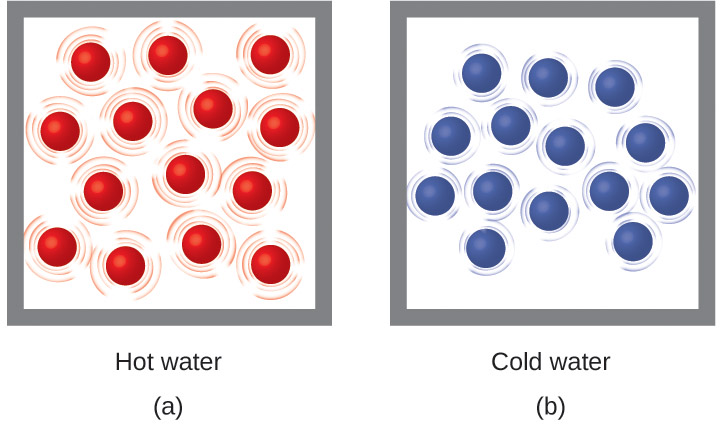
Figure 5.4図 5.4
(a) The molecules in a sample of hot water move more rapidly than (b) those in a sample of cold water.
(a) 熱い水の分子は、(b) 冷たい水の分子より速く動く。
Most substances expand as their temperature increases and contract as their temperature decreases. This property can be used to measure temperature changes, as shown in Figure 5.5. The operation of many thermometers depends on the expansion and contraction of substances in response to temperature changes.
英語のヒント
ほとんどの物質は、温度が上がると膨張し、下がると収縮する。この性質を使って、図5.5のように温度変化を測定できる。多くの温度計は、温度変化に応じた物質の膨張と収縮を利用して動作する。
Image omitted because its reuse rights could not be verified.権利の確認ができないため画像を割愛。
Figure 5.5図 5.5
(a) In an alcohol or mercury thermometer, the liquid (dyed red for visibility) expands when heated and contracts when cooled, much more so than the glass tube that contains the liquid. (b) In a bimetallic thermometer, two different metals (such as brass and steel) form a two-layered strip. When heated or cooled, one of the metals (brass) expands or contracts more than the other metal (steel), causing the strip to coil or uncoil. Both types of thermometers have a calibrated scale that indicates the temperature. (credit a: modification of work by “dwstucke”/Flickr)
(a) アルコール温度計や水銀温度計では、見やすく赤く着色した液体が、加熱で膨張し、冷却で収縮する。液体の変化は、それを入れたガラス管よりはるかに大きい。(b) バイメタル温度計では、黄銅と鋼など2種類の金属を重ねた帯を使う。加熱や冷却によって黄銅の方が鋼より大きく膨張・収縮するため、帯が巻き込まれたり、ほどけたりする。どちらの温度計にも、温度を示す校正済みの目盛りがある。(出典a:dwstucke/Flickrの作品を改変)
Heat (q) is the transfer of thermal energy between two bodies at different temperatures. Heat flow (a redundant term, but one commonly used) increases the thermal energy of one body and decreases the thermal energy of the other. Suppose we initially have a high temperature (and high thermal energy) substance (H) and a low temperature (and low thermal energy) substance (L). The atoms and molecules in H have a higher average KE than those in L. If we place substance H in contact with substance L, the thermal energy will flow spontaneously from substance H to substance L. The temperature of substance H will decrease, as will the average KE of its molecules; the temperature of substance L will increase, along with the average KE of its molecules. Heat flow will continue until the two substances are at the same temperature (Figure 5.6).
英語のヒント
熱qとは、温度の異なる2つの物体間での熱エネルギーの移動である。「熱の流れ」という表現は意味が重複しているが、よく使われる。熱が流れると、一方の物体の熱エネルギーが増え、もう一方は減る。初めに、高温で熱エネルギーの大きい物質Hと、低温で熱エネルギーの小さい物質Lがあるとする。Hの原子や分子の平均運動エネルギーKEは、Lより大きい。HをLに接触させると、熱エネルギーはHからLへ自然に流れる。Hの温度と分子の平均KEは低下し、Lの温度と分子の平均KEは増加する。熱の流れは、2つの物質の温度が等しくなるまで続く(図5.6)。
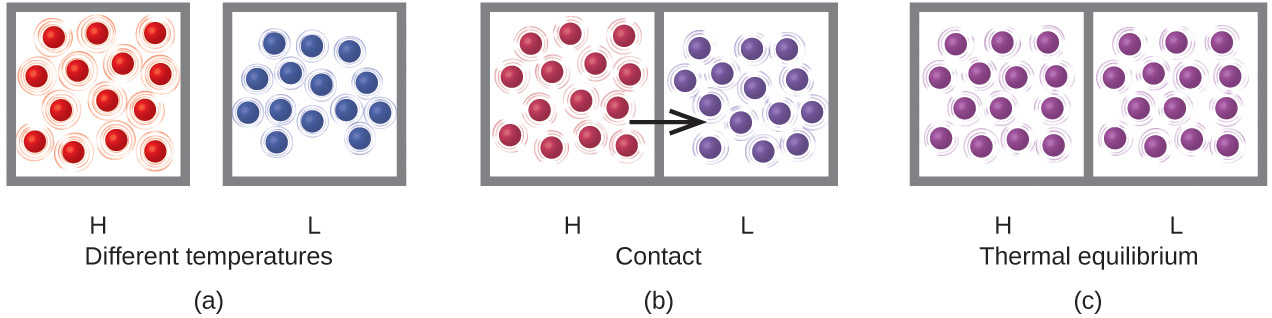
Figure 5.6図 5.6
(a) Substances H and L are initially at different temperatures, and their atoms have different average kinetic energies. (b) When they contact each other, collisions between the molecules result in the transfer of kinetic (thermal) energy from the hotter to the cooler matter. (c) The two objects reach “thermal equilibrium” when both substances are at the same temperature and their molecules have the same average kinetic energy.
(a) 初め、物質HとLの温度は異なり、原子の平均運動エネルギーも異なる。(b) 接触すると、分子間の衝突によって、高温の物質から低温の物質へ運動エネルギー、すなわち熱エネルギーが移る。(c) 両方の温度が等しく、分子の平均運動エネルギーも同じになると、2つの物体は熱平衡に達する。
Matter undergoing chemical reactions and physical changes can release or absorb heat. A change that releases heat is called an exothermic process. For example, the combustion reaction that occurs when using an oxyacetylene torch is an exothermic process—this process also releases energy in the form of light as evidenced by the torch’s flame (Figure 5.7). A reaction or change that absorbs heat is an endothermic process. A cold pack used to treat muscle strains provides an example of an endothermic process. When the substances in the cold pack (water and a salt like ammonium nitrate) are brought together, the resulting process absorbs heat, leading to the sensation of cold.
英語のヒント
化学反応や物理変化を起こす物質は、熱を放出または吸収することがある。熱を放出する変化を発熱過程という。たとえば、酸素アセチレントーチを使うときの燃焼反応は発熱過程である。トーチの炎からわかるように、光としてもエネルギーが放出される(図5.7)。熱を吸収する反応や変化を吸熱過程という。筋肉の損傷の手当に使う冷却パックは、その一例である。パック内の水と硝酸アンモニウムのような塩を混ぜると、その過程が熱を吸収し、冷たく感じられる。
Image omitted because its reuse rights could not be verified.権利の確認ができないため画像を割愛。
Figure 5.7図 5.7
(a) An oxyacetylene torch produces heat by the combustion of acetylene in oxygen. The energy released by this exothermic reaction heats and then melts the metal being cut. The sparks are tiny bits of the molten metal flying away. (b) A cold pack uses an endothermic process to create the sensation of cold. (credit a: modification of work by “Skatebiker”/Wikimedia commons)
(a) 酸素アセチレントーチは、酸素中でアセチレンを燃焼させて熱を生じる。この発熱反応のエネルギーが金属を加熱して溶かし、切断する。火花は、飛び散る溶融金属の小片である。(b) 冷却パックは、吸熱過程を利用して冷たさを生み出す。(出典a:Skatebiker/Wikimedia Commonsの作品を改変)
Historically, energy was measured in units of calories (cal). A calorie is the amount of energy required to raise one gram of water by 1 degree C (1 kelvin). However, this quantity depends on the atmospheric pressure and the starting temperature of the water. The ease of measurement of energy changes in calories has meant that the calorie is still frequently used. The Calorie (with a capital C), or large calorie, commonly used in quantifying food energy content, is a kilocalorie. The SI unit of heat, work, and energy is the joule. A joule (J) is defined as the amount of energy used when a force of 1 newton moves an object 1 meter. It is named in honor of the English physicist James Prescott Joule. One joule is equivalent to 1 kg m2/s2, which is also called 1 newton–meter. A kilojoule (kJ) is 1000 joules. To standardize its definition, 1 calorie has been set to equal 4.184 joules.
英語のヒント
歴史的に、エネルギーはカロリーcalで測られてきた。1カロリーは、水1 gの温度を1 °C、すなわち1 K上げるのに必要なエネルギー量である。ただしこの量は、大気圧と水の初期温度に依存する。カロリーを使うとエネルギー変化を測りやすいため、現在もよく使われている。食品のエネルギー量によく使う、大文字CのCalorie、すなわち大カロリーは、キロカロリーを意味する。熱、仕事、エネルギーのSI単位はジュールである。1ジュールJは、1 Nの力で物体を1 m動かすときに使われるエネルギー量と定義される。イギリスの物理学者ジェームズ・プレスコット・ジュールにちなんで名づけられた。1 Jは1 kg m2/s2に等しく、1ニュートンメートルとも呼ぶ。1キロジュールkJは1000 Jである。定義を統一するため、1 calは4.184 Jに等しいと定められている。
We now introduce two concepts useful in describing heat flow and temperature change. The heat capacity (C) of a body of matter is the quantity of heat (q) it absorbs or releases when it experiences a temperature change (ΔT) of 1 degree Celsius (or equivalently, 1 kelvin):
熱の流れと温度変化を記述するのに役立つ2つの概念を導入する。ある量の物質の熱容量Cは、温度変化ΔTが1 °C、すなわち1 Kとなるときに、その物質が吸収または放出する熱量qである。
Heat capacity is determined by both the type and amount of substance that absorbs or releases heat. It is therefore an extensive property—its value is proportional to the amount of the substance.
英語のヒント
熱容量は、熱を吸収・放出する物質の種類と量の両方で決まる。したがって示量性の性質であり、値は物質量に比例する。
For example, consider the heat capacities of two cast iron frying pans. The heat capacity of the large pan is five times greater than that of the small pan because, although both are made of the same material, the mass of the large pan is five times greater than the mass of the small pan. More mass means more atoms are present in the larger pan, so it takes more energy to make all of those atoms vibrate faster. The heat capacity of the small cast iron frying pan is found by observing that it takes 18,140 J of energy to raise the temperature of the pan by 50.0 °C:
英語のヒント
たとえば、鋳鉄製フライパン2つの熱容量を考えよう。大きいフライパンの熱容量は小さいものの5倍である。同じ材料でできているが、質量が5倍だからである。質量が大きいということは、含まれる原子が多いことを意味する。そのすべてを速く振動させるには、より大きなエネルギーが必要になる。小さいフライパンの温度を50.0 °C上げるには18,140 Jが必要だと観測されるので、熱容量は次のように求められる。
The larger cast iron frying pan, while made of the same substance, requires 90,700 J of energy to raise its temperature by 50.0 °C. The larger pan has a (proportionally) larger heat capacity because the larger amount of material requires a (proportionally) larger amount of energy to yield the same temperature change:
英語のヒント
大きいフライパンも同じ鋳鉄製だが、温度を50.0 °C上げるには90,700 Jが必要である。物質の量が多いほど、同じ温度変化に必要なエネルギーも比例して大きくなるため、熱容量も比例して大きくなる。
The specific heat capacity (c) of a substance, commonly called its “specific heat,” is the quantity of heat required to raise the temperature of 1 gram of a substance by 1 degree Celsius (or 1 kelvin):
物質の比熱容量c、通常「比熱」と呼ぶ量は、その物質1 gの温度を1 °C、すなわち1 K上げるのに必要な熱量である。
Specific heat capacity depends only on the kind of substance absorbing or releasing heat. It is an intensive property—the type, but not the amount, of the substance is all that matters. For example, the small cast iron frying pan has a mass of 808 g. The specific heat of iron (the material used to make the pan) is therefore:
英語のヒント
比熱は、熱を吸収・放出する物質の種類だけで決まる。これは示強性の性質であり、問題になるのは物質の量ではなく種類だけである。たとえば、小さい鋳鉄製フライパンの質量は808 gである。したがって、その材料である鉄の比熱は次のようになる。
The large frying pan has a mass of 4040 g. Using the data for this pan, we can also calculate the specific heat of iron:
大きいフライパンの質量は4040 gである。こちらのデータからも、鉄の比熱を計算できる。
Although the large pan is more massive than the small pan, since both are made of the same material, they both yield the same value for specific heat (for the material of construction, iron). Note that specific heat is measured in units of energy per temperature per mass and is an intensive property, being derived from a ratio of two extensive properties (heat and mass). The molar heat capacity, also an intensive property, is the heat capacity per mole of a particular substance and has units of J/mol °C (Figure 5.8).
英語のヒント
大きいフライパンの方が質量は大きいが、どちらも同じ材料なので、比熱は同じ値になる。これは材料である鉄の比熱である。比熱の単位は、温度・質量当たりのエネルギーであり、熱と質量という2つの示量性の量の比から導かれる示強性の性質である。モル熱容量も示強性の性質で、ある物質1 mol当たりの熱容量を表し、単位はJ/mol °Cである(図5.8)。
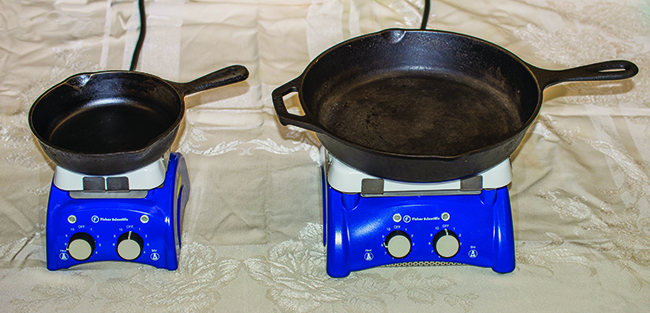


Figure 5.8図 5.8
Because of its larger mass, a large frying pan has a larger heat capacity than a small frying pan. Because they are made of the same material, both frying pans have the same specific heat. (credit: Mark Blaser)
大きいフライパンは質量が大きいため、小さいフライパンより熱容量が大きい。同じ材料でできているので、比熱は等しい。(出典:Mark Blaser)
Water has a relatively high specific heat (about 4.2 J/g °C for the liquid and 2.09 J/g °C for the solid); most metals have much lower specific heats (usually less than 1 J/g °C). The specific heat of a substance varies somewhat with temperature. However, this variation is usually small enough that we will treat specific heat as constant over the range of temperatures that will be considered in this chapter. Specific heats of some common substances are listed in Table 5.1.
英語のヒント
水の比熱は比較的大きく、液体では約4.2 J/g °C、固体では2.09 J/g °Cである。ほとんどの金属の比熱ははるかに小さく、通常1 J/g °C未満である。物質の比熱は温度によって多少変わるが、その変化は通常小さいため、この章で扱う温度範囲では一定とみなす。代表的な物質の比熱を表5.1に示す。
Specific Heats of Common Substances at 25 °C and 1 bar 25 °C、1 barにおける代表的な物質の比熱 |
||
|---|---|---|
Substance 物質 |
Symbol (state) 化学式(状態) |
Specific Heat (J/g °C) 比熱(J/g °C) |
helium ヘリウム |
He(g) |
5.193 |
water 水 |
H2O(l) |
4.184 |
ethanol エタノール |
C2H6O(l) |
2.376 |
ice 氷 |
H2O(s) |
2.093 (at −10 °C) 2.093(−10 °C) |
water vapor 水蒸気 |
H2O(g) |
1.864 |
nitrogen 窒素 |
N2(g) |
1.040 |
air 空気 |
1.007 |
|
oxygen 酸素 |
O2(g) |
0.918 |
aluminum アルミニウム |
Al(s) |
0.897 |
carbon dioxide 二酸化炭素 |
CO2(g) |
0.853 |
argon アルゴン |
Ar(g) |
0.522 |
iron 鉄 |
Fe(s) |
0.449 |
copper 銅 |
Cu(s) |
0.385 |
lead 鉛 |
Pb(s) |
0.130 |
gold 金 |
Au(s) |
0.129 |
silicon ケイ素 |
Si(s) |
0.712 |
If we know the mass of a substance and its specific heat, we can determine the amount of heat, q, entering or leaving the substance by measuring the temperature change before and after the heat is gained or lost:
英語のヒント
物質の質量と比熱がわかれば、熱の出入りの前後の温度変化を測ることで、その物質が吸収または放出する熱量qを求められる。
In this equation, c is the specific heat of the substance, m is its mass, and ΔT (which is read “delta T”) is the temperature change, Tfinal − Tinitial. If a substance gains thermal energy, its temperature increases, its final temperature is higher than its initial temperature, Tfinal − Tinitial has a positive value, and the value of q is positive. If a substance loses thermal energy, its temperature decreases, the final temperature is lower than the initial temperature, Tfinal − Tinitial has a negative value, and the value of q is negative.
この式で、cは物質の比熱、mは質量、ΔT(デルタ・ティー)は温度変化Tfinal − Tinitialを表す。物質が熱エネルギーを得ると温度が上がり、最後の温度が最初より高くなるので、Tfinal − Tinitialは正となり、qも正である。熱エネルギーを失うと温度が下がり、最後の温度が最初より低くなるので、Tfinal − Tinitialは負となり、qも負である。
Example 5.1例題 5.1
Measuring Heat熱の測定
A flask containing 8.0 102 g of water is heated, and the temperature of the water increases from 21 °C to 85 °C. How much heat did the water absorb?
8.0 102 gの水が入ったフラスコを加熱すると、水温が21 °Cから85 °Cに上がった。水が吸収した熱量はいくらか。
Solution解答
To answer this question, consider these factors:
この問いに答えるには、次の要素を考える。
- the specific heat of the substance being heated (in this case, water)加熱する物質の比熱。ここでは水の比熱。
- the amount of substance being heated (in this case, 8.0 × 10² g)加熱する物質の量。ここでは8.0 × 10² g。
- the magnitude of the temperature change (in this case, from 21 °C to 85 °C).温度変化の大きさ。ここでは21 °Cから85 °Cへの変化。
The specific heat of water is 4.184 J/g °C, so to heat 1 g of water by 1 °C requires 4.184 J. We note that since 4.184 J is required to heat 1 g of water by 1 °C, we will need 800 times as much to heat 8.0 × 10² g of water by 1 °C. Finally, we observe that since 4.184 J are required to heat 1 g of water by 1 °C, we will need 64 times as much to heat it by 64 °C (that is, from 21 °C to 85 °C).
水の比熱は4.184 J/g °Cなので、水1 gの温度を1 °C上げるには4.184 Jが必要である。したがって、8.0 × 10² gの水を1 °C上げるには、その800倍のエネルギーが必要になる。また、水1 gを64 °C、つまり21 °Cから85 °Cまで上げるには、1 °C上げるのに必要な4.184 Jの64倍が必要になる。
This can be summarized using the equation:
これを式にまとめると、次のようになる。
Because the temperature increased, the water absorbed heat and q is positive.
温度が上昇したので、水は熱を吸収しており、qは正である。
Check Your Learning理解を確かめよう
How much heat, in joules, must be added to a 502 g iron skillet to increase its temperature from 25 °C to 250 °C? The specific heat of iron is 0.449 J/g °C.
質量502 gの鉄製フライパンの温度を25 °Cから250 °Cに上げるには、何ジュールの熱を加える必要があるか。鉄の比熱は0.449 J/g °Cである。
Note that the relationship between heat, specific heat, mass, and temperature change can be used to determine any of these quantities (not just heat) if the other three are known or can be deduced.
英語のヒント
熱量、比熱、質量、温度変化の関係式は、熱量だけでなく、どの量を求めるのにも使える。ほかの3つの量がわかっているか、推定できればよい。
Example 5.2例題 5.2
Determining Other Quantitiesほかの量を求める
A piece of unknown metal weighs 348 g. When the metal piece absorbs 6.64 kJ of heat, its temperature increases from 22.4 °C to 43.6 °C. Determine the specific heat of this metal (which might provide a clue to its identity).
英語のヒント
未知の金属片の質量は348 gである。6.64 kJの熱を吸収すると、温度が22.4 °Cから43.6 °Cに上がった。この金属の比熱を求めなさい。比熱は、金属を特定する手がかりになるかもしれない。
Solution解答
Since mass, heat, and temperature change are known for this metal, we can determine its specific heat using the relationship:
この金属の質量、熱量、温度変化は既知なので、次の関係から比熱を求められる。
Substituting the known values:
既知の値を代入すると、
Solving:
解くと、
Comparing this value with the values in Table 5.1, this value matches the specific heat of aluminum, which suggests that the unknown metal may be aluminum.
この値を表5.1と比べると、アルミニウムの比熱と一致するので、未知の金属はアルミニウムの可能性がある。
Check Your Learning理解を確かめよう
A piece of unknown metal weighs 217 g. When the metal piece absorbs 1.43 kJ of heat, its temperature increases from 24.5 °C to 39.1 °C. Determine the specific heat of this metal, and predict its identity.
未知の金属片の質量は217 gである。1.43 kJの熱を吸収すると、温度が24.5 °Cから39.1 °Cに上がった。この金属の比熱を求め、金属の種類を予測しなさい。