第5章熱化学
5.2 Calorimetry5.2 熱量測定
Learning Objectives学習目標
By the end of this section, you will be able to:
この節を終えると、次のことができるようになる。
- Explain the technique of calorimetry熱量測定の手法を説明する。
- Calculate and interpret heat and related properties using typical calorimetry data代表的な熱量測定データを使い、熱量や関連する性質を計算し、解釈する。
One technique we can use to measure the amount of heat involved in a chemical or physical process is known as calorimetry. Calorimetry is used to measure amounts of heat transferred to or from a substance. To do so, the heat is exchanged with a calibrated object (calorimeter). The temperature change measured by the calorimeter is used to derive the amount of heat transferred by the process under study. The measurement of heat transfer using this approach requires the definition of a system (the substance or substances undergoing the chemical or physical change) and its surroundings (all other matter, including components of the measurement apparatus, that serve to either provide heat to the system or absorb heat from the system).
英語のヒント
化学的または物理的な過程に関わる熱量を測る方法の1つが、熱量測定である。物質に出入りする熱量を測るため、校正された物体である熱量計と熱を交換させる。熱量計で測った温度変化から、調べている過程で移動した熱量を求める。この方法では、系と外界を定義する必要がある。系は、化学変化や物理変化を起こす物質である。外界はそれ以外のすべての物質であり、測定装置の構成部分も含む。外界は系に熱を与えたり、系から熱を吸収したりする。
A calorimeter is a device used to measure the amount of heat involved in a chemical or physical process. For example, when an exothermic reaction occurs in solution in a calorimeter, the heat produced by the reaction is absorbed by the solution, which increases its temperature. When an endothermic reaction occurs, the heat required is absorbed from the thermal energy of the solution, which decreases its temperature (Figure 5.11). The temperature change, along with the specific heat and mass of the solution, can then be used to calculate the amount of heat involved in either case.
熱量計は、化学的または物理的な過程に関わる熱量を測る装置である。たとえば、熱量計内の溶液で発熱反応が起きると、発生した熱を溶液が吸収し、その温度が上がる。吸熱反応では、必要な熱が溶液の熱エネルギーから吸収され、温度が下がる(図5.11)。どちらの場合も、温度変化と、溶液の比熱・質量を使って、関わる熱量を計算できる。
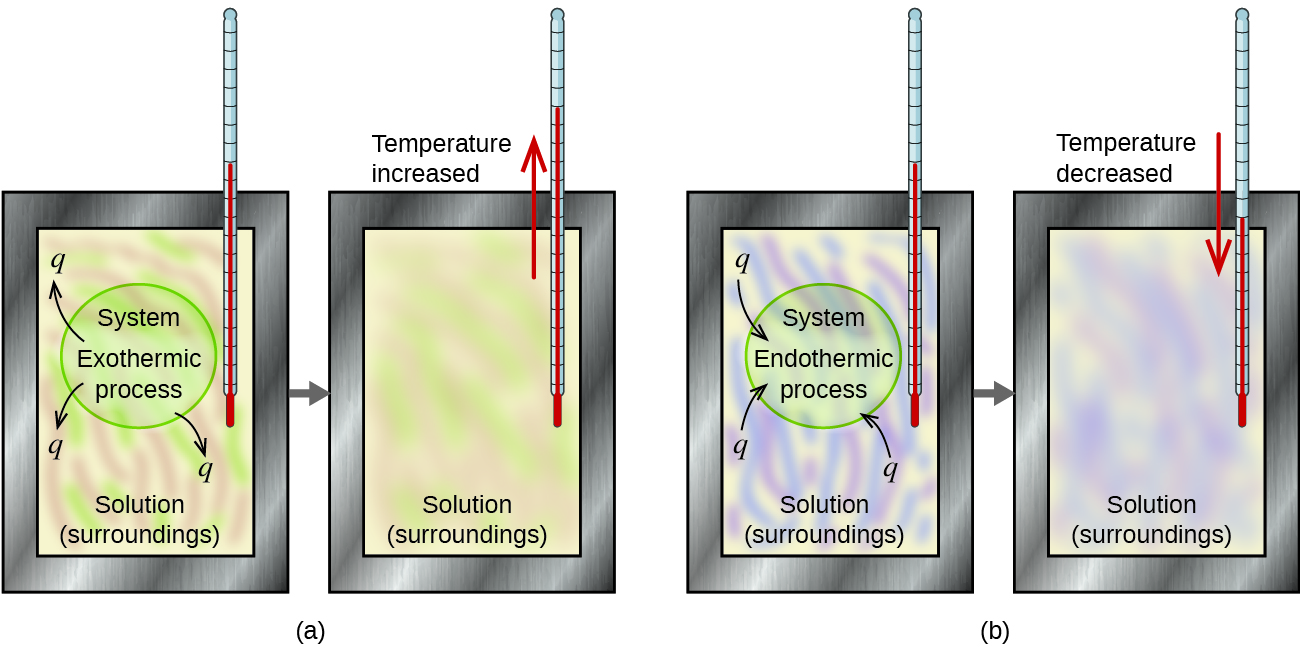
Figure 5.11図 5.11
In a calorimetric determination, either (a) an exothermic process occurs and heat, q, is negative, indicating that thermal energy is transferred from the system to its surroundings, or (b) an endothermic process occurs and heat, q, is positive, indicating that thermal energy is transferred from the surroundings to the system.
熱量測定では、(a) 発熱過程の熱qは負で、熱エネルギーが系から外界へ移ることを示す。または、(b) 吸熱過程のqは正で、熱エネルギーが外界から系へ移ることを示す。
Calorimetry measurements are important in understanding the heat transferred in reactions involving everything from microscopic proteins to massive machines. During her time at the National Bureau of Standards, research chemist Reatha Clark King performed calorimetric experiments to understand the precise heats of various fluorine compounds. Her work was important to NASA in their quest for better rocket fuels.
英語のヒント
熱量測定は、微小なタンパク質から巨大な機械まで、さまざまなものが関わる反応の熱移動を理解するうえで重要である。研究化学者リーサ・クラーク・キングは、米国国立標準局に在籍した時期に、さまざまなフッ素化合物の正確な熱量を理解するため、熱量測定実験を行った。この研究は、よりよいロケット燃料を求めるNASAにとって重要であった。
Scientists use well-insulated calorimeters that all but prevent the transfer of heat between the calorimeter and its environment, which effectively limits the “surroundings” to the nonsystem components within the calorimeter (and the calorimeter itself). This enables the accurate determination of the heat involved in chemical processes, the energy content of foods, and so on. General chemistry students often use simple calorimeters constructed from polystyrene cups (Figure 5.12). These easy-to-use “coffee cup” calorimeters allow more heat exchange with the outside environment, and therefore produce less accurate energy values.
英語のヒント
科学者は、熱量計と周囲の環境との熱交換をほぼ完全に防ぐ、断熱性の高い熱量計を使う。これにより「外界」は、実質的に熱量計内部の系以外の部分と、熱量計そのものに限られる。その結果、化学過程に関わる熱量や、食品のエネルギー量などを正確に求められる。一般化学の学生は、ポリスチレン製カップで作った簡単な熱量計をよく使う(図5.12)。この扱いやすい「コーヒーカップ型」熱量計は、外部環境との熱交換が大きいため、得られるエネルギー値の精度は低くなる。
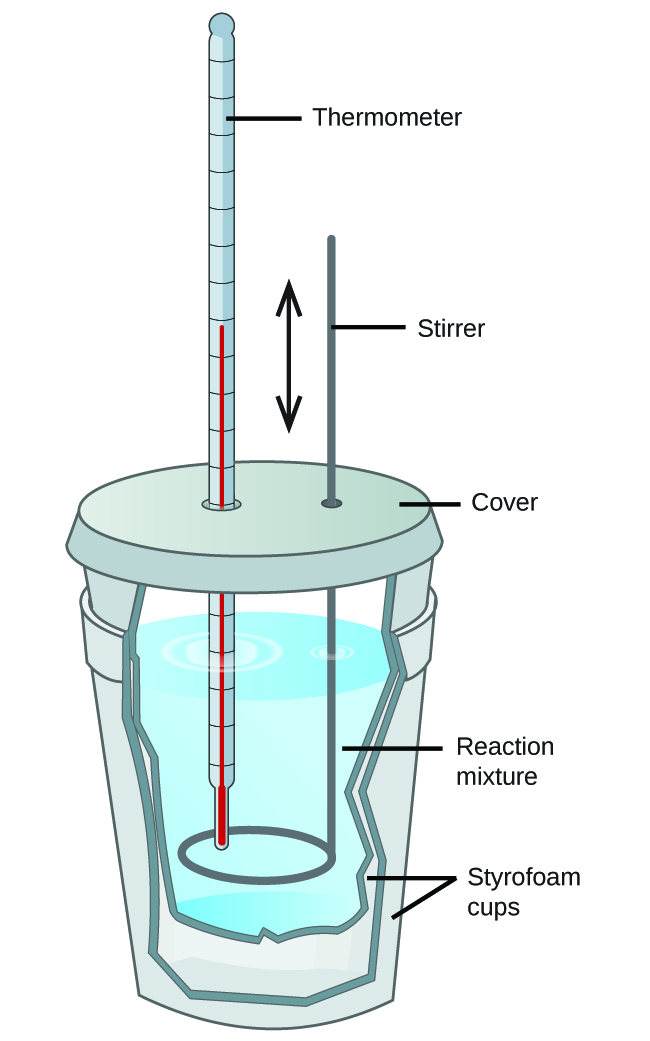
Figure 5.12図 5.12
A simple calorimeter can be constructed from two polystyrene cups. A thermometer and stirrer extend through the cover into the reaction mixture.
ポリスチレン製カップ2つで簡単な熱量計を作れる。温度計と撹拌棒をふたに通し、反応混合物に差し込む。
Commercial solution calorimeters are also available. Relatively inexpensive calorimeters often consist of two thin-walled cups that are nested in a way that minimizes thermal contact during use, along with an insulated cover, handheld stirrer, and simple thermometer. More expensive calorimeters used for industry and research typically have a well-insulated, fully enclosed reaction vessel, motorized stirring mechanism, and a more accurate temperature sensor (Figure 5.13).
英語のヒント
市販の溶液熱量計もある。比較的安価なものは、使用中の熱的接触を最小にするように重ねた薄肉のカップ2つ、断熱ふた、手で動かす撹拌棒、簡単な温度計で構成されることが多い。工業や研究で使う高価なものには通常、断熱性が高く完全に閉じた反応容器、電動撹拌機構、より正確な温度センサーがある(図5.13)。
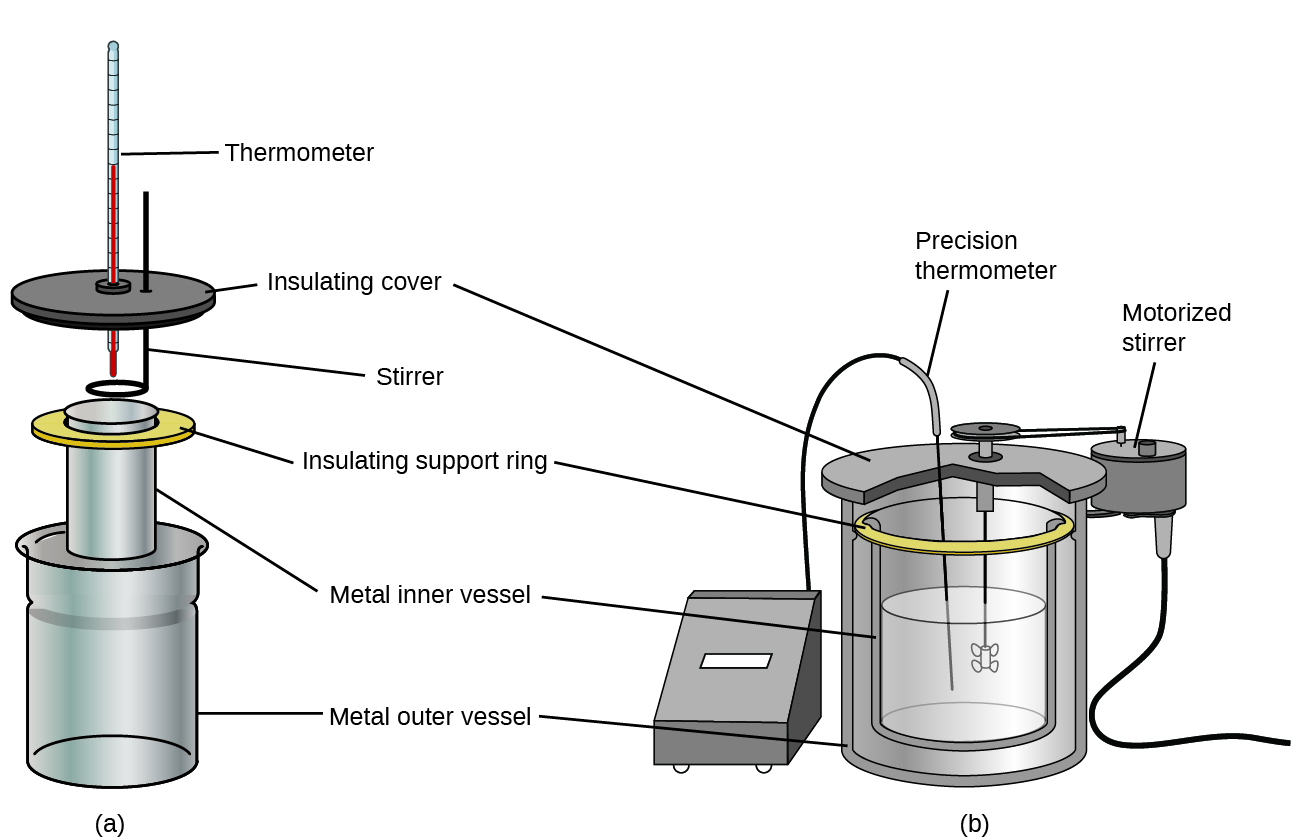
Figure 5.13図 5.13
Commercial solution calorimeters range from (a) simple, inexpensive models for student use to (b) expensive, more accurate models for industry and research.
市販の溶液熱量計には、(a) 学生用の簡単で安価なものから、(b) 工業・研究用の高価で精密なものまである。
Before discussing the calorimetry of chemical reactions, consider a simpler example that illustrates the core idea behind calorimetry. Suppose we initially have a high-temperature substance, such as a hot piece of metal (M), and a low-temperature substance, such as cool water (W). If we place the metal in the water, heat will flow from M to W. The temperature of M will decrease, and the temperature of W will increase, until the two substances have the same temperature—that is, when they reach thermal equilibrium (Figure 5.14). If this occurs in a calorimeter, ideally all of this heat transfer occurs between the two substances, with no heat gained or lost by either its external environment. Under these ideal circumstances, the net heat change is zero:
英語のヒント
化学反応の熱量測定を扱う前に、その基本的な考えを示す、より単純な例を考えよう。初めに、高温の金属片Mと低温の水Wがあるとする。金属を水に入れると、熱はMからWへ流れる。Mの温度は下がり、Wの温度は上がり、やがて等しくなる。このとき熱平衡に達する(図5.14)。これが熱量計内で起これば、理想的には、熱移動はすべて2つの物質の間だけで起こり、外部環境との熱の授受はない。この理想的な条件では、正味の熱量変化は0である。
This relationship can be rearranged to show that the heat gained by substance M is equal to the heat lost by substance W:
この関係を変形すると、物質Mが得た熱量は、物質Wが失った熱量に等しいことを示せる。
The magnitude of the heat (change) is therefore the same for both substances, and the negative sign merely shows that qsubstance M and qsubstance W are opposite in direction of heat flow (gain or loss) but does not indicate the arithmetic sign of either q value (that is determined by whether the matter in question gains or loses heat, per definition). In the specific situation described, qsubstance M is a negative value and qsubstance W is positive, since heat is transferred from M to W.
英語のヒント
したがって、熱量変化の大きさは両方の物質で等しい。負号は、qsubstance Mとqsubstance Wの熱の流れの向き、すなわち吸収と放出が逆であることを示すだけで、それぞれのqの算術上の符号を示すものではない。個々の符号は、定義に従い、その物質が熱を得るか失うかで決まる。ここで述べた具体的な場合では、熱がMからWへ移るので、qsubstance Mは負、qsubstance Wは正である。
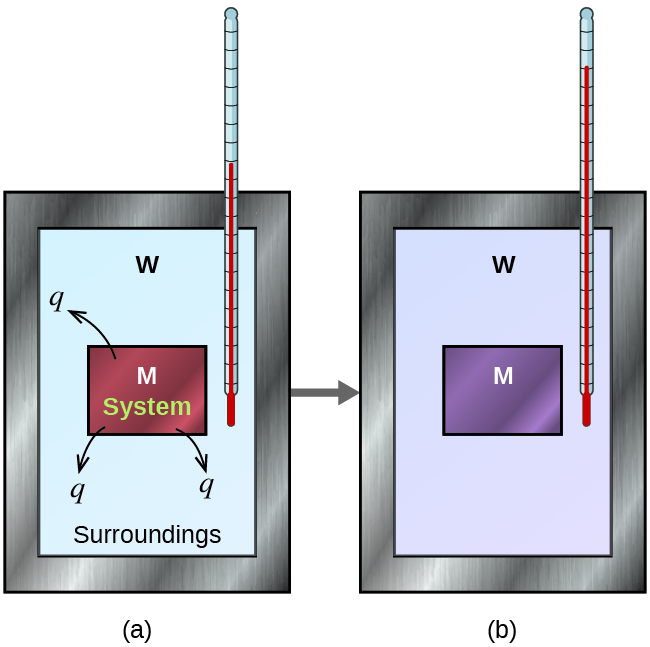
Figure 5.14図 5.14
In a simple calorimetry process, (a) heat, q, is transferred from the hot metal, M, to the cool water, W, until (b) both are at the same temperature.
簡単な熱量測定では、(a) 高温の金属Mから低温の水Wへ熱qが移動し、(b) 両方が同じ温度になるまで続く。
Example 5.3例題 5.3
Heat Transfer between Substances at Different Temperatures温度の異なる物質間の熱移動
A 360.0-g piece of rebar (a steel rod used for reinforcing concrete) is dropped into 425 mL of water at 24.0 °C. The final temperature of the water was measured as 42.7 °C. Calculate the initial temperature of the piece of rebar. Assume the specific heat of steel is approximately the same as that for iron (Table 5.1), and that all heat transfer occurs between the rebar and the water (there is no heat exchange with the surroundings).
英語のヒント
コンクリート補強用の鋼の棒である鉄筋360.0 gを、24.0 °Cの水425 mLに入れた。最後の水温は42.7 °Cだった。鉄筋の初期温度を求めなさい。鋼の比熱は鉄とほぼ同じ(表5.1)で、熱移動はすべて鉄筋と水の間で起き、外界との熱交換はないと仮定する。
Solution解答
The temperature of the water increases from 24.0 °C to 42.7 °C, so the water absorbs heat. That heat came from the piece of rebar, which initially was at a higher temperature. Assuming that all heat transfer was between the rebar and the water, with no heat “lost” to the outside environment, then heat given off by rebar = −heat taken in by water, or:
水温は24.0 °Cから42.7 °Cへ上がるので、水は熱を吸収する。その熱は、初めに高温だった鉄筋から来た。外部環境へ熱が「失われる」ことなく、すべての熱移動が鉄筋と水の間で起きたと仮定すると、鉄筋の放出熱 = −水の吸収熱、すなわち次のようになる。
Since we know how heat is related to other measurable quantities, we have:
熱量と、ほかの測定可能な量の関係はわかっているので、
Letting f = final and i = initial, in expanded form, this becomes:
fを最後、iを最初として、式を展開すると、
The density of water is 1.0 g/mL, so 425 mL of water = 425 g. Noting that the final temperature of both the rebar and water is 42.7 °C, substituting known values yields:
水の密度は1.0 g/mLなので、水425 mLは425 gである。鉄筋と水の最後の温度がどちらも42.7 °Cであることに注意して、既知の値を代入すると、
Solving this gives Ti,rebar= 248 °C, so the initial temperature of the rebar was 248 °C.
これを解くとTi,rebar = 248 °Cとなる。したがって、鉄筋の初期温度は248 °Cである。
Check Your Learning理解を確かめよう
A 248-g piece of copper is dropped into 390 mL of water at 22.6 °C. The final temperature of the water was measured as 39.9 °C. Calculate the initial temperature of the piece of copper. Assume that all heat transfer occurs between the copper and the water.
銅片248 gを、22.6 °Cの水390 mLに入れた。最後の水温は39.9 °Cだった。すべての熱移動が銅と水の間で起きると仮定し、銅片の初期温度を求めなさい。
Check Your Learning理解を確かめよう
A 248-g piece of copper initially at 314 °C is dropped into 390 mL of water initially at 22.6 °C. Assuming that all heat transfer occurs between the copper and the water, calculate the final temperature.
初め314 °Cの銅片248 gを、初め22.6 °Cの水390 mLに入れた。すべての熱移動が銅と水の間で起きると仮定し、最後の温度を求めなさい。
This method can also be used to determine other quantities, such as the specific heat of an unknown metal.
この方法は、未知の金属の比熱など、ほかの量を求めるのにも使える。
Example 5.4例題 5.4
Identifying a Metal by Measuring Specific Heat比熱測定による金属の特定
A 59.7 g piece of metal that had been submerged in boiling water was quickly transferred into 60.0 mL of water initially at 22.0 °C. The final temperature is 28.5 °C. Use these data to determine the specific heat of the metal. Use this result to identify the metal.
英語のヒント
沸騰水に浸していた金属片59.7 gを、初め22.0 °Cの水60.0 mLへ素早く移した。最後の温度は28.5 °Cだった。このデータから金属の比熱を求め、その結果を使って金属を特定しなさい。
Solution解答
Assuming perfect heat transfer, heat given off by metal = −heat taken in by water, or:
熱が完全に移動すると仮定すると、金属の放出熱 = −水の吸収熱、すなわち、
In expanded form, this is:
展開すると、
Noting that since the metal was submerged in boiling water, its initial temperature was 100.0 °C; and that for water, 60.0 mL = 60.0 g; we have:
金属は沸騰水に浸していたので初期温度は100.0 °Cであり、水60.0 mLは60.0 gであることに注意すると、
Solving this:
これを解くと、
Comparing this with values in Table 5.1, our experimental specific heat is closest to the value for copper (0.39 J/g °C), so we identify the metal as copper.
表5.1と比べると、実験で求めた比熱は銅の0.39 J/g °Cに最も近いので、金属は銅と特定できる。
Check Your Learning理解を確かめよう
A 92.9-g piece of a silver/gray metal is heated to 178.0 °C, and then quickly transferred into 75.0 mL of water initially at 24.0 °C. After 5 minutes, both the metal and the water have reached the same temperature: 29.7 °C. Determine the specific heat and the identity of the metal. (Note: You should find that the specific heat is close to that of two different metals. Explain how you can confidently determine the identity of the metal).
銀灰色の金属片92.9 gを178.0 °Cに加熱し、初め24.0 °Cの水75.0 mLへ素早く移した。5分後、金属と水はともに29.7 °Cになった。金属の比熱と種類を求めなさい。注:比熱は2種類の金属に近い値になるはずである。金属の種類を確信をもって判断できる理由を説明すること。
When we use calorimetry to determine the heat involved in a chemical reaction, the same principles we have been discussing apply. The amount of heat absorbed by the calorimeter is often small enough that we can neglect it (though not for highly accurate measurements, as discussed later), and the calorimeter minimizes energy exchange with the outside environment. Because energy is neither created nor destroyed during a chemical reaction, the heat produced or consumed in the reaction (the “system”), qreaction, plus the heat absorbed or lost by the solution (the “surroundings”), qsolution, must add up to zero:
英語のヒント
化学反応に関わる熱を熱量測定で求める場合にも、これまでと同じ原理が適用される。熱量計そのものが吸収する熱量は、無視できるほど小さいことが多い。ただし、後で述べる高精度の測定では無視できない。熱量計は、外部環境とのエネルギー交換も最小限に抑える。化学反応の間にエネルギーは作られも消滅もしないため、「系」である反応が発生・消費する熱qreactionと、「外界」である溶液が吸収・放出する熱qsolutionの和は、0でなければならない。
This means that the amount of heat produced or consumed in the reaction equals the amount of heat absorbed or lost by the solution:
つまり、反応が生じさせる、または消費する熱量は、溶液が吸収する、または失う熱量に等しい。
This concept lies at the heart of all calorimetry problems and calculations.
この考え方が、すべての熱量測定の問題と計算の中心となる。
Example 5.5例題 5.5
Heat Produced by an Exothermic Reaction発熱反応で生じる熱
When 50.0 mL of 1.00 M HCl(aq) and 50.0 mL of 1.00 M NaOH(aq), both at 22.0 °C, are added to a coffee cup calorimeter, the temperature of the mixture reaches a maximum of 28.9 °C. What is the approximate amount of heat produced by this reaction?
ともに22.0 °Cの、1.00 M HCl水溶液50.0 mLと1.00 M NaOH水溶液50.0 mLを、コーヒーカップ型熱量計に加えると、混合物の温度は最高28.9 °Cになった。この反応が発生する熱量は、およそいくらか。
Solution解答
To visualize what is going on, imagine that you could combine the two solutions so quickly that no reaction took place while they mixed; then after mixing, the reaction took place. At the instant of mixing, you have 100.0 mL of a mixture of HCl and NaOH at 22.0 °C. The HCl and NaOH then react until the solution temperature reaches 28.9 °C.
英語のヒント
何が起こるかを思い描くため、2つの溶液を、混ざる間には反応しないほど素早く合わせ、その後に反応が起こると想像しよう。混合した瞬間には、22.0 °CのHClとNaOHの混合液100.0 mLがある。その後HClとNaOHが反応し、溶液の温度が28.9 °Cまで上がる。
The heat given off by the reaction is equal to that taken in by the solution. Therefore:
反応が放出する熱量は、溶液が吸収する熱量に等しい。したがって、
(It is important to remember that this relationship only holds if the calorimeter does not absorb any heat from the reaction, and there is no heat exchange between the calorimeter and the outside environment.)
英語のヒント
この関係が成り立つのは、熱量計が反応から熱を吸収せず、熱量計と外部環境の間にも熱交換がない場合だけであることを、忘れないようにしよう。
Next, we know that the heat absorbed by the solution depends on its specific heat, mass, and temperature change:
溶液が吸収する熱量は、その比熱、質量、温度変化によって決まるので、
To proceed with this calculation, we need to make a few more reasonable assumptions or approximations. Since the solution is aqueous, we can proceed as if it were water in terms of its specific heat and mass values. The density of water is approximately 1.0 g/mL, so 100.0 mL has a mass of about 1.0 102 g (two significant figures). The specific heat of water is approximately 4.184 J/g °C, so we use that for the specific heat of the solution. Substituting these values gives:
英語のヒント
計算を進めるには、さらにいくつかの妥当な仮定や近似を置く必要がある。水溶液なので、比熱と質量の値については、水であるかのように扱える。水の密度は約1.0 g/mLなので、100.0 mLの質量は約1.0 102 g、有効数字2桁である。水の比熱は約4.184 J/g °Cなので、これを溶液の比熱として使う。代入すると、
Finally, since we are trying to find the heat of the reaction, we have:
最後に、求めたいのは反応の熱なので、
The negative sign indicates that the reaction is exothermic. It produces 2.9 kJ of heat.
負号は発熱反応であることを示す。発生する熱は2.9 kJである。
Check Your Learning理解を確かめよう
When 100 mL of 0.200 M NaCl(aq) and 100 mL of 0.200 M AgNO3(aq), both at 21.9 °C, are mixed in a coffee cup calorimeter, the temperature increases to 23.5 °C as solid AgCl forms. How much heat is produced by this precipitation reaction? What assumptions did you make to determine your value?
ともに21.9 °Cの、0.200 M NaCl水溶液100 mLと0.200 M AgNO3水溶液100 mLを、コーヒーカップ型熱量計で混ぜると、固体AgClができて温度が23.5 °Cに上がった。この沈殿反応で発生する熱量はいくらか。値を求める際、どのような仮定を置いたか。
Example 5.6例題 5.6
Heat Flow in an Instant Ice Pack瞬間冷却パック内の熱の流れ
When solid ammonium nitrate dissolves in water, the solution becomes cold. This is the basis for an “instant ice pack” (Figure 5.16). When 3.21 g of solid NH4NO3 dissolves in 50.0 g of water at 24.9 °C in a calorimeter, the temperature decreases to 20.3 °C.
固体の硝酸アンモニウムが水に溶けると、溶液は冷たくなる。これが「瞬間冷却パック」の原理である(図5.16)。熱量計内で、24.9 °Cの水50.0 gに固体NH4NO3を3.21 g溶かすと、温度が20.3 °Cに下がった。
Calculate the value of q for this reaction and explain the meaning of its arithmetic sign. State any assumptions that you made.
この反応のqを求め、その正負の符号が何を意味するか説明しなさい。置いた仮定もすべて述べること。
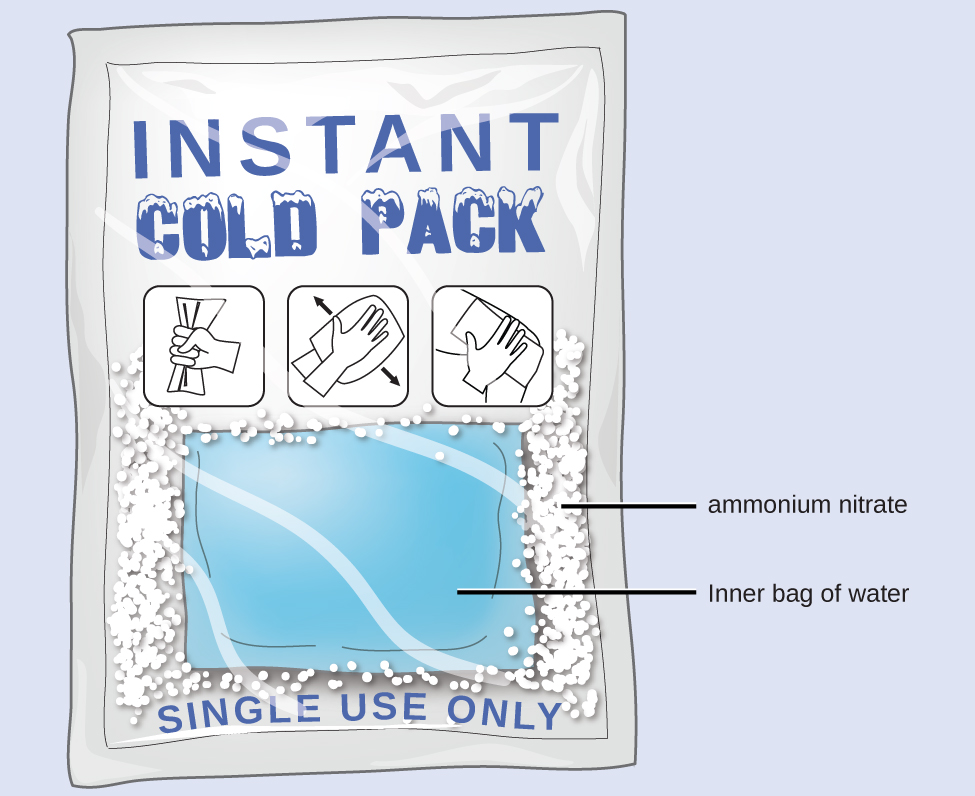


Figure 5.16図 5.16
An instant cold pack consists of a bag containing solid ammonium nitrate and a second bag of water. When the bag of water is broken, the pack becomes cold because the dissolution of ammonium nitrate is an endothermic process that removes thermal energy from the water. The cold pack then removes thermal energy from your body.
英語のヒント
瞬間冷却パックは、固体の硝酸アンモニウムが入った袋と、水の入った内袋からなる。水の袋を破るとパックが冷たくなる。硝酸アンモニウムの溶解が吸熱過程で、水から熱エネルギーを奪うからである。その後、冷却パックは体から熱エネルギーを奪う。
Solution解答
We assume that the calorimeter prevents heat transfer between the solution and its external environment (including the calorimeter itself), in which case:
英語のヒント
熱量計は、溶液と外部環境(熱量計自身を含む)の間の熱移動を防ぐものと仮定する。この場合、
with “rxn” and “soln” used as shorthand for “reaction” and “solution,” respectively.
英語のヒント
ここで「rxn」と「soln」は、それぞれ「反応」と「溶液」の略記である。
Assuming also that the specific heat of the solution is the same as that for water, we have:
英語のヒント
さらに、溶液の比熱は水の比熱と同じと仮定すると、
The positive sign for q indicates that the dissolution is an endothermic process.
qの符号が正であることは、溶解が吸熱過程であることを示す。
Check Your Learning理解を確かめよう
When a 3.00-g sample of KCl was added to 3.00 102 g of water in a coffee cup calorimeter, the temperature decreased by 1.05 °C. How much heat is involved in the dissolution of the KCl? What assumptions did you make?
コーヒーカップ型熱量計で、3.00 102 gの水にKClを3.00 g加えると、温度が1.05 °C下がった。KClの溶解に伴う熱量はいくらか。どのような仮定を置いたか。
If the amount of heat absorbed by a calorimeter is too large to neglect or if we require more accurate results, then we must take into account the heat absorbed both by the solution and by the calorimeter.
英語のヒント
熱量計が吸収する熱量が無視できないほど大きい場合や、より正確な結果が必要な場合は、溶液と熱量計の両方が吸収する熱を考慮しなければならない。
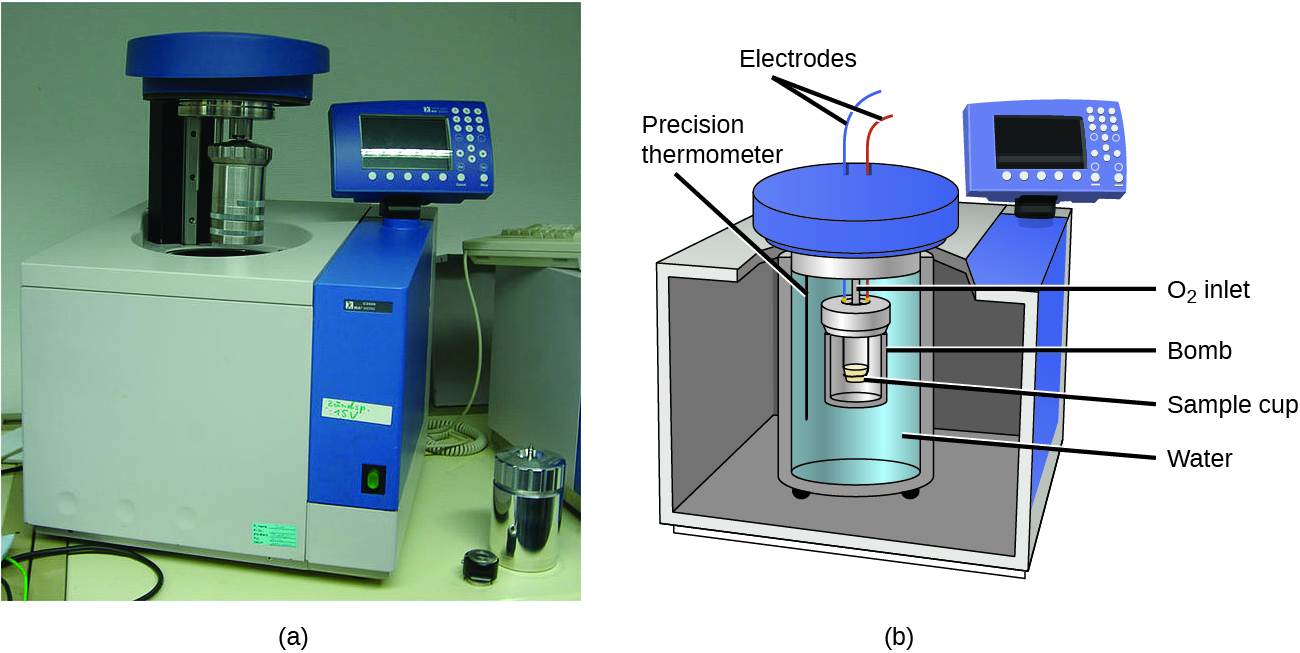
The calorimeters described are designed to operate at constant (atmospheric) pressure and are convenient to measure heat flow accompanying processes that occur in solution. A different type of calorimeter that operates at constant volume, colloquially known as a bomb calorimeter, is used to measure the energy produced by reactions that yield large amounts of heat and gaseous products, such as combustion reactions. (The term “bomb” comes from the observation that these reactions can be vigorous enough to resemble explosions that would damage other calorimeters.) This type of calorimeter consists of a robust steel container (the “bomb”) that contains the reactants and is itself submerged in water (Figure 5.17). The sample is placed in the bomb, which is then filled with oxygen at high pressure. A small electrical spark is used to ignite the sample. The energy produced by the reaction is absorbed by the steel bomb and the surrounding water. The temperature increase is measured and, along with the known heat capacity of the calorimeter, is used to calculate the energy produced by the reaction. Bomb calorimeters require calibration to determine the heat capacity of the calorimeter and ensure accurate results. The calibration is accomplished using a reaction with a known q, such as a measured quantity of benzoic acid ignited by a spark from a nickel fuse wire that is weighed before and after the reaction. The temperature change produced by the known reaction is used to determine the heat capacity of the calorimeter. The calibration is generally performed each time before the calorimeter is used to gather research data.
英語のヒント
ここまでに説明した熱量計は、一定の圧力(大気圧)で使用する設計になっており、溶液中で起こる過程に伴う熱の流れを測るのに便利である。これとは別に、一定の体積で使用するボンベ熱量計と呼ばれる熱量計がある。燃焼のように、多量の熱と気体の生成物を生じる反応のエネルギー測定に使う。「bomb」という名は、こうした反応が、ほかの熱量計なら壊してしまう爆発に似るほど激しくなる場合があることに由来する。この熱量計は、反応物を収める頑丈な鋼製容器(ボンベ)を水に沈めたものである(図5.17)。ボンベに試料を入れ、高圧の酸素で満たし、小さな電気火花で試料に点火する。反応で生じるエネルギーは、鋼製ボンベと周囲の水に吸収される。温度上昇を測定し、既知の熱量計の熱容量と合わせて、反応の発生エネルギーを計算する。ボンベ熱量計では、熱容量を決めて正確な結果を得るために校正が必要である。校正にはqが既知の反応を使う。たとえば、量を測った安息香酸に、反応前後に質量を測るニッケル製導火線の火花で点火する。既知の反応による温度変化から熱量計の熱容量を決める。研究データの収集に用いる場合は、通常、使用のたびに事前の校正を行う。
Harbor1; modified by OpenStax. · CC BY 3.0; CC BY 4.0 composition · Source出典

Figure 5.17図 5.17
(a) A bomb calorimeter is used to measure heat produced by reactions involving gaseous reactants or products, such as combustion. (b) The reactants are contained in the gas-tight “bomb,” which is submerged in water and surrounded by insulating materials. (credit a: modification of work by “Harbor1”/Wikimedia commons)
(a) ボンベ熱量計は、燃焼のように気体の反応物や生成物が関わる反応の発生熱を測定する。(b) 反応物は気密なボンベに入れられる。ボンベは水に沈められ、周囲を断熱材で囲まれている。(aの出典:「Harbor1」/Wikimedia Commonsの作品を改変)
Example 5.7例題 5.7
Bomb Calorimetryボンベ熱量測定
When 3.12 g of glucose, C6H12O6, is burned in a bomb calorimeter, the temperature of the calorimeter increases from 23.8 °C to 35.6 °C. The calorimeter contains 775 g of water, and the bomb itself has a heat capacity of 893 J/°C. How much heat was produced by the combustion of the glucose sample?
ボンベ熱量計でグルコースC6H12O6を3.12 g燃焼させると、熱量計の温度が23.8 °Cから35.6 °Cに上がった。熱量計には775 gの水が入っており、ボンベ自体の熱容量は893 J/°Cである。このグルコース試料の燃焼による発生熱量はいくらか。
Solution解答
The combustion produces heat that is primarily absorbed by the water and the bomb. (The amounts of heat absorbed by the reaction products and the unreacted excess oxygen are relatively small and dealing with them is beyond the scope of this text. We will neglect them in our calculations.)
英語のヒント
燃焼で生じる熱は、主に水とボンベに吸収される。(反応生成物と未反応の過剰な酸素が吸収する熱量は比較的小さく、その扱いは本書の範囲を超える。ここでの計算では無視する。)
The heat produced by the reaction is absorbed by the water and the bomb:
反応が発生する熱は、水とボンベに吸収される。
This reaction released 48.7 kJ of heat when 3.12 g of glucose was burned.
この反応では、グルコース3.12 gの燃焼によって48.7 kJの熱が放出された。
Check Your Learning理解を確かめよう
When 0.963 g of benzene, C6H6, is burned in a bomb calorimeter, the temperature of the calorimeter increases by 8.39 °C. The bomb has a heat capacity of 784 J/°C and is submerged in 925 mL of water. How much heat was produced by the combustion of the benzene sample?
ボンベ熱量計でベンゼンC6H6を0.963 g燃焼させると、熱量計の温度が8.39 °C上がった。ボンベの熱容量は784 J/°Cで、水925 mLに沈められている。このベンゼン試料の燃焼による発生熱量はいくらか。
Since the first one was constructed in 1899, 35 calorimeters have been built to measure the heat produced by a living person. Francis D. Reardon et al. “The Snellen human calorimeter revisited, re-engineered and upgraded: Design and performance characteristics.” Medical and Biological Engineering and Computing 8 (2006)721–28, http://link.springer.com/article/10.1007/s11517-006-0086-5. These whole-body calorimeters of various designs are large enough to hold an individual human being. More recently, whole-room calorimeters allow for relatively normal activities to be performed, and these calorimeters generate data that more closely reflect the real world. These calorimeters are used to measure the metabolism of individuals under different environmental conditions, different dietary regimes, and with different health conditions, such as diabetes.
英語のヒント
生きている人が生じる熱を測る熱量計は、1899年に最初の装置が作られて以来、35台が製作されてきた。Francis D. Reardonほか「The Snellen human calorimeter revisited, re-engineered and upgraded: Design and performance characteristics(スネレン人体熱量計の再検討・再設計・改良:設計と性能特性)」Medical and Biological Engineering and Computing 8(2006)721–28、http://link.springer.com/article/10.1007/s11517-006-0086-5。さまざまな設計の全身熱量計はいずれも、人1人が入る大きさがある。近年の部屋全体を使う熱量計では、比較的ふだんどおりの活動ができるため、実生活をよりよく反映するデータが得られる。環境条件や食事内容、糖尿病などの健康状態が異なる人々の代謝を測るのに使われる。
For example Carla Prado's team at University of Alberta undertook whole-body calorimetry to understand the energy expenditures of women who had recently given birth. Studies like this help develop better recommendations and regimens for nutrition, exercise, and general wellbeing during this period of significant physiological change. In humans, metabolism is typically measured in Calories per day. A nutritional calorie (Calorie) is the energy unit used to quantify the amount of energy derived from the metabolism of foods; one Calorie is equal to 1000 calories (1 kcal), the amount of energy needed to heat 1 kg of water by 1 °C.
英語のヒント
たとえば、アルバータ大学のカーラ・プラドの研究チームは、出産後間もない女性のエネルギー消費量を調べるため、全身熱量測定を行った。こうした研究は、体の働きが大きく変わるこの時期に、栄養、運動、全般的な健康について、よりよい助言や生活プログラムを作るのに役立つ。人の代謝は、通常1日あたりのCaloriesで測る。栄養学のカロリー(Calorie)は、食物の代謝によって得るエネルギーを数量化する単位である。1 Calorieは1000 calories(1 kcal)に等しく、水1 kgの温度を1 °C上げるのに必要なエネルギー量に相当する。