第8章データ管理
Types of Analytics分析の種類
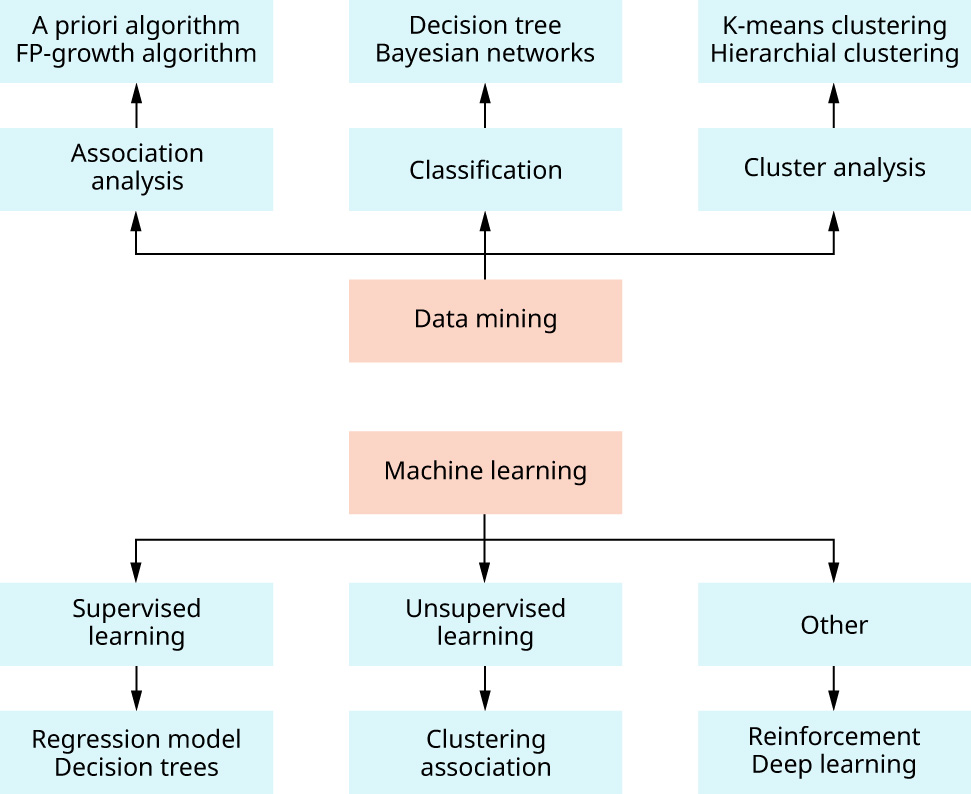
After finishing the preprocessing, the analytic step will start (Figure 8.26). This step aims to extract a decision model from the preprocessed data. To build such a model, there are many models, such as predictive analytics, evaluating predictive models, descriptive analytics, and social network analytics.
英語のヒント
前処理が終わると、分析の段階が始まる(図8.26)。この段階の目的は、前処理済みのデータから意思決定モデルを取り出すことである。このようなモデルを構築するためのモデルには、予測分析、予測モデルの評価、記述的分析、ソーシャルネットワーク分析など、多くのものがある。
attribution: Copyright Rice University, OpenStax, under CC BY 4.0 license · CC BY 4.0 · Source出典
Figure 8.26 Many techniques can be used to analyze data in order to make a business decision. (attribution: Copyright Rice University, OpenStax, under CC BY 4.0 license)
図8.26 事業上の判断を下すためのデータ分析には、多くの技法を使える。(出典表記:著作権者 Rice University、OpenStax、CC BY 4.0ライセンス)
Predicting the target measure of interest using regression (e.g., linear regression, logistic regression) and classification (e.g., decision trees) is predictive analysis. Evaluating predictive models splits up the dataset with specific performance measures. Patterns of customer behavior (e.g., association rules, sequence rules, and clustering) are considered descriptive analytics.
英語のヒント
回帰(線形回帰、ロジスティック回帰など)と分類(決定木など)を使って、関心のある対象指標を予測するのが、予測分析である。予測モデルの評価では、特定の性能指標を用いてデータセットを分割する。顧客行動のパターン(関連規則、系列規則、クラスタリングなど)は、記述的分析とされる。
GLOBAL ISSUES IN TECHNOLOGY技術をめぐる世界の課題
Predictive Analytics予測分析
Predictive analytics is a set of techniques that uses data, statistics, and machine learning to make predictions about future events and/or behaviors. These predictions rely on data being accurate and unbiased to provide value. As we move toward generative artificial intelligence (GenAI) technology that makes use of existing data to create large language models, issues associated with the possibility of using biased data to train these models are becoming critical. Recent research is focusing on fairness in the decisions taken by models trained with biased data, and on designing methods to increase the transparency of automated decision-making processes so that possible bias issues may be easily spotted and “fixed” by removing bias.
英語のヒント
予測分析は、データ、統計、機械学習を使って、将来の出来事や行動を予測する一連の技法である。こうした予測が価値を生むには、データが正確で偏りのないものでなければならない。既存のデータを利用して大規模言語モデルを作る生成AI(GenAI)技術へと進むにつれ、これらのモデルの学習に偏ったデータを使う可能性に伴う問題が、重大になっている。近年の研究は、偏ったデータで学習したモデルが下す判断の公平性や、自動化された意思決定過程の透明性を高める方法の設計に注目している。透明性が高まれば、偏りの問題を容易に見つけ、偏りを取り除くことによって「修正」できるようになる。
Postprocessing of Analytical Models分析モデルの後処理
The last step is the postprocessing step, and the first activities in this step are interpretation and validation. Business experts validate the data and detect any unknown pattern. In addition, sensitivity analysis takes place in postprocessing to verify the robustness of the created model. After that, experts approve the deployment of the model and the production activity can start. Finally, the expert applies the backtesting activity to be sure the model produces the correct output.
英語のヒント
最後の段階は後処理であり、まず解釈と検証を行う。業務の専門家がデータを検証し、未知のパターンを検出する。また、作成したモデルの頑健性を確かめるため、後処理では感度分析も行う。その後、専門家がモデルの配備を承認すると、実運用を始められる。最後に、専門家はバックテストを行い、モデルが正しい出力を生成することを確認する。
Evaluating Analytics分析の評価
Analytics models should solve the business problem for which it was developed (business relevance) and should be acceptable statically (statistical performance and validity). The analytical model should be understandable to the decision-maker (interpretability) and operationally efficient. Measuring the model performance uses TCO and ROI. The total cost of ownership (TCO) represents the cost of owning and operating the analytical model over time. The calculation of return on investment (ROI) determines the ratio of net profits divided by the investment of resources.
英語のヒント
分析モデルは、その開発目的となった事業上の問題を解決するべきであり(事業との関連性)、静的に受け入れられるものであるべきである(統計的性能と妥当性)。分析モデルは、意思決定者に理解できるものであり(解釈可能性)、運用面でも効率的であるべきである。モデルの性能の測定には、TCOとROIを使う。総保有費用(TCO)は、長期にわたって分析モデルを保有・運用する費用を表す。投資収益率(ROI)の計算では、純利益を、投入した資源で割った比率を求める。
THINK IT THROUGH考えてみよう
Machine Learning機械学習
You are given a dataset that pertains to hospital patients affected with a particular condition and you are asked to create a predictive model that could be used to assess testing new individuals for this condition.
英語のヒント
ある疾患を持つ入院患者に関するデータセットが与えられ、この疾患について新たな人を検査する際の評価に使える予測モデルを作るよう求められたとする。
Would you use shallow or deep machine learning to solve this problem? Explain your dataset and logic for solving the health-care problem.
この問題を解決するには、浅い機械学習と深層機械学習のどちらを使うか。この医療上の問題を解決するためのデータセットと、その論理を説明しなさい。
Big Data Analytics Frameworks for Shallow Machine Learning浅い機械学習のためのビッグデータ分析フレームワーク
Big data analytics creates a model from a set of data, and to learn from the data, we need machine learning (ML) algorithms. This section discusses MapReduce, Hadoop framework, SQL on Hadoop, Apache Spark framework, streaming big data analytics, on-premises versus cloud solutions, and searching unstructured data and enterprise search.
英語のヒント
ビッグデータ分析は、データの集合からモデルを作る。データから学習するには、機械学習(ML)のアルゴリズムが必要である。この節では、MapReduce、Hadoopフレームワーク、SQL on Hadoop、Apache Sparkフレームワーク、ストリーミングビッグデータ分析、オンプレミスとクラウドのソリューションの比較、非構造化データの検索と企業内検索を扱う。
MapReduceMapReduce
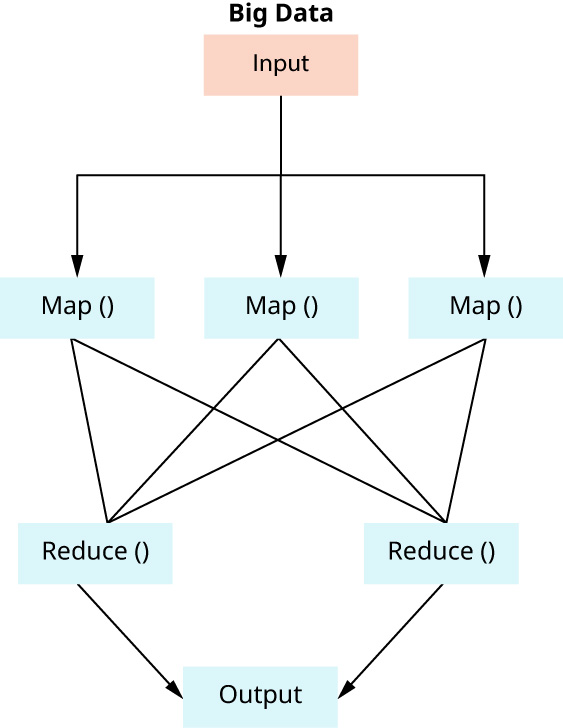
MapReduce is a two-step computational approach for processing large (multiterabyte or greater) datasets distributed across large clusters of commodity hardware in a reliable, fault-tolerant way (Figure 8.27). The first step is distributing data across multiple computers (Map) with each performing a computation on its slice of the data in parallel. The next step combines those results in a pair-wise manner (Reduce).
英語のヒント
MapReduceは、一般に入手できるハードウェアの大規模なクラスタへ分散した大きなデータセット(数テラバイト以上)を、信頼性と耐障害性のある方法で処理する、2段階の計算手法である(図8.27)。第1段階では、複数のコンピューターへデータを分配する(Map)。各コンピューターは、担当するデータの部分について、並列に計算する。次の段階では、それらの結果を、対にして組み合わせる(Reduce)。
attribution: Copyright Rice University, OpenStax, under CC BY 4.0 license · CC BY 4.0 · Source出典
Figure 8.27 After the data input stage, Map will start then Reduce to produce the output. (attribution: Copyright Rice University, OpenStax, under CC BY 4.0 license)
図8.27 データ入力段階の後、Mapが始まり、続いてReduceが出力を生成する。(出典表記:著作権者 Rice University、OpenStax、CC BY 4.0ライセンス)
Hadoop FrameworkHadoopフレームワーク
Hadoop is distributed data infrastructures that leverage clusters to store and process massive amounts of data. An open-source software framework used for distributed storage and processing of big datasets can be set up over a cluster of computers built from normal, commodity hardware. Many vendors such as Amazon, Cloudera, Dell, Oracle, and Microsoft offer their implementation of a Hadoop stack.
英語のヒント
Hadoopは、クラスタを活用して膨大なデータを保存・処理する、分散データ基盤である。大規模なデータセットの分散保存・処理に使うオープンソースのソフトウェアフレームワークは、通常の汎用ハードウェアで構成したコンピューターのクラスタ上に構築できる。Amazon、Cloudera、Dell、Oracle、Microsoftなど、多くの事業者が、独自に実装したHadoopスタックを提供している。
Hadoop leverages distribution and consists of three main components:
Hadoopは分散を活用し、主に3つの構成要素から成る。
• Hadoop Distributed File System (HDFS): A way to store and keep track of data across multiple (distributed) physical hard drives
英語のヒント
• Hadoop Distributed File System(HDFS):複数の(分散した)物理ハードドライブにまたがって、データを保存し、所在を管理する方法。
• MapReduce: A framework for processing data across distributed processors
• MapReduce:分散したプロセッサーにまたがって、データを処理するフレームワーク。
• Yet Another Resource Negotiator (YARN): A cluster management framework that orchestrates the distribution of CPU usage, memory, and network bandwidth allocation across distributed computers
英語のヒント
• Yet Another Resource Negotiator(YARN):分散したコンピューター間で、CPU使用量、メモリ、ネットワーク帯域幅の割当てを調整する、クラスタ管理フレームワーク。
Hadoop is built for iterative computations. It scans massive amounts of data in a single operation from disk, distributes the processing across multiple nodes, and stores the results back on disk. Hadoop is typically used to generate complex analytics models or high-volume data storage applications, such as retrospective and predictive analytics that involve analyzing past data to identify trends, machine learning and pattern matching that involve using algorithms to automatically identify patterns and trends in data, customer segmentation and churn analysis that involve dividing customers into groups based on shared characteristics or behaviors and using this information to better understand their needs and preferences, and active archives that involve storing data in a way that allows it to be easily accessed and used for analytics purposes.
英語のヒント
Hadoopは、反復計算のために作られている。1回の操作で大量のデータをディスクから走査し、処理を複数のノードへ分散させ、結果をディスクへ書き戻す。通常、Hadoopは、複雑な分析モデルや大量のデータを保存するアプリケーションを生成するために使われる。その例には、過去のデータを分析して傾向を見つける回顧的分析と予測分析、アルゴリズムを使ってデータ内のパターンや傾向を自動的に見つける機械学習とパターン照合、共通の特徴や行動に基づいて顧客をグループ分けし、その情報で顧客のニーズや好みをよりよく理解する顧客セグメンテーションと離反分析、分析のために容易にアクセスして利用できる方法でデータを保存するアクティブアーカイブがある。