第8章データ管理
Data Martsデータマート
A data mart is a scaled-down version of a data warehouse aimed at meeting the information needs of a homogeneous small group of end users such as a department or business unit. It provides focused content and improves query performance. Dependent data marts pull their data directly from a central data warehouse. Independent data marts are stand-alone systems drawing data directly from the operational systems, external sources, or a combination of both.
英語のヒント
データマートは、部門や事業単位など、共通した性質を持つ少人数のエンドユーザーの情報ニーズを満たすため、データウェアハウスを小規模にしたものである。内容を絞り込み、クエリーの性能を高める。従属型データマートは、中央のデータウェアハウスから直接データを取り込む。独立型データマートは単独で動くシステムであり、運用システム、外部の情報源、または両方の組み合わせから直接データを取り込む。
GLOBAL ISSUES IN TECHNOLOGY技術に関わる世界的な問題
Storing Dataデータを保存する
For the past decade, the trend has been to store data in any shape or form without knowing whether it will be used in the future. This has been facilitated by the advent of cloud technology that has allowed people to store unlimited amounts of data at low cost into data lakes. The amount of data stored will keep increasing over the next few decades as daily usage of computer processes keeps increasing.
英語のヒント
この10年ほどは、将来使うかどうか分からなくても、あらゆる形や形式のデータを保存する傾向が続いている。クラウド技術の登場がこれを容易にし、際限のない量のデータを、低費用でデータレイクに保存できるようにした。日々のコンピューター処理の利用が増え続けるにつれ、保存されるデータの量も、今後数十年にわたって増え続ける。
What are some of the global issues you foresee with today’s ability to store an unlimited amount of data that may be analyzed at a later time?
後で分析するかもしれないデータを、際限なく保存できる今日の能力について、どのような世界的な問題が起こると予想するか。
Virtual Data Warehouses and Virtual Data Marts仮想データウェアハウスと仮想データマート
A virtual data mart has no physical data but provides a single point of access to a set of underlying physical data stores; data are only accessed (“pulled”) at query time. A virtual data warehouse can be built as a set of SQL views directly on the underlying operational data sources as an extra layer on top of a collection of physical independent data marts. The metadata model contains the schema mappings between the schemas of the underlying data stores and the schema of the virtual data warehouse (involves query reformulation). A virtual data mart is usually defined as a single SQL view. There can be virtual-independent versus virtual-dependent data marts. Disadvantages are the extra processing capacity from the underlying (operational) data sources and the fact that it is not possible to keep track of historical data.
英語のヒント
仮想データマートは、物理的なデータを持たず、基盤にある複数の物理データストアへアクセスする単一の窓口を提供する。データへアクセスして「取り込む」のは、クエリーを行うときだけである。仮想データウェアハウスは、物理的に独立したデータマートの集合の上に追加の層を置き、基盤となる運用データ源に直接SQLビューの集合を定義して作れる。メタデータモデルには、基盤のデータストアのスキーマと、仮想データウェアハウスのスキーマとの対応付けが含まれる。これには、クエリーの再構成が関わる。仮想データマートは通常、単一のSQLビューとして定義する。仮想の独立型と従属型がある。欠点は、基盤の運用データ源側に追加の処理能力を必要とすることと、過去のデータを追跡できないことである。
Operational Data Stores運用データストア
An operational data store (ODS) is a staging area that provides query facilities. It is good for analysis tools that need data that are closer to real time. More complex analyses are still conducted on the actual data warehouse.
英語のヒント
運用データストア(ODS)は、クエリー機能を備えた一時的なデータ格納領域である。よりリアルタイムに近いデータを必要とする分析の道具に向く。複雑な分析は、引き続き実際のデータウェアハウスで行う。
Data Lakesデータレイク
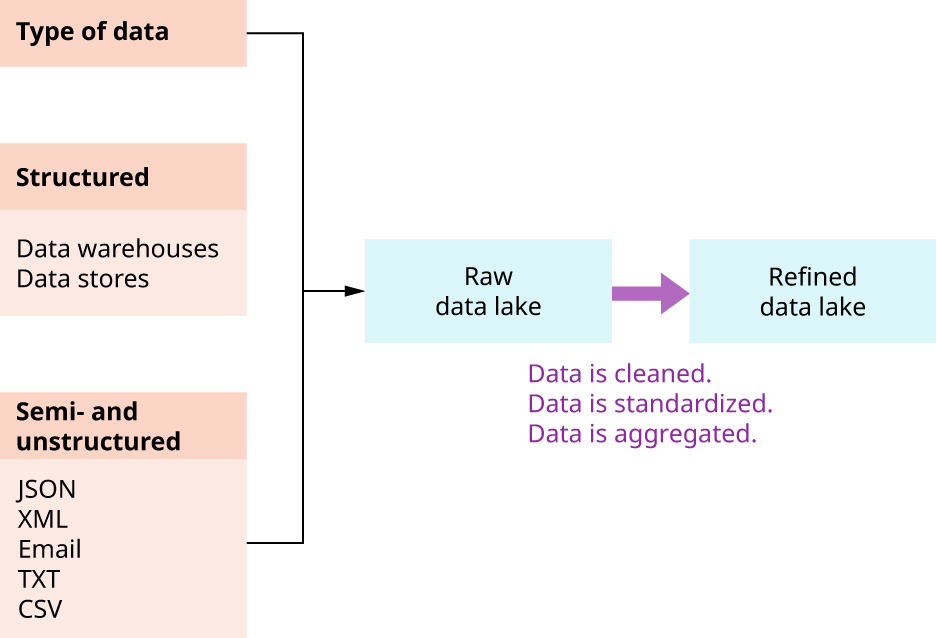
A data lake stores all of an enterprise’s structured and unstructured data at any scale. Data lakes are large data repositories that store raw data and can be set up without having to first define the data structure and schema. They allow users to run analytics without having to move the data to a separate analytics system, enabling businesses to gain insights from new sources of data not available for analysis before. For example, by building machine learning models using data from log files (e.g., log files generated by an application that writes to operating system event), click-streams (e.g., information about visited pages on the Web), social media (e.g., LinkedIn), and IoT devices (e.g., smartwatch). By making all of the enterprise data readily available for analysis, computer/data scientists can answer a new set of business questions or tackle old questions with new data. Figure 8.22 shows an example of a data lake process.
英語のヒント
データレイクは、企業の構造化・非構造化データを、規模を問わずすべて保存する。生のデータを保存する大きなリポジトリーで、データ構造やスキーマを先に定義せずに設置できる。別の分析システムへデータを移さずに分析できるため、企業は、以前は分析に使えなかった新しい情報源から知見を得られる。たとえば、ログファイル(OSのイベントへ書き込むアプリケーションが生成したものなど)、クリックストリーム(訪れたウェブページの情報など)、ソーシャルメディア(LinkedInなど)、IoT装置(スマートウォッチなど)のデータで、機械学習モデルを作る方法がある。企業の全データをすぐに分析へ使えるようにすれば、コンピューター科学者やデータ科学者は、新たな業務上の問いに答えたり、新しいデータで以前からの問いに取り組んだりできる。図8.22は、データレイクの処理の例を示す。
attribution: Copyright Rice University, OpenStax, under CC BY 4.0 license · CC BY 4.0 · Source出典
Figure 8.22 A data lake stores structured, semistructured, and unstructured data. The store process stores the data as raw data lake then applies many processes such as cleansing and aggregation to load the data as a refined data lake. (attribution: Copyright Rice University, OpenStax, under CC BY 4.0 license)
図8.22 データレイクは、構造化・半構造化・非構造化データを保存する。まず生のデータレイクとして保存し、クレンジングや集約などの多くの処理を加え、精製されたデータレイクとして読み込む。(出典:著作権 Rice University、OpenStax。CC BY 4.0ライセンス)
Data Warehouses vs. Data Lakesデータウェアハウスとデータレイクの比較
A data lake is an architectural approach specifically designed to handle data of every variety, ingestion velocity, and storage volume. A data lake allows the storage of massive amounts of data into a central location so it's readily available to be categorized, processed, analyzed, and consumed by diverse groups within an organization. Because data can be stored as-is, there is no need to convert it to a predefined schema as typically required in traditional RDBMS-driven architectures. Consumer usage patterns and the sourcing of the data itself directly influence how data are collected, stored, processed, moved, transformed, automated, and visualized. Data are the ultimate asset with boundless usage patterns now being generated and consumed by humans, machines, devices, sensors, and applications. There are some differences between data warehouse and data lakes listed in Table 8.11.
英語のヒント
データレイクは、あらゆる種類、取り込み速度、保存量のデータを扱うために設計された、構造設計の方法である。大量のデータを中央の場所へ保存し、組織内の多様な集団が、すぐに分類・処理・分析・利用できるようにする。データをそのまま保存できるため、従来のRDBMSを中心とした構成で通常必要になる、事前定義されたスキーマへの変換が不要である。利用者の使い方と、データ自体をどこから入手するかが、収集・保存・処理・移動・変換・自動化・可視化の方法へ直接影響する。人、機械、装置、センサー、アプリケーションが、今やデータを生成・利用している。データは、限りない利用方法を持つ究極の資産である。表8.11に、データウェアハウスとデータレイクの違いを挙げる。
Characteristic 特徴 | Data Warehouse データウェアハウス | Data Lake データレイク |
|---|---|---|
Data データ | Relational 関係型 | Nonrelational and relational 非関係型と関係型 |
Schema スキーマ | Schema-on-write designed before the implementation 書き込み時スキーマ。実装前に設計する | Schema-on-write Written at the time of analysis 書き込み時スキーマ。分析時に記述する |
Storage 保存 | Expensive 高費用 | Low cost 低費用 |
Performance 性能 | Fastest query results クエリーの結果が最も速い | Query results getting faster クエリーの結果が速くなりつつある |
Users 利用者 | Decision-makers 意思決定者 | Data scientist データ科学者 |
Analysis 分析 | Batch reporting, business intelligence, and visualization バッチレポート、ビジネスインテリジェンス、可視化 | Machine learning, predictive analysis 機械学習、予測分析 |
Table 8.11 Difference between a Data Warehouse and a Data Lake
表8.11 データウェアハウスとデータレイクの違い